Showing posts with label order. Show all posts

21 November, 2017

Indexing Free-for-All - US District Court Issues Injunction against Canadian Supreme Court De-indexing Order

After the decision in the Canadian Supreme court in the Equustek case, many, including this writer, raised concerns about the possible abuse of the precedent set by the case. The de-indexing of online content, while well-intentioned in the removal of infringing content, could still be used as a sword more than a shield against legitimate infringement, including against free speech. This writer for one awaited the first application of the case, particularly in a jurisdiction that leans more towards free speech, and seems like the wish has been granted by the District Court of the Northern District of California only a few weeks ago.

The case of Google LLC v Equustek Solutions Inc. concerns the same subject matter as the Canadian case. In short, Equustek sued Google seeking to force Google to block websites selling infringing goods all over the world, not just in Canada where Google had blocked the websites selling the goods. The Supreme Court of Canada ultimately issued the order, and forced Google to block access to the websites all over the world.

Google challenged this ruling in the United States, arguing that the order conflicts with the First Amendment right to free speech, and disregards the Communication Decency Act, which affords immunity to interactive service providers.

Justice Davila first looked at the CDA, which affords immunity from claims to "…providers of interactive computer services against liability arising from content created by third parties". This means that should another publisher, using these services, publish infringing content Google couldn't be sued for that infringement. Even so, to qualify for immunity three criteria need to be satisfied: (1) the company is a "provider or user of an interactive computer service"; (2) the information in question was "provided by another information content provider"; and (3) the Canadian order would hold it liable as the "publisher or speaker" of that information.

Looking at the first criterion, Justice Davila concluded that Google was a 'provider of interactive computer services'. This means that the company provides "…any information service, system, or access software provider that provides or enables computer access by multiple users to a computer server", which encompasses Google's search facility, among other services.

As the content, i.e. the website and the information contained in it (including the infringing goods for sale), was provided by Datalink and not Google, the second criteria was also easily fulfilled. The provision of Google's search facility relies on the company 'crawling' websites on the Internet, which it then indexes and makes available through search results. This allows for users to discover the content, which Google does not post, clearly being provided by 'another information content provider'.

The First Amendment - the best kind of pop-up
Finally, the third criterion looks at whether Google would be held liable for the content provided by another under the order made by the Canadian Supreme Court as the 'publisher or speaker' of that content. According to the order Google has to "…de-index the Datalink websites [from its global search results]… [because it is] the determinative player in allowing the harm to occur".

Per the decision in Barnes v Yahoo!, "…removing content is something publishers do, and to impose liability on the basis of such conduct necessarily involves treating the liable party as a publisher of the content it failed to remove". This liability as a third party for the non-removal of content, should Google not do so when ordered, clearly treats Google as the publisher of that content rather than a mere intermediary with no liability.

Justice Davila therefore considered that Google was immune from the claim under the CDA.

The Court then turned to the question of free speech and irreparable harm. Justice Davila swiftly determined that the Canadian order restricts Google's activity protected by the CDA, and deprives of it of benefits given by US federal law. Similarly an injunction wouldn't serve the public interest, as free speech would be restricted if websites "…were to face tort liability for hosting user-generated content". This has been particularly legislated against through the CDA. As the Internet and other interactive computer services "…offer a forum for a true diversity of political discourse, unique opportunities for cultural development, and myriad avenues for intellectual activity", the legislature deemed it required protecting for that purpose to flourish.

Justice Davila issued the injunction against the Canadian order as it "…undermines the policy goals of [the CDA] and threatens free speech on the global internet".

The decision is a very interesting one, and strongly advocates for the protection of the Internet from blanket orders requiring the removal of content globally. This writer is very much a proponent of this approach, as, amongst its faults, the Internet is a bastion of freedom and dissemination of information (including this blog as a very example of that). Infringements should be dealt with appropriately, but blanket de-indexing orders might not be the best way; however, with this in mind, third-party service providers do have to take some responsibility on the removal of content when needed.

09 January, 2014

Retrospective - Is Piracy Theft?

Rhetoric surrounding copyright infringement can often be hyperbolic or just outright incorrect. Whether one would want to call it 'piracy', 'theft' or 'illegal copying', the end result often is a discussion as to what copyright infringement actually is. Is the copying of intangible content theft, even when the owner of the copyrighted material doesn't actually lose the tangible or intangible material in question? This hasn't been addressed directly in most common law courts, purely due to the fact that criminal acts and civil wrongs don't intersect as much when it comes to the infringement of intellectual property rights; however the question was indirectly answered, to an extent, in the House of Lords over 30 years ago.

The decision in question was Rank Film Distributors Ltd v Video Information Centre, decided in 1982. The case concerned the making of video cassettes of films, which the plaintiffs were the copyright holders of, and selling those videos. Under this infringement the plaintiffs had acquired a motion from the court to enter the defendants' premises and to infringe any and all copies of the aforementioned films, while also compelling the defendants to hand over any relevant documents and to answer questions relating to the supply and sale of the videos. The defendants argued, initially unsuccessfully, that should they comply they might expose themselves to criminal proceedings, or in other words, incriminate themselves. Upon appeal they argued further that a copyright action would be able to claim privilege from discovery due to self-incrimination; a question that the House of Lords would have to answer.

Although the case, prima facie, relates to evidentiary matters more so than copyright, the case is important in answering the question posed in the title of this article. Lord Denning, in his judgment for the Court of Appeal prior to the House of Lords' judgment, discussed the potential criminal liability issues, and the court order that was concerned; something which the House of Lords did not dispute in their deliberations. The order in question which was dealt with in the case was an 'Anton Pillar order', one which stems from the case of Anton Piller KG v Manufacturing Processes Ltd. Under the Theft Act 1968 a defendant or defendants are protected from self-incrimination through the provision of evidence that might do so; however the important fact is that it only pertains to offenses under the Act itself, namely theft in this instance. His Lordship distinguishes copyright infringement from the theft of regular property: "[the Theft Act 1968] covers nearly all kinds of property. But it does not cover the form of industrial property known as copyright". Through his Lordship's rationale, one cannot be convicted of theft under the Theft Act, as it does not apply to the 'stealing' of intellectual property. His Lordship put forth several analogies, and finally concluded that "There is no reason why a privilege against self-incrimination should be available in copyright cases when it is not available in cases involving the other forms of industrial property". This is "...because the infringement is not a criminal offence".

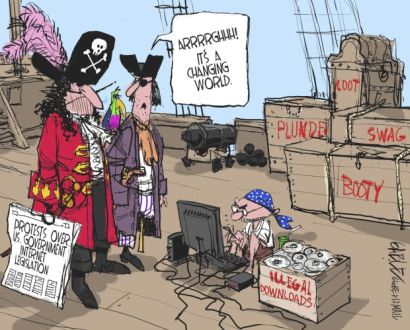
Even pirates need to change their business model (Source)
In the House of Lords' majority decision, Lord Wilberforce summarized the issue at hand, and the law's application: "The appellants' submission amounts to a request to the courts, by judicial decision, to extend this statutory provision [under section 31 of the Theft Act 1968] to civil proceedings generally, or at least to these proceedings. But this, in my opinion, the courts cannot do". By refusing to extend the provision to civil cases, more specifically copyright infringement, his Lordship clearly distinguishes copyright infringement from theft, although not in express terms. In the end the House of Lords denied the appeal and rejected the Anton Piller order, and allowed for the protection against self-incrimination to be used in copyright infringement cases. Even though the House of Lords did not discuss theft and copyright in more depth, Lord Fraser did discuss it in his brief judgment. In his Lordship's mind "The risk of prosecution under the Theft Act may, I think, be disregarded as remote, because that Act applies to theft of "property" which is defined in a way that does not appear to include copyright, but only, so far as this appeal is concerned, to the physical objects such as tapes and cassettes which are of small value by themselves". Clearly therefore copyright infringement could not be defined as 'theft', at least referring to the terms used in the United Kingdom Theft Act.

Similar views have been expressed under US case law, more specifically in the case of Dowling v United States, where the Supreme Court of the United States saw that "...interference with copyright does not easily equate with theft, conversion, or fraud... [as the infringer] does not assume physical control over the copyright; nor does he wholly deprive its owner of its use". The US Supreme Court, although arriving to it through a different argument, seems to align itself close to the view of the UK courts, clearly differentiating copyright infringement as a civil action from the criminal action under theft.

As one can see above the question of whether copyright infringement, or more colloquially 'piracy', equates to theft is answered in the negative. This does not mean that copyright holders are not losing monetarily because of copyright infringement, but the rhetoric surrounding copyright infringement is inflammatory should it be placed in the same category as theft. The two offenses need to be distinguished as such.