Showing posts with label video. Show all posts

03 October, 2017

Hungry for a Fight - Are There Rights in a Recipe How-to Video?

Food has become incredibly trendy in recent years (not that people didn't eat in years before), and many aspiring home cooks and chefs alike have moved onto modern platforms to share their know-how and passion with others. Sites like YouTube are filled with instructional and entertaining cooking videos, garnering millions of views from all over the world. Because of this, there is tremendous value in these videos and their viewers, and competition can get heated. This blog has discussed IP and food before (more here and here), and this writer has just come across a very interesting dispute over a how-to video involving cupcakes.

While the case has only recently begun, it still shows an interesting facet of copyright, particularly surrounding recipe videos.

The case of Elizabeth Labau v Food Network (complaint accessible here) concerns a recipe video made by Ms Labau for her website SugarHero. After a very successful online recipe that went viral, Ms Labau created a how-to video showing how to make her recipe step-by-step, following the success of her recipe article, which was subsequently published in December 2016. Sometime later in December 2016, the Food Network had published a video illustrating their take on the snow globe cupcake, and according to Ms Labau, copied numerous elements from her video, including "...choices of shots, camera angles, colors, and lighting [and] textual descriptors". Ms Labau has since complained to the District Court of the Central District of California, alleging copyright infringement.


Alex's take on cupcakes was a little "unique"
Although the decision from the District Court is still pending, the case will face its share of problems along the way. Ms Labau has not asserted copyright infringement in the recipe for the snow globe cupcakes, but only in the video showing how to make the cupcakes themselves. As discussed on this blog before, recipes are incredibly difficult to protect, and the only thing one can pursue in relation to them is the expression of that recipe, i.e. pictures or video. A simple list of ingredients won't be protectable.

It'll be interesting to see where the case goes, and whether the Food Network has actually copied elements of Ms Labau's video. Due to the proximity on posting the videos it is likely that one took inspiration from another, but as long as the expression of the recipe differs from Ms Labau's video, it'll be difficult for an argument for infringement to be established. This writer thinks Ms Labau could have a case, but this would require a near exact shot-for-shot recreation to have much strength in a court of law.

This writer does think that the case will most likely settle out of court, but a proper inspection of how-to videos and copyright would be very interesting, considering the generic nature of these types of videos. The style of many cooking how-to videos are only distinguished through choices of lighting and general filmography, and this writer thinks it would be interesting to see whether a sequence of steps could attract copyright protection, and how close would one have to get to infringe those rights, seeing as the style of these types of videos if widely established. Should the court side with Ms Labau, it could open the floodgates for many claims involving simple step-by-step videos of the same, or similar recipes to fight for the scrupulous viewership of today's Internet populace.

Source: Hollywood Reporter

27 October, 2014

Retrospective - Copyright in Video Games

If you're oblivious to gaming and the strong attraction that a virtual world has on today's people, you will have missed arguably one of the biggest changes in the entertainment landscape since the emergence of the TV. With this great appeal comes great monetary worth, and something which is very desirable to protect, especially on part of the creators of very popular gaming titles. The difficulty in the protectability of video games stems from their complexity and in the fact that most popular games emulate one-another within certain genres of games, making them quite similar to the casual observer. Where does a game's protectability start from and where does it end? This question was answered first when gaming was in its infancy, but still remains quite relevant in today's world of gaming and law.

The case in question was Atari v North American Philips Consumer Electronics, decided by the United States Court of Appeals in 1982. The case dealt with the well-known game Pac-Man, created by Atari and Midway in the sunrise of the 1980s, which sold a staggering (at the time at least) 7 million copies. In the wake of Pac-Man's popularity a similar game, K. C. Munchkin, was created by North American Philips. Due to the incredibly similar styles and mechanics of both games Atari sued North American for copyright infringement, which ultimately was decided by the US Court of Appeals 7th Circuit.

The court initially described the copyrighted work in question, which, to the uninitiated, consists of a maze-like playing area, where the player controls the Pac-Man creature, moving him through the maze collecting pellets and fruits, accumulating points as they go. In addition to this the game contains four characters which pursue the main character, often called ghosts, which try to touch Pac-Man, thus 'killing' the character and having the player lose a life. Pac-Man has the capability to fight back, however, through the consumption of bigger pellets, enabling him to eat the ghosts and thus collect more points and avoid losing lives for a brief period of time. K.C. Munchkin is incredibly similar in its design, with a maze-like playing area, four ghost-type pursuers and the collection of pellets, bigger pellets and fruit. Its board design is slightly different, with the maze being slightly taller, and containing hazard elements such as dead-ends, with a slightly different shaped corral area for the ghosts than in Pac-Man. Finally, K.C. Munchkin contains far less pellets in the playing area, and uses a different style to the look of its main protagonist.

After initial discussion relating to the facts of the case the court turned its attention to the meat of the question; whether a game can be a subject matter protected under copyright, and whether the defendant's work infringed upon that work. The former is a much more straight-forward application of copyright law, yet the test for infringement of that work, if found to be copyrightable, is, as stated by Justice Wood: "...whether the accused work is so similar to the plaintiff's work that an ordinary reasonable person would conclude that the defendant unlawfully appropriated the plaintiff's protectible expression by taking material of substance and value". This test only applies to the parts of that work, which are deemed protected, and not any other included parts, even if infringed.

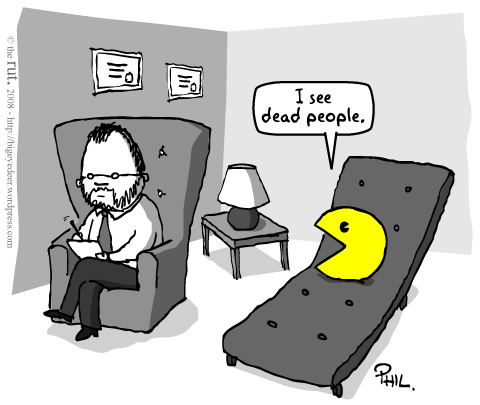
Even game characters have their issues (Source: The Rut)
As decided in Chamberlin v Uris Sales Corporation: "...copyright protection does not extend to games as such". One has to observe that, even if copyright does not subside in games as such, it still can protect parts of those games, not the 'idea' of a game. At the heart of it, the assessment is an assessment of whether what is sought to be protected is merely an 'idea' or the expression of that idea, which is quite protectable. Should the expression and the idea be nearly indistinguishable from one-another, i.e. it is not possible to express said idea in more ways than one, it is difficult to afford protection for that expression. This was well iterated by Justice Browning in Kalpakian: "[w]hen the "idea" and its "expression" are thus inseparable, copying the "expression" will not be barred, since protecting the "expression" in such circumstances would confer a monopoly of the "idea" upon the copyright owner free of the conditions and limitations imposed by the patent law".

Could you therefore protect the 'idea' of Pac-Man as a game? The court did not see much difficulty in answering this question, quickly determining that the work is mostly not protectable; however its components could very well provide "...new or additional [things] over the idea". How the game is displayed, in graphics and music for example, allows for those particular elements to be protectable, yet the 'idea' of a game where the protagonist is chased in a maze cannot be by itself.

An important point raised by the court in the case are certain elements in the game (or games in general), which can be viewed as scenes a faire, or as explained in Alexander v Haley "...incidents, characters or settings which are as a practical matter indispensable, or at least standard, in the treatment of a given topic". The maze and the score boards can be said to be indispensable to games such as Pac-Man, and arguably others, and thus not protectable. K. C. Munchkin was viewed by the court to have no infringed those designs, and to have been sufficiently different in its expression. What the court saw infringing Pac-Man's copyright was the character design within K. C. Munchkin. They had copied both the protagonist and the antagonist ghosts nearly identically, infringing on Atari's copyright in the expression of those ideas. Even if slight differences still existed, they will not by themselves preclude the finding of infringement. The court ultimately saw that "[a]lthough not "virtually identical" to PAC-MAN, K. C. Munchkin captures the "total concept and feel" of and is substantially similar to PAC-MAN". The court therefore reversed the previous decision and agreed to grant an injunction against K C. Munchkin.

Similar thoughts have been echoed in the UK, illustrated by cases such as Nova Productions Ltd v Mazooma Games Ltd, where the protected subject matter in a game was deemed to be the expression of the idea of a game, and how a game plays was seen as something which can be copied, as long as the visual and audio of that game was not.

What the above case illustrates is the initial considerations of video games as a protectable subject matter under copyright. As technology advances more and more, and games have surely come a long way since Pac-Man, the differentiation of what is copyrightable in a game and what isn't could be said to become more difficult. Even so, this case remains an important landmark in the development of the area, and shows that even dot eating circle creatures can be an expression worth protecting.

18 April, 2014

Free Speech and Copyright - When Copyrights and Personal Rights are at Odds

Although intellectual property law protects expression in its multitude of applications sometimes it comes at odds with the rights that are conveyed through the aforementioned expression, whether it was intended or not. Previous examples are the potential curtailing of criticism by using trademarks, where the line between the intended protection offered by trademarks and its potential misuse against freedom of speech came to light. Copyright in itself can potentially be used in a similar fashion, although most common law jurisdictions do expressly allow for copyrighted content to be used for criticism. A recent instance in the United States faced this very conundrum; can copyright trump your right to criticize another?

The case in question was Garcia v Google, which concerned Ms. Cindy Lee Garcia, who acted in a small role in a movie titled "Desert Warrior" (a working title at the time of casting). Even though Ms. Garcia had participated in the filming of the movie, the finished film never saw the light of day. Some time after Ms. Garcia's scene was used in the infamous YouTube video "Innocence of Muslims", in which her scene was partially dubbed having her say "is Mohammed a child molester?". As a result Ms. Garcia soon began receiving death threats from various parties, and she subsequently took precautions and asked Google to remove the aforementioned video relying on the Digital Millennium Copyright Act and its take-down provisions. Google refused her initial reasoning for the video's removal, finally having Ms. Garcia resort to a copyright claim over the video's content, asserting it infringed her copyright in her performance.

Although the case discussed Ms. Garcia's copyright in the film quite extensively, it remains but worth a mention. In Chief Justice Kozinski's judgment Ms. Garcia did have a copyright interest in the film, even though her part was only 5 seconds long in a 13 minute video. As a copyright interest was seen by the court Google were ordered to remove the video from YouTube due to it infringing the aforementioned rights. In Chief Justice Kozinski's view this was a matter of balancing equities, in other words, an assessment of the balance of fairness, and saw that Ms. Garcia's rights in the video overshadowed those afforded in the First Amendment of the American Constitution through free speech. Her security was also a consideration in this assessment; a truly sad result of her unwilling part in the video.

Compliance, or passive aggressiveness?
What should be discussed in this instance, and has rightfully so become the vocal point of this case, is whether copyright should be able to be used to curtail free speech. As Google argued in the case: "[a] court order requiring removal from YouTube of the Film or any portion thereof would impose a substantial burden on free expression, without preventing any future harm to [Ms. Garcia]". In the majority's opinion Ms. Garcia only had the likelihood of success in her claim, or in other words, potentially had a copyright interest in the work, and the majority subsequently saw that this potential interest would weigh heavier than the public interest under free speech. Commenting on this, in his dissenting judgment, Justice Smith saw that "...the law and facts do not clearly demonstrate how granting a preliminary injunction in Garcia's favor would serve the public interest". Clearly one can agree with Justice Smith in this instance, at least under these facts. Although this writer fully accepts that Ms. Garcia's safety is paramount and should be a consideration in this instance, her argument fails in the uncertainty of her copyright interest and lack of concrete harm caused. Her protection should not be handled through copyright, and as stated by Justice Smith: "It's disappointing, though perhaps not surprising, that Garcia needed to sue in order to protect herself and her rights".

The Garcia case is an unfortunate result of unforeseen circumstances and the infamy to which the video rose. The decision has since come to a vote over whether the 9th Circuit Court of Appeals should rehear the case. The video's infamy served a two-fold purpose when gauged under US law; it started a conversation over religion and attitude's towards it, however it also caused severe distress to Ms. Garcia and even fear for her life. Her argument through copyright was flimsy at best, but seemingly was her only avenue for respite. The majority's view on the matter can be argued to be incorrect, and does not fairly assess the balance between her alleged copyright interest and the public interest. As Google stated: "...[o]ur laws permit even the vilest criticisms of governments, political leaders, and religious figures as legitimate exercises in free speech", and this right should be protected, although not used as a veil to protect those who wish to blatantly infringe copyright under the guise of free speech. Even though copyright and free speech do overlap quite extensively, their relationship does come with a price, and each case will present a different situation where the court will have to find the right spot where protection is afforded, but not at the expense of free speech. Copyright serves as a shield to those expressing themselves, and it should not be used to stifle others; something which clearly was not Ms. Garcia's intention in her action.

Source: Reuters

09 January, 2014

Retrospective - Is Piracy Theft?

Rhetoric surrounding copyright infringement can often be hyperbolic or just outright incorrect. Whether one would want to call it 'piracy', 'theft' or 'illegal copying', the end result often is a discussion as to what copyright infringement actually is. Is the copying of intangible content theft, even when the owner of the copyrighted material doesn't actually lose the tangible or intangible material in question? This hasn't been addressed directly in most common law courts, purely due to the fact that criminal acts and civil wrongs don't intersect as much when it comes to the infringement of intellectual property rights; however the question was indirectly answered, to an extent, in the House of Lords over 30 years ago.

The decision in question was Rank Film Distributors Ltd v Video Information Centre, decided in 1982. The case concerned the making of video cassettes of films, which the plaintiffs were the copyright holders of, and selling those videos. Under this infringement the plaintiffs had acquired a motion from the court to enter the defendants' premises and to infringe any and all copies of the aforementioned films, while also compelling the defendants to hand over any relevant documents and to answer questions relating to the supply and sale of the videos. The defendants argued, initially unsuccessfully, that should they comply they might expose themselves to criminal proceedings, or in other words, incriminate themselves. Upon appeal they argued further that a copyright action would be able to claim privilege from discovery due to self-incrimination; a question that the House of Lords would have to answer.

Although the case, prima facie, relates to evidentiary matters more so than copyright, the case is important in answering the question posed in the title of this article. Lord Denning, in his judgment for the Court of Appeal prior to the House of Lords' judgment, discussed the potential criminal liability issues, and the court order that was concerned; something which the House of Lords did not dispute in their deliberations. The order in question which was dealt with in the case was an 'Anton Pillar order', one which stems from the case of Anton Piller KG v Manufacturing Processes Ltd. Under the Theft Act 1968 a defendant or defendants are protected from self-incrimination through the provision of evidence that might do so; however the important fact is that it only pertains to offenses under the Act itself, namely theft in this instance. His Lordship distinguishes copyright infringement from the theft of regular property: "[the Theft Act 1968] covers nearly all kinds of property. But it does not cover the form of industrial property known as copyright". Through his Lordship's rationale, one cannot be convicted of theft under the Theft Act, as it does not apply to the 'stealing' of intellectual property. His Lordship put forth several analogies, and finally concluded that "There is no reason why a privilege against self-incrimination should be available in copyright cases when it is not available in cases involving the other forms of industrial property". This is "...because the infringement is not a criminal offence".

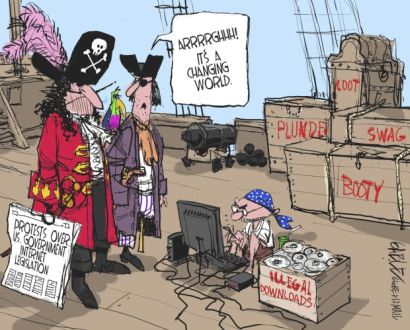
Even pirates need to change their business model (Source)
In the House of Lords' majority decision, Lord Wilberforce summarized the issue at hand, and the law's application: "The appellants' submission amounts to a request to the courts, by judicial decision, to extend this statutory provision [under section 31 of the Theft Act 1968] to civil proceedings generally, or at least to these proceedings. But this, in my opinion, the courts cannot do". By refusing to extend the provision to civil cases, more specifically copyright infringement, his Lordship clearly distinguishes copyright infringement from theft, although not in express terms. In the end the House of Lords denied the appeal and rejected the Anton Piller order, and allowed for the protection against self-incrimination to be used in copyright infringement cases. Even though the House of Lords did not discuss theft and copyright in more depth, Lord Fraser did discuss it in his brief judgment. In his Lordship's mind "The risk of prosecution under the Theft Act may, I think, be disregarded as remote, because that Act applies to theft of "property" which is defined in a way that does not appear to include copyright, but only, so far as this appeal is concerned, to the physical objects such as tapes and cassettes which are of small value by themselves". Clearly therefore copyright infringement could not be defined as 'theft', at least referring to the terms used in the United Kingdom Theft Act.

Similar views have been expressed under US case law, more specifically in the case of Dowling v United States, where the Supreme Court of the United States saw that "...interference with copyright does not easily equate with theft, conversion, or fraud... [as the infringer] does not assume physical control over the copyright; nor does he wholly deprive its owner of its use". The US Supreme Court, although arriving to it through a different argument, seems to align itself close to the view of the UK courts, clearly differentiating copyright infringement as a civil action from the criminal action under theft.

As one can see above the question of whether copyright infringement, or more colloquially 'piracy', equates to theft is answered in the negative. This does not mean that copyright holders are not losing monetarily because of copyright infringement, but the rhetoric surrounding copyright infringement is inflammatory should it be placed in the same category as theft. The two offenses need to be distinguished as such.

21 December, 2013

Streams of Infringers - Germans Face Infringement Allegations over Adult Material

People's Internet browsing habits can be incredibly personal, especially when it relates to certain materials of an adult nature. As such pornographic materials have been used to coerce people into paying for alleged cases of copyright infringement, mostly because of the potentially embarrassing effect a publicly accessible litigation process would have on those individuals. Recent instances have been noted in Australia and more prominently in the US by Prenda Law (something which will be discussed on this blog very soon in more depth). Although seemingly a much rarer vehicle for short-term profits for some entities, recent times have shown an increase in behavior deemed as "copyright trolling"; much akin to patent trolling discussed on this blog prior.

The Germans are the current recipient of such claims, with thousands of Germans being targeted as alleged copyright infringers after visiting the streaming website RedTube (no affiliation with the more known YouTube I'm sure). With numbers having been reported as high as 30,000 Germans as recipients of these letters, the potential value sought by the firm U+C would be over 7,5 million euros.

As such web streaming has been deemed to not infringe copyright in many jurisdictions due to no copy being created in the process of streaming; however U+C argue that "...watching videos on sites such as Redtube can qualify as a proliferation of copyrighted material as a small copy of the file is created in the memory of the viewer’s computer", thus making a copy of the work and potentially infringing copyright. Commenting on behalf of RedTube Alex Taylor, their Vice-President. stated that "RedTube stands by its firm opinion that these letters are completely unfounded and that they violate the rights of those who received it in a very serious manner".

Many are unsure of how to pay the pizza delivery man, if some videos are any indication
Alongside the potential precedent that could be set by the case should it be taken further, potentially causing web streaming to be deemed to infringe copyright, the issue of whether this does infringe the privacy of German citizens can be raised. As stated by Christian Solmecke for the Guardian "...there was not only no legal basis for the fines, but that it was possible that the law firm behind the letters may have broken the law...[and] [i]t is hard to imagine how the IP addresses of the users could have been obtained on a legal basis". More notably this could be an infringement of the right to a private and family life under the European Convention on Human Rights, in addition to any specific German legislation.

The issue of the temporary copies has been argued by Tim Worstall as being potentially correct, stating that "If the original streaming site hasn’t been paying the right royalties it is possible that the viewers owe them. for that idea of a copy existing in the browser would not be, in at least some jurisdictions, be rejected out of hand". This writer for one can see the potential argument as being valid given the right line of argument or set of facts; however due to the current precedent surrounding web streaming it would be unlikely for it to be deemed a form of infringement.

As it stands the matter has not been taken to court, but due to the sheer visibility of the matter it seems unlikely it would avoid litigation entirely, assuming U+C have belief in their argument and are not simply trying to use peoples' embarrassment as a way to make a quick buck. Whether this will go further will remain to be seen, but this writer for one would love for U+C's argument to be tested in court.

Source: The Guardian

03 November, 2013

Video Games and Copyright - 21st Century Art

Video games have surged to become the new pass-time of choice for millions of people, with sales of new titles like Grand Theft Auto V reaching a billion dollars in sales in its first three days alone. This clearly demonstrates just how important video games are in the sphere of commerce, and therefore the sphere of intellectual property. Even with its immense popularity video games have still been largely left out, at least in terms of specific protection, in most jurisdictions. In addition to this the sheer complexity of video games as copyrighted works presents some issues.

A recent study prepared for the World Intellectual Property Organization attempted to shed some more light on this matter by looking at a variety of jurisdictions and the protection they offer for video games. The study clearly is weighted towards civil law countries (included were for example Denmark, Germany, China and Russia), but common law countries such as Canada and the United States were included in the study.

Super Mario - a modern literary hero?
Copyright protected subject matter in video games shows exactly just broad the category itself is when dealt with under copyright. Three distinct elements can be found in video games, along with their sub-categories respectively; audio elements (e.g. speech, music, sound effects), video elements (e.g. images, animation, text), and computer code (e.g. game engines, ancillary code, plug-ins). In addition to the above any  literary works would be covered as well, including scripts, maps and characters. However the study does point out that "...the real issue, and one of the objects of this study, involves analyzing the legal protection of video games as single, unique works of authorship, since it is irrefutable that the individual elements included in video games can deserve independent copyright protection". The objective of the study is not to introduce possible legal reform or frameworks to protect video games, but to increase awareness to all possible stakeholders, through which potentially exact change or better protection for video games.

In Canada video games are not protected by themselves under the Canadian Copyright Act, but predominantly as a computer program. This would still include all the other copyrighted parts individually, and potentially as a literary work as well. In addition video games could be protected as a 'collective work' as a sum of several distinct parts by different authors. In the US video games would fall under 17 USC § 102, although not expressly mentioned, should it fulfill its specific requirements. Video games have shown some problems to the American judiciary, as is pointed out by the study, but can be said to fall under the protection of copyright.

Always pointing fingers
So this begs the question: why should there be specific protection for video games? Arguably the protection offered to them as it stands can be said to cause some uncertainty. If a video game is not protected as a whole, if individual elements are not deemed protectable the entire game's integrity as an artistic work would clearly be undermined, as the pieces making the game arguably constitute that very artistic expression as a part of a whole. Even in the case of Brown v EMA, the US Supreme Court saw that "[l]ike the protected books, plays, and movies that preceded them, video games communicate ideas-and even social messages-through many familiar literary devices (such as characters, dialogue, plot, and music) and through features distinctive to the medium (such as the player’s interaction with the virtual world)..."; clearly demonstrating this very point. Video games as a whole are a work which should be protected, not merely a collection of pieces which only merit protection by themselves.

The study is an intriguing and wide-scoped view of the sphere where video games currently reside, and do highlight some issues in a variety of jurisdictions, not to mention their protection in the world as a whole through inconsistencies in approaches. As the medium has become very prevalent, this matter should be addressed further and provided with explicit protection not as a mere collection of different forms of expression, but as a viable form in itself.

03 July, 2013

Retrospective - Betamax and Copyright Infringement

When copyright is concerned there has always been a struggle between two competing interests; copyright owners who wish to benefit from the fruits of their labor, and the consumers who want to utilize copyrighted material, sometimes to the potential detriment of the former party. As new methods have emerged in the consumption of copyrighted works, so have the wishes of the owners to protect their material gotten louder. At the end of that path to equilibrium lies a simple albeit still complex question: do people have the right to use copyrighted material in manners which the owner's object to?

One of the most influential cases of the past few decades, Sony Corporation of America v Universal City Studios, endeavored to tackle that issue in relation to a wholly new piece of technology; Betamax tapes. For those born after the 70s (this writer included), Betamax tapes were akin to VHS cassettes which were used to both view and record movies and TV shows, much like DVDs today. This technology enable the recording and re-watching of content on TV at a later date outside of the broadcast times or releases of commercial copies of those programs. Universal Studios and Disney objected to this new technology as it clashed with their interest in re-releasing content to be sold to consumers, which they clearly would not buy should they have recorded the programs once they were broadcast on TV. Subsequently Universal Studios took Sony to court, eventually ending up in the US Supreme Court.

"What is this 'video cassette' you speak of..?"
What the court had to assess was whether the users of Betamax, who recorded content broadcast on TV, were infringing copyright and whether Sony could be held responsible for that infringement. In essence what was being decided was whether Sony was making the infringement of copyright possible by providing the users with this capability through their Betamax recorders, thus being liable for their infringement. What makes this argument is that at the time no such express provision existed in copyright, however Universal argued that Sony was liable for contributory infringement, a principle relating to patents and not copyright. The court put forth that this would come down to assessing whether "...the product is widely used for legitimate, unobjectionable purposes". What this means is just looking at whether the recorder would be used for recording TV programs for a legitimate, unobjectionable purpose, such as for later viewing for the sake of convenience, and not for example used for commercial copying of content. Clearly one could argue that domestic copying of content in that fashion is a non-objectionable use and wholly legitimate, and at the time was one of the primary uses for the device. There always has to be a balance between the legitimate interests of users and the protection afforded to copyright owners.

For Sony to be deemed to be liable under contributory infringement, the court had to decide whether Betamax recorders are capable of commercially significant non-infringing uses. This could be seen as whether the non-infringing uses would impact Universal Studios, or others, commercially through those uses. The court stated that it would be a matter of exploring all possible uses for the machines and determining whether those uses would be infringing or not, and what amount of uses would be commercially significant. The court did decide that Betamax recorders could be capable of commercially significant non-infringing uses, but for Sony to be liable there still remained the factor of whether those uses would be infringing ones.
How teenagers view older generations and themselves

The court drew its attention to the US fair use provision in deciding whether domestic time-shifting would be an infringing act. The court accepted the District Court's findings and saw that domestic time-shifting of content would fall under fair use. This was due to Sony's evidence as to the licensing of content for broadcasting on free TV, and content providers not objecting to its recording for viewing at a later time, and Universal could not show any actual damage caused due to time-shifting.

The decision swayed 5-4 in favor of Sony, but the dissenting opinion given by Justice Blackmun could've shaped copyright in a wholly different manner should it have been the majority opinion. The dissenting view was one which emphasized the exclusive rights given to copyright owners, noting that in their opinion expanding fair use would take away control for the copyright owners and deprive them of their incentive to create. Justice Blackmun also noted that fair use should apply mainly to 'productive' uses of works, such as for criticism and review, and prohibit their uses for 'unproductive' purposes such as time-shifting. Arguably Justice Blackmun's views come from a wrong approach, one which protects the copyright holder's rights but completely ignores the evolving needs and uses by ordinary consumers, thus creating an imbalance. Justice Blackmun also criticized the majority's approach in deciding contributory infringement through the capability of commercially significant non-infringing uses in stating that "[s]uch a definition essentially eviscerates the concept of contributory infringement. Only the most unimaginative manufacturer would be unable to demonstrate that a image-duplicating product is "capable" of substantial noninfringing uses. Surely Congress desired to prevent the sale of products that are used almost exclusively to infringe copyrights; the fact that noninfringing uses exist presumably would have little bearing on that desire".

All-in-all Sony v Universal Studios made an important mark on copyright and fair use, and has helped in formulating current principles in both. Should Sony have been found liable for contributory infringement, how we record or enjoy media today could be totally different. Manufacturers would have to either pay hefty licensing fees for any recording devices, the cost of which would have been undoubtedly transferred onto the end-consumer, or the manufacturers would have refrained from producing such devices completely. As someone who grew up using VHS recorders to watch content, I can't imagine a World without such a capability.