Morality seems to be the topic of the day on this blog, having recently written about the US Supreme Court case relating to the registration of immoral trademarks. While this writer will is not by any means the 'morality police', it is an important topic to discuss, albeit unusually so in connection with intellectual property. Similarly to US legislation, many other jurisdictions prevent the registration of trademarks that contravenes morality, including in Europe. In the light of this, what makes a trademark contrary to morality, and when can the courts reject those marks? Luckily the CJEU is facing this very question, and Advocate General Bobeck gave his take on the matter very recently.
The case of Constantin Film Produktion GmbH v EUIPO concerned the registration of the name "Fack Ju Göhte" (EUTM 13971163) by the film company, which is a very successful German comedy. The company, naturally, wanted to register the mark due to this success, but the application was rejected by the EUIPO due to it being contrary to "accepted principles of morality". Constantin then appealed the rejection, which ended up going all the way to the CJEU.
A trademark application can be rejected under Article 7(1)(f) of the CTM Regulation if it is "...contrary to public policy or to accepted principles of morality". The Advocate General therefore had to opine on when a trade mark application is contrary to public policy or to accepted principles of morality, and what the relevant test is in determining that.
The first thing considered by the AG was the relationship between trademarks and the freedom of expression. The AG set out that, even though the registration of trademarks is a commercial activity by nature, it by no means limits the applicability of the freedom of expression to trademarks, and is further codified by the Regulation as a part of trademark law. He further set out that "…although freedom of expression, as well as other fundamental rights potentially at stake, must be taken into account in the overall balancing exercise, the protection of freedom of expression is not the primary goal of trade mark protection". One can agree with this, since trademarks, while clearly an important expression of a particular brand, are primarily focused on showcasing the quality of a product and ensuring its origin to the consumer; not to make statements for the sake of it.
The AG then moved onto consider the relationship between public policy and accepted principles of morality. In practice, the terms have been considered both interchangeably and separately, which leaves the option open for the CJEU to determine how exactly they should be considered.
In defining public policy, the AG set out that it means "…a normative vision of values and goals, defined by the relevant public authority, to be pursued now and in the future", i.e. the legislature's attempt to solidify the normative values of society at that time. Accepted principles of morality, however, are "…values and convictions currently adhered to by a given society, set and enforced by the prevailing social consensus within that society at a given time", which contrasts as a less guided sense of what is right, but how society at large feels about issues. The distinction therefore is a top-down v bottom-up approach to public morality, with the former being a more objective measure, and the latter a subjective one.
When relying on either one of the above grounds, the AG considered that the EUIPO must therefore establish, with references to the prevailing perception among the relevant public, why they believe that a given sign would offend those principles.
The AG considered that the public relevant to the matter at hand would be a general and German-speaking one, and that any public policy or morality considerations would have to be made in the light of that fact. Vulgarity in one language, here English, would not therefore necessarily be considered such by non-English speakers. Additionally, any assessment by the EUIPO cannot be made solely and exclusively looking at the word sign, in isolation from the broader societal perception and context, if any evidence for such exists.
In this matter the name "Fack Ju Göhte" was fully authorized to screen with the name by the German authorities with no age restrictions. They clearly therefore considered the name to not be vulgar; contrary to the findings of the EUIPO. This national context is important, which should be taken into account by the EUIPO. If the EUIPO wants to depart from this the standard of proof is raised, and in this case they failed to prove otherwise. The first ground of appeal consequently failed according to the AG.
The AG also criticized the EUIPO for a lack of consistency in its decision-making, and for failing to explain why this application's outcome was different to previous decisions (including in Die Wanderhure).
The opinion is very thorough and convincing, and it is very likely that the CJEU will follow the AG's well-reasoned view on the matter. Any rejections by the EUIPO over a contravention of morality should be consistent in their approach, and the CJEU's clarification will hopefully bring them to this outcome. This writer will wait for the CJEU's ultimate decision patiently.
Showing posts with label speech. Show all posts
Showing posts with label speech. Show all posts
23 July, 2019


14 January, 2016
A Different Slant on Things - Disparaging Trademarks Infringe US First Amendment
As a global society we have come a long way when it comes to racial equality and acceptance. Whether there is true equality and no lingering issues is a strong point of contention, and arguably something that will never be wholly equal, but we have come a long way when it comes to the terminology employed when discussing those of different ethnic background. Even so, there still are huge tensions when it comes to the use of racially derogatory terms, and in the light of the recent Washington Redskins litigation (discussed more here) it has become more poignant than ever in conjunction with trademarks. In similar proceedings, in In Re Tam (discussed more here), the Court of Appeals saw that the use of derogatory terminology would not infringe free speech under the First Amendment to the US Constitution, and would, therefore, not be registrable. The Court then issued a rehearing of the case sua sponte (without any applications from either party to do so), for which a decision was handed down just before Christmas 2015.
As the case's facts have been presented in the article published on this very blog earlier, they will be discussed only briefly. The case of In Re Simon Shiao Tam dealt with Mr. Tam and his band The Slants. The name, a term described as offensive to Asians, was used by the band in an effort to reclaim the negative term and to use it to inspire those of Asian heritage to embrace who they are, even in the face of negativity. Mr. Tam filed an application to register the name as a trademark in the US; however, his application was rejected as being 'disparaging' towards Asians under 15 USC § 1052. He appealed the subsequent decisions, arguing that the rejection impeded his rights under the First Amendment (an argument that was also rejected in earlier proceedings), finally ending up in the sua sponte proceedings in question.
Does section 2(a) restrict freedom of speech?
The Court, in the judgment of Judge Moore, goes onto great lengths discussing the impact that the section has, or could have, on the expression embodied in a given (applied for or registered) trademark. The Court asserts that the section "... does more than discriminate on the basis of
topic... [but] also discriminates on the basis of message conveyed". As the government, through the USPTO, rejects marks on a prima facie assessment of the message contained or conveyed through them, it will in some instances prevent the expression using those marks by rejecting them. It should, arguably allow all expression or none of it, should it be disparaging or potentially disparaging. Although they defend that the rejections only reject certain words and not viewpoints, one could argue, and the Court agreed, that this is indeed a rejection of a particular viewpoint, rather than a mere word or words (i.e. a negative viewpoint).
The Court further highlighted the often dual-expression contained in a trademark, and the regulation of its 'commercial speech', rather than its concrete expression, would not deflect its standards under the First Amendment. By rejecting a mark the government is rejecting the expression contained in that mark, no matter if its used for a commercial purpose (as commercial speech) or not. The Court concluded that the government did indeed restrict speech through section 2(a).
Trademarks can be used even if not registered, or are government speech
The government defended the section through asserting that it does not prevent the party from using the mark (i.e. they can still call themselves The Slants, just will not be able to register the name). The Court's focus on this was in relation to the benefits lost by the parties who faced rejection, even though they could use the name, deeming it an imposition of their freedom of speech. Arguably, the loss of a trademark through registration might push the parties to changes names to ones where they can enjoy the benefit of registration, which would prevent free speech indirectly. The value in registration if significant, and preventing the parties from enjoying this would create a disincentive to register potentially disparaging marks.
In Judge Moore's mind this would be a significant chilling effect on free speech in the marketplace, and contrary to the First Amendment. Mr. Tam would, even in the absence of a registration, be able to defend the band's name under common law (although, Judge Moore pointed out, this would be highly unlikely), the rejection would still deny him the significant benefits that registration would afford him.
The government also asserted that a trademark registration is government speech, and therefore not covered by the First Amendment. This does not, however, include the registrant's use of the mark, but merely the act of registration or rejection of that mark. One can appreciate that the registration of a mark does not convey any endorsement or approval of a product or service adorning the mark registered, and thus, arguably at least, would not amount to any form of government speech, nor would the inclusion of the ® symbol do the same (contrary to the government's argument to the latter). Clearly, the conversion of any speech into government speech by the mere registration or affixing of the ® symbol would allow for the government to regulate that speech without infringing the First Amendment. The Court therefore swiftly rejected this argument, acknowledging the slippery slope this would create with all government registrations and their suppression on a whim. As Judge Moore summarized: "When the government registers a trademark, it regulates private speech. It does not speak for itself".
Is the registration of a trademark a subsidy?
The Court also discussed whether the registration of a mark would amount to a subsidy, but in the end strongly rejected this notion, as the denial of a benefit to a citizen under the rationale of restricting their speech (by disincentivizing their expression through the loss of these benefits). Also, as the Lanham Act derives itself from the Commerce Clause and not the Spending Clause (which allows the government to set conditions to the benefits that derive from it), it is further evidence that the registration of a trademark is not a subsidy. The Court concluded that the section is not a subsidy, and does not therefore avoid strict scrutiny.
Conclusion
The Court rejected the government's arguments and deemed section 2(a) to be unconstitutional. The case did provoke a great deal of discussion among the judges, with several concurring and/or dissenting judgments being handed down, demonstrating just how unsure the judiciary is on the section. Yet, this writer is sure that all of the judges can agree on one position, expressed by Judge Moore: "Even when speech “inflict[s] great pain,” our Constitution protects it “to ensure that we do not stifle public debate“".
The case does have a significant effect on the up-coming Redskins case, which is set for its appeals hearing later this year. Whether they adopt the position set by the Court in this case remains to be seen, but this writer would imagine the assertion that section 2(a) is unconstitutional to stick, unless the Fourth Circuit conjures up a novel way of avoiding the extensive considerations above. Nevertheless, it would set the stage for a Supreme Court decision on the case; one which many would undoubtedly welcome.
Source: Washington Post
As the case's facts have been presented in the article published on this very blog earlier, they will be discussed only briefly. The case of In Re Simon Shiao Tam dealt with Mr. Tam and his band The Slants. The name, a term described as offensive to Asians, was used by the band in an effort to reclaim the negative term and to use it to inspire those of Asian heritage to embrace who they are, even in the face of negativity. Mr. Tam filed an application to register the name as a trademark in the US; however, his application was rejected as being 'disparaging' towards Asians under 15 USC § 1052. He appealed the subsequent decisions, arguing that the rejection impeded his rights under the First Amendment (an argument that was also rejected in earlier proceedings), finally ending up in the sua sponte proceedings in question.
Does section 2(a) restrict freedom of speech?
The Court, in the judgment of Judge Moore, goes onto great lengths discussing the impact that the section has, or could have, on the expression embodied in a given (applied for or registered) trademark. The Court asserts that the section "... does more than discriminate on the basis of
topic... [but] also discriminates on the basis of message conveyed". As the government, through the USPTO, rejects marks on a prima facie assessment of the message contained or conveyed through them, it will in some instances prevent the expression using those marks by rejecting them. It should, arguably allow all expression or none of it, should it be disparaging or potentially disparaging. Although they defend that the rejections only reject certain words and not viewpoints, one could argue, and the Court agreed, that this is indeed a rejection of a particular viewpoint, rather than a mere word or words (i.e. a negative viewpoint).
The Court further highlighted the often dual-expression contained in a trademark, and the regulation of its 'commercial speech', rather than its concrete expression, would not deflect its standards under the First Amendment. By rejecting a mark the government is rejecting the expression contained in that mark, no matter if its used for a commercial purpose (as commercial speech) or not. The Court concluded that the government did indeed restrict speech through section 2(a).
Trademarks can be used even if not registered, or are government speech
The government defended the section through asserting that it does not prevent the party from using the mark (i.e. they can still call themselves The Slants, just will not be able to register the name). The Court's focus on this was in relation to the benefits lost by the parties who faced rejection, even though they could use the name, deeming it an imposition of their freedom of speech. Arguably, the loss of a trademark through registration might push the parties to changes names to ones where they can enjoy the benefit of registration, which would prevent free speech indirectly. The value in registration if significant, and preventing the parties from enjoying this would create a disincentive to register potentially disparaging marks.
 |
| Little Timmy didn't realize just how insensitive he was with his expression |
The government also asserted that a trademark registration is government speech, and therefore not covered by the First Amendment. This does not, however, include the registrant's use of the mark, but merely the act of registration or rejection of that mark. One can appreciate that the registration of a mark does not convey any endorsement or approval of a product or service adorning the mark registered, and thus, arguably at least, would not amount to any form of government speech, nor would the inclusion of the ® symbol do the same (contrary to the government's argument to the latter). Clearly, the conversion of any speech into government speech by the mere registration or affixing of the ® symbol would allow for the government to regulate that speech without infringing the First Amendment. The Court therefore swiftly rejected this argument, acknowledging the slippery slope this would create with all government registrations and their suppression on a whim. As Judge Moore summarized: "When the government registers a trademark, it regulates private speech. It does not speak for itself".
Is the registration of a trademark a subsidy?
The Court also discussed whether the registration of a mark would amount to a subsidy, but in the end strongly rejected this notion, as the denial of a benefit to a citizen under the rationale of restricting their speech (by disincentivizing their expression through the loss of these benefits). Also, as the Lanham Act derives itself from the Commerce Clause and not the Spending Clause (which allows the government to set conditions to the benefits that derive from it), it is further evidence that the registration of a trademark is not a subsidy. The Court concluded that the section is not a subsidy, and does not therefore avoid strict scrutiny.
Conclusion
The Court rejected the government's arguments and deemed section 2(a) to be unconstitutional. The case did provoke a great deal of discussion among the judges, with several concurring and/or dissenting judgments being handed down, demonstrating just how unsure the judiciary is on the section. Yet, this writer is sure that all of the judges can agree on one position, expressed by Judge Moore: "Even when speech “inflict[s] great pain,” our Constitution protects it “to ensure that we do not stifle public debate“".
The case does have a significant effect on the up-coming Redskins case, which is set for its appeals hearing later this year. Whether they adopt the position set by the Court in this case remains to be seen, but this writer would imagine the assertion that section 2(a) is unconstitutional to stick, unless the Fourth Circuit conjures up a novel way of avoiding the extensive considerations above. Nevertheless, it would set the stage for a Supreme Court decision on the case; one which many would undoubtedly welcome.
Source: Washington Post
16 June, 2015
Words Hurt - Disparaging Trademarks and Free Speech Collide
Freedom of speech or expression has often been a sore point of contention for those wishing to protect a full freedom of expression (i.e. no restrictions on speech whatsoever) and those who want to limit it within a certain space to ensure a more harmonious society (i.e. the prevention of hate speech, for example, but allowing for a broad freedom of expression nonetheless) - although the former surely does not prevent a harmonious society as a concept itself. With that in mind, intellectual property is no exception, after all, most ways of expression yourself and/or marking your goods to distinguish them often tread the line of good taste and offense in order to further their respective goals. Especially with trademarks there are certain limitations on what you can use as a registered trademark, but does a limitation on your use of said marks prohibit your effective freedom of speech?
This issue was largely brought to light in the recent Washington Redskins trademark litigation, where the offensiveness of a trademark potentially disparaging native Americans was a heavy point of contention, and the Redskins were subsequently stripped of their trademark (although the loss of their mark is not as straightforward as that) due to the disparaging nature of the mark. However, the Redskins never brought a claim under the First Amendment of the US Constitution.
The matter of free speech was brought into the limelight regarding the refusal to register a trademark after a US Court of Appeals decision in Re: Simon Shiao Tam where the Court affirmed a prior decision to refuse the mark "THE SLANTS" due to its offensiveness against people of Asian descent. The mark related to the name of a rock band called The Slants, fronted by Mr. Tam (including several other members of Asian descent as well). The Court also promptly concluded that there was no impairment of Mr. Tam's First Amendment rights, following the precedent set in Re: Robert L. McGinley some 30 years ago, where the United States Court of Customs and Patent Appeals saw that "...the PTO's refusal to register... [a] mark does not affect his right to use it. No conduct is proscribed, and no tangible form of expression is suppressed. Consequently, [the mark's holder's] First Amendment rights would not be abridged by the refusal to register his mark". Arguably, prima facie at least, a refusal of registration does not prevent the use of a mark, but it does, however, prevent its effective protection under trademark law and can cause issues for the proper monetization of a mark in other commercial endeavors should the holder's venture become more successful than its own field allows it. Albeit this does not affect the use or 'expression' in the mark, but mainly the commercial aspects surrounding the mark.
What makes the decision in Re Simon Shiao Tam interesting are the remarks made by Justice Moore, although not dissenting, after the majority's decision to reject the mark (after which the Court of Appeals issued an Order for an en banc hearing to decide the issue). In her Honor's mind: "...it is unquestionably true that trademarks
are protected speech under Supreme Court commercial
speech jurisprudence" and that "...the government has conceded that “[t]rademarks are a form of commercial speech.”. Because a trademark identifies the source of a product or service for users, it is protected commercial speech". This writer will wholly admit that his knowledge of US trademark law is not as extensive as he'd hope to be, but the argument presented here seems a tad flimsy. The use of a mark in commerce, on the face of it, is not expressing a point or a view, but merely the distinction of a product or service from other similar ones. The more 'offensive' a mark does not correlate to a higher form of expression necessarily, even if it's to utilize or bring to light racial issues. Yet, the US courts will know more of the substantive side of things, so this writer will not address any other jurisprudential issues here, and awaits the en banc decision in Re Tam with interest.
Are there any freedom of expressions issues in the UK in relation to the same subject matter? Under the Trade Marks Act 1994 a mark can be refused registration if it is "...contrary to public policy or to accepted principles of morality". This would, arguably, cover any racial slurs or other content deemed offensive in the public's view (such as the name The Slants, potentially). Also, under the Public Order Act 1986 speech inciting racial hatred is not allowed, although the freedom of expression is sacrosanct under the Human Rights Act 1998. Arguably freedom of expression is narrower than the one protected by our cousins across the pond, and would not allow for the use of negative language even in trademarks, provided the mark is against public morality (and negative racial connotations, even if hidden behind good intentions, would probably be). This view was firmly illustrated by the UK Intellectual Property Office's decision in Basic Trademark SA's Trade Mark Application, where a mark was refused under the Trade Marks Act's morality provision, and was seen to not infringe Article 10 of the European Convention on Human Rights (and therefore, the Human Rights Act above). The case does, however, highlight the need to balance both interests: "...[the] right to freedom of expression must always be taken into account without discrimination under s3(3)(a) [of the Trade Marks Act] and any real doubt as to the applicability of the objection must be resolved by upholding the right to freedom of expression, hence acceptability for registration". The UK does have more questions in terms of freedom of expression and registered trademarks, but the balancing of both interests does take it into account even in this area of law.
All-in-all the line between the protection of a legitimate freedom of speech (or a more open freedom, such as in the US) and the curbing of possible moral outrage is a fine one, and both interests should be balanced in an assessment of the registrability of a mark. Nevertheless, it is hard to draw a strict comparison with EU and US rights due to their big differences, but both jurisdictions do see a clear need for the allowance of expression even in the world of trademarks. This writer for one, as said above, awaits the en banc decision of the US Court of Appeals in the Tam case, and it will be interesting to see whether trademarks are a true form of expression under US law, and therefore protected by the First Amendment.
Source: World Trademark Review
This issue was largely brought to light in the recent Washington Redskins trademark litigation, where the offensiveness of a trademark potentially disparaging native Americans was a heavy point of contention, and the Redskins were subsequently stripped of their trademark (although the loss of their mark is not as straightforward as that) due to the disparaging nature of the mark. However, the Redskins never brought a claim under the First Amendment of the US Constitution.
The matter of free speech was brought into the limelight regarding the refusal to register a trademark after a US Court of Appeals decision in Re: Simon Shiao Tam where the Court affirmed a prior decision to refuse the mark "THE SLANTS" due to its offensiveness against people of Asian descent. The mark related to the name of a rock band called The Slants, fronted by Mr. Tam (including several other members of Asian descent as well). The Court also promptly concluded that there was no impairment of Mr. Tam's First Amendment rights, following the precedent set in Re: Robert L. McGinley some 30 years ago, where the United States Court of Customs and Patent Appeals saw that "...the PTO's refusal to register... [a] mark does not affect his right to use it. No conduct is proscribed, and no tangible form of expression is suppressed. Consequently, [the mark's holder's] First Amendment rights would not be abridged by the refusal to register his mark". Arguably, prima facie at least, a refusal of registration does not prevent the use of a mark, but it does, however, prevent its effective protection under trademark law and can cause issues for the proper monetization of a mark in other commercial endeavors should the holder's venture become more successful than its own field allows it. Albeit this does not affect the use or 'expression' in the mark, but mainly the commercial aspects surrounding the mark.
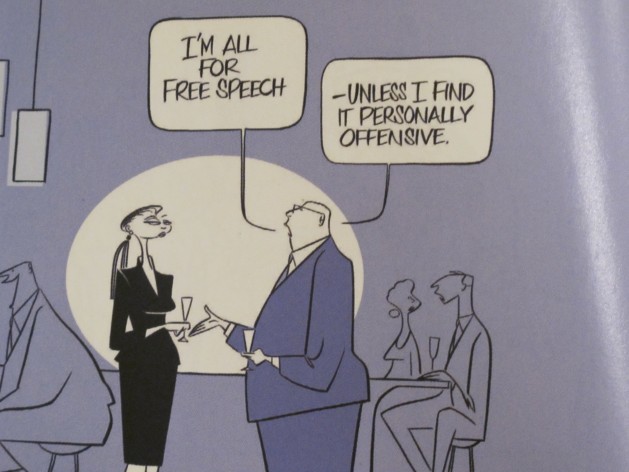 |
| Peter never was a man of consistency |
Are there any freedom of expressions issues in the UK in relation to the same subject matter? Under the Trade Marks Act 1994 a mark can be refused registration if it is "...contrary to public policy or to accepted principles of morality". This would, arguably, cover any racial slurs or other content deemed offensive in the public's view (such as the name The Slants, potentially). Also, under the Public Order Act 1986 speech inciting racial hatred is not allowed, although the freedom of expression is sacrosanct under the Human Rights Act 1998. Arguably freedom of expression is narrower than the one protected by our cousins across the pond, and would not allow for the use of negative language even in trademarks, provided the mark is against public morality (and negative racial connotations, even if hidden behind good intentions, would probably be). This view was firmly illustrated by the UK Intellectual Property Office's decision in Basic Trademark SA's Trade Mark Application, where a mark was refused under the Trade Marks Act's morality provision, and was seen to not infringe Article 10 of the European Convention on Human Rights (and therefore, the Human Rights Act above). The case does, however, highlight the need to balance both interests: "...[the] right to freedom of expression must always be taken into account without discrimination under s3(3)(a) [of the Trade Marks Act] and any real doubt as to the applicability of the objection must be resolved by upholding the right to freedom of expression, hence acceptability for registration". The UK does have more questions in terms of freedom of expression and registered trademarks, but the balancing of both interests does take it into account even in this area of law.
All-in-all the line between the protection of a legitimate freedom of speech (or a more open freedom, such as in the US) and the curbing of possible moral outrage is a fine one, and both interests should be balanced in an assessment of the registrability of a mark. Nevertheless, it is hard to draw a strict comparison with EU and US rights due to their big differences, but both jurisdictions do see a clear need for the allowance of expression even in the world of trademarks. This writer for one, as said above, awaits the en banc decision of the US Court of Appeals in the Tam case, and it will be interesting to see whether trademarks are a true form of expression under US law, and therefore protected by the First Amendment.
Source: World Trademark Review
17 April, 2015
Stifled Words - The DMCA and Censoring Free Speech
Since its enactment at the cusp of the 21st century, the Digital Millennium Copyright Act in the United States has been the subject of discussion within the IP community, practitioners and even the public in general. With its inception being in the early days of the internet, back when our full understanding of the scale and complexity it will achieve later in its life was all but naught, the provisions in the DMCA can be seen as being quite broad and outdated in their application to the Internet as we know it today. The Electronic Frontier Foundation published a white paper some 2 years ago, detailing very thoroughly the potential abuse of the DMCA and its provisions, and this writer can agree that the DMCA has its issues and needs to be addressed by the US legislature. That being said, a lot of laws have their negative applications (some IP related discussion can be found here and here), but could the DMCA be used to stifle free speech, even abroad?
For the uninitiated, under the DMCA a noticed can be issued to a service provider to request the taking down of copyright infringing works on that provider's services, for example, on a website, under 17 USC section 512. After a sufficient amount of information is provided, the content has to be taken down, should the material alleged actually be infringed as described. While the provision purely affects intellectual property rights, there have been instances where the takedown notice has been abused, and more often than not, service providers will comply with the request just to cover their own backs.
A recent instance, as discussed above, prompted this writer to look into a matter where the DMCA was clearly used for more nefarious purposes, and not to protect legitimate interests in one's intellectual property. The case in question was Automattic Inc and Oliver Hotham v Nick Steiner, for which summary judgment was passed early last month (PDF copy can be downloaded here), regarded a young journalist called Oliver Hotham. Mr. Hotham, in his journalistic endeavors, contacted an organization called Straight Pride UK, one which advocates their notion of current discrimination of heterosexual people in the light of emerging gay rights. In his email communication to Straight Pride UK Mr. Hotham identified himself as a 'freelance journalist' and asked the organization some questions relating to them and their agenda. They promptly answered a week later, attaching a document titled "Press Release", in which they detailed their answers to most of Mr. Hotham's questions. He subsequently cleaned up the answers, rearranged them and published them in his blog article "It's great to be straight... yeah" (quoted in full here), which garnered a great deal of traction. Due to the article painting Straight Pride UK in a less beneficial light, they threatened to, and did, issue a takedown notice under the DMCA if the article wasn't take off Mr. Hotham's blog. Wordpress did, however, take down the article, yet after some voicing out on Mr. Hotham's part as to his ordeal, Wordpress took action and sued Straight Pride UK (through their representative, Nick Steiner) for abuse of the DMCA.
Under section 512(f) a claim can be brought against a false DMCA notice that has been issued through materially misrepresenting that the activity in question infringes their rights, i.e. that you claim someone's post on a website infringes your copyright when it (potentially at least) doesn't. Wordpress asserted that, as Mr. Steiner represented that "[the] [u]ser http://oliverhotham.wordpress.com did not have my permission to reproduce this content, on Wordpress.com or twitter account or tweets, no mention of material being published was made in communications... [and that] [i]t is of good faith belief that use of the material in the manner complained of here is not authorized by me, the copyright holder, or the law". As Mr. Hotham had identified himself as a journalist, and the work sent had been titled as a press release, clearly Mr. Hotham did not infringe copyright in the US, or hypothetically even in the UK had the case been brought forth here. Wordpress firmly contested Mr. Steiner's assertion and the court agreed with their argument, issuing a summary judgment in their favor.
Although the case discussed nothing in terms of substantive arguments relating to section 512(f), it highlights an important issue regarding the potential abuse of DMCA when it comes to freedom of expression, and not only limiting it to the US (as the case was here, and wholly related to two UK entities and a US service provider). Had Mr. Hotham not been a journalist (says the writer, writing his own 'journalistic' blog) the nature of the case could have been very different. The DMCA, or any provisions regarding copyright, should protect legitimate interests, and not merely those aiming to stifle criticism or dissent in the veil of protecting copyright. However, as was stated by Paul Sieminski, Chief Legal Counsel for Automattic: "...[this] DMCA abuse may go unpunished this time. But, we're heartened that our case makes some good new law for future cases. There's very little case law in this area, and previously no case law about what damages were available if a plaintiff were to win". Arguably this is very true, and serves as an important milestone in the protection of free speech under the DMCA.
Source: The Guardian
For the uninitiated, under the DMCA a noticed can be issued to a service provider to request the taking down of copyright infringing works on that provider's services, for example, on a website, under 17 USC section 512. After a sufficient amount of information is provided, the content has to be taken down, should the material alleged actually be infringed as described. While the provision purely affects intellectual property rights, there have been instances where the takedown notice has been abused, and more often than not, service providers will comply with the request just to cover their own backs.
 |
| Discussions can be odd at times (Source: HiJinks Ensue) |
Under section 512(f) a claim can be brought against a false DMCA notice that has been issued through materially misrepresenting that the activity in question infringes their rights, i.e. that you claim someone's post on a website infringes your copyright when it (potentially at least) doesn't. Wordpress asserted that, as Mr. Steiner represented that "[the] [u]ser http://oliverhotham.wordpress.com did not have my permission to reproduce this content, on Wordpress.com or twitter account or tweets, no mention of material being published was made in communications... [and that] [i]t is of good faith belief that use of the material in the manner complained of here is not authorized by me, the copyright holder, or the law". As Mr. Hotham had identified himself as a journalist, and the work sent had been titled as a press release, clearly Mr. Hotham did not infringe copyright in the US, or hypothetically even in the UK had the case been brought forth here. Wordpress firmly contested Mr. Steiner's assertion and the court agreed with their argument, issuing a summary judgment in their favor.
Although the case discussed nothing in terms of substantive arguments relating to section 512(f), it highlights an important issue regarding the potential abuse of DMCA when it comes to freedom of expression, and not only limiting it to the US (as the case was here, and wholly related to two UK entities and a US service provider). Had Mr. Hotham not been a journalist (says the writer, writing his own 'journalistic' blog) the nature of the case could have been very different. The DMCA, or any provisions regarding copyright, should protect legitimate interests, and not merely those aiming to stifle criticism or dissent in the veil of protecting copyright. However, as was stated by Paul Sieminski, Chief Legal Counsel for Automattic: "...[this] DMCA abuse may go unpunished this time. But, we're heartened that our case makes some good new law for future cases. There's very little case law in this area, and previously no case law about what damages were available if a plaintiff were to win". Arguably this is very true, and serves as an important milestone in the protection of free speech under the DMCA.
Source: The Guardian
04 March, 2015
Retrospective - IP Infringement and Free Speech
Almost as holy as expression in its many forms, is the fact that, in most countries at least, expression is largely free of limitations, and that even dissenting opinions can, and should be voiced. With this vast freedom, especially in the United States, one can argue that the freedom of expression can be misused and utilized for nefarious means, or to harm others or their more intangible assets such as reputation or notoriety. In any instances where one's reputation is harmed through the freedom of expression (assuming that expression falls within the letter of the law), those parties would clearly want to prevent that speech through any means necessary; even more questionable ones. The attempted curtailment of speech has been discussed on this blog before, but that still leaves the question of can intellectual property rights be used to prevent freedom of expression? A case in the US Court of Appeals attempted to face this very question some decades ago.
The case in question was Rogers v Grimaldi, decided in the late 80s, which concerned a movie made by Frederico Fellini for the defendants in 1986. The subject matter of the movie, wonderfully titled as "Ginger and Fred", were two fictional cabaret dancers, Pippo and Amelia, who were known for their imitation of both Ginger Rogers (an Academy Award winning actress in the 1940s, and the plaintiff in the case), and Fred Astaire, who Ms. Rogers often co-starred with in various productions. The cabaret dancers were known as "Ginger and Fred" to their viewers in Italy, and the movie's title, and subsequent plot, refers to their reunion after years of retirement. After distribution within Europe and the US the movie was received rather negatively, and undoubtedly in the wake of this negative publicity, Ms. Rogers sued and claimed false designation of origin under 15 USC section 1125 and a violation of her common law rights to publicity.
Effectively what the case is assessing is a balance between free speech and the protection of an individual's (or entity's) rights in their trademarks, albeit more in the context of passing off than registered trademarks (more on which can be found here). Justice Newman presented the question well in the majority's opinion: "Poetic license is not without limits. The purchaser of a book, like the purchaser of a can of peas, has a right not to be misled as to the source of the product. Thus, it is well established that where the title of a movie or a book has acquired secondary meaning — that is, where the title is sufficiently well known that consumers associate it with a particular author's work — the holder of the rights to that title may prevent the use of the same or confusingly similar titles by other authors".
In answering this question, the Court of Appeal approached the matter through a balance of public interest and those of any affected parties: "We believe that in general [15 USC 1125] should be construed to apply to artistic works only where the public interest in avoiding consumer confusion outweighs the public interest in free expression. In the context of allegedly misleading titles using a celebrity's name, that balance will normally not support application of the Act unless the title has no artistic relevance to the underlying work whatsoever, or, if it has some artistic relevance, unless the title explicitly misleads as to the source or the content of the work". What Justice Newman's opinion states, is that the potentially misleading title has to apply to the work it represents, or in other words, has to showcase or illustrate the work somehow, and not merely mislead a person to pay for the work thinking it is connected to a potentially affected party such as Ms. Rogers. Arguably this approach is sensible, as the use of IP rights to protect those rights has to be legitimate, just as much as the use of those rights in conjunction with newer works is. Free speech should be promoted through legitimate use, and not stifled merely to further shallow interests such as fame.
The Court of Appeal lengthily discuss the nuances of this approaches application, yet, what remains relevant is the use and applicability of those rights to the underlying work, and the legitimacy of that use. Ms. Rogers relied heavily on survey and anecdotal evidence in establishing a claim of false advertising of designation of origin; however this was dismissed handily by the Court: "...the title "Ginger and Fred" surpasses the minimum threshold of artistic relevance to the film's content. The central characters in the film are nicknamed "Ginger" and "Fred," and these names are not arbitrarily chosen just to exploit the publicity value of their real life counterparts but instead have genuine relevance to the film's story". No amount of confusion, arguably at least, will counteract freedom of speech, so long as the use of a name or names is relevant to the underlying work. As such the Court of Appeal dismissed Ms. Rogers' appeal.
Freedom of expression poses an interesting balancing act of human rights and commercial interests (or even other human's rights against said expression). The European Court of Human Rights weighed on the issue of copyright interfering with freedom of expression in the case of Ashby Donald and Others v France (case text only in French), and deemed that "...a conviction based on copyright law for illegally reproducing or publicly communicating copyright protected material can be regarded as an interference with the right of freedom of expression and information under Article 10 of the European Convention". Even so, the case saw that the copyright interests asserted did trump the appellants' human rights, as their interests were purely commercial and did not contribute to a specific expression or discussion of opinion. As such, the case can be seen to align with the view that intellectual property rights should not hinder legitimate expression, but can, and should, be used to protect commercial interests.
Overall one can appreciate that freedom of speech is seen as a valuable tool for discussion and a strong point of public interest, yet it should not overshadow the protection of some rights, at least in some instances. A blatant use of copyrighted material, or trademarks, for the purposes of making a quick buck should be dissuaded; however one man's folly should not silence a nation.
The case in question was Rogers v Grimaldi, decided in the late 80s, which concerned a movie made by Frederico Fellini for the defendants in 1986. The subject matter of the movie, wonderfully titled as "Ginger and Fred", were two fictional cabaret dancers, Pippo and Amelia, who were known for their imitation of both Ginger Rogers (an Academy Award winning actress in the 1940s, and the plaintiff in the case), and Fred Astaire, who Ms. Rogers often co-starred with in various productions. The cabaret dancers were known as "Ginger and Fred" to their viewers in Italy, and the movie's title, and subsequent plot, refers to their reunion after years of retirement. After distribution within Europe and the US the movie was received rather negatively, and undoubtedly in the wake of this negative publicity, Ms. Rogers sued and claimed false designation of origin under 15 USC section 1125 and a violation of her common law rights to publicity.
Effectively what the case is assessing is a balance between free speech and the protection of an individual's (or entity's) rights in their trademarks, albeit more in the context of passing off than registered trademarks (more on which can be found here). Justice Newman presented the question well in the majority's opinion: "Poetic license is not without limits. The purchaser of a book, like the purchaser of a can of peas, has a right not to be misled as to the source of the product. Thus, it is well established that where the title of a movie or a book has acquired secondary meaning — that is, where the title is sufficiently well known that consumers associate it with a particular author's work — the holder of the rights to that title may prevent the use of the same or confusingly similar titles by other authors".
 |
| Frank was worried he would not be heard |
The Court of Appeal lengthily discuss the nuances of this approaches application, yet, what remains relevant is the use and applicability of those rights to the underlying work, and the legitimacy of that use. Ms. Rogers relied heavily on survey and anecdotal evidence in establishing a claim of false advertising of designation of origin; however this was dismissed handily by the Court: "...the title "Ginger and Fred" surpasses the minimum threshold of artistic relevance to the film's content. The central characters in the film are nicknamed "Ginger" and "Fred," and these names are not arbitrarily chosen just to exploit the publicity value of their real life counterparts but instead have genuine relevance to the film's story". No amount of confusion, arguably at least, will counteract freedom of speech, so long as the use of a name or names is relevant to the underlying work. As such the Court of Appeal dismissed Ms. Rogers' appeal.
Freedom of expression poses an interesting balancing act of human rights and commercial interests (or even other human's rights against said expression). The European Court of Human Rights weighed on the issue of copyright interfering with freedom of expression in the case of Ashby Donald and Others v France (case text only in French), and deemed that "...a conviction based on copyright law for illegally reproducing or publicly communicating copyright protected material can be regarded as an interference with the right of freedom of expression and information under Article 10 of the European Convention". Even so, the case saw that the copyright interests asserted did trump the appellants' human rights, as their interests were purely commercial and did not contribute to a specific expression or discussion of opinion. As such, the case can be seen to align with the view that intellectual property rights should not hinder legitimate expression, but can, and should, be used to protect commercial interests.
Overall one can appreciate that freedom of speech is seen as a valuable tool for discussion and a strong point of public interest, yet it should not overshadow the protection of some rights, at least in some instances. A blatant use of copyrighted material, or trademarks, for the purposes of making a quick buck should be dissuaded; however one man's folly should not silence a nation.
18 April, 2014
Free Speech and Copyright - When Copyrights and Personal Rights are at Odds
Although intellectual property law protects expression in its multitude of applications sometimes it comes at odds with the rights that are conveyed through the aforementioned expression, whether it was intended or not. Previous examples are the potential curtailing of criticism by using trademarks, where the line between the intended protection offered by trademarks and its potential misuse against freedom of speech came to light. Copyright in itself can potentially be used in a similar fashion, although most common law jurisdictions do expressly allow for copyrighted content to be used for criticism. A recent instance in the United States faced this very conundrum; can copyright trump your right to criticize another?
The case in question was Garcia v Google, which concerned Ms. Cindy Lee Garcia, who acted in a small role in a movie titled "Desert Warrior" (a working title at the time of casting). Even though Ms. Garcia had participated in the filming of the movie, the finished film never saw the light of day. Some time after Ms. Garcia's scene was used in the infamous YouTube video "Innocence of Muslims", in which her scene was partially dubbed having her say "is Mohammed a child molester?". As a result Ms. Garcia soon began receiving death threats from various parties, and she subsequently took precautions and asked Google to remove the aforementioned video relying on the Digital Millennium Copyright Act and its take-down provisions. Google refused her initial reasoning for the video's removal, finally having Ms. Garcia resort to a copyright claim over the video's content, asserting it infringed her copyright in her performance.
Although the case discussed Ms. Garcia's copyright in the film quite extensively, it remains but worth a mention. In Chief Justice Kozinski's judgment Ms. Garcia did have a copyright interest in the film, even though her part was only 5 seconds long in a 13 minute video. As a copyright interest was seen by the court Google were ordered to remove the video from YouTube due to it infringing the aforementioned rights. In Chief Justice Kozinski's view this was a matter of balancing equities, in other words, an assessment of the balance of fairness, and saw that Ms. Garcia's rights in the video overshadowed those afforded in the First Amendment of the American Constitution through free speech. Her security was also a consideration in this assessment; a truly sad result of her unwilling part in the video.
What should be discussed in this instance, and has rightfully so become the vocal point of this case, is whether copyright should be able to be used to curtail free speech. As Google argued in the case: "[a] court order requiring removal from YouTube of the Film or any portion thereof would impose a substantial burden on free expression, without preventing any future harm to [Ms. Garcia]". In the majority's opinion Ms. Garcia only had the likelihood of success in her claim, or in other words, potentially had a copyright interest in the work, and the majority subsequently saw that this potential interest would weigh heavier than the public interest under free speech. Commenting on this, in his dissenting judgment, Justice Smith saw that "...the law and facts do not clearly demonstrate how granting a preliminary injunction in Garcia's favor would serve the public interest". Clearly one can agree with Justice Smith in this instance, at least under these facts. Although this writer fully accepts that Ms. Garcia's safety is paramount and should be a consideration in this instance, her argument fails in the uncertainty of her copyright interest and lack of concrete harm caused. Her protection should not be handled through copyright, and as stated by Justice Smith: "It's disappointing, though perhaps not surprising, that Garcia needed to sue in order to protect herself and her rights".
The Garcia case is an unfortunate result of unforeseen circumstances and the infamy to which the video rose. The decision has since come to a vote over whether the 9th Circuit Court of Appeals should rehear the case. The video's infamy served a two-fold purpose when gauged under US law; it started a conversation over religion and attitude's towards it, however it also caused severe distress to Ms. Garcia and even fear for her life. Her argument through copyright was flimsy at best, but seemingly was her only avenue for respite. The majority's view on the matter can be argued to be incorrect, and does not fairly assess the balance between her alleged copyright interest and the public interest. As Google stated: "...[o]ur laws permit even the vilest criticisms of governments, political leaders, and religious figures as legitimate exercises in free speech", and this right should be protected, although not used as a veil to protect those who wish to blatantly infringe copyright under the guise of free speech. Even though copyright and free speech do overlap quite extensively, their relationship does come with a price, and each case will present a different situation where the court will have to find the right spot where protection is afforded, but not at the expense of free speech. Copyright serves as a shield to those expressing themselves, and it should not be used to stifle others; something which clearly was not Ms. Garcia's intention in her action.
Source: Reuters
The case in question was Garcia v Google, which concerned Ms. Cindy Lee Garcia, who acted in a small role in a movie titled "Desert Warrior" (a working title at the time of casting). Even though Ms. Garcia had participated in the filming of the movie, the finished film never saw the light of day. Some time after Ms. Garcia's scene was used in the infamous YouTube video "Innocence of Muslims", in which her scene was partially dubbed having her say "is Mohammed a child molester?". As a result Ms. Garcia soon began receiving death threats from various parties, and she subsequently took precautions and asked Google to remove the aforementioned video relying on the Digital Millennium Copyright Act and its take-down provisions. Google refused her initial reasoning for the video's removal, finally having Ms. Garcia resort to a copyright claim over the video's content, asserting it infringed her copyright in her performance.
Although the case discussed Ms. Garcia's copyright in the film quite extensively, it remains but worth a mention. In Chief Justice Kozinski's judgment Ms. Garcia did have a copyright interest in the film, even though her part was only 5 seconds long in a 13 minute video. As a copyright interest was seen by the court Google were ordered to remove the video from YouTube due to it infringing the aforementioned rights. In Chief Justice Kozinski's view this was a matter of balancing equities, in other words, an assessment of the balance of fairness, and saw that Ms. Garcia's rights in the video overshadowed those afforded in the First Amendment of the American Constitution through free speech. Her security was also a consideration in this assessment; a truly sad result of her unwilling part in the video.
 |
| Compliance, or passive aggressiveness? |
The Garcia case is an unfortunate result of unforeseen circumstances and the infamy to which the video rose. The decision has since come to a vote over whether the 9th Circuit Court of Appeals should rehear the case. The video's infamy served a two-fold purpose when gauged under US law; it started a conversation over religion and attitude's towards it, however it also caused severe distress to Ms. Garcia and even fear for her life. Her argument through copyright was flimsy at best, but seemingly was her only avenue for respite. The majority's view on the matter can be argued to be incorrect, and does not fairly assess the balance between her alleged copyright interest and the public interest. As Google stated: "...[o]ur laws permit even the vilest criticisms of governments, political leaders, and religious figures as legitimate exercises in free speech", and this right should be protected, although not used as a veil to protect those who wish to blatantly infringe copyright under the guise of free speech. Even though copyright and free speech do overlap quite extensively, their relationship does come with a price, and each case will present a different situation where the court will have to find the right spot where protection is afforded, but not at the expense of free speech. Copyright serves as a shield to those expressing themselves, and it should not be used to stifle others; something which clearly was not Ms. Garcia's intention in her action.
Source: Reuters
Subscribe to:
Posts (Atom)