Showing posts with label donald. Show all posts

16 November, 2016

A New Era - What Does the Donald Trump Presidency Potentially Mean for IP?

Now that the dust has settled in the long and arduous process that is the American presidential race, it is time to look ahead to the future and the possible implications of the Donald Trump presidency. While it can be appreciated that the next 4 (or even 8) years will be ones of change one way or the other, this writer is not concerned with the wider implications, but only of those impacting intellectual property law. The 45th president's particular focus on this area of law still remains very murky; however, his position has been stated in some amount of press and campaign materials, which will form a basis for this discussion.

In his own policy manifesto for his campaign, Mr Trump set out that he will "...use every lawful presidential power to remedy trade disputes if China does not stop its illegal activities, including its theft of American trade secrets - including the application of tariffs consistent with Section 201 and 301 of the Trade Act of 1974 and Section 232 of the Trade Expansion Act of 1962". Clearly his approach echoes largely a trade-based plan, rather than the change of laws and regulations surrounding IP in the United States. Arguably, these are quite strong deterrents for the infringement of intellectual property rights in China, but these measures have had little effect before due to the massive presence of Chinese manufacturing in the world stage (although the country has taken significant steps forward to better enforce IP rights). Recent changes to the Chinese IP law landscape have possibly mitigated the current issues highlighted by the Trump campaign, but this will undoubtedly not deter him should the president want to go after China in a more direct fashion.

Aside from legislative or policy changes, his 100 day plan encompasses withdrawal from the Trans-Pacific Partnership and the renegotiation of bilateral trade agreements, many of which will touch on IP in one way or another. This will have drastic effects on US trade relations, but the implications for IP will be minimal.

The face of an uncertain future for IP
Some have argued that, per his close ties to the entertainment industry, that copyright regulations would be tightened and copyright enforcement made stricter, with higher sentencing and easier claims by rightsholders (in this writer's thinking anyway). Similarly, his position on copyright might impact the regulation of the Internet, with broad-ranging implications should it be used as a weapon to combat against those who infringe copyright online. Overall Donald Trump has been quite quiet in his views on intellectual property and what his concrete plans are during his presidency.

This can be compared with Hillary Clinton's Initiative on Technology & Innovation, which set out a myriad of action points in this sphere, but specifically targeted copyright as a sub-point. In her initiative she set out to "...modernize the copyright system through reforms that facilitate access to out-of-print and orphan works, while protecting the innovation incentives in the system.  It should also promote open-licensing arrangements for copyrighted material supported by federal grant funding". Her plan seemed to focus more on accessibility than enforcement, but echoes vagueness, as expected in a political campaign. Similarly, she aimed to take on patents with "...reforms to the patent system to reduce excessive patent litigation and strengthen the capacity of the Patent and Trademark Office". Clearly this was to reduce frivolous patent litigation by patent trolls, but more particular reforms were left to be sorted if she were ultimately elected. Mrs Clinton was overall much more up-front with her plans and vision for IP, but even so it left much to decipher as to what might actually happen, rather than what might.

As one can appreciate the future developments of this coming presidency are unknown, and while candidates often give indications as to their stances or policy intentions, these don't necessarily stick once they reach the Oval Office. This writer will remain optimistic, but does wonder whether a more pro-rightsholder position will become the norm, with a clear reduction in fair use and other legitimate uses of copyright materials, especially in an online environment. Odds are the trajectory that IP legislation was already headed will most likely remain the same irrespective of who the president is, as a swooping overhaul of this would lead to too much uncertainty and possibly a negative impact in IP and innovation as a whole (with the rapid pace of technological development making things even worse if not kept up with). While the media has calmed down after the election, it will surely be quite the next 4 years to come.

04 March, 2015

Retrospective - IP Infringement and Free Speech

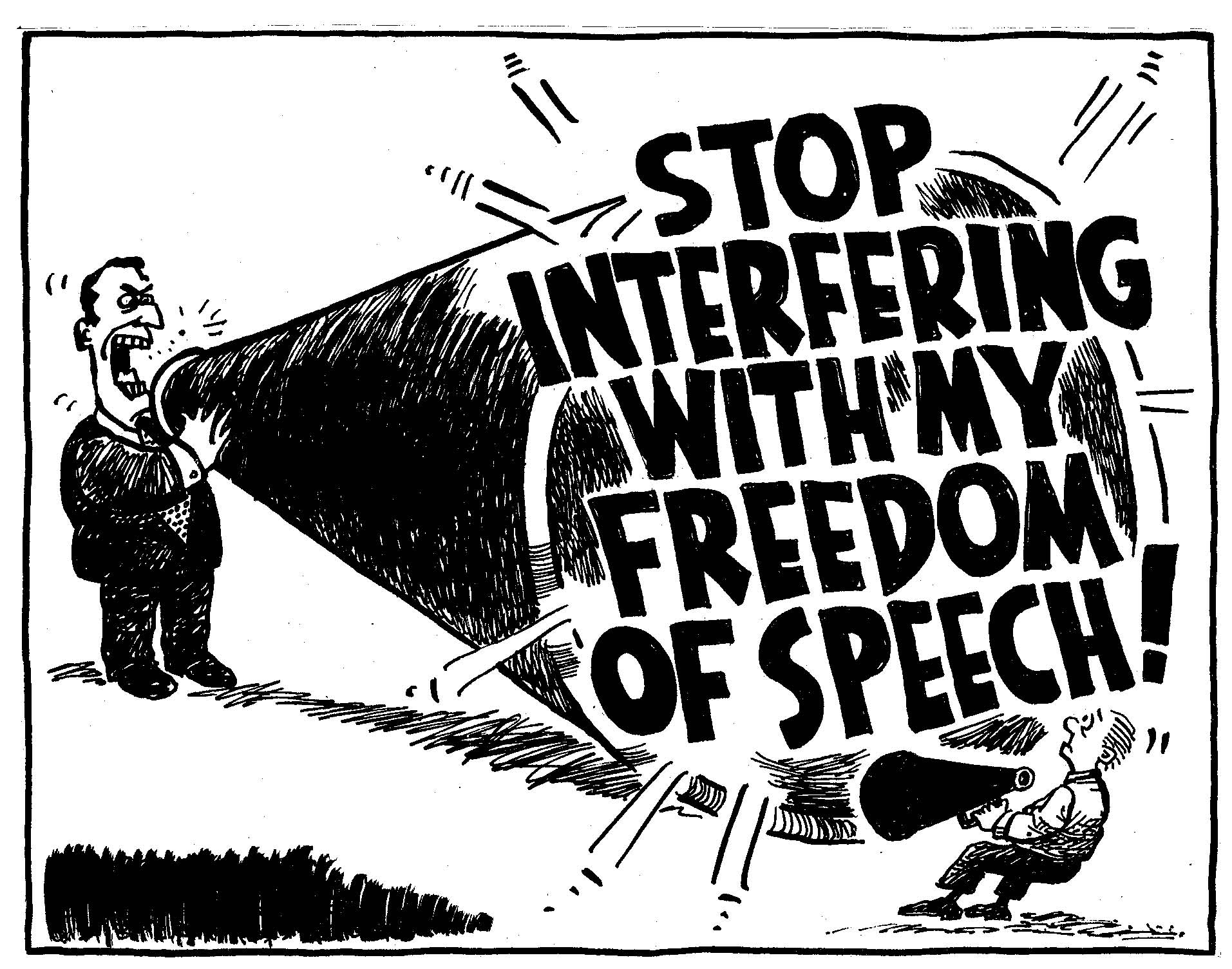
Almost as holy as expression in its many forms, is the fact that, in most countries at least, expression is largely free of limitations, and that even dissenting opinions can, and should be voiced. With this vast freedom, especially in the United States, one can argue that the freedom of expression can be misused and utilized for nefarious means, or to harm others or their more intangible assets such as reputation or notoriety. In any instances where one's reputation is harmed through the freedom of expression (assuming that expression falls within the letter of the law), those parties would clearly want to prevent that speech through any means necessary; even more questionable ones. The attempted curtailment of speech has been discussed on this blog before, but that still leaves the question of can intellectual property rights be used to prevent freedom of expression? A case in the US Court of Appeals attempted to face this very question some decades ago.

The case in question was Rogers v Grimaldi, decided in the late 80s, which concerned a movie made by Frederico Fellini for the defendants in 1986. The subject matter of the movie, wonderfully titled as "Ginger and Fred", were two fictional cabaret dancers, Pippo and Amelia, who were known for their imitation of both Ginger Rogers (an Academy Award winning actress in the 1940s, and the plaintiff in the case), and Fred Astaire, who Ms. Rogers often co-starred with in various productions. The cabaret dancers were known as "Ginger and Fred" to their viewers in Italy, and the movie's title, and subsequent plot, refers to their reunion after years of retirement. After distribution within Europe and the US the movie was received rather negatively, and undoubtedly in the wake of this negative publicity, Ms. Rogers sued and claimed false designation of origin under 15 USC section 1125 and a violation of her common law rights to publicity.

Effectively what the case is assessing is a balance between free speech and the protection of an individual's (or entity's) rights in their trademarks, albeit more in the context of passing off than registered trademarks (more on which can be found here). Justice Newman presented the question well in the majority's opinion: "Poetic license is not without limits. The purchaser of a book, like the purchaser of a can of peas, has a right not to be misled as to the source of the product. Thus, it is well established that where the title of a movie or a book has acquired secondary meaning — that is, where the title is sufficiently well known that consumers associate it with a particular author's work — the holder of the rights to that title may prevent the use of the same or confusingly similar titles by other authors".

Frank was worried he would not be heard
In answering this question, the Court of Appeal approached the matter through a balance of public interest and those of any affected parties: "We believe that in general [15 USC 1125] should be construed to apply to artistic works only where the public interest in avoiding consumer confusion outweighs the public interest in free expression. In the context of allegedly misleading titles using a celebrity's name, that balance will normally not support application of the Act unless the title has no artistic relevance to the underlying work whatsoever, or, if it has some artistic relevance, unless the title explicitly misleads as to the source or the content of the work". What Justice Newman's opinion states, is that the potentially misleading title has to apply to the work it represents, or in other words, has to showcase or illustrate the work somehow, and not merely mislead a person to pay for the work thinking it is connected to a potentially affected party such as Ms. Rogers. Arguably this approach is sensible, as the use of IP rights to protect those rights has to be legitimate, just as much as the use of those rights in conjunction with newer works is. Free speech should be promoted through legitimate use, and not stifled merely to further shallow interests such as fame.

The Court of Appeal lengthily discuss the nuances of this approaches application, yet, what remains relevant is the use and applicability of those rights to the underlying work, and the legitimacy of that use. Ms. Rogers relied heavily on survey and anecdotal evidence in establishing a claim of false advertising of designation of origin; however this was dismissed handily by the Court: "...the title "Ginger and Fred" surpasses the minimum threshold of artistic relevance to the film's content. The central characters in the film are nicknamed "Ginger" and "Fred," and these names are not arbitrarily chosen just to exploit the publicity value of their real life counterparts but instead have genuine relevance to the film's story". No amount of confusion, arguably at least, will counteract freedom of speech, so long as the use of a name or names is relevant to the underlying work. As such the Court of Appeal dismissed Ms. Rogers' appeal.

Freedom of expression poses an interesting balancing act of human rights and commercial interests (or even other human's rights against said expression). The European Court of Human Rights weighed on the issue of copyright interfering with freedom of expression in the case of Ashby Donald and Others v France (case text only in French), and deemed that "...a conviction based on copyright law for illegally reproducing or publicly communicating copyright protected material can be regarded as an interference with the right of freedom of expression and information under Article 10 of the European Convention". Even so, the case saw that the copyright interests asserted did trump the appellants' human rights, as their interests were purely commercial and did not contribute to a specific expression or discussion of opinion. As such, the case can be seen to align with the view that intellectual property rights should not hinder legitimate expression, but can, and should, be used to protect commercial interests.

Overall one can appreciate that freedom of speech is seen as a valuable tool for discussion and a strong point of public interest, yet it should not overshadow the protection of some rights, at least in some instances. A blatant use of copyrighted material, or trademarks, for the purposes of making a quick buck should be dissuaded; however one man's folly should not silence a nation.