Showing posts with label expression. Show all posts

15 January, 2019

Military Grade News - CJEU Advocate General Opines on Copyright and the Freedom of Expression

IP and freedom of speech have always had a difficult relationship. What could be freer that the ability to use any works you have seen, and share them with a wider potentially different audience, while IP seeks to protect the interests of the original author, even sometimes at the expense of the rightsholders. These issues often come to blows in the courts, and a recent case in the CJEU has brought this conversation back to the forefront. Can you protect works using copyright, even with strong issues of freedom of speech underpinning the sharing of those documents? We found out the precursor to the European answer to this question late last October.

The case of Funke Medien NRW GmbH v Federal Republic of Germany concerned military status reports drawn up for the German government on a weekly basis, which detail developments of deployed forces abroad. These reports are subsequently sent to e.g. various members of the Federal Parliament and the Ministry of Defense for briefing purposes. The documents are classed as classified and restricted. Funke Media published summaries of some of these reports, having acquired copies of them through potentially illicit means as an application to access them was rejected by the German government. They were subsequently taken to court for copyright infringement, with the matter ultimately ending with Advocate General Szpunar.

The balancing act between ensuring freedom of expression, but still protecting copyright owners' rights, is a difficult one, since the interests are often very much in competition with each other. The Court was tasked in balancing this difficult dichotomy.

Copyright through numerous exceptions allows for some freedoms when it comes to using copyright materials, including for critique, satire and review. However, the exceptions are by no means very broad (like in the US under fair use), and could be used to curtail genuine public discourse and commentary.

The Charter of Fundamental Rights of the European Union sets out the various rights enjoyed within the Union, and Article 51 asserts those rights onto any EU legislation implemented by Member States. In this case, Article 11 is in contention, which gives everyone the right of freedom of expression.

Other methods might've worked better to keep matters 'secret'
The main question that the Advocate General sought to answer is whether the grounds asserted by the German government are good enough to trump the Claimant's right to freedom of expression. The Advocate General did, however, note that as the copyright holder in this case is a Member State, it does not enjoy the same rights as the people living in that Member State. He distinguished the matter in that "...the State cannot rely on the fundamental right to property as a means of restricting another fundamental right guaranteed by the ECHR or the Charter", even though the State might have a remedy under civil rights.

The Advocate General summarized the position as "...If the State were able to invoke its individual rights, other than the public interest, in order to limit fundamental rights, the result would be the destruction of those fundamental rights". The State would have to put forward an argument under public interest to protect the works in question in order to limit the fundamental rights guaranteed in the Charter. In his view, the State fails under the public interest argument.

He then turned to the matter of copyright protection offered for the military reports. Copyright at its core aims to achieve two objectives: (i) to protect the personal relationship between the author and his work as his intellectual creation; and (ii) to enable authors to exploit their works economically.

While Germany does own the copyright in the military reports, the country itself cannot be construed as the author of those works. Even though they were drafted by State employees, strictly speaking the works themselves do not have an author at all. The Advocate General saw that, as copyright endeavors to protect the relationship between the author and the works created, the State's interests cannot be protected in works it isn't the author of. As he put succinctly: "...where there is no author, there is no copyright, in the form of either moral or property rights".

Similarly, as the State does not seek to profit from the works themselves economically, but to protect the contents from public scrutiny, the Advocate General deemed the matter outside of the remit of copyright.

In short, "...the answer should be that Article 11 of the Charter, read in conjunction with Article 52(1) thereof, must be interpreted as precluding a Member State from invoking copyright under Article 2(a) and Article 3(1) of [the] Directive in order to prevent the communication to the public, in the context of a debate concerning matters of public interest, of confidential documents emanating from that Member State. That interpretation does not prevent the Member State from applying, in compliance with EU law, other provisions of its domestic law, including those relating to the protection of confidential information".

The Advocate General clearly sought to protect the interests of those seeking to share and disseminate information, while the State attempted to curtail those efforts through incorrect means. Copyright clearly was not the appropriate vehicle to protect the legitimate interests in keeping military documents secret, and the State therefore could pursue it through other avenues. In the end, it remains to be seen what the CJEU rules in this case.

16 June, 2015

Words Hurt - Disparaging Trademarks and Free Speech Collide

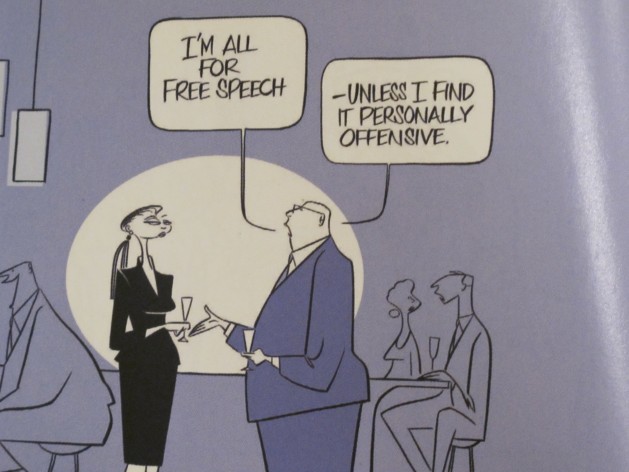
Freedom of speech or expression has often been a sore point of contention for those wishing to protect a full freedom of expression (i.e. no restrictions on speech whatsoever) and those who want to limit it within a certain space to ensure a more harmonious society (i.e. the prevention of hate speech, for example, but allowing for a broad freedom of expression nonetheless) - although the former surely does not prevent a harmonious society as a concept itself. With that in mind, intellectual property is no exception, after all, most ways of expression yourself and/or marking your goods to distinguish them often tread the line of good taste and offense in order to further their respective goals. Especially with trademarks there are certain limitations on what you can use as a registered trademark, but does a limitation on your use of said marks prohibit your effective freedom of speech?

This issue was largely brought to light in the recent Washington Redskins trademark litigation, where the offensiveness of a trademark potentially disparaging native Americans was a heavy point of contention, and the Redskins were subsequently stripped of their trademark (although the loss of their mark is not as straightforward as that) due to the disparaging nature of the mark. However, the Redskins never brought a claim under the First Amendment of the US Constitution.

The matter of free speech was brought into the limelight regarding the refusal to register a trademark after a US Court of Appeals decision in Re: Simon Shiao Tam where the Court affirmed a prior decision to refuse the mark "THE SLANTS" due to its offensiveness against people of Asian descent. The mark related to the name of a rock band called The Slants, fronted by Mr. Tam (including several other members of Asian descent as well). The Court also promptly concluded that there was no impairment of Mr. Tam's First Amendment rights, following the precedent set in Re: Robert L. McGinley some 30 years ago, where the United States Court of Customs and Patent Appeals saw that "...the PTO's refusal to register... [a] mark does not affect his right to use it. No conduct is proscribed, and no tangible form of expression is suppressed. Consequently, [the mark's holder's] First Amendment rights would not be abridged by the refusal to register his mark". Arguably, prima facie at least, a refusal of registration does not prevent the use of a mark, but it does, however, prevent its effective protection under trademark law and can cause issues for the proper monetization of a mark in other commercial endeavors should the holder's venture become more successful than its own field allows it. Albeit this does not affect the use or 'expression' in the mark, but mainly the commercial aspects surrounding the mark.

Peter never was a man of consistency
What makes the decision in Re Simon Shiao Tam interesting are the remarks made by Justice Moore, although not dissenting, after the majority's decision to reject the mark (after which the Court of Appeals issued an Order for an en banc hearing to decide the issue). In her Honor's mind: "...it is unquestionably true that trademarks are protected speech under Supreme Court commercial speech jurisprudence" and that "...the government has conceded that “[t]rademarks are a form of commercial speech.”. Because a trademark identifies the source of a product or service for users, it is protected commercial speech". This writer will wholly admit that his knowledge of US trademark law is not as extensive as he'd hope to be, but the argument presented here seems a tad flimsy. The use of a mark in commerce, on the face of it, is not expressing a point or a view, but merely the distinction of a product or service from other similar ones. The more 'offensive' a mark does not correlate to a higher form of expression necessarily, even if it's to utilize or bring to light racial issues. Yet, the US courts will know more of the substantive side of things, so this writer will not address any other jurisprudential issues here, and awaits the en banc decision in Re Tam with interest.

Are there any freedom of expressions issues in the UK in relation to the same subject matter? Under the Trade Marks Act 1994 a mark can be refused registration if it is "...contrary to public policy or to accepted principles of morality". This would, arguably, cover any racial slurs or other content deemed offensive in the public's view (such as the name The Slants, potentially). Also, under the Public Order Act 1986 speech inciting racial hatred is not allowed, although the freedom of expression is sacrosanct under the Human Rights Act 1998. Arguably freedom of expression is narrower than the one protected by our cousins across the pond, and would not allow for the use of negative language even in trademarks, provided the mark is against public morality (and negative racial connotations, even if hidden behind good intentions, would probably be). This view was firmly illustrated by the UK Intellectual Property Office's decision in Basic Trademark SA's Trade Mark Application, where a mark was refused under the Trade Marks Act's morality provision, and was seen to not infringe Article 10 of the European Convention on Human Rights (and therefore, the Human Rights Act above). The case does, however, highlight the need to balance both interests: "...[the] right to freedom of expression must always be taken into account without discrimination under s3(3)(a) [of the Trade Marks Act] and any real doubt as to the applicability of the objection must be resolved by upholding the right to freedom of expression, hence acceptability for registration". The UK does have more questions in terms of freedom of expression and registered trademarks, but the balancing of both interests does take it into account even in this area of law.

All-in-all the line between the protection of a legitimate freedom of speech (or a more open freedom, such as in the US) and the curbing of possible moral outrage is a fine one, and both interests should be balanced in an assessment of the registrability of a mark. Nevertheless, it is hard to draw a strict comparison with EU and US rights due to their big differences, but both jurisdictions do see a clear need for the allowance of expression even in the world of trademarks. This writer for one, as said above, awaits the en banc decision of the US Court of Appeals in the Tam case, and it will be interesting to see whether trademarks are a true form of expression under US law, and therefore protected by the First Amendment.

Source: World Trademark Review

04 March, 2015

Retrospective - IP Infringement and Free Speech

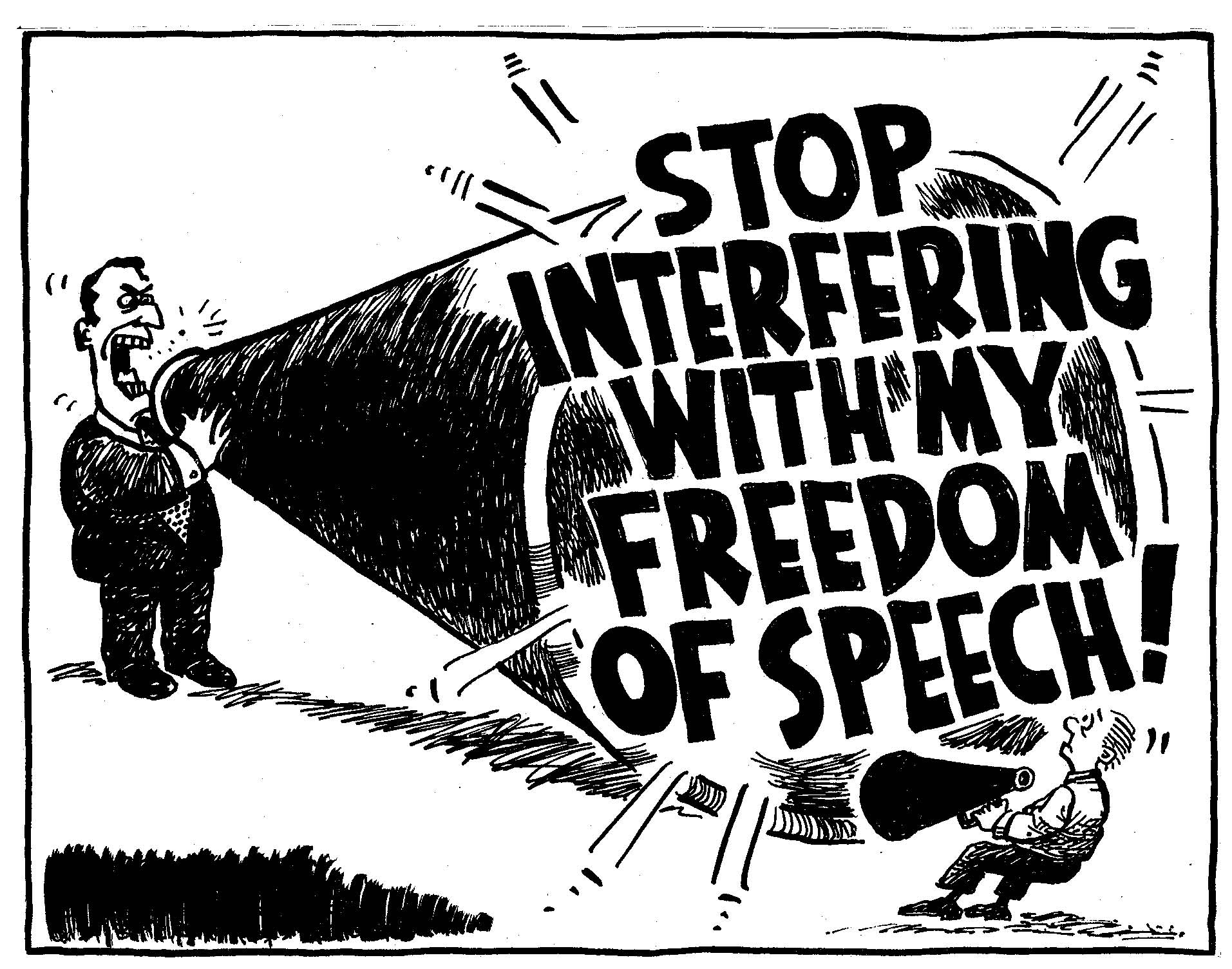
Almost as holy as expression in its many forms, is the fact that, in most countries at least, expression is largely free of limitations, and that even dissenting opinions can, and should be voiced. With this vast freedom, especially in the United States, one can argue that the freedom of expression can be misused and utilized for nefarious means, or to harm others or their more intangible assets such as reputation or notoriety. In any instances where one's reputation is harmed through the freedom of expression (assuming that expression falls within the letter of the law), those parties would clearly want to prevent that speech through any means necessary; even more questionable ones. The attempted curtailment of speech has been discussed on this blog before, but that still leaves the question of can intellectual property rights be used to prevent freedom of expression? A case in the US Court of Appeals attempted to face this very question some decades ago.

The case in question was Rogers v Grimaldi, decided in the late 80s, which concerned a movie made by Frederico Fellini for the defendants in 1986. The subject matter of the movie, wonderfully titled as "Ginger and Fred", were two fictional cabaret dancers, Pippo and Amelia, who were known for their imitation of both Ginger Rogers (an Academy Award winning actress in the 1940s, and the plaintiff in the case), and Fred Astaire, who Ms. Rogers often co-starred with in various productions. The cabaret dancers were known as "Ginger and Fred" to their viewers in Italy, and the movie's title, and subsequent plot, refers to their reunion after years of retirement. After distribution within Europe and the US the movie was received rather negatively, and undoubtedly in the wake of this negative publicity, Ms. Rogers sued and claimed false designation of origin under 15 USC section 1125 and a violation of her common law rights to publicity.

Effectively what the case is assessing is a balance between free speech and the protection of an individual's (or entity's) rights in their trademarks, albeit more in the context of passing off than registered trademarks (more on which can be found here). Justice Newman presented the question well in the majority's opinion: "Poetic license is not without limits. The purchaser of a book, like the purchaser of a can of peas, has a right not to be misled as to the source of the product. Thus, it is well established that where the title of a movie or a book has acquired secondary meaning — that is, where the title is sufficiently well known that consumers associate it with a particular author's work — the holder of the rights to that title may prevent the use of the same or confusingly similar titles by other authors".

Frank was worried he would not be heard
In answering this question, the Court of Appeal approached the matter through a balance of public interest and those of any affected parties: "We believe that in general [15 USC 1125] should be construed to apply to artistic works only where the public interest in avoiding consumer confusion outweighs the public interest in free expression. In the context of allegedly misleading titles using a celebrity's name, that balance will normally not support application of the Act unless the title has no artistic relevance to the underlying work whatsoever, or, if it has some artistic relevance, unless the title explicitly misleads as to the source or the content of the work". What Justice Newman's opinion states, is that the potentially misleading title has to apply to the work it represents, or in other words, has to showcase or illustrate the work somehow, and not merely mislead a person to pay for the work thinking it is connected to a potentially affected party such as Ms. Rogers. Arguably this approach is sensible, as the use of IP rights to protect those rights has to be legitimate, just as much as the use of those rights in conjunction with newer works is. Free speech should be promoted through legitimate use, and not stifled merely to further shallow interests such as fame.

The Court of Appeal lengthily discuss the nuances of this approaches application, yet, what remains relevant is the use and applicability of those rights to the underlying work, and the legitimacy of that use. Ms. Rogers relied heavily on survey and anecdotal evidence in establishing a claim of false advertising of designation of origin; however this was dismissed handily by the Court: "...the title "Ginger and Fred" surpasses the minimum threshold of artistic relevance to the film's content. The central characters in the film are nicknamed "Ginger" and "Fred," and these names are not arbitrarily chosen just to exploit the publicity value of their real life counterparts but instead have genuine relevance to the film's story". No amount of confusion, arguably at least, will counteract freedom of speech, so long as the use of a name or names is relevant to the underlying work. As such the Court of Appeal dismissed Ms. Rogers' appeal.

Freedom of expression poses an interesting balancing act of human rights and commercial interests (or even other human's rights against said expression). The European Court of Human Rights weighed on the issue of copyright interfering with freedom of expression in the case of Ashby Donald and Others v France (case text only in French), and deemed that "...a conviction based on copyright law for illegally reproducing or publicly communicating copyright protected material can be regarded as an interference with the right of freedom of expression and information under Article 10 of the European Convention". Even so, the case saw that the copyright interests asserted did trump the appellants' human rights, as their interests were purely commercial and did not contribute to a specific expression or discussion of opinion. As such, the case can be seen to align with the view that intellectual property rights should not hinder legitimate expression, but can, and should, be used to protect commercial interests.

Overall one can appreciate that freedom of speech is seen as a valuable tool for discussion and a strong point of public interest, yet it should not overshadow the protection of some rights, at least in some instances. A blatant use of copyrighted material, or trademarks, for the purposes of making a quick buck should be dissuaded; however one man's folly should not silence a nation.

18 June, 2014

APIs Protected By Copyright, Programmers Stand Aghast

The more and more information becomes digitized and hidden beyond a invisible wall to the layman in the form of code and programming languages, the more convoluted its application can become in the world of intellectual property law. One phenomenon of this world are APIs, or in other words, Application Programming Interfaces. APIs are software-to-software applications released by companies, like Google, which enable other developers to more easily access and use their services, such as embedding Google's search services onto a web blog allowing for readers to search the site more easily. Effectively it allows for the two applications to communicate between each other without any interference by the users themselves. APIs have been fought over for some time by the two tech giants, Google and Oracle, since 2012, and came to a head early last month in the US Court of Appeals.

The case, decided in May 2014, dealt with 37 API packages released by Oracle (at the time Sun Microsystems) which pertained to its Java platform. The two parties, Google and Oracle, attempted to reach an agreement to use the Java platform in Google's new mobile operating system, Android, but failed to do so eventually. Nevertheless Google developed its own similar platform to be used in Android, Dalvik, which consisted of over 160 APIs, of which 37 corresponded to the Java APIs in contention; something which Google had copied verbatim into its own code. Oracle subsequently took Google to court over copyright infringement, and in a decision by the District Court of California some two years ago the court saw that APIs were not copyrightable. Oracle appealed the decision, which ended up in the Court of Appeals last year.

Many developers' thoughts after the decision 
Under the 'merge' doctrine, if there is only a finite amount of ways through which an idea can be expressed it is said to 'merge' the idea-expression doctrine, or in other words, prevents copyright from protecting the expression as part and parcel to the idea. Should there only be a single way to implement said idea no copyright protection will be given to the merged idea. The District Court initially saw that Oracle could not protect its APIs as their expression was the idea, and could not be protected. On appeal the Court of Appeal saw different, deciding that the copied code could have been implemented in unlimited ways, not limiting the expression of the idea and warranting copyrightability. The declaration of the source code by Oracle therefore does not preclude its copyrightability, as was seen by the District Court initially. Even if the code consists of short phrases or sentences, i.e. lines of code, it does not preclude copyright protection.

Should the disputed APIs be merely a system or a method of operation, they cannot be protected under copyright. A myriad of cases have stated that programs and code cannot be protected by copyright; however the approach by the District Court was seen as being erroneous. Under the Court of Appeals' decision even though computer programs contain functional elements it does not fully leave out the possibility that they may contain elements which are protected by copyright. This does not completely cover the effect of the program, but merely the expression within that code for that function. Should Google have implemented that very function through a different expression, there would be no risk of infringement.

Google's last argument was for interoperability, in that the verbatim copying of Oracle's code was essential for the interoperability of Java and Android, initially supported by the District Court. However, the Court of Appeals saw differently, as precedent heavily approached interoperability as a fair use right, not as a requirement for copyrightability. This gave the final blow to Google's argument in the appeal case, with the Court of Appeals fully rejecting the District Court's initial decision and deciding that APIs could be protected by copyright.

Needless to say this decision has created quite the fervor and will undoubtedly be appealed on Google's part. The precedent set can be argued to be dangerous, and present a hurdle for the free development of technology, at least on the programming side. As more and more programs have to be able to interact with each other for a convenient, practical and fast experience for the consumer, locking down APIs can hinder this development quite significantly. Developers could be cherry-picked or even prevented from using certain APIs or even charged exorbitant amounts for their use; however this is pure speculation. Whether the case goes further will remain to be seen, and will set an interesting cloud over the programming sphere for the time being.

Source: Ars Technica

04 December, 2013

Retrospective - Authorship

The expression of ideas is one of the cornerstones of copyright. The conveyance of ideas is more complex today through the use of various mediums, far from the more simple approaches in latter days. Who has written something can become exceedingly convoluted, especially in a sphere such as the Internet where anyone can claim authorship over others' works with relative ease. Although former expression mediums such as news papers and books provided a much more straightforward identification of the author on the face of it, some questions did remain as to who can be classed as the author of a work when it involves a person conveying their ideas to another for their expression of said ideas.

The more prominent case which deals with authorship is the case of Donoghue v Allied Newspapers Ltd, faced by the High Court in the United Kingdom in 1938. This case concerned a series of articles published in the News of the World newspaper about the then-famous jockey Stephen Donoghue and his experiences in the world of horse racing. Mr. Donoghue was interviewed about his adventures, which were subsequently used by a professional journalist S. T. Felstead. The series of articles published were called "Steve Donoghue’s Racing Secrets, Enthralling Stories of the Sport of Kings", and all articles were approved by Mr. Donoghue prior to publishing. Mr. Felstead wanted to further use the material which was published in these articles by writing a new piece titled "My Racing Secrets. By Steve Donoghue" to be published in the newspaper Guides and Ideas, which used condensed parts from the older articles, effectively creating a new work. Mr. Donoghue did not consent to the publication of new works, yet when the piece was published in the newspaper, Mr. Donoghue took action to prevent any further publications of such articles.

The question for the court was whether Mr. Donoghue could be seen as the author or co-author of the published articles in the News of the World under the then in-force Copyright Act 1911. Justice Farwell summarized the position of the law well as exposition to this question:
"...there is no copyright in an idea, or in ideas. A person may have a brilliant idea for a story, or for a picture, or for a play, and one which appears to him to be original; but if he communicates that idea to an author or an artist or a playwright, the production which is the result of the communication of the idea to the author or the artist or the playwright is the copyright of the person who has clothed the idea in a form, whether by means of a picture, a play, or a book, and the owner of the idea has no rights in that product."
What is important in the court's assessment is not the idea or ideas themselves, but their expression in a particular form. In the case at hand Mr. Donoghue essentially provided Mr. Felstead the ideas for his articles; ideas which were then conveyed through Mr. Felstead's expression. The language used in the articles was accepted to being that of Mr. Felstead's and not Mr. Donoghue's, even though some of the articles contained dialogue arguably taken verbatim from Mr. Donoghue's recollections.

Pete was a man of ideas, not action
Justice Farwell utilized precedent in his judgment, noting the judgment of Justice Tomlin in Evans v E Hulton & Co Ltd. Justice Tomlin expressed the need to produce the "...express matter which is the original literary work, the subject-matter of the copyright" in works to be the author of those works; something which was accepted by Justice Farwell in the case at hand. His Honor, in his mind, saw this as being the "...particular form of language in which the information is conveyed", and saw that although Mr. Donoghue influenced the substance of the works, the language used was Mr. Felstead's, making him the author of the works. Mr. Donoghue therefore failed in his action.

What can be taken away from the decision is yet again the line which authors and contributors tread; the divide between ideas and expression in copyright (something which has been discussed on this blog more extensively). Whether one contributes themes and ideas, as opposed to written material, can sway the pendulum towards either side, potentially impacting future claims should the material be abused by others. Clearly the world of copyright is not for men of pure ideas.

04 August, 2013

Retrospective - The Nature of Copyright

One of the most important aspects when dealing with copyright is the definition of what it actually protects. Does it protect the financial interests of authors? Cultural interests at large? Without the understanding of what it exactly is that it protects, the scope of copyright would be near impossible to determine, leaving it either open for abuse, or it would leave it too strict as to prevent further dissemination of information or expression creating something wholly new. This issue was decided as far back as 1890 in the English case of Kenrick v Lawrence.

The case dealt with Mr. Kenrick and Mr. Jefferson who owned a printing and publishing company called the Free Press Company. During the 1800s, Mr. Jefferson had noticed that illiterate voters had a hard time understanding how to vote, effectively consisting of drawing a cross in a certain part of a piece of paper indicating who you would vote for, without the aid of a picture or pictures showing them exactly what to do. In attempting to resolve this he sought the help of Mr. Bott to draw a hand drawing a cross in an enclosed box, as per his own initial sketch. Mr. Bott did exactly that, and the drawing was determined to being the creation of Mr. Jefferson and the property of his company under the Fine Art Copyright Act 1862. Subsequently the defendant, Mr. Lawrence, published a similar informational card where the hand was in a slightly difference position also finishing a cross in a blank box, and was sued by the plaintiffs for copyright infringement.

An incredibly 'complex' form of expression
What had to be looked at by the courts is what is often referred to as the 'idea-expression dichotomy'. This rule was formulated to protect the expression of ideas as opposed to the ideas themselves. As mentioned above, should ideas be protected expression would be severely hindered. To illustrate this further, if someone drew a picture of a castle and was therefore offered the protection over the concept of a castle, effectively preventing anyone from using that idea, clearly any subsequent authors would be hindered. The original author should be able to protect the expression of that idea in his particular way (the look of the castle for example) from possible copycats, but protecting the whole idea of a single thing would prevent any dissemination of similar ideas in the future.

Looking at the issue at hand, should the 'idea' of a hand drawing a cross be protected by copyright? The court in its judgment rejected this notion. In his opinion Justice Wills saw that if the work is copied exactly, there could be an infringement, but if the idea of a hand drawing a cross is used but expressed in a different manner, as what Mr. Lawrence had done, there would not be infringement. Offering Mr. Jefferson protection for the concept of a hand drawing something would impede others from drawing anything similar, as anyone attempting to draw a hand drawing something would inevitably end up with something similar to what Mr. Jefferson had produced. Justice Wills did admit however, that the more skill and labor has been put into a work, the more protection will be offered to it as a consequence. In summarizing the court's position, Justice Wills stated that:
"It seems to me, therefore, that although every drawing of whatever kind may be entitled to registration, the degree and kind of protection given must vary greatly with the character of the drawing, and that with such a drawing as we are dealing with the copyright must be confined to that which is special to the individual drawing over and above the idea - in other words, the copyright is of the extremely limited character which I have endeavored to describe. A square can only be drawn as a square, a cross can only be drawn as a cross, and for such purposes the plaintiffs' drawing was intended to fulfill there are scarcely more ways that one of drawing a pencil or the hand that holds it. If the particular arrangement of square, cross, hand, or pencil be relied upon it is nothing more than a claim of copyright for the subject, which in my opinion cannot possibly be supported."
Copyright does not serve as to protect broad concepts like ideas, but a very specific expression of those ideas. The complexity of the work will play into its protection, as more abstract concepts are harder to recreate without any influence or copying of the original work, but simple concepts can be recreated without any prior knowledge of them due to their simple character. Once this is understood, copyright finally shows its true colors and intent, and more detailed considerations in any given case can be assessed.