Showing posts with label euipo. Show all posts

06 September, 2022

You Gonna Keep That? - EU General Court Considers Trademark Registrations of Dormant Brands and Bad Faith

Many brands from the distant past have fallen by the wayside or haven't been used in years or even decades, despite some still fondly remembering them. These 'dormant' brands do also present an opportunity for revival and use of the potential remaining goodwill in those brands, but what happens when an unrelated third party decides to "revive" one of these dormant brands and register it as a trademark? The answer isn't always crystal clear, but a recent decision by the EU General Court set to look at just that and whether this could amount to a bad faith registration. 

The case of Ladislav Zdút v EUIPO concerned a trademark for a figurative mark for the brand "NEHERA" (EUTM 11794112), which was applied for and registered in 2013-2014, including a number of different types of goods such as clothing and footwear. Some 5 years after registration three interveners, Ms Isabel Nehera, Mr Jean-Henri Nehera and Ms Natacha Sehnal, filed an application for a declaration of invalidity of the trademark, alleging that the registrant, Mr Zdut, had acted in bad faith when he filed the application for registration of the contested mark. This was due to the first two interveners' grandfather, Jan Nehera, having established a business using the same brand in Czechoslovakia in the 1930s and had acquired a trademark in Czechoslovakia for the same. However, the brand has not been used since the 1940s. The application was rejected at first instance by the Cancellation Division, but the decision was reversed by the Second Board of Appeal which declared the trademark invalid. Mr Zdut subsequently appealed that decision, with the matter ending up with the General Court.

Considering the law around the matter, Article 52 of the CTM Regulation sets out that an EU trademark should be declared invalid where the applicant was acting in bad faith when they filed the application for registration of that trademark. 'Bad faith' in this regard "… presupposes the presence of a dishonest state of mind or intention" so it means that the applicant "…has filed the application for registration of that mark, not with the aim of engaging fairly in competition but with the intention of undermining, in a manner inconsistent with honest practices, the interests of third parties, or with the intention of obtaining, without even targeting a specific third party, an exclusive right for purposes other than those falling within the functions of a trade mark"

However, the subjective intentions of the applicant must still be assessed objectively considering all the factual circumstances relevant to the particular case. These circumstances can include: (i) the fact that the applicant knows or must know that a third party is using, in at least one Member State, an identical or similar sign for an identical or similar product or service capable of being confused with the sign for which registration is sought; (ii) the applicant’s intention to prevent that third party from continuing to use such a sign; and (iii) the degree of legal protection enjoyed by the third party’s sign and by the sign for which registration is sought. 
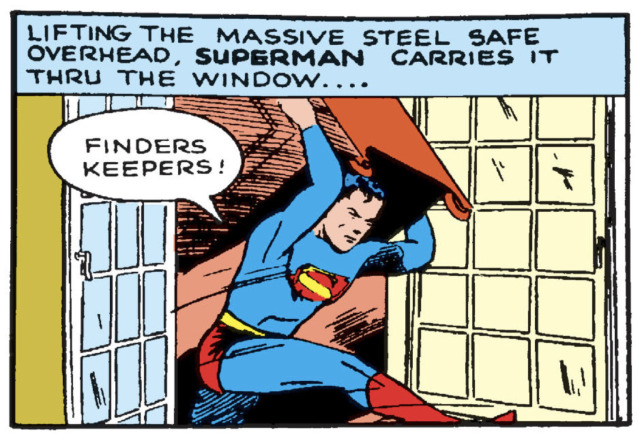
Even Superman had no respect for historical ownership
of things

Even outside of the specific circumstances above, the General Court noted that other factors, such as the origin of the sign at issue and of its use since its creation, the commercial logic underlying the filing of the application for the trademark, the reputation of the sign at the time of the registration, and the chronology of events leading up to that filing might be very relevant. 

The General Court then turned to the actual matter at hand. It initially noted that there is currently no registration for the "NEHERA" brand in the EU, and that the earlier Czechoslovakian trademark had lapsed in the 1940s and hasn't been used since. 

Interestingly Mr Zdut had been fully aware of the existence and reputation of Jan Nehera and of the old trademark in Czechoslovakia, and even had noted that he wanted to launch the brand to ‘pay a tribute’ to the ‘great days of the Czechoslovak textile industry of the 1930s’ and in particular to Mr Jan Nehera. 

Considering the law in light of the matter, the General Court set out that "[f]ree-riding behaviour with regard to the reputation of a sign or of a name… is, in principle, only possible if that sign or that name actually and currently enjoys a certain reputation or a certain celebrity". With that in mind, the EU courts have found an intention to take unfair advantage of the surviving reputation of an earlier mark, including where that mark was no longer used or of the current celebrity of the name of a natural person, where the surviving reputation or fame was established.  

In contrast to this position, there is no usurpation of the reputation of a term claimed by a third party and, therefore, no bad faith, where that term was neither registered, used, nor renowned in the EU. 

With that in mind, the General Court noted that in the absence of surviving reputation in respect of the former Czechoslovak trademark and of current celebrity in respect of Jan Nehera’s name at the time of filing, the use of the mark wouldn't be free-riding behavior indicating bad faith. Even though Mr Zdut knew of the individual and the original trademark, it isn't sufficient to establish the existence of bad faith. 

The interveners also highlighted an intention to create a link between the name and the new brand, but the General Court saw that this wasn't in itself sufficient to support a finding that unfair advantage was taken of the reputation of the sign or of the former name. 

The General Court also focused on the lack of a current reputation in relation to the old trademark or the name. As they noted, currently both have been forgotten by the relevant public, and the applicant had made considerable efforts to build up the brand again. This was far from merely parasitically taking advantage of an existing reputation. 

The General Court also determined that it is possible, in certain specific circumstances, that reuse by a third party of a previously renowned former mark or of the name of a previously famous person may give a false impression of continuity or of inheritance with that former mark or with that person. This can happen where the applicant presents itself to the relevant public as the legal or economic successor of the holder of the former mark, when there is no continuity or inheritance relationship. That could then be considered in establishing bad faith. However, no such intention was found in relation to Mr Zdut. 

In summary, the General Court found that the concept of bad faith presupposes the presence of a dishonest state of mind or intention, which they were unable to find in the present matter, and overturned the Board of Appeal's decision. 

The case is an important reminder for any brand owners (even historical ones), or their potential legatees, to make sure that those brands are properly registered if any use of the brand is ever even contemplated. If this isn't done it may present an opportunity for a third party to jump in and take over the brand, which could very well be fully legal and without much recourse down the line. It is possible that this matter will be appealed to the Court of Justice for an ultimate decision, but in the absence of that any dormant brands could very well be up for grabs. 

14 April, 2020

Mind Your Language! - CJEU Decides on the Registration of Offensive Trademarks

Rude language can be a sore point of contention for many people. The offensive nature of trademarks has been litigated quite a bit in high-profile cases recently, including the case regarding the band "The Slants" (discussed more here) in the US. The European courts have faced the question of offensive trademarks sometime ago, and Advocate General Bobeck looked at this in some detail in the Summer of 2019. Following the AG's decision, the CJEU has finally considered the question of offensive trademarks and handed down their judgment earlier this year.

The case of Constantin Film Produktion GmbH v EUIPO concerned an application to register the name "Fack Ju Göhte" (EUTM 13971163), which is the name of a German comedy film produced by Constantin. The film saw tremendous success in the year it was published, and Constantin released a subsequent two sequels under the same name. The EUIPO refused the application under Article 7(1)(f) of the CTM Regulation, which prevents the registration of trademarks "...which are contrary to public policy or to accepted principles of morality". Constantin then appealed the decision, which ultimately ended up with the CJEU.

The Court began by limiting the scope of the issue, following the guidance of the Advocate General, to only consider whether the mark was contrary to accepted principles of morality, as the matter didn't relate to any issues of public policy.

To consider the above, the Court noted that, to determine the scope of Article 7(1)(f) "...it is not sufficient for the sign concerned to be regarded as being in bad taste. It must, at the time of the examination, be perceived by the relevant public as contrary to the fundamental moral values and standards of society as they exist at that time". This clearly shows that the morality the courts will be concerned with is transient, and the standard can fluctuate as morality does within wider society; however, the examiner will have to consider it within a snapshot in time when applied for.

Mittens just couldn't handle Rover learning any more bad words
Furthermore, the Court saw that this would be determined according to "...the perception of a reasonable person with average thresholds of sensitivity and tolerance, taking into account the context in which the mark may be encountered and, where appropriate, the particular circumstances of the part of the Union concerned". This includes "...elements such as legislation and administrative practices, public opinion and, where appropriate, the way in which the relevant public has reacted in the past to that sign or similar signs, as well as any other factor which may make it possible to assess the perception of that public".

Reviewing the judgment of the General Court, the CJEU determined that they had misapplied the law concerning Article 7. In their assessment, the General Court should have included, among the things they considered, the great success of the comedy, the fact that its title does not appear to have caused controversy, as well as the fact that access to it by young people had been authorised and that the Goethe Institute (which promotes the German language abroad) uses the movie for educational purposes. The General Court should not have merely considered the inherent vulgar nature of the English phrase it was compared to, namely "Fuck You", to decide that the mark would be contrary to public morality.

The Court also noted that one would have to take into account the freedom of expression, enshrined in Article 11 of the Charter of Fundamental Rights of the European Union when considering any infringement of Article 7(1)(f). The General Court considered that this would not be the case, which the CJEU clearly did not agree with.

Following the dismissal of the General Court's decision the CJEU then moved onto consider the trademark in question under Article 7(1)(f).

The CJEU thought that, following a discussion of the Board of Appeal's decision, the title of a film need not be descriptive of its content in order to constitute a relevant contextual factor in assessing whether the relevant audience perceives that title and an eponymous word sign as contrary to accepted principles of morality. Additionally, although the success of a film does not automatically prove the social acceptance of its title and of a word sign of the same name, it is at least an indication of such acceptance which must be assessed in the light of all the relevant factors in the case in order to establish the perception of that sign in the event of use of that sign as a trademark.

As said above, the movie spawned a further two sequels with the same name, all of which have had great success, and is used in educational purposes, it goes to show that it isn't against the public morality in Germany. The Court did note that, however, the perception of the phrase "Fuck You" will be different between German-speaking countries and English-speaking ones, especially when dealing with a phrase written phonetically and inclusive of other words, such as the name Goethe.

The CJEU determined that the EUIPO has failed to demonstrate to the requisite legal standard that Article 7(1)(f) precludes registration of the mark applied for under the above grounds.

The case is a very important one and highlights the potential evidence looked for when determining whether a mark is contrary to public morality or not. The case also demonstrates that freedom of expression is very relevant in this exercise, which this writer agrees with since the remit of trademarks should by no means be exempt from freedom of expression even though one could describe it as "commercial expression" rather than traditional expression as you would commonly think of it.

23 July, 2019

I'm Offended! - Advocate General Bobeck Opines on When a TM is Contrary to Morality or Public Policy

Morality seems to be the topic of the day on this blog, having recently written about the US Supreme Court case relating to the registration of immoral trademarks. While this writer will is not by any means the 'morality police', it is an important topic to discuss, albeit unusually so in connection with intellectual property. Similarly to US legislation, many other jurisdictions prevent the registration of trademarks that contravenes morality, including in Europe. In the light of this, what makes a trademark contrary to morality, and when can the courts reject those marks? Luckily the CJEU is facing this very question, and Advocate General Bobeck gave his take on the matter very recently.

The case of Constantin Film Produktion GmbH v EUIPO concerned the registration of the name "Fack Ju Göhte" (EUTM 13971163) by the film company, which is a very successful German comedy. The company, naturally, wanted to register the mark due to this success, but the application was rejected by the EUIPO due to it being contrary to "accepted principles of morality". Constantin then appealed the rejection, which ended up going all the way to the CJEU.

A trademark application can be rejected under Article 7(1)(f) of the CTM Regulation if it is "...contrary to public policy or to accepted principles of morality". The Advocate General therefore had to opine on when a trade mark application is contrary to public policy or to accepted principles of morality, and what the relevant test is in determining that.

The first thing considered by the AG was the relationship between trademarks and the freedom of expression. The AG set out that, even though the registration of trademarks is a commercial activity by nature, it by no means limits the applicability of the freedom of expression to trademarks, and is further codified by the Regulation as a part of trademark law. He further set out that "…although freedom of expression, as well as other fundamental rights potentially at stake, must be taken into account in the overall balancing exercise, the protection of freedom of expression is not the primary goal of trade mark protection". One can agree with this, since trademarks, while clearly an important expression of a particular brand, are primarily focused on showcasing the quality of a product and ensuring its origin to the consumer; not to make statements for the sake of it.

The AG then moved onto consider the relationship between public policy and accepted principles of morality. In practice, the terms have been considered both interchangeably and separately, which leaves the option open for the CJEU to determine how exactly they should be considered.

In defining public policy, the AG set out that it means "…a normative vision of values and goals, defined by the relevant public authority, to be pursued now and in the future", i.e. the legislature's attempt to solidify the normative values of society at that time. Accepted principles of morality, however, are "…values and convictions currently adhered to by a given society, set and enforced by the prevailing social consensus within that society at a given time", which contrasts as a less guided sense of what is right, but how society at large feels about issues. The distinction therefore is a top-down v bottom-up approach to public morality, with the former being a more objective measure, and the latter a subjective one.

When relying on either one of the above grounds, the AG considered that the EUIPO must therefore establish, with references to the prevailing perception among the relevant public, why they believe that a given sign would offend those principles.

The AG considered that the public relevant to the matter at hand would be a general and German-speaking one, and that any public policy or morality considerations would have to be made in the light of that fact. Vulgarity in one language, here English, would not therefore necessarily be considered such by non-English speakers. Additionally, any assessment by the EUIPO cannot be made solely and exclusively looking at the word sign, in isolation from the broader societal perception and context, if any evidence for such exists.

In this matter the name "Fack Ju Göhte" was fully authorized to screen with the name by the German authorities with no age restrictions. They clearly therefore considered the name to not be vulgar; contrary to the findings of the EUIPO. This national context is important, which should be taken into account by the EUIPO. If the EUIPO wants to depart from this the standard of proof is raised, and in this case they failed to prove otherwise. The first ground of appeal consequently failed according to the AG.

The AG also criticized the EUIPO for a lack of consistency in its decision-making, and for failing to explain why this application's outcome was different to previous decisions (including in Die Wanderhure).

The opinion is very thorough and convincing, and it is very likely that the CJEU will follow the AG's well-reasoned view on the matter. Any rejections by the EUIPO over a contravention of morality should be consistent in their approach, and the CJEU's clarification will hopefully bring them to this outcome. This writer will wait for the CJEU's ultimate decision patiently.

06 February, 2019

McLoss - McDonald's Big Mac Trademark Revoked by EUIPO

It is not often when the 'little guy' wins in a court of law, particularly when coming up against more established and well-known brands and companies. This is even more monumental when the brand in question is near ubiquitous with an industry, namely McDonald's. Although the case has been very widely reported on in the IP community and the wider press, some nuance has been lost in the discourse on the case and what it ultimately means.

The case of Supermac's (Holdings) Ltd v McDonald's International Property Company Ltd concerned the trademark for the iconic Big Mac, which McDonald's had registered as an EU trademark in 1998 (EUTM 62638). Supermac's is an Irish fast food chain, which has been operating in Ireland since the late 1970s. After a prolonged legal fight due to the chain's name against McDonald's (unrelated to the revocation proceedings), Supermac's sought the revocation of the Big Mac trademark at the EUIPO Cancellation Division.

Supermac's argued at the EUIPO that the Big Mac trademark was not put to genuine use within the EU under Article 58 of the EU Trademark Regulation, which stipulates that "...if, within a continuous period of five years, the trade mark has not been put to genuine use in the Union in connection with the goods or services in respect of which it is registered" an EU trademark should be revoked.

What is key is that the Big Mac trademark was registered for a number of goods and services in classes 29 and 30 (covering food items), but also under class 42 for the provision of restaurant services.

The Cancellation Division first set out that genuine use requires "...actual use on the market of the registered goods and services and does not include token use for the sole purpose of preserving the rights conferred by the mark, nor use which is solely internal". Genuine use is assessed looking at all of the relevant facts and circumstances in establishing whether the commercial exploitation is real; however, this does not include commercial success or its scale.

Having reviewed an extensive amount of evidence filed by McDonald's, including affidavits, marketing and internet materials, the panel considered whether they demonstrated genuine use of the Big Mac trademark. Although a great deal of evidence was filed, the panel considered that it didn't prove the extent of the use of the trademark itself. this includes looking at "...the nature of the relevant goods or services and the characteristics of the market concerned, the territorial extent of use, its commercial volume, duration and frequency".

With regards to internet materials, McDonald's failed to submit evidence on the actual data relating to visitors, their locations and the time frame in which this was done. Similarly, the Cancellation Division considered that, although sandwiches using the trademark were demonstrated in the excerpts from the proprietor's website, it was not possible to order the items online (or information on total orders placed and their details if possible). Finally, while brochures were provided as evidence, details on their circulation were not provided to the panel. Clearly McDonald's failed to submit detailed evidence on the use of its trademark, even though common sense demonstrates that the trademark is used within the EU.

The Cancellation Division concluded that "...the evidence analysed above does not provide sufficient details concerning the extent of use; other than exhibiting the sign in relation to goods which could be considered to be part of the relevant goods, these materials do not give any data for the real commercial presence of the EUTM for any of the relevant goods or services".

The proprietor therefore failed to demonstrate that the products marked with the trademark are offered for actual sale, as there is no confirmation of any commercial transactions, either online, or via brick-and-mortar operations. The trademark was deemed to not have been genuinely used within the EU, and the panel revoked the mark.

Clearly the case is an instance of poor evidence selection and provision, and undoubtedly will be appealed by McDonald's to the EU Boards of Appeal. It only goes to show that even the biggest and most resourceful entities can fall foul of a lack of preparation and consideration of evidence. To McDonald's chagrin, their competitors are already taking advantage of the opportunity.

31 July, 2018

KitKat Cut - The KitKat Shape Trademark Ultimately Rejected by CJEU

The KitKat shape trademark saga has been detailed on this blog in great detail, going back several years (e.g. here, here and here). The fight over the chocolate bar shape seems to have gone on forever, and this writer thought he would be old and grey before the matter ultimately concluded. After Advocate General Wathelet's opinion in April, the CJEU has finally taken the matter on, and the decision will decide the fate of the current KitKat shape registration.

While the facts of the case have been discussed extensively, it is still useful to recite the basics to anyone not familiar with the background. The case of Société des produits Nestlé v Mondelez UK Holdings & Services concerns the registration of the shape of the KitKat chocolate bar (EUTM 2632529), owned by Nestle. Cadbury challenged the registration, seeking to invalidate it, with the matter ending up with the CJEU 11 years later.

The case revolves around Article 52(2) of the CTM Regulation, which allows for the registration of marks that have acquired distinctiveness through the use of the mark in conjunction with the goods or services. The distinctive character of the mark has to exist in the entirety of the EU for it to avoid invalidation.

What underpinned the matter was whether evidence has to be proved for the entirety of the EU, and not just a select sample of countries. In the case of August Storck KG v OHIM, the CJEU saw that a mark can be registered under Article 7(3) (which has to be read in conjunction with Article 52 above) "…only if evidence is provided that it has acquired, in consequence of the use which has been made of it, distinctive character in the part of the [EU] in which it did not, ab initio, have such character". If no distinctiveness exists in relation to the mark from the very beginning, acquired distinctiveness would have to be shown in the EU.

When it comes to acquired distinctiveness, the Court emphasised that, for any mark devoid of inherent distinctiveness, "…evidence be submitted, in respect of each individual Member State, of the acquisition by that mark of distinctive character through use, the evidence submitted must be capable of establishing such acquisition throughout the Member States of the European Union". Evidence therefore does not have to be produced for each individual Member State, but can be produced in a way that shows acquired distinctiveness due to proximity in geography, culture or linguistics, and therefore acquired via another Member State even in the absence of evidence for that particular Member State.

The assessment of whether the evidence produced is enough to give the mark acquired distinctiveness in the EU is a matter for the EUIPO or its appellate courts in any given case.

The CJEU agreed with the General Court's decision, which rejected the argument by Nestle that the evidence covered the entirety of the EU, or a substantial part of it, leading to sufficient coverage. The Court therefore rejected all of Nestle's appeals, and the mark was invalidated.

The decision is a huge culmination of years of litigation, but by no means is the end of the KitKat shape trademark. While evidence was lacking for the current registration with regards to Belgium, Ireland, Greece and Portugal, Nestle are still within their rights to apply for a new registration, producing evidence to cover any missing Member States. Due to the clear monetary value of the mark, it is clear that Nestle will pursue to register the shape one way or another; however, this might just be the beginnings of a reboot for this particular litigation series

25 July, 2017

Seeing Red - Registration of Red Shoe Sole Potentially Invalid, Says AG Szpunar

The color of a product or a logo can often be just as memorable as its shape, design or quality. When you think of a Coca Cola bottle, do you think of the color red? If you see a chocolate bar draped in purple, do you think of Cadbury? Colors are a great differentiator, and the more striking the color the more you tend to probably remember it. That's why many companies register a particular color as a trademark in relation to their goods or services, protecting that very association from competitors. In a similar vein, could you register a trademark that incorporates a color with your product, for example in conjunction with a shoe? A recent case involving this has been going through the European courts, and the Advocate General has finally given their two cents on the matter ahead of the CJEU's decision.

The case of Christian Louboutin SAS v Van Haren Schoenen BV concerns the registration of a mark in Benelux by Louboutin, comprising of a high-heel shoe with a red sole. Only the sole was registered. Van Haren made and sold similar red-soled shoes, and upon identifying this, Louboutin took the company to court for trademark infringement. Van Haren challenged the infringement opposing the mark's registration, claiming invalidity. Having made its way through the Dutch courts, the case ultimately ended up with the CJEU, and prior to their judgment Advocate General Szpunar aimed to give the court guidance on the issue.

The question referred to the Court was "[i]s the notion of ‘shape’ within the meaning of Article 3(1)(e)(iii) of Directive 2008/95... limited to the three-dimensional properties of the goods, such as their contours, measurements and volume (expressed three-dimensionally), or does it include other (non three-dimensional) properties of the goods, such as their colour?" In essence, the question asks whether a 'shape', as defined in the Directive, can include colors as well as the actual three-dimensional shape of an object.

The Advocate General first considered the classification of the mark and its impact on the registration. He determined that the classification of the contested mark is a factual assessment to be made by the referring court. That consideration does not prevent the CJEU from making remarks which may guide that court in making its assessment. He also saw that the classification of the goods does not necessarily have any legal consequences regarding the goods. Even if the mark is a 'position mark', which some parties argued it was, it doesn’t prevent that mark from consisting of the shape of the goods (i.e. the color). He then concluded that "…it is for the referring court to determine whether the mark at issue in the present case is a per se colour mark or a mark consisting of the shape of the goods, but also seeking protection for a colour".

To determine whether the mark is a color mark per say, or consists of the shape of the goods, as defined in the Directive, the Advocate General set out the test as "…the referring court should carry out an overall assessment, taking into account the graphic representation and any descriptions filed at the time of application for registration, as well as other material relevant to identifying the essential characteristics of the contested mark, where applicable". One would also have to account for whether the mark was registered as for the color only, or if the shape was incorporated in the registration as a part of the color.


The CJEU could impede Cindy's new color schemes 
The Advocate General rejected that the color, albeit restricted from applying to a particular shape, would not in itself limit the mark to simply a color mark. Instead "…what must be determined is whether the sign derives its distinctive character from the colour in respect of which protection is sought per se, or from the exact positioning of that colour in relation to other elements of the shape of the goods". Therefore the Advocate General accepts that it is possible for the mark to apply to the position of the color as well.

When considering the actual mark that was registered, the Advocate General saw that, even though the contours of the shoe were not a part of the registered mark, its placement on the shoe was very relevant. The mark sought to protect simply a red sole on any high-heeled shoe, irrespective of its shape. He finally thought that "…[t]he contours of the sole appear in any event to be a negligible element of the mark, which derives its distinctive character from the unusual positioning of the coloured element and, potentially, the colour contrast between different parts of the shoe".

Although the Advocate General considered that the mark, at least on the outset, would be one that consists of a shape in conjunction with the color, he still aimed to analyse both possible outcomes in more depth.

Firstly, whether the mark consists of a color per say. As established in previous cases, colors per say don't have distinctive character; however, they may become distinctive through use. The registration, even so, shouldn't prevent other proprietors from using the color for goods of a similar type. The Advocate General ultimately concluded that "…if the contested mark were to be classified as a ‘mark consisting of a colour per se’, it would be appropriate to hold that it did not fall within the scope of Article 3(1)(e)".

Secondly, whether the mark consisting of the shape of the goods and of a certain colour. The Advocate General set out that, to answer whether a mark consists of both the shape and the color applied to it, one has to heed the logic and scheme of Article 3(1)(e), i.e. to prevent the registration of marks that would impede fair competition. The Advocate general considered that any shape that incorporates color in the mark would have to be analysed under Article 3(1)(e) as a part of the overall assessment of the sign. This would apply even under the new Directive.

He concluded that "… Article 3(1)(e) of [the] Directive… does potentially apply to signs consisting of the shape of the goods which seek protection for a certain colour". The mark in question would also be, in his view, potentially caught by the Article and therefore invalid. He also observed that, while the color potentially does add value to the mark (and potentially falls under Article 3(1)(e)(iii)), the value added only relates to the intrinsic value of the shape (for example, is it commonly used and therefore valuable) and not the reputation of the proprietor or the mark.

The Advocate General clearly sets the stage for the CJEU to find that color marks applied to a particular shape would be invalid, as the protection of a color to an indeterminate amount of soles could prevent fair competition. Less conventional trademarks could be hindered by a negative decision by the CJEU, and it remains to be seen how they navigate this paradigm in the light of the expansion of registrations through the new Directive 2015/2436. Should the shape be taken into account the mark could survive, but it looks like Louboutin might have to simply rely on their goodwill in passing off in the future.

18 May, 2017

Get a Grip - CJEU Decides on 'Hybrid' EUTMs With Technical and Decorative Features

The registration of trademarks can be quite finicky, especially when it comes to the nuance of graphical representation and what it covers (the Trunki case being a poignant reminder in the UK of the same in registered designs). One has to distinguish between the decorative and functional or technical features of the registration, without which your mark could be under threat for invalidity. After a lengthy battle in the EUIPO, spanning nearly 20 years, a case dealing with the same subject matter has faced its ultimate decision in the CJEU.

The case of Yoshida Metal Industry Co. Ltd v EUIPO dealt with the registration of a trademarks for the design of a knife handle by Yoshida (marks 1371244 and 1372580), which comprised of a metal handle with black dots in the handle (signifying circular indents in the metal). The marks were ultimately registered by the EUIPO; however, the decision was challenged by Pi-Design AG and Bodum. Having lost at the Board of Appeal and the General Court, Yoshida finally appealed to the CJEU.

Yoshida's arguments hinged only on the infringement of Articles 7(1)(e)(ii) and 51(3) of the Community Trade Mark Regulation.

Under Article 7(1)(e)(ii), a trademark cannot be registered if "signs which consist exclusively of… the shape of goods which is necessary to obtain a technical result". Case law, particularly in the LEGO decision, has noted that a shape cannot be rejected solely on the ground that it has functional characteristics. The dots used in the handles were, according to Yoshida, a hybrid mark, having both aesthetic and functional characteristics, therefore remaining registrable under Article 7.

The CJEU considered that, in adopting the wording used in Article 7 above, the exclusion of marks solely on their technical result or nature would be contrary to the law's intention, and clearly intends for marks that only incorporate the technical result and no aesthetic component to be unregistrable. Similarly, the introduction of one or more minor arbitrary elements in a sign, all of whose essential characteristics are dictated by the technical solution to which that sign gives effect, won't alter the conclusion that the sign would only achieve a technical result. Even so, a mark can still be registered if the sign incorporates major non-technical elements that play an important role in the shape of the sign.

Some sharp wit
The Court determined that "...the fact that the sign concerned has ornamental and fanciful aspects does not preclude the ground for refusal under Article 7(1)(e)(ii)... from applying, in so far as those aspects do not play an important role in the shape of goods at issue, all the essential characteristics of which must perform a technical function". In short, even if the sign has ornamental aspects along with the major technical features, it can still be rejected. This follows the decision by the General Court, who saw that Article 7(1)(e)(ii) applies where all the essential characteristics of the sign perform a technical function. The CJEU therefore rejected Yoshida's appeal under Article 7.

The second argument on appeal was under Article 51(3), which excludes particular goods and services applied for only if the invalidity grounds apply to those goods and/or services exclusively. Yoshida argued that the General Court had failed to consider Article 7 as above for all of the goods and services in question (particularly in relation to those that lacked handles, i.e. whetstones, and kitchen utensils and containers).

The Court swiftly despatched this argument, as Yoshida had neglected to bring the argument forward earlier during the proceedings, particularly at the stage when the consideration over the relevant goods were made. They had only limited themselves to the above argument under Article 7, ignoring Article 51 entirely. The CJEU therefore rejected the second argument simply for a lack of raising it at the General Court, barring them from arguing it at the CJEU.

The case brought up a very interesting argument, albeit a flawed one when looking at the wording of the Regulation. The CJEU's decision make sense, since, if Yoshida's argument were allowed, the introduction of any non-technical features to a sign could then avoid the limitation of registering those types of features. As long as the important parts of the sign registered for are the ones that create the technical feature, the mark should not be registered. This writer is sure that both Yoshida and Bodum are happy the case is over, even if the decision didn't swing their way.

13 January, 2017

Not Taking a Break - EU General Court Sends Kit Kat TM for Reconsideration at EUIPO

The Kit Kat chocolate bar trademark saga is one that seems to just keep on giving and giving to the IP community, offering new and fangled ways where the iconic (or dare we might now say the opposite) chocolate bar has been fought over in Europe. After a hard-fought several rounds in the CJEU and the UK courts, it all seemed all over; however, the EU General Court offered us a new judgment as an early Christmas present in mid-December.

The case of Mondelez UK Holdings & Services Ltd, formerly Cadbury Holdings Ltd v EUIPO dealt with an EU registered trademark (2632529) for a three-dimensional mark comprising of the Kit Kat chocolate bar without any markings. The mark was subsequently challenged by Nestle's favorite candy competitor, Cadbury (now owned by Mondelez), and the matter has since ultimately ended up in the General Court, largely dealing with lack of use and distinctive character.

The GC only concerned itself with Article 52(2) of the Community Trade mark Regulation, in conjunction with Article 7(3), which set out that a trademark, even if potentially found invalid, might still be registrable should the mark have acquired a distinctive character with respect to the goods and services covered. Mondelez argued that the EUIPO had failed to correctly assess this distinctive character (allowing the mark to be registered), and directed their argumentation in four separate parts.

The Court initially dealt with the second part of their plea argues that the mark had not been used for all of the relevant goods it was registered for. The Board of Appeal had seen that, based on the evidence submitted, the mark had been used for all of the goods listed above. This assessment, according to the GC, would be done "...in relation, on the one hand, to the goods or services in respect of which registration has been sought and, on the other, to the presumed perception of the mark by an average consumer of the category of goods or services in question, who is reasonably well informed and reasonably observant and circumspect". Any proof employed would have to be viewed independently within the context of sub-sections within the broad terms of goods to identify whether the mark has been used for those goods.


Gilbert always forgot what his chocolate bars looked like

Under the evidence supplied, the GC did concede that the Kit Kat mark had been used for the majority of the goods listed; however, saw that it had equally not been used for bakery products, pastries, cakes and waffles, since the advertising materials only showed biscuit-like, chocolate treats with no real bakery goods included at all. This was deemed an error on the part of the Board of Appeal.


The first part of the plea dealt with a lack of use of the mark in the form as registered, and therefore would only stem from the branding or the use of other marks in conjunction with the contested mark. The EU courts have previously held that a 3D mark can acquire distinctive character even if used with other marks, as long as the public distinguishes the product from originating from a particular source as a result. The GC quickly rejected this argument, as surveys indicated a high percentage of individuals identifying the brand from just the shape alone.

They then moved onto the third part of the plea, which argues that there is a lack of use of the mark as an indicator of origin and insufficient evidence to that effect. The latter point would be assessed based on evidence showing that a significant portion of the public identifies the mark as an indicator of origin, which entails in it several factors, including market share and duration of use. The GC rejected this argument as well, having extensively discussed the evidence submitted and its application to the matter at hand, illustrating a clear recognition of the mark as an indicator of origin for those particular goods, and that it was sufficient to overcome this plea.

Finally, the fourth part of the plea asserted a lack of proof of distinctive character acquired through use of the contested trade mark throughout the European Union. Mondelez contested that, as Nestle only provided evidence with respect to 10 Member States out of 15, the Board of Appeal should not have extrapolated from that evidence applicable to the entire EU (with the Board only finding evidence of distinctive character for 5 being sufficient for the whole of the EU). According to established EU case law, a mark needs to have distinctive character in the whole of the EU, and would fail to be registered should it not have it for a part of the EU, even one single Member State. Evidence provided needs to be quantitively sufficient to prove distinctive character in the Member States concerned. The GC corrected the Board of Appeal's approach in assessing this, and set out that "…the relevant question is not whether it was shown that a substantial proportion of the public in the European Union, merging all the Member States and regions, perceived a mark as an indication of the commercial origin of the goods designated by that mark, but whether, throughout the European Union, it was proved that a significant proportion of the relevant public perceived a mark as an indication of the commercial origin of the goods designated by that mark".

The GC allowed this part of the first plea, determining that a lack of evidence for the rest of the Member States would mean that the mark has not been established to have distinctive character in the entire EU, and the registration is therefore invalid and would have to be re-examined.

The case is a very curious one, and highlights a potential big issue for applicants when it comes to evidencing the distinctive character in the entire EU. With surveys and other evidence gathering exercises being costly both monetarily and time wise, and newer launches in other territories being a hindrance for proving distinctive character. In the end, the threshold should be high; however, this writer would be a firm believer in statistics, especially for more notable, established brands, and would want more flexibility at the EUIPO (although, understanding the risks associated with giving away trademarks like candy). It will remain to be seen whether the case is appealed, and this writer would not want to see the fight for chocolate bars to ever end.

Source: Reuters

10 November, 2016

Ringing Hollow - Ringtone Trademark Rejected by EU General Court

Since the introduction of the new Trade Mark Regulation No 2015/2424, this writer for one has been awaiting the inevitable landslide of unusual trademark registrations, particularly for sounds and even smells. While this rush has yet to materialize, some attempts have been made, and quite recently one of those applications ended up in the EU General Court. This writer laments his lateness in relation to this case; however, it is interesting enough to have to be discussed even a month or two after the fact.

The case of Globo Comunicação e Participações S/A v EUIPO concerned the registration of a mobile phone ringtone by Globo for goods and services in classes 9, 16, 38 and 41, covering a wide array of tangible and intangible goods (the musical notation for the sound can be viewed here). The mark was rejected by both the Examiner and the Board of Appeal for a lack of distinctive character under Article Article 7(1)(b) of the old Trade Mark Regulation No 207/2009. The matter was subsequently appealed to the General Court, who handed down their judgment in mid-September.

The first matter dealt with by the General Court was a simple procedural point, where Globo argued that no reasons were given by the Board of Appeal as to why the mark was rejected under Article 7(1)(b). While the Court acknowledged that the Board of Appeal does have a requirement to state their reasons for rejecting a mark, this was not omitted in the case at hand, as the reasons issued (namely on the banality of the sign with regard to the relevant goods or services) and their correlation with the classes was clearly given, even if regarding all of the classes of goods as a whole. A single conclusion did not result in reasons only being given to one class, but all classes summarily.

The Court then moved onto the meat of the matter, namely whether the mark infringed Article 7(1)(b) through a lack of distinctive character. Globo argued that, contrary to previous findings, the brevity or the simplicity of the sound in question should not impact the assessment of its distinctive character. 

Some combinations of notes are a little less simple
As with 'traditional' marks, the assessment of distinctive character is based on the goods or services in respect of which registration of the mark is sought and to the relevant public’s perception of that mark. While this is much more straightforward in word or image marks, as observed by the Court: "...although the public is used to perceiving word or figurative marks as signs which identify the commercial origin of goods and services, the same is not necessarily true when the sign consists solely of a sound element". Arguably it is much more difficult to build an association with a sound, but a good example of a an arguable successful campaign to do so is the whistle adopted by McDonald's in their TV advertising.

The unfamiliarity of peoples' perceptions on sound marks is also added to by the classes of goods or services the mark is registered for. The use of sound marks in TV, for example, would lead to a much higher likelihood of consumer identification and association, while physical media does not lend itself to this perception. The Court explained that "...as regards certain goods and services linked, in particular, first, to tools for communicating or entertaining by means of television broadcasting or radio broadcasting and to telephony and, secondly, to IT media, computer software or to the media sector in general, sound elements, such as jingles or melodies, are used in order to enable the product or service at issue to be identified aurally as coming from a particular undertaking". Consumers would therefore have to perceive the sound as indicating a particular brand of goods or services via these mediums.

The Court found that, a sound that only consists of merely a banal combination of notes would not be perceived as referring to any particular brand, as it would cause a 'mirror effect', meaning it only refers back to itself. Following this, the General Court considered whether the sound in the mark in question would be distinctive, and found that it isn't, as the simple two note combination would only "...be perceived by the relevant public only as a mere function of the goods and services covered and not as an indication of their commercial origin". This was further exasperated by the excessive simplicity (only sounding like an alarm or a telephone ringing) and only therefore refers to itself, rather than the goods or services in was applied for. The Court concluded that the Board of Appeal did not err in their findings and dismissed the appeal.

The case shows the difficulty in the registration of simple sound marks, especially ones that are not 'jingle-like', i.e. serve as a longer, more distinctive part of a product or show for example. It will be interesting to see how the change in the requiremet of graphical representation changes things; however, as the sound was played in court, it seems unlikely that the addition of a playable example would sway the pendulum the other way.

Source: Ars Technica

19 October, 2016

In the Shadows - A Silhouette Image is Not a Registrable Trademark, Says EU General Court

Images can evoke powerful feelings, associations and preconceptions, especially when paired with particular goods that aim to enhance our lives or even our own well-being. With the health supplement market reaching a staggering $19 billion in 2015, even a small slice of that pie can make any product a huge success monetarily. As the market has grown this competitive, so have the efforts of product manufacturers to distinguish their goods from the rest, including through the use of trademarks and distinctive names. As the products are often, arguably at least, quite similar in functionality and marketing, can one expect to register something simple as, say the silhouette of a body builder, in conjunction with protein supplements? In a recent decision the EU General Court aimed to tackle this problem, and to potentially narrow or widen the scope of these types of marks in the EU.

The case of Universal Protein Supplements v EUIPO dealt with an application to register the silhouette of a body builder by UPS as a EU trademark (using the same image as their registered trademark 11827599), specifically in classes 5, 25 and 35, covering, among others, clothing, nutritional supplements and online retails store services for nutritional supplements. Following UPS' application both the initial examiner and the Board of Appeal rejected the mark, refusing it under both Article 7(1)(b) and (c) of Regulation No 207/2009. USP appealed both decisions, and ultimately ended up in the EU General Court, which handed down its judgment nearly three weeks ago.

Body-building is rough, even with supplements
The General Court first started by assessing whether the mark was only indicative of, among other factors, quality, quantity, intended purpose, value, geographical origin or the time of production of the goods, under Article 7(1)(c). To further expand on this, the provision aims to allow all producers of goods to use certain common indicators of quality and origin, so as to enable proper competition in a particular area of commerce. These indicators also don't serve as proper indicators of origin, allowing for consumers to purchase the same quality product (or in the inverse, avoid the same) knowing fully where it comes from per the marks used. This means that, for a mark to avoid Article 7(1)(c) "...there must be a sufficiently direct and specific relationship between the sign and the goods or services in question such as to enable the public concerned to perceive immediately, without further reflection, a description of the goods and services in question or one of their characteristics".

The Court quickly determined that, in relation to all of the goods in the above classes, the mark was descriptive of those goods, as they related to body-building and were clearly designed for the very same. They added that "...it is common knowledge that drawings and photos of body-builders posing are often reproduced on the products themselves or in advertisements in order to indicate the intended purpose of the goods and services at issue, all relating, in particular, to the practice of body-building". One can appreciate this rationale, since the use of body builders, whether in silhouette form or not, is quite common in body-building and goods associated with it. It is arguable that, as there are plenty of other marks that use the same style of silhouette which have been registered, that the mark should be, potentially, registrable as well.

To summarize their position, the General Court concluded that "...informing the relevant public that the goods and services concerned are made or adapted for body-building, the mark applied for has a sufficiently direct and specific link with nutritional supplements, clothing, footwear, as well as online retail store services of those goods and goods related to health and diet", and the mark therefore fell foul of Article 7(1)(c).

The Court rejected the assertion that a silhouette could not be descriptive of goods as a style of mark, especially when the characteristics of the silhouette are clear and indicative of a body-builder. Also, the mark, although not highly detailed, doesn't require any mental effort from the public that perceives it, making a connection with body-building easily. Finally, although a silhouette of a body-builder can be, in many ways, a very variable style, it still does not mean the silhouette would not be descriptive, even with the possibility of several similar signs distinguishing similar goods successfully. The General Court ultimately rejected the appeal.

While the case is by no means revolutionary, it does illustrate a need to be careful in the choice of marks for specific goods, especially when the depiction could be closely linked to the goods at hand (by way of example, a bar bell could've just as well been descriptive here). Trademarks are a fickle mistress, as many similar marks to the one in question have been successfully registered, and applicants therefore have to be doubly careful with the marks that they choose to use.