Showing posts with label american. Show all posts

27 October, 2014

Retrospective - Copyright in Video Games

If you're oblivious to gaming and the strong attraction that a virtual world has on today's people, you will have missed arguably one of the biggest changes in the entertainment landscape since the emergence of the TV. With this great appeal comes great monetary worth, and something which is very desirable to protect, especially on part of the creators of very popular gaming titles. The difficulty in the protectability of video games stems from their complexity and in the fact that most popular games emulate one-another within certain genres of games, making them quite similar to the casual observer. Where does a game's protectability start from and where does it end? This question was answered first when gaming was in its infancy, but still remains quite relevant in today's world of gaming and law.

The case in question was Atari v North American Philips Consumer Electronics, decided by the United States Court of Appeals in 1982. The case dealt with the well-known game Pac-Man, created by Atari and Midway in the sunrise of the 1980s, which sold a staggering (at the time at least) 7 million copies. In the wake of Pac-Man's popularity a similar game, K. C. Munchkin, was created by North American Philips. Due to the incredibly similar styles and mechanics of both games Atari sued North American for copyright infringement, which ultimately was decided by the US Court of Appeals 7th Circuit.

The court initially described the copyrighted work in question, which, to the uninitiated, consists of a maze-like playing area, where the player controls the Pac-Man creature, moving him through the maze collecting pellets and fruits, accumulating points as they go. In addition to this the game contains four characters which pursue the main character, often called ghosts, which try to touch Pac-Man, thus 'killing' the character and having the player lose a life. Pac-Man has the capability to fight back, however, through the consumption of bigger pellets, enabling him to eat the ghosts and thus collect more points and avoid losing lives for a brief period of time. K.C. Munchkin is incredibly similar in its design, with a maze-like playing area, four ghost-type pursuers and the collection of pellets, bigger pellets and fruit. Its board design is slightly different, with the maze being slightly taller, and containing hazard elements such as dead-ends, with a slightly different shaped corral area for the ghosts than in Pac-Man. Finally, K.C. Munchkin contains far less pellets in the playing area, and uses a different style to the look of its main protagonist.

After initial discussion relating to the facts of the case the court turned its attention to the meat of the question; whether a game can be a subject matter protected under copyright, and whether the defendant's work infringed upon that work. The former is a much more straight-forward application of copyright law, yet the test for infringement of that work, if found to be copyrightable, is, as stated by Justice Wood: "...whether the accused work is so similar to the plaintiff's work that an ordinary reasonable person would conclude that the defendant unlawfully appropriated the plaintiff's protectible expression by taking material of substance and value". This test only applies to the parts of that work, which are deemed protected, and not any other included parts, even if infringed.
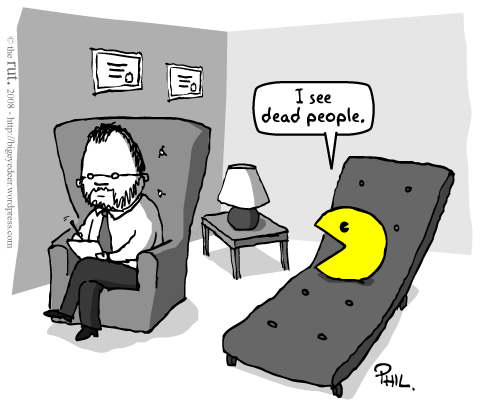
Even game characters have their issues (Source: The Rut)
As decided in Chamberlin v Uris Sales Corporation: "...copyright protection does not extend to games as such". One has to observe that, even if copyright does not subside in games as such, it still can protect parts of those games, not the 'idea' of a game. At the heart of it, the assessment is an assessment of whether what is sought to be protected is merely an 'idea' or the expression of that idea, which is quite protectable. Should the expression and the idea be nearly indistinguishable from one-another, i.e. it is not possible to express said idea in more ways than one, it is difficult to afford protection for that expression. This was well iterated by Justice Browning in Kalpakian: "[w]hen the "idea" and its "expression" are thus inseparable, copying the "expression" will not be barred, since protecting the "expression" in such circumstances would confer a monopoly of the "idea" upon the copyright owner free of the conditions and limitations imposed by the patent law".

Could you therefore protect the 'idea' of Pac-Man as a game? The court did not see much difficulty in answering this question, quickly determining that the work is mostly not protectable; however its components could very well provide "...new or additional [things] over the idea". How the game is displayed, in graphics and music for example, allows for those particular elements to be protectable, yet the 'idea' of a game where the protagonist is chased in a maze cannot be by itself.

An important point raised by the court in the case are certain elements in the game (or games in general), which can be viewed as scenes a faire, or as explained in Alexander v Haley "...incidents, characters or settings which are as a practical matter indispensable, or at least standard, in the treatment of a given topic". The maze and the score boards can be said to be indispensable to games such as Pac-Man, and arguably others, and thus not protectable. K. C. Munchkin was viewed by the court to have no infringed those designs, and to have been sufficiently different in its expression. What the court saw infringing Pac-Man's copyright was the character design within K. C. Munchkin. They had copied both the protagonist and the antagonist ghosts nearly identically, infringing on Atari's copyright in the expression of those ideas. Even if slight differences still existed, they will not by themselves preclude the finding of infringement. The court ultimately saw that "[a]lthough not "virtually identical" to PAC-MAN, K. C. Munchkin captures the "total concept and feel" of and is substantially similar to PAC-MAN". The court therefore reversed the previous decision and agreed to grant an injunction against K C. Munchkin.

Similar thoughts have been echoed in the UK, illustrated by cases such as Nova Productions Ltd v Mazooma Games Ltd, where the protected subject matter in a game was deemed to be the expression of the idea of a game, and how a game plays was seen as something which can be copied, as long as the visual and audio of that game was not.

What the above case illustrates is the initial considerations of video games as a protectable subject matter under copyright. As technology advances more and more, and games have surely come a long way since Pac-Man, the differentiation of what is copyrightable in a game and what isn't could be said to become more difficult. Even so, this case remains an important landmark in the development of the area, and shows that even dot eating circle creatures can be an expression worth protecting.

28 June, 2014

Aereo's Streaming Service Infringes Copyright, Says Supreme Court

Having discussed the Aereo saga quite extensively through its litigation life cycle (speculation on the Supreme Court decision can be found here, discussion on the District Court decision here), this writer for one bated his breath waiting for the US Supreme Court decision on the case. Arguably the outcome of the Justices' deliberation is important, especially as the Internet is slowly overtaking traditional means of media distribution all over the world. Netflix alone has over 30 million subscribers, showcasing how the paradigm is shifting towards a more convenient, on-demand consumption of media. In the end the final word was the Supreme Court's.

For the uninitiated, the American Broadcasting Companies Inc v Aereo Inc case dealt with the web-based service Aereo, which offered, for a subscription fee, the streaming, recording and live watching of TV programming. This was done on an individual basis, and relied on the subscribes' request to watch a given show, live or not. Subsequently several broadcast companies objected to this as the service potentially infringed on their copyright, and took Aereo to court. Initial judgments have gone Aereo's way, and the final word fell on the Supreme Court.

The question for the court boiled down to whether Aereo's service was a public performance of copyrighted works under 17 USC section 106, or in other words a transmission of a performance, and as such, infringed the provision. In the vein of the historical decisions of Fortnightly and Teleprompter, the court equated Aereo's service to those of cable providers, with Justice Breyer (in the majority's opinion) stating that "[t]he subscribers of the Fortnightly and Teleprompter cable systems also selected what programs to display on their receiving sets... The same is true of an Aereo subscriber". Through this likeness the court decided that Aereo was indeed performing for the purposes of the provision, and Congress' intent was to prevent just that with the amendments after the aforementioned cases. The latter part of whether this performance was public remained in the Justices' deliberation.

Justice Breyer's decision assessed whether the performance was a transmission to the public mostly through the court's view on Congress' legislative intent, largely ignoring technological differences of the transmissions. Whether the transmissions are made to individuals makes no difference as "...the members of the public capable of receiving the performance... receive it in the same place or inseparate places and at the same time or at different times", which does not make a difference to whether it is to 'a public'. As long as several people have the potential to watch those programs, the transmission is to a public within the scope of the provision.

Sharon was distraught after the decision
Justice Breyer summarized the judgment well: "...having considered the details of Aereo's practices,we find them highly similar to those of the CATV systems in Fortnightly and Teleprompter. And those are activities that the 1976 amendments sought to bring within thescope of the Copyright Act. Insofar as there are differences, those differences concern not the nature of the service that Aereo provides so much as the technologicalmanner in which it provides the service. We conclude that those differences are not adequate to place Aereo's activities outside the scope of the Act". Aereo therefore infringed the copyright of the TV broadcasts it transmitted, and was held liable.

Justice Scalia in the dissenting opinion saw things differently, and equated the service to more of a library card rather than an on-demand video service, as users access freely available content through a small antenna. The service is not automatic, and wholly relies on the user, furthering Justice Scalia's opinion. He outright rejects the majority's opinion on Aereo's potential performance, stating that "...Aereo does not “perform” for the sole and simple reason that it does not make the choice of content. And because Aereo does not perform, it cannot be held directly liable for infringing the Networks’ public-performance right".

The majority's opinion is an odd one, at least from the stand-point of argumentation. It relies heavily on Congress' intent, rather than the wording of the provisions. As was presented by Mitch Stoltz from SCOTUSBlog: "...the majority’s approach in Aereo transformed interpretation of the transmission clause into a common-law-style exercise in judicial discretion", leaving the provision very open to future application. Mr. Stoltz further argues that "[t]he opinion sets out guidelines that more closely resemble the open-ended fair use analysis, or perhaps the proximate cause analysis in a tort case", which one can wholly agree with. The future of the Transmit Clause remains less certain after the ruling, and its future effects on Internet service like Aereo will remain to be seen. Aereo for one will have to take steps and modify its service to remain usable.

Source: The Verge

22 June, 2014

Thoughts on the Cancelled Washington Redskins' Trademarks

After having discussed what is inappropriate in trademarks a few months ago, the topic has since emerged in the global trademarks discussion after an update regarding the often debated Washington Redskins mark emerged. The discussion has largely focused on the reasoning of the US Trademark Trial and Appeal Board, and has yielded a certain level of hyperbole and misinformation regarding the mark and trademarks in general. It is because of this this humble writer thought it would be appropriate to expand more on what has happened and what the decision's impact truly is.

In the decision issued a few days ago, the TTAB cancelled the trademark "REDSKINS" (and five other marks) as a result of an appeal proceeding brought over by several Native American appellants who argued that the mark was disparaging to Native Americans, violating 15 USC 1052. The court found that at least 1/3 of Native Americans found the mark disparaging, satisfying the requirement under section 1052. As such the marks were cancelled; however this is not the end of the matter entirely.

Even after the mark has been cancelled the organization retains the rights in the marks during any appeal processes; something which Bob Raskopf, the trademark lawyer for the Redskins, has indicated they will do. Outside of the marks' registration the organization will still enjoy ample protection under both common law and federal legislation. Under 15 USC 1125 any person using of a mark to confuse the consumer as to its origins or quality, causing damage to the original user of that mark, can be held liable under the provision for damages resulting from that use. As such the Redskins could easily prevent the use of its mark even if their marks are cancelled. Under common law a mark is protectable through its use, or as was stated by Justice Pitney in United Drug Co v Theodore Rectans Co: "...the right to a particular mark grows out of its use, not its mere adoption; its function is simply to designate the goods as the product of a particular trader and to protect his good will against the sale of another's product as his". Through their extensive use of the Redskins mark since the team's beginnings in the 1930s, the team can protect the mark even outside of federal registration. This is highly important, and often forgotten.

A less offensive alternative?
It was however pointed out by Richard Biagi, a partner at a US intellectual property law firm, that: "[o]ne interesting twist is that owning a trademark registration is a requirement by Department of Homeland Security/US Customs in order to impound counterfeit goods entering the  US... So, it is possible that an overseas manufacturer of knock-off apparel or souvenirs bearing the REDSKINS mark could get their products through customs without any trouble – however, that still doesn't prohibit the NFL from suing the manufacturer for trademark infringement". A minor quibble, but worth mentioning in conjunction with the case.

As one can see the effects the decision potentially will have are minimal, at least in terms of the marks protection. The mark will be very much alive and worth protecting; however the negative perception of the mark and the team could damage its monetary worth. In addition 50 US Senators have put some pressure on the team to change its name in a recent letter to the NFL Commissioner Roger Goddell, further exasperating the team's current situation. The decision is symbolic at best, and it is still very likely it will be overturned on appeal.

The discussion surrounding the events has been lively, and has brought trademarks and their worth more into the consciousness of the general populous; yet the discussion has been riddled with inaccuracies as to the mark and its future and over its protectability as a result. Hopefully this article has cleared things up for some, and this writer for one will await the results of the forthcoming appeals process.

Source: Washington Post

05 May, 2014

The US Supreme Court Faces Aereo and Web Streaming

Ever since its emergence in early 2012 the tech company Aereo has ruffled some feathers within the broadcasting sphere, and rightfully so. As discussed prior on this very blog, the website offers the ability to both stream and watch TV on-demand for a subscription fee, and functions much like a online DVR system as opposed to a licence based service provider such as Netflix. Although initially winning in the District Court of New York, the case has finally come to the US Supreme Court for final judgment, and presents a curious argument which will potentially affect the future of online streaming quite significantly.

The initial article on this blog discussed the Aereo case in the District Court of New York where the plaintiffs failed to demonstrate they would prevail on the merits of their infringement case, after which the case was subsequently appealed and went to the US Court of Appeals. It is worth discussing the issues again in light of this decision, facing final consideration in the US Supreme Court.

Under US copyright a copyright holder has an exclusive right to publicly perform their copyrighted works such as TV shows. Through this the Court was faced with determining whether Aereo's broadcasting of TV shows to its subscribers, whether live or on-demand, would amount to an infringement of this right as no licence was sought or paid for from the copyright holders of their respective contents broadcast over Aereo's systems.

"There has to be a better way!", thought Terry
The case largely hinges on the Transmit Clause within the US Copyright Act 1976, under which a public performance of a copyrighted work includes its transmission via cables, such as cable TV programming. The Clause's interpretation in the case of Cartoon Network v CSC Holdings, or more commonly known as the Cablevision case, is highly important in relation to Aereo and their potential infringement of the aforementioned public performance right. Under the Cablevision interpretation of the Transmit Clause, the Court of Appeals had to first consider the potential size of the audience of the transmission. A smaller amount of viewers, or a restricted ability to view the content, such as individual copies, would clearly weigh against the finding of a public performance of the copyrighted work. Secondly the court would have to avoid aggregating private transmissions of the works, making it irrelevant for the court to consider a large number of individual transmissions as opposed to a single, viewable by all transmission. This is important when assessing the first point, as a restricted and isolated transmission of a work would not be a public performance, clearly then not infringing that right. Thirdly the court would have to aggregate any transmissions made from a single copy of the work, i.e. if a single DVD is played in a player and distributed to several TVs. That transmission would clearly be a public performance of the work, at least more so than individual transmissions from individual copies. Finally, the court would have to take into account the factors which limit the potential size of the public who would view the transmission (emphasis the court's) in applying the Transmit Clause.

The Cablevision decision hinged on the very fact that all copies of the TV shows which were recorded through their DVR system were individual copies, and not merely a copy which was available to all. This limited both the actual and the potential amount of viewers for the copied transmission, clearly not making the performance a public one. Aereo's service functions much like Cablevision's DVR system, only creating a single copy viewable by that particular user upon their request to record it. As such Aereo's copies would, arguably at least, not be public performances, and not infringe the plaintiffs' rights in that content. Aereo's lack of licence is irrelevant as one is only required for public performances; something which Aereo's services are not doing. The Court of Appeals also reject the aggregation of Aereo's transmissions, as Cablevision's DVR functioned in a very similar way, and aggregating Aereo's transmissions would mean that Cablevision's transmissions would also have to be aggregated, clearly going against the precedent set by the case. The Court of Appeals rejected the plaintiffs' appeal, which is now being taken to the highest court in the US for final consideration.

The decision would have quite wide-ranging implications for both cable broadcasters and services much like Aereo. As the company pays no licencing fees to copyright holders, should they be allowed to operate and be deemed not to infringe copyright, similar services would undoubtedly spring up and cause significant losses to cable providers. On the other hand should the Supreme Court decide that Aereo infringes copyright, it could potentially restrict the future of the Cloud and cloud computing, further restricting the freedom of use over copyrighted content, at least on a commercial level. What ever the result will be, this writer for one is very interested in the decision and its potential impact on either side of the field.

22 November, 2013

Google Free to Scan Books - For Now

Google Books is a great resource, especially for books which have gone out of copyright. As a part of their vast repository of both partially available and fully available titles, Google has taken upon themselves the task to digitize millions of books from libraries in their Google Books Library Project. As stated by Google this Project aims to "...make it easier for people to find relevant books – specifically, books they wouldn't find any other way such as those that are out of print – while carefully respecting authors' and publishers' copyrights. Our ultimate goal is to work with publishers and libraries to create a comprehensive, searchable, virtual card catalog of all books in all languages that helps users discover new books and publishers discover new readers". As one can imagine, several publishers did not like this initiative and sued Google over the Project. After a legal battle that has been waged for over 8 years, the matter has come to an end - at least for the time being.

The case of Authors Guild v Google came to its initial conclusion a little over a week ago, and the decision has already shown a clear division of opinions. As briefly explained above, the case concerned Google's attempts to digitize book collections from public libraries in the United States, having digitized over 20 million books since the effort began almost 10 years ago. The main concern for the copyright holders in the case, represented by the Author's Guild as a part of a class-action lawsuit, was the provision of 'snippets' of books which were still under copyright (making the entire book searchable), in addition to a multitude of books no longer under copyright. The plaintiffs in the matter argued that Google was infringing copyright in the digitization of these books and providing the snippets for the public to view as a part of their search results in Google Books.

"Daddy, what's a 'book'? Why isn't it on the computer?"
What Justice Chin had to decide was whether Google's use of the books fell under the US doctrine of fair use. More specifically the Court was concerned as to whether the use would amount to a 'transformative' use, or in other words, adds something new to the old work or alters its expression or meaning. In the Court's view Google's use of the books was indeed transformative, due to the creation of an index of the information which aids readers, scholars and the like in the finding of books. The service also aids libraries in their work in identifying and finding books. Under an overall assessment of the four factors Google's use would fall under fair use. The Court also accepted that the text snippets provided did not infringe copyright as their only provided a mere glimpse into the expressive value of the books.

Justice Chin weighed the benefits that the service provides heavily in Google's favor in his decision, in his mind: "It advances the progress of the arts and sciences, while maintaining respectful consideration for the rights of authors and other creative individuals, and without adversely impacting the rights of copyright holders". In addition to the benefits the service provides the Court saw that Google could not be liable as a secondary infringer, as the libraries themselves do not infringe copyright in their uses of copyrighted material; "...if there is no liability for copyright infringement on the libraries part, there can be no liability on Google's part".The plaintiffs have indicated that they will appeal the decision to the US Court of Appeals, potentially lengthening the proceedings till 2015 if the matter goes all the way to the Supreme Court.

The decision was also criticized by Hillel Parness (a partner at Robins, Kaplan, Miller & Ciresi), where he stated that "[t]he suggestion is that if a particular unauthorized use of copyrighted materials becomes ‘essential’ or ‘important’ to society, the fact that it was brought about by brazen, unapologetic copying becomes far less important... It gives rise to the dangerous idea that allowing society to become accustomed to - or even reliant upon - such widespread commercial copyright infringement will damage the ability of the rightsholders to obtain relief". Whether Mr. Parness' concerns are valid is questionable, as the provision of books as searchable results does not, at least in this writer's mind, provide individuals with an effective route to infringe copyright. Should Google provide full text versions of the books the matter would be different; however a index of books and some of their content fulfills a useful tool for readers, not infringes.

As said the Google Books saga has yet to face its ultimate conclusion, but this writer for one believes the result was right. Whether the decision is upheld on appeal will remain to be seen, but Google should keep optimistic about their chances. As HathiTrust before it, fair use for digital indexes seems to be firmly within fair use.

Source: GigaOM