Showing posts with label games. Show all posts

04 April, 2017

Sine Hominum - The Impact of Artificial Intelligence on Copyright

When people speak about artificial intelligence, or AI (the development of computer simulation of human behavior), they often think of things like Skynet or a near omnipotent, all-knowing computer entity that will overcome human's capabilities and rule us all through their superiority. While sci-fi can be a little heavy-handed on the drama, AI is coming and is already somewhat a part of our lives. As things develop in this field more and more legal question will have to be answered; however, this writer has been pondering its effects on copyright specifically, and what the future might hold, particularly in relation to authorship.

In the UK, under the Copyright, Designs and Patents Act 1988, section 154, for a work to be protected by copyright it needs an author (discussed more here). As the law stands today this would have to be a legal person, and a computer generated piece of work, with no human input bar the basic themes or elements of the work, would have no rights in the work as an author (nor, arguably, its creator). Similar provisions exist in Canada and Australia that also require a human author.

In the United States the situation is not much different, as an author is required under 17 USC 201 (albeit is not defined further), but the US Copyright Office has raised it as a possible future problem as far back as over 50 years ago. Their considerations even back then echo the main question when it comes to copyright and AI: "...whether the "work" is basically one of human authorship, with the computer merely being an assisting instrument, or whether the traditional elements of authorship in the work …were actually conceived and executed not by man but by a machine". The US District Court did look at non-human authorship some time ago in Naruto v Slater (discussed more here and here), and maintained that non-humans cannot have authorship in works, which has been established some time in the US judiciary (specifically referring to 'humans' or 'persons'). It is quite clear therefore that AI wouldn't have authorship under US law, and no copyright would vest in the works created.

AI can make up its own mind
A possible extension of the authorship of the work, to enable to protect the work under copyright, is to view the AI (or computer executing the AI's commands) as an extension of the human author. The UK case of Express Newspapers Plc. v Liverpool Daily Post & Echo Plc discussed the creation of works with computers programs, and determined that "...[t]he computer was no more than the tool by which the...[works] were produced to the instructions, via the computer programmes, of [the author]". This was codified in section 9 of the CPDA 1988, where the provision states that "[i]n the case of a literary, dramatic, musical or artistic work which is computer-generated, the author shall be taken to be the person by whom the arrangements necessary for the creation of the work are undertaken". While one could conceive that the AI could be seen as an extension of the human author, it still raises the question of actual input. A very sophisticated AI wouldn't, and at the heart of AI development, shouldn't require human input, bar the very basics of what is meant to be achieved through it. The AI should be able to 'think for itself' and therefore it would be a stretch to call the AI a mere tool of the human operating it initially.

The case of Nova Productions Ltd v Mazooma Games Ltd further adds to this, where the court deemed that the authorship of the copyright protected works would be afforded to the human programmer as they "…devised the appearance of the various elements of the [video] game and the rules and logic by which each frame is generated and he wrote the relevant computer program". One should be cautious with this logic as the creation of an AI that could itself create, with minimal or no input at all, a near limitless amount of protected works, and possibly lead to a virtual monopoly in music, art or whatever the AI creates simply due to its capacity to create works on-demand (or even outside of demand). Clearly, in a broad application of creative AI in this way should be denied protection as the original programmer(s) would simply reap the benefits of their artistic 'creations' and potentially limiting the market based on the AI's capacity to create and do so nearly instantaneously. A distinction therefore needs to be made between computer-created works and works created with the assistance of computers, which would protect the interest of active, computer-assisted creators, but limit rights in passive AI creation in the absence of clear and substantial human input.

The future of copyright and AI seems quite murky, with very little legislative discussion surrounding these issues and their future. Even though changes right now might be premature, the law should be ready to follow the technology as it develops and not only be reactionary as and when needed. In being one of the few to look ahead, the EU Legal Affairs Committee has called for "...a criteria for an ‘own intellectual creation’ for copyrightable works produced by computers or robots", but left the nature of this criteria open. As technologies like Google's DeepDream, Project Magenta and Future University Hakodate's AI that writes novels, the future is almost here, and the law seems potentially unable to adjust or adapt as it stands right now.

AI presents us with a wealth of possibilities, and a way for us to revolutionize how we create, work and interact with our world, but much like the revolution presented by the Internet, AI will drastically change the landscape in which the law has to operate. While it might be possible to extend the current provisions to cover these issues, particularly relating to computer-assisted creation, specific legislation would arguably be needed to prepare, not just for what exists now, but what might exist in the coming decades.

27 October, 2014

Retrospective - Copyright in Video Games

If you're oblivious to gaming and the strong attraction that a virtual world has on today's people, you will have missed arguably one of the biggest changes in the entertainment landscape since the emergence of the TV. With this great appeal comes great monetary worth, and something which is very desirable to protect, especially on part of the creators of very popular gaming titles. The difficulty in the protectability of video games stems from their complexity and in the fact that most popular games emulate one-another within certain genres of games, making them quite similar to the casual observer. Where does a game's protectability start from and where does it end? This question was answered first when gaming was in its infancy, but still remains quite relevant in today's world of gaming and law.

The case in question was Atari v North American Philips Consumer Electronics, decided by the United States Court of Appeals in 1982. The case dealt with the well-known game Pac-Man, created by Atari and Midway in the sunrise of the 1980s, which sold a staggering (at the time at least) 7 million copies. In the wake of Pac-Man's popularity a similar game, K. C. Munchkin, was created by North American Philips. Due to the incredibly similar styles and mechanics of both games Atari sued North American for copyright infringement, which ultimately was decided by the US Court of Appeals 7th Circuit.

The court initially described the copyrighted work in question, which, to the uninitiated, consists of a maze-like playing area, where the player controls the Pac-Man creature, moving him through the maze collecting pellets and fruits, accumulating points as they go. In addition to this the game contains four characters which pursue the main character, often called ghosts, which try to touch Pac-Man, thus 'killing' the character and having the player lose a life. Pac-Man has the capability to fight back, however, through the consumption of bigger pellets, enabling him to eat the ghosts and thus collect more points and avoid losing lives for a brief period of time. K.C. Munchkin is incredibly similar in its design, with a maze-like playing area, four ghost-type pursuers and the collection of pellets, bigger pellets and fruit. Its board design is slightly different, with the maze being slightly taller, and containing hazard elements such as dead-ends, with a slightly different shaped corral area for the ghosts than in Pac-Man. Finally, K.C. Munchkin contains far less pellets in the playing area, and uses a different style to the look of its main protagonist.

After initial discussion relating to the facts of the case the court turned its attention to the meat of the question; whether a game can be a subject matter protected under copyright, and whether the defendant's work infringed upon that work. The former is a much more straight-forward application of copyright law, yet the test for infringement of that work, if found to be copyrightable, is, as stated by Justice Wood: "...whether the accused work is so similar to the plaintiff's work that an ordinary reasonable person would conclude that the defendant unlawfully appropriated the plaintiff's protectible expression by taking material of substance and value". This test only applies to the parts of that work, which are deemed protected, and not any other included parts, even if infringed.

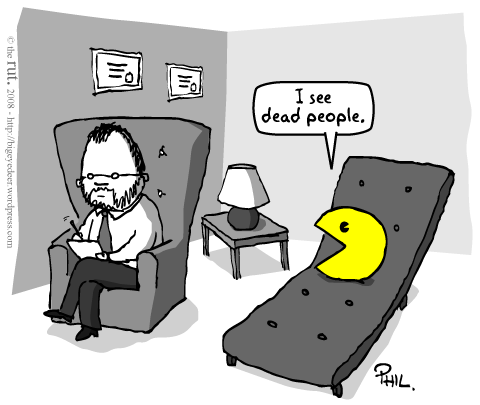
Even game characters have their issues (Source: The Rut)
As decided in Chamberlin v Uris Sales Corporation: "...copyright protection does not extend to games as such". One has to observe that, even if copyright does not subside in games as such, it still can protect parts of those games, not the 'idea' of a game. At the heart of it, the assessment is an assessment of whether what is sought to be protected is merely an 'idea' or the expression of that idea, which is quite protectable. Should the expression and the idea be nearly indistinguishable from one-another, i.e. it is not possible to express said idea in more ways than one, it is difficult to afford protection for that expression. This was well iterated by Justice Browning in Kalpakian: "[w]hen the "idea" and its "expression" are thus inseparable, copying the "expression" will not be barred, since protecting the "expression" in such circumstances would confer a monopoly of the "idea" upon the copyright owner free of the conditions and limitations imposed by the patent law".

Could you therefore protect the 'idea' of Pac-Man as a game? The court did not see much difficulty in answering this question, quickly determining that the work is mostly not protectable; however its components could very well provide "...new or additional [things] over the idea". How the game is displayed, in graphics and music for example, allows for those particular elements to be protectable, yet the 'idea' of a game where the protagonist is chased in a maze cannot be by itself.

An important point raised by the court in the case are certain elements in the game (or games in general), which can be viewed as scenes a faire, or as explained in Alexander v Haley "...incidents, characters or settings which are as a practical matter indispensable, or at least standard, in the treatment of a given topic". The maze and the score boards can be said to be indispensable to games such as Pac-Man, and arguably others, and thus not protectable. K. C. Munchkin was viewed by the court to have no infringed those designs, and to have been sufficiently different in its expression. What the court saw infringing Pac-Man's copyright was the character design within K. C. Munchkin. They had copied both the protagonist and the antagonist ghosts nearly identically, infringing on Atari's copyright in the expression of those ideas. Even if slight differences still existed, they will not by themselves preclude the finding of infringement. The court ultimately saw that "[a]lthough not "virtually identical" to PAC-MAN, K. C. Munchkin captures the "total concept and feel" of and is substantially similar to PAC-MAN". The court therefore reversed the previous decision and agreed to grant an injunction against K C. Munchkin.

Similar thoughts have been echoed in the UK, illustrated by cases such as Nova Productions Ltd v Mazooma Games Ltd, where the protected subject matter in a game was deemed to be the expression of the idea of a game, and how a game plays was seen as something which can be copied, as long as the visual and audio of that game was not.

What the above case illustrates is the initial considerations of video games as a protectable subject matter under copyright. As technology advances more and more, and games have surely come a long way since Pac-Man, the differentiation of what is copyrightable in a game and what isn't could be said to become more difficult. Even so, this case remains an important landmark in the development of the area, and shows that even dot eating circle creatures can be an expression worth protecting.

27 January, 2014

King.com Trademarks "Candy" - Discussion About the Mark

Mobile games have become huge in the last 10 years, with app sales having been predicted to reach 26 billion dollars in 2013 alone, making the field of mobile gaming incredibly lucrative. Examples like Angry Birds and Clash of Clans have shown that great monetary incentives lie in the production of simple, time-wasting games for your commute, and many others have succeeded in doing so as well. A recent example of immense success is a game called Candy Crush Saga made by the developer King.com, which in its simplicity consists of the alignment of icons in particular patterns, scoring points by destroying the patters and furthering your progress in the game. The game has been downloaded over 100 million times on the Android platform, while achieving great success on its iOS counterpart as well.

In a recent move, King.com have registered the term "candy" in relation to games and clothing, having been marked for approval in late January. This has created quite the uproar in the mobile gaming community, and I felt it would be appropriate to address the situation from a more legal stand-point given the discussion surrounding the potential mark.

Candy Crush, the analog game
In the US a trademark, under 15 USC § 1127, is defined as "...any word, name, symbol, or design, or any combination thereof, used in commerce to identify and distinguish the goods of one manufacturer or seller from those of another and to indicate the source of the goods". The mark has to be subsequently used in commerce, something which King.com clearly have done in using it in the name of a commercial application, and it has to be distinctive in order to distinguish the application from others in the category it is registered in. Distinctiveness has been divided into four categories in relation to trademarks: arbitrary/fanciful, suggestive, descriptive, and generic. How each of the aforementioned categories distinguish the goods or services varies: "If a mark is categorized as either arbitrary/fanciful or suggestive, it is considered to be inherently distinctive and exclusive rights to the mark are determined solely by priority of use. A trademark that is categorized as descriptive is only protectable as a trademark if it has acquired a secondary meaning in the minds of the consuming public. Secondary meaning is also necessary to establish trademark protection for a personal name or a geographic term. Generic terms are never eligible for trademark protection because they refer to a general class of products rather than indicating a unique source. A mark may be generic ab initio and refused registration, or it may become generic over time through use".

As can be observed from the above, King.com's alleged trademark could be seen as legitimate under law, assuming it satisfies all of the requirements. This writer for one would argue that the mark would fall under either a descriptive mark or a generic mark, which leaves the mark under some level of scrutiny should it face litigation. Clearly the term "candy" is not inherently distinctive awarding it clear protection, especially since there are prior instances where the term has been used in conjunction with games. The connection between the mark and the goods or services would have to be assessed by the courts on an individual basis, as there is no set metric to assess this.

So can King.com enforce their trademark, and above all else, should they? This would be yes, at least from a legal stand-point. If an entity does not actively protect their trademarks they will lose them. In the game company's position the enforcement of the marks is the only option. They have already begun to enforce the mark to an extent, at least against other game developers. The mark will undoubtedly be heavily challenged, especially due to its 30-day contest period, and could be revoked as a result.

The discussion around the mark can be argued as being legitimate, and should pose some critique about the laws surrounding trademarks. In the same vein we should not ban all 'generic' terms outright, as they can still easily distinguish goods or services given the right type of goods or services and the right area where they operate. King.com's intentions are legitimate, which is to protect the intellectual property rights they own; however that does not mean they should not be open to criticism as a result. Some of the aforementioned discussion has been riddled with inaccuracies or even outright hyperbole, prompting this writer to give some insight into the matter. Even so, I for one will follow this with curiosity, and enjoy the fact that situations like this bring intellectual priority matters into a more of a public sphere, prompting discussion.

Source: Android Police

03 November, 2013

Video Games and Copyright - 21st Century Art

Video games have surged to become the new pass-time of choice for millions of people, with sales of new titles like Grand Theft Auto V reaching a billion dollars in sales in its first three days alone. This clearly demonstrates just how important video games are in the sphere of commerce, and therefore the sphere of intellectual property. Even with its immense popularity video games have still been largely left out, at least in terms of specific protection, in most jurisdictions. In addition to this the sheer complexity of video games as copyrighted works presents some issues.

A recent study prepared for the World Intellectual Property Organization attempted to shed some more light on this matter by looking at a variety of jurisdictions and the protection they offer for video games. The study clearly is weighted towards civil law countries (included were for example Denmark, Germany, China and Russia), but common law countries such as Canada and the United States were included in the study.

Super Mario - a modern literary hero?
Copyright protected subject matter in video games shows exactly just broad the category itself is when dealt with under copyright. Three distinct elements can be found in video games, along with their sub-categories respectively; audio elements (e.g. speech, music, sound effects), video elements (e.g. images, animation, text), and computer code (e.g. game engines, ancillary code, plug-ins). In addition to the above any  literary works would be covered as well, including scripts, maps and characters. However the study does point out that "...the real issue, and one of the objects of this study, involves analyzing the legal protection of video games as single, unique works of authorship, since it is irrefutable that the individual elements included in video games can deserve independent copyright protection". The objective of the study is not to introduce possible legal reform or frameworks to protect video games, but to increase awareness to all possible stakeholders, through which potentially exact change or better protection for video games.

In Canada video games are not protected by themselves under the Canadian Copyright Act, but predominantly as a computer program. This would still include all the other copyrighted parts individually, and potentially as a literary work as well. In addition video games could be protected as a 'collective work' as a sum of several distinct parts by different authors. In the US video games would fall under 17 USC § 102, although not expressly mentioned, should it fulfill its specific requirements. Video games have shown some problems to the American judiciary, as is pointed out by the study, but can be said to fall under the protection of copyright.

Always pointing fingers
So this begs the question: why should there be specific protection for video games? Arguably the protection offered to them as it stands can be said to cause some uncertainty. If a video game is not protected as a whole, if individual elements are not deemed protectable the entire game's integrity as an artistic work would clearly be undermined, as the pieces making the game arguably constitute that very artistic expression as a part of a whole. Even in the case of Brown v EMA, the US Supreme Court saw that "[l]ike the protected books, plays, and movies that preceded them, video games communicate ideas-and even social messages-through many familiar literary devices (such as characters, dialogue, plot, and music) and through features distinctive to the medium (such as the player’s interaction with the virtual world)..."; clearly demonstrating this very point. Video games as a whole are a work which should be protected, not merely a collection of pieces which only merit protection by themselves.

The study is an intriguing and wide-scoped view of the sphere where video games currently reside, and do highlight some issues in a variety of jurisdictions, not to mention their protection in the world as a whole through inconsistencies in approaches. As the medium has become very prevalent, this matter should be addressed further and provided with explicit protection not as a mere collection of different forms of expression, but as a viable form in itself.