Showing posts with label mark. Show all posts

06 December, 2016

As Clear as Grey - Sale of 'Grey' Goods a Criminal Offense in the UK

The sale of counterfeit goods is a touchy subject, and definitely an issue that many rightsholders are attempting to tackle head on, particularly in the context of the Internet (a good example is the recent Cartier litigation, more on which here and here). Added to this is also the "grey" market, meaning items obtained from duly licenced factories; however, bought without the authorization of the original licensor. This is, as the name indicates, a grey area within the law, and whether the sale of 'grey' goods is actually an offense under the law remains unclear. While arguments can be thrown back and forth, a recent case in the Court of Appeal set to decide the criminal ramifications of the sale of 'grey' goods in the UK, on which the Court handed down its judgment early last month.

The case of R v C & Ors dealt with a limited liability company that sold shoes and clothing, the operation of which included several different defendants. In the course of their business, the defendants sold branded goods, such as Ralph Lauren, Adidas and Under Armor, attained from sources outside of the EU, both from factories that were and were not authorized by the original rightsholder (and subsequently sold without their authorization in both instances). The goods sold included "...goods which had been part of an order placed with an authorised manufacturer by the trade mark proprietor but then cancelled; goods part of a batch whose manufacture had been authorised but which, after manufacture, were rejected as not being of sufficient standard; or goods manufactured, pursuant to an order, with authority but in excess of the required amount" (none of the categories had been confirmed by the prosecution). None of the goods sold were a part of any authorized batches of produced goods or parallel imports. The parties were taken to court for the contravention of section 92 of the Trade Marks Act 1994. 
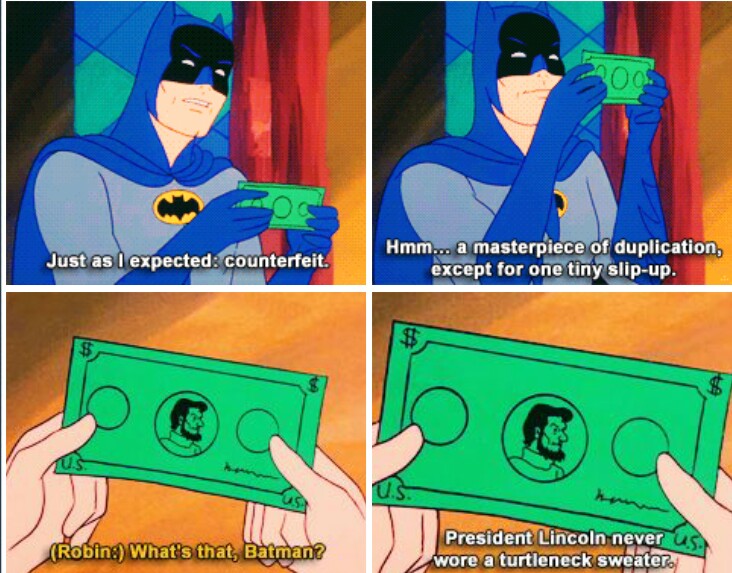
Counterfeit Criminals Countered by Caped Crusader
Having set the legislative scene for trademarks in general, the Court moved onto dealing with the criminal aspect of the case. What section 92 sets out is that a person commits a criminal offense if they, either causing loss or aiming to gain from, use trademarks on goods and sell them, or uses the same marks for advertising or packaging in general. While the provision is very similar to that of trademark infringement (a civil offense), what distinguishes the criminal aspect is the mental state of the infringer, i.e. that the act has to be done "with a view" to gain or cause loss. AS established by previous cases, there is clear overlap, and a criminal offense under section 92 cannot happen without civil infringement as well.

The defense tried to separate the application of the mark by an authorized licensee on the goods from ones where it was done by an unauthorized entity. The Court rejected this position as patently false. According to the Court, the wording in the provision does not support this line of argument. In particular, the Court highlighted the lack of implied consent on the part of the authorizing entity for the brands applied on the goods, especially in the case of 'grey' goods. Their sale was not, through the licensing of the marks, authorized to unauthorized third-parties.

The final argument put forth by the appellants was that of ambiguity, and required clarification on Parliament's intention. The Court swiftly dispatched with the argument, deeming that the language of section 92 was perfectly clear and required no discussion of Parliamentary debates as to its meaning. While the discussions in Parliament were often lacking in detail as to the meaning of a 'counterfeit' (i.e. would it include 'grey' goods), the Court still considered that "...Trade mark violation gravely undermines the value of a brand and affects legitimate trade. The very fact of a cheap sale of a an unauthorised branded item can both dupe a customer and diminish the market and overall value of the trade mark, in terms of perception of quality and exclusivity. In some cases moreover (for example, electrical goods or toys) very real issues of public health and safety can arise where the goods are fake or, even if originally manufactured with the trade mark proprietor's authorisation, are then rejected as sub-standard but nevertheless sold on without authorisation". Due to this potential impact on the brand and public safety, the sale of 'grey' goods would therefore be detrimental in a multitude of ways, and should be protected by criminal sanctions. The Court did concede that the definition of 'grey' goods does potentially raise issues with parallel imports, but discussion on this was kept limited, as it did not apply to the case at hand.

The Court of Appeal ultimately considered that the sale of grey goods could amount to a criminal offense under section 92.

The case is a very important one, especially as a reminder to those who wish to import goods from outside the EU, and don't do their due diligence as to their origin and legitimacy. Businesses would need to be careful and verify that the products sold would be fully authorized, even for sale if bought directly from the factory itself. This writer would hesitate to wager that the case will have major implications to businesses importing branded goods from abroad, since the courts are reluctant to push criminal prosecution, even in parallel importation matters; however, one needs to be careful to dismiss the possibility outright.

21 January, 2016

Another Break - Justice Arnold Settles the Kit Kat Case After CJEU Decision

After quite an unsatisfying Court of Justice decision earlier in September in the Kit Kat case, many of us invested in the world of IP were waiting for the decision by the High Court of Justice in the UK applying the CJEU's considerations. The case has since been decided by Justice Arnold, finally settling (for now?) the debate around the the-dimensional marks.

By way of a short introduction, the case of Société Des Produits Nestlé SA v Cadbury UK Ltd dealt with the arguably iconic Kit Kat chocolate bar. The bars comprise four individual chocolate wafer fingers connected to each other with a solid chocolate base. Nestle applied to register the three-dimensional shape of the bar as a trademark without the Kit Kat logo embossed on the top of each finger, which was subsequently opposed by Cadbury. The case was referred to the CJEU by Justice Arnold (discussed more here), leading to the decision in question.

Justice Arnold post the CJEU decision (approximation)
The biggest issue in the case was the apparent mistranslation of Justice Arnold's question, who, in essence, asked whether an applicant needed to only prove recognition (and subsequent association to the applicant) of the mark by a significant portion the relevant public, or whether they have to rely on the mark to indicate the origin of the goods for a mark to have acquired distinctiveness. One has to note that this has to be in isolation of any other marks present in that product, and that particular feature has to identify the origin of the goods by themselves (i.e. the shape of the bar rather than the embossed logo on the top of it). The questions were, however, partially mistranslated during the proceedings, with the latter question being changed to a matter of perception rather than reliance.

Both the Opinion of Advocate General Wathelet and the judgment by the CJEU failed to address Justice Arnold's question in full, rejecting the first part of the question but leaving the matter of reliance unanswered.

Having considered the possible answer to his question, Justice Arnold summarized what he perceived the accurate consideration to be: "...in order to demonstrate that a sign has acquired distinctive character, the applicant or trade mark proprietor must prove that, at the relevant date, a significant proportion of the relevant class of persons perceives the relevant goods or services as originating from a particular undertaking because of the sign in question (as opposed to any other trade mark which may also be present)". (emphasis the court's)

Additionally, he concluded that "...when assessing whether the applicant has proved that a significant proportion of the relevant class of persons perceives the relevant goods or services as originating from a particular undertaking because of the sign in question, to consider whether such persons would rely upon the sign as denoting the origin of the goods if it were used on its own".

The focus on provenance is therefore on both perception of a particular mark as the indicator of the origin of certain goods or service, and whether the same public subsequently relied on that mark to indicate that very origin, irrespective of any other marks that might be present on those goods.

Justice Arnold then answered the question, agreeing the initial decision of the Hearing Officer. In his mind, although he referred to reliance on the mark, his rationale was in line with the CJEU decision. He correlated reliance with perception, which would fulfill the requirement set by the CJEU. Although survey evidence showed identification of the Kit Kat bar, it merely displayed recognition and not that they perceived it as the exclusive designation of the origin of the goods in question. Therefore he dismissed Nestle's appeal due to a lack of concrete evidence establishing acquired distinctiveness.

The Kit Kat saga has been a curious one, and does highlight some issues that surround CJEU referrals and linguistic nuances. Even so, this writer thinks Justice Arnold applied the law as well as he could in the light of the answer given by the CJEU. This does, however, raise questions on evidence, especially with the survey evidence shown by Nestle and the uncertainty as to what would be sufficient to establish 'perception' and subsequent reliance.

11 November, 2015

Taking a Break - Kit Kat Decision Issued by ECJ

For all lovers of confectionery goods the name Kit Kat will undoubtedly be a familiar one, even without its highly memorably slogan. The iconic British chocolate bar has been around since the 1930s, and above all else what many will remember is its shape, comprising of five individual chocolate covered wafer 'fingers' connected at the base by a lawyer of chocolate. As such shapes can be protected through intellectual property law, but whether Kit Kat's design is truly distinctive enough to be protected as a trade mark, has been a contested question here in the UK for several years, ultimately being referred to the European Court of Justice by Justice Arnold nearly two years ago in Société Des Produits Nestlé SA v Cadbury UK Ltd [UK High Court of Chancery]. As a result the ECJ handed down its judgment in September this year.

The case of Société Des Produits Nestlé SA v Cadbury UK Ltd [European Court of Justice] dealt with an application for a trademark by Nestle for a three-dimensional representation of the Kit Kat bar, omitting the embossed words "Kit Kat" from the top of the chocolate bar's individual fingers. After the application's publication Cadbury submitted an opposition against its registration, arguing a lack of distinctive character, initially having the mark rejected by the UK Intellectual Property Office, ending in Nestle's appeal to the UK High Court.

Justice Arnold submitted three questions to the ECJ prior to his later judgment applying the Court's consideration.

The ECJ started by answering the second question posed by Justice Arnold. What was asked was seen as "...whether Article 3(1)(e) of Directive 2008/95... must be interpreted as precluding registration as a trade mark of a sign consisting of the shape of goods where that shape contains three essential features, one of which results from the nature of the goods themselves and two of which are necessary to obtain a technical result".

After a very brief consideration of precedent, especially relating to the prevention of any registration monopolizing a technical solution or functional characteristics, the Court determined that "...Article 3(1)(e)... must be interpreted as precluding registration as a trade mark of a sign consisting of the shape of goods where that shape contains three essential features, one of which results from the nature of the goods themselves and two of which are necessary to obtain a technical result, provided, however, that at least one of the grounds for refusal of registration set out in that provision is fully applicable to the shape at issue". What remains key is the refusal of registration based on a single ground under Article 3(1)(e), even if, predominantly, the shape does not fall under all of the grounds. Public interest in the strict enforcement of the grounds of refusal was important in the Court's view, as a contrary position would allow for the monopolization of the very subject matter the Article seeks to disallow. What is uncertain is how this applies to a shape as whole and its respective components. Would a shape be negated as a whole if it contains a part that would fall under the grounds (negating the registrability of the whole design)? Arguably, this would be the case, but the decision leaves this unclear.

Terry's take on Halloween was more diabetes inducing
The Court then moved on to the third question, which it saw as asking "...whether Article 3(1)(e)(ii)... under which registration may be refused of signs consisting exclusively of the shape of goods which is necessary to obtain a technical result, must be interpreted as referring only to the manner in which the goods at issue function or whether it also applies to the manner in which they are manufactured". As the wording of the sub-section does not discuss the manner of manufacture for the goods, the Court had to decide whether it implicitly does so. They quickly decided against this, setting out that "...that Article 3(1)(e)(ii)... must be interpreted as referring only to the manner in which the goods at issue function and it does not apply to the manner in which the goods are manufactured". The inclusion of manufacturing methods, in this writer's mind, would encroach onto the territory of patents, and how a product is made does not designate its origin; the primary function of trademarks.

Finally, the Court proceeded to question one, which was set out as "...whether an applicant to register a trade mark which has acquired a distinctive character following the use which has been made of it within the meaning of Article 3(3)... must prove that the relevant class of persons perceive the goods or services designated exclusively by that mark, as opposed to any other mark which might also be present, as originating from a particular company, or whether it is sufficient for that applicant to prove that a significant proportion of the relevant class of persons recognise that mark and associate it with the applicant’s goods".

Again, considering precedent in brevity, the Court saw that "...in order to obtain registration of a trade mark which has acquired a distinctive character following the use which has been made of it within the meaning of Article 3(3)... regardless of whether that use is as part of another registered trade mark or in conjunction with such a mark, the trade mark applicant must prove that the relevant class of persons perceive the goods or services designated exclusively by the mark applied for, as opposed to any other mark which might also be present, as originating from a particular company". What the question therefore requires is that the proprietor of the mark has to prove that the relevant class of people perceive their mark, in this case "Kit Kat", to only originate from them and not other proprietors selling similar goods, even if the goods contain other registered trademarks (or a design, in this case). The onus would be on Nestle to show that the shape of the chocolate bar, regardless of the inclusion of the words "Kit Kat", would be indicative of the source of the bar by itself (i.e. a distinctive feature). The Court did omit Justice Arnold's question on reliance on the mark, focusing on their 'perception' and 'recognition' of the mark. Arguably reliance does not necessarily follow the two, but this writer thinks, in the Court's mind, their intention is to include reliance through perception, as seeing and knowing a mark in conjunction with another would still carry some weight in the purchase decision, effectively creating a level of 'reliance'.

The case has since been referred back to the High Court for ultimate decision, but this writer thinks, based on earlier considerations, that the shape of the Kit Kat bar might not be enough to distinguish it from other similar ones to allow for the registration of the mark. The ECJ's answers to the questions seemed unsurprising, however leaving many things uncertain or somewhat unanswered, but give more nuanced guidance, which is never too abundant in today's legal sphere. How the case will be applied in the future is uncertain, but hopefully this application will manifest even more clarity as a result.

Source: IPKat

28 October, 2015

Impulsive Decisions - Reputation of a Trademark in Europe

In the world of trademarks the goodwill, or in other words reputation, of goods and services is paramount for their protection and enjoyment in a relevant territory. As commerce has become more and more global, with other territories seeing goods or services after their introduction to others, jurisdictional issues are even more poignant and relevant, providing a judicial headache for many attempting to benefit from those limitations (for example, in the recent NOW TV case, discussed here). Community Trade Marks, or CTMs for short, are registered as European-wide trademarks, but the goods or services' introduction to all of the Member States can sometimes differ, and potentially leave their registration open to challenge. Could, however, a proprietor prove goodwill in a Member State through use in other Member States, without actually having a commercial presence for that item in the Member State in question? Luckily, the European Court of Justice answered this question over a month ago.

The case of Iron & Smith v Unilever dealt with a national application for the mark "be Impulsive" in Hungary, lodged by Iron & Smith. The application was challenged by Unilever on he basis of their earlier mark "IMPULSE" (CTM 3116233); however they failed to demonstrate goodwill in Hungary, although Unilever had done so, arguably at least, in the UK and Italy.

The Court was asked four questions, the first three of which were distilled down by the Court as "...what conditions, in circumstances such as those at issue in the main proceedings, are to be met in order for a Community mark to be regarded as having a reputation in the European Union, pursuant to Article 4(3) of Directive 2008/95".

Extending beyond one's limitations can be a good thing
After a brief consideration of precedent relating to goodwill the Court quickly saw that "...if the reputation of an earlier Community mark is established in a substantial part of the territory of the European Union, which may, in some circumstances, coincide with the territory of a single Member State, which does not have to be the State in which the application for the later national mark was filed, it must be held that that mark has a reputation in the European Union". What this means is that you don't have to prove reputation all over Europe, but only in a substantial part of it (how ever that might be defined), in order to establish reputation in any Member State. This is a curious finding, as not all nationals of all Member States are aware of goods or services elsewhere in the Union, and effectively creates goodwill in those that have not, and might never, see those goods or services.

The final remaining question for the Court was also put in very succinct terms: "...in what circumstances Article 4(3)... is applicable if the earlier Community trade mark has already acquired a reputation in a substantial part of the territory of the European Union, but not with the relevant public in the Member State in which the registration of the later national mark concerned by the opposition has been applied for".

The Court, again, briefly considered earlier decisions, and concluded that "...if the earlier Community trade mark has already acquired a reputation in a substantial part of the territory of the European Union, but not with the relevant public in the Member State in which registration of the later national mark concerned by the opposition has been applied for, the proprietor of the Community trade mark may benefit from the protection introduced by Article 4(3)... where it is shown that a commercially significant part of that public is familiar with that mark, makes a connection between it and the later national mark, and that there is, taking account of all the relevant factors in the case, either actual and present injury to its mark, for the purposes of that provision or, failing that, a serious risk that such injury may occur in the future". The answer relates heavily to the above, as if goodwill is proved in a significant part of the Union, it is possible to rely on a CTM to invalidate a national mark, provided there is actual or potential damage to the CTM or its owner if the national mark were to be registered.

Overall the decision of the Court seems odd, effectively creating goodwill where none have existed in evidential terms, but aligns itself with earlier precedent. To prove goodwill or reputation in any European Member State one only has to prove it in a 'significant' portion of the European Union, which, to this writer's mind, expands the remit of an unused CTM beyond that for which it is intended (even if the mark is registered in the whole of Europe). Although the Court's rationale aligns itself with earlier decisions, it seems to give rights where no rights existed, potentially even hindering legitimate competition. Nevertheless, this writer will not purport himself to know better than the judges at the Court, but is puzzled by this outcome nonetheless.

Source: IPKat 

20 January, 2015

Tripping the Trapp - Trademarks in the Third Dimention

Trademarks can be an interesting novelty, especially when it comes to what is actually sought to be protected through trademarks. This ranges from trademarking the color of your football field to the phrase "Let's Get Ready to Rumble!", and only illustrates just how complex and varied trademarks can be, while offering a near perpetual right to protect what you have registered. With this kind of longevity, having a strong trademark, especially in an area where it could benefit you beyond just one product or product line, is incredibly valuable and desired by many (a lengthy legal battle over the color purple is a great example of just how much it can mean to a company). Most of the time though, trademarks are registered as one-dimensional items, which poses the question: could you register a three-dimensional trademark? The European Court of Justice aimed to answer this very question in the latter part of 2014, in a case anticipated by many.

The case in question was Hauck GmbH & Co. KG v Stokke A/S, in which the dispute centered around children's chairs. Peter Opsvik, a co-defendant in the case, had designed a children's chair called "Tripp Trapp", being sold under the Stokke brand since the early 1970s. The chair itself consisted of two L-shaped upright pieces, which contained slots, into which platforms and other pieces could be slotted into, forming the chair. The company sought to protect the highly-regarded chairs, and their look, by lodging a trademark application in 2003 (for example application 003514171). Hauck have also been involved with the production and sale of children's articles, including two chairs, Alpha and Beta. Hauck were subsequently taken to court for trademark infringement, due to the sale and manufacture of its Alpha chair in the German courts (with Stokke winning in the German courts), and also in the Netherlands, culminating in the ECJ some years later.

What the Court of Justice faced was a decision under Directive 89/104/EEC, which governs the registration of certain marks within the EU, as to whether the registered mark would be considered invalid under the Directive.

The first question posed to the Court sought to clarify "[d]oes the ground for refusal or invalidity in [the Directive], namely that [three-dimensional] trade marks may not consist exclusively of a shape which results from the nature of the goods themselves, refer to a shape which is indispensable to the function of the goods, or can it also refer to the presence of one or more substantial functional characteristics of goods which consumers may possibly looks for in the goods of competitors?" The question poses, in more simplistic terms, the conundrum of whether the grounds for refusal would encompass either a three-dimensional shape. which is indispensable to the function of the item and exclusively being only that shape, or would it include the functional shape of the item containing one or more parts that are integral to the function of that item, which consumers find desirable in that type of item.

The Court quickly clarified that, for a shape to be ineligible to be registered, due to the shape resulting from the nature of the goods themselves (Article 3), the shape has to be one which would unduly prevent competitors from using a similar shape, effectively giving a monopoly for similar items; or to put in better terms: "...[the Article's aim is to] prevent trade mark protection from granting its proprietor a monopoly on technical solutions or functional characteristics of a product which a user is likely to seek in the products of competitors".  This also applies to efforts in extending protection through trademarks to subject matters, which should be protected through other means (e.g. patents), or have been exhausted prior to the mark's registration. In the end, the Court poignantly answered the first question: "...[the] directive must be interpreted as meaning that the ground for refusal of registration set out in that provision may apply to a sign which consists exclusively of the shape of a product with one or more essential characteristics which are inherent to the generic function or functions of that product and which consumers may be looking for in the products of competitors"; meaning a trademark cannot claim a monopoly on e.g. adjustable children's chairs, through registering that functional shape as a trademark.

Kids should not be placed on all traps.
The second question referred to the Court necessitated the assessment of whether a registered sign, consisting of several elements adding value to the product itself, much like the changeable pieces of the Tripp Trapp chair. Value does not, by itself, only mean aesthetic qualities, and the distinction between aesthetic and functional can often be blurry as well. The Court saw that the Directive must be interpreted "...as meaning that the ground for refusal of registration set out in that provision may apply to a sign which consists exclusively of the shape of a product with several characteristics each of which may give that product substantial value. The target public’s perception of the shape of that product is only one of the assessment criteria which may be used to determine whether that ground for refusal is applicable". The public's perception of the mark is not the sole deciding factor, as was seen by the Court, but is one of a number of factors, such as ones described by the Attorney General: "...such as the nature of the category of goods concerned, the artistic value of the shape in question, its dissimilarity from other shapes in common use on the market concerned, a substantial price difference in relation to similar products, and the development of a promotion strategy which focuses on accentuating the aesthetic characteristics of the product in question". Whether a mark would be rejected as only adding substantial value to the item is a case-by-case assessment, with no clear deciding criteria as the only guidelines in this question.

Finally, the Court faced its third question, essentially asking whether a mark can be rejected based on a combination of the first and third indent in the Article (questions one and two, respectively, deal with the first and then the third indent). The Court put things bluntly, as, even from a prima facie assessment, the three indents are wholly separate from each other, and thus operate differently in each given argument. If a product fails over one indent, it will fail overall; an assessment based on the two other indents is wholly irrelevant past that point, and failing in more than one indent will not make the invalidity any more serious - the mark will fail either way. In the end the question of whether Stokke's mark will fail is up to the Dutch courts, as the answer has since been sent back for a final decision.

The Directive has been applied to domestic UK legislation, within the Trade Marks Act 1994, and thus is fully relevant within a UK scheme of things. In the United States the protection of three-dimensional marks falls under trade dress (defined in 15 USC 1127), and is more mailable than legislation applying purely to registered trademarks.

Overall the world of 3D marks is interesting, but a question filled with a lot of uncertainties. As the regime is not in place to protect patentable subject matter, or even registerable designs, the provisions serve as a protective means for items falling outside of those regimes. Whether a registrant would be successful depends largely on the mark for which protection is sought for, and is an assessment done on a case-by-case basis, with no clear bright line rules to follow.

Source: JDSupra

19 December, 2014

Non Parlo Inglese - Australian High Court Takes on Foreign Words as Trademarks

As the world's become evermore global, the mixing of different cultures, conventions and languages is completely inevitable. With this intermingling comes variety and novelty in expression, yet another perspective in this is added confusion and the potential for a well-known foreign brand to be completely overlooked or missed in these new markets with their introduction through immigrants or other people who wish to have access to these goods or services, especially if the mark in question is in a language not commonly used in that new country. This in mind, as trademarks have to distinguish specific goods or services, can a foreign mark achieve this and be considered a trademark, or will the language barrier potentially deter their use in a country? Luckily this matter was recently brought to the Australian High Court, which ultimately decided the fate of foreign marks in Australia, and whether they can inherently distinguish the goods or services provided.

The case in question was Cantarella Bros Pty Ltd v Modena Trading Pty Ltd, which dealt with the ever-loved subject matter of coffee. The claim dealt with two registered trademarks held by Cantarella Bros, an Italian coffee company: Australian Trademark 829098 "ORO" ('gold' in Italian) and 878231 "CINQUE STELLE" ('five stars' in Italian). Modena, an importer of Italian coffee, used similar marks indicating their coffee products, including both of the marks in question, using them in conjunction with their coffee brands as marks of quality.  Modena argued, after being sued for trademark infringement by Cantarella Bros, that the marks are merely signs of quality and cannot inherently distinguish Cantarella's products from others, and therefore be valid trademarks.

The question hinged largely on the Australian Trade Marks Act 1995, more specifically section 41, under which a trademark has to be "...inherently adapted to distinguish the designated goods ...from the goods ...of other persons". If the mark does not do so, due to it being merely descriptive for example, it will be deemed an invalid mark. The High Court saw that the question which needs to be answered, basing their decision quite heavily on UK precedent, is "...an enquiry into the word's ordinary signification and whether or not it has acquired a secondary meaning". To put things in simpler terms, it is an assessment of what the word means ordinarily, and whether that particular meaning has acquired a secondary meaning, indicating a specific origin or quality of product in relation to a brand of goods or services, even if its ordinary meaning can be said to be descriptive or generic.

After a discussion of relevant precedent, the court formulated its final question regarding foreign marks:

Other languages can be very confusing
"The principles settled by this Court (and the United Kingdom authorities found in this Court to be persuasive) require that a foreign word be examined from the point of view of the possible impairment of the rights of honest traders and from the point of view of the public. It is the "ordinary signification" of the word, in Australia, to persons who will purchase, consume or trade in the goods which permits a conclusion to be drawn as to whether the word contains a "direct reference" to the relevant goods (prima facie not registrable) or makes a "covert and skilful allusion" to the relevant goods (prima facie registrable). When the "other traders" test from Du Cros is applied to a word (other than a geographical name or a surname), the test refers to the legitimate desire of other traders to use a word which is directly descriptive in respect of the same or similar goods. The test does not encompass the desire of other traders to use words which in relation to the goods are allusive or metaphorical. In relation to a word mark, English or foreign, "inherent adaption to distinguish" requires examination of the word itself, in the context of its proposed application to particular goods in Australia".

Effectively what the court is saying, is that the mark has to be examined so it does not impair its use unduly from other traders in a similar field (for example, trademarking the word 'fresh' in relation to bubblegum), and the end assessment is whether the public who will buy and consume that product or service will see a connection between that good or service and the provider. The reference to the goods or services has to be covert and skilful, and not a purely direct usage of that word.

Justices French, Hayne, Crennan and Kiefel, in the majority's decision, saw that, on the face of the evidence given that the marks have are not merely descriptive, and Cantarelle got to keep their trademarks. The general public were not seen as understanding the words sufficiently commonly as to convey a signature of quality, rather than an indication of origin, as there are few people in Australia who speak Italian.

To this writer the decision of the Court is an odd one, especially since the marks are, by their definition in Italian, purely descriptive, with the added issue that the marks have been commonly used even before the marks' registration. Nevertheless, the evidence produced was not enough to establish a case for Modena and the common understanding of these words, and it is hard to argue against that.

Source: Lexology

05 December, 2014

Words in Action - Trademarks as Verbs

This writer, for one, will fully admit to often using very well-known brands as the descriptive term for all such items, for example calling all plasters Band-Aids and all cotton-tipped plastic cleaning things (a technical term, undoubtedly) as Q-Tips, regardless of all of those terms having been, or still being, registered trademarks. While my misstep in potentially diluting these valuable brands in using them in this way can be seen as a small error, or even wholly unnoticeable in the grand scheme of things, it still brings light to an issue all trademark holders face; the potential of losing your mark to genericization. While this topic has been discussed on this very blog before quite extensively, the use of trademarks as verbs specifically has been left a bit in the dark, yet is illustrative of a newer problem technology companies especially will face. Who hasn't said they will 'Google' something, or if they will 'Facebook' their aunt Mary; a grave threat the holders of those particular marks will lose sleep over. One such giant facing a recent challenge to its widely recognized trademark is Google, which posed an interesting question to all trademark holders.

The case in question is Elliot v Google Inc, where the claimant, David Elliot, registered over 760 different domain names combining the word 'Google' and another brand or a famous person, for example googledisney.com, or with generic terms such as googletvnews.com. As you might have guessed, Google has trademarked the term 'Google' in a number of variants; two of which were at issue in the case: US trademark 2884502 and 2806075. These two marks encompass the word 'Google' in several categories, such as web indexes and computer software - promptly leading to Google pursuing the domain names through the Uniform Domain-Name Dispute-Resolution Process (UDRP). In his defense Mr. Elliot asserted that the term 'Google' had become generic and could therefore be used by him (and others) without infringing on Google's marks. The domain names Mr. Elliot had registered were transferred to Google in the UDRP, which prompted Mr. Elliot to pursue the matter further in the US District Court of Arizona.

What Mr. Elliot's argument largely states, and what the court had to assess, was whether the term 'Google' had effectively become ubiquitous with the verb 'googling' - defined by the Oxford Dictionary as "[s]earch[ing] for information about (someone or something) on the Internet using the search engine Google" - rendering it generic rather than distinctive as to Google and/or Google's services. As trademarks need to specifically distinguish the origin of goods or services, becoming a generic verb can be the mark's end.

Stacy was unnerved after 'googling' herself
What the court had to determine was whether the mark's "...primary significance" was that of distinguishing the goods or services from other similar ones. The test was phrased well by Justice Brandeis in Kellogg v National Biscuit: "...the primary significance of the term in the minds of the consuming public is not the product but the producer". This is highly important, as if a product is named as the major brand (i.e. if you refer to all plasters as 'Band-Aids') in general terms, the mark loses its status as the seal of origin for that brand, or as stated by Justice O'Scannlain in Filipino Yellow Pages: "...if the primary significance of the trademark is to describe the type of product rather than the producer, the trademark is a generic term and cannot be a valid trademark".

Using a trademark as a verb does not automatically change the primary significance of that mark, and a mark, such as 'Google', can be used for both the designation of an origin for goods and services and as a term describing the searching of information via the search engine - noted by the court in the case. This synecdochian dual-functionality of a mark is wholly valid; however, should the perception of the public change drastically as to the meaning of the word, i.e. if most people would believe and/or use the term "to google" to mean using any search engine online to seek information, then the mark can be determined to be compromised, even with this accepted dual-functionality. This was phrased well by Justice McNamee (the name seems more than appropriate considering the case's subject matter): "It is thus contrary to both the letter and spirit of trademark law to strip a mark of legal protection solely because the mark—cultivated by diligent marketing, enforcement, and quality control—has become so strong and widespread that the public adopts the mark to describe that act of using the class of products or services to which the mark belongs". Arguably this argument holds well, and this writer for one agrees wholeheartedly with the court's view, as the stripping of a mark's distinctive nature the moment it becomes even partially descriptive of a class of products or services would run contrary to the value given by trademarks to brands and their place in a given class.

In the end the action failed, as Mr. Elliot failed to demonstrate how the mark 'Google' had turned generic, as the public still strongly perceived it as part and parcel to the company, not just internet search engines or internet searching at large. The case does bring light an important issue, and often something that the general public will not think about; how our daily use of terminology, especially trademarks, can alter their value. Some examples include 'Xerox' (become a term for all photocopying) and 'Thermos' (used as a term for all heat-retaining drinks containers), which have become generic due to their use as the identifying term in a given class. Due to this the International Trademark Association has even issued guidelines on the proper use of trademarks, which most of us will find potentially excessive, yet is quite important. As can be seen, trademarks are a dangerous beast, especially when they become famous to the point of ubiquity; however for most this risk is quite worth it.

Source: JDSupra

09 February, 2014

Retrospective - Intention to Use Trademarks

Often in business it pays off to preempt what might be the next big thing, especially when it comes to names. The right timing can yield quite the monetary results, even if such predatory practices could be argued to linger outside of what is acceptable. To limit the potential hoarding of signs which could be used as trademarks, most common law legislatures have enacted provisions preventing such practices, such as in the United Kingdom and Australia for example. Under such provisions a mark has to be used, or intended to be used, as a trademark for it to be eligible for protection as such. Without proper use, or the compulsion to do so, companies would hoard any and all marks they could, with no intent to use them, only to sue for infringement if others would use that mark even when they are not doing so themselves. Even with the existence of such provisions, the question still remains as to what counts as an intention to use in the absence of actual usage; a question which was subsequently answered in the 1980s.

The case in question is Imperial Group v Philip Morris & Co, decided in the very beginning of the 80s. This concerned the prior Trade Marks Act 1938; however the provision in question is still in the currently in force Trade Marks Act 1994, and would apply equally in relation to the more modern legislation. The case concerned the word "NERIT", which was successfully registered by Philip Morris. Their registration of the word was a result of an unsuccessful attempt to register the word "MERIT" in relation to tobacco products; a mark which was rejected due to it being a laudatory and thus, descriptive word. In their mind the registration of the word "NERIT" would be close enough to be used to enforce against any uses of the word "MERIT" should their competition adopt or use the word in relation to competing products. To further legitimize the mark, Philip Morris sold roughly 1 million cigarettes under the name "NERIT", although had no real interest in using the mark as a legitimate trademark aside from its potential use against anyone using the word "MERIT". Subsequently Imperial Group challenged the mark, having used the word "MERIT" in relation to their cigarettes, and the case finally ended up in the UK Court of Appeals.

Mark loved to dress up as a ghost
In its deliberation the Court of Appeals saw that Philip Morris' mark was merely a ghost mark, with no real intention to be used as a legitimate trademark, and was registered under bad faith, contrary to the Trade Marks Act 1938. For a trademark to be considered legitimate under the legislation it must be used "...in the normal course of trade", and not merely under the guise of use through the manufacture of a small batch in order to legitimize the mark or its use. What the plaintiff had was merely a ghost mark. To further illustrate the intent by the plaintiff in the matter, the Court saw that "[t]hey wanted to treat the word "MERIT" as if they had a copyright interest in it"; which they clearly did not have. The Court of Appeal in the end determined that the word "NERIT" was not registered bona fide, and clearly not used for a legitimate commercial purpose and therefore would not be allowed as a registered trademark.

As one can see the use of trademarks is complex, and predatory registrations are no longer allowed. Registration of ghost marks was common practice before the Imperial Group decision, and clearly the case illustrates a well-needed adjustment from those practices. Should frivolous marks, or unused marks, be allowed to be registered by anyone, their function as a badge of origin could potentially cease to exist, and would only serve as a means to prevent others from trading through legitimate marks. The Imperial Group case has been decided in a multitude of countries, such as Australia, with similar results, clearly showcasing the common law's position in relation to modern trademark law with regards to ghost marks.

27 January, 2014

King.com Trademarks "Candy" - Discussion About the Mark

Mobile games have become huge in the last 10 years, with app sales having been predicted to reach 26 billion dollars in 2013 alone, making the field of mobile gaming incredibly lucrative. Examples like Angry Birds and Clash of Clans have shown that great monetary incentives lie in the production of simple, time-wasting games for your commute, and many others have succeeded in doing so as well. A recent example of immense success is a game called Candy Crush Saga made by the developer King.com, which in its simplicity consists of the alignment of icons in particular patterns, scoring points by destroying the patters and furthering your progress in the game. The game has been downloaded over 100 million times on the Android platform, while achieving great success on its iOS counterpart as well.

In a recent move, King.com have registered the term "candy" in relation to games and clothing, having been marked for approval in late January. This has created quite the uproar in the mobile gaming community, and I felt it would be appropriate to address the situation from a more legal stand-point given the discussion surrounding the potential mark.

Candy Crush, the analog game
In the US a trademark, under 15 USC § 1127, is defined as "...any word, name, symbol, or design, or any combination thereof, used in commerce to identify and distinguish the goods of one manufacturer or seller from those of another and to indicate the source of the goods". The mark has to be subsequently used in commerce, something which King.com clearly have done in using it in the name of a commercial application, and it has to be distinctive in order to distinguish the application from others in the category it is registered in. Distinctiveness has been divided into four categories in relation to trademarks: arbitrary/fanciful, suggestive, descriptive, and generic. How each of the aforementioned categories distinguish the goods or services varies: "If a mark is categorized as either arbitrary/fanciful or suggestive, it is considered to be inherently distinctive and exclusive rights to the mark are determined solely by priority of use. A trademark that is categorized as descriptive is only protectable as a trademark if it has acquired a secondary meaning in the minds of the consuming public. Secondary meaning is also necessary to establish trademark protection for a personal name or a geographic term. Generic terms are never eligible for trademark protection because they refer to a general class of products rather than indicating a unique source. A mark may be generic ab initio and refused registration, or it may become generic over time through use".

As can be observed from the above, King.com's alleged trademark could be seen as legitimate under law, assuming it satisfies all of the requirements. This writer for one would argue that the mark would fall under either a descriptive mark or a generic mark, which leaves the mark under some level of scrutiny should it face litigation. Clearly the term "candy" is not inherently distinctive awarding it clear protection, especially since there are prior instances where the term has been used in conjunction with games. The connection between the mark and the goods or services would have to be assessed by the courts on an individual basis, as there is no set metric to assess this.

So can King.com enforce their trademark, and above all else, should they? This would be yes, at least from a legal stand-point. If an entity does not actively protect their trademarks they will lose them. In the game company's position the enforcement of the marks is the only option. They have already begun to enforce the mark to an extent, at least against other game developers. The mark will undoubtedly be heavily challenged, especially due to its 30-day contest period, and could be revoked as a result.

The discussion around the mark can be argued as being legitimate, and should pose some critique about the laws surrounding trademarks. In the same vein we should not ban all 'generic' terms outright, as they can still easily distinguish goods or services given the right type of goods or services and the right area where they operate. King.com's intentions are legitimate, which is to protect the intellectual property rights they own; however that does not mean they should not be open to criticism as a result. Some of the aforementioned discussion has been riddled with inaccuracies or even outright hyperbole, prompting this writer to give some insight into the matter. Even so, I for one will follow this with curiosity, and enjoy the fact that situations like this bring intellectual priority matters into a more of a public sphere, prompting discussion.

Source: Android Police

19 July, 2013

Star Jumps and Trademarks

Marketing is an incredibly powerful tool for a brand, and its protection can often be the difference between a successful promotion of your goods, distinguishing them in a favorable way from others. Trademarks offer such protection, with a variety of things being included as possible trademarks in Australia. The issue in a recent dispute over a trademark being sought by Jetstar (a subsidiary of Qantas Airways) was something potentially worth jumping to arms for.

Elephants don't see why you'd ever need to jump
In a recent promotional campaign Jetstar used people doing a star jump as an expression of the joys that travel can give you when using their services when flying to a destination, having started the campaign in 2004. Toyota have been running a campaign featuring a similar jump since the 1980s, and applied for trademarks for over 30 different variations of the star jump in 2012. A few of these applications were contested by Jetstar, who in turn filed several applications for a number of variations of the jump in the last few months. Clearly there was an issue over who has the trademark for the particular jump.

In a recent development Jetstar's representative indicated that they were only concerned with the straight-legged star jump, and would not be concerned with Toyota's bent-knee versions of the jump. With both parties having successfully registered a number of variations, they have equal claim to the trademark should things be litigated. Toyota's history of using it in advertising should work in their favor, however successfully retaining motion marks is a difficult matter. Whether the parties choose to litigate on the matter or opt to settle will remain to be seen, but the situation goes to show just how varied trademarks can be and how important something simple as a jump can be when it comes to a company's image.

Source: Sydney Morning Herald

14 July, 2013

App Store Struggles End

Yet another chapter in the Apple litigation era came to an end roughly a week ago. The fight over the trademarked phrase "App Store" has raged between Apple and Amazon since early 2011,  having had its ups and downs during the two years. The matter ended once Apple approached Amazon with an agreement to end all current and possible future disputes over the term, effectively allowing both parties to use the phrase as they please. The case, set to have a hearing in August of this year, was subsequently dismissed by Judge Hamilton in the Oakland District Court.

A cavalcade of time-wasting apptastic action
For a bit further exposition in where the situation stood prior to this settlement, Apple own the trademark for the name "App Store", having applied for it in 2008. The name was contended as being too generic, covered under 15 USC § 1064, where the registration of a trademark can be cancelled should it stop from distinguishing the goods of the original registrar from others which are similar. Arguably with other companies such as Amazon and Microsoft using similar names in similar services offering applications for their respective operating systems, the term has indeed become generic and purely descriptive of a digital store-front for applications. As in their statement to Reuters, Apple will now have to distinguish its services from the rest of the pack purely on merit, not by the protection of a specific name to those services.

Only a few months ago in Australia the same trademark was rejected by the Australian Trade Marks Office due to it being merely descriptive and didn't distinguish Apple's services from their competitors. The application was rejected under the Trade Marks Act 1995. Instead of the name being considered generic, as was contended in the US, the mark was seen to only descriptive a store where applications were sold, and only functioned in conjunction with other well-known marks such as "iPod" or "iPhone"; the name itself didn't sufficiently stand on its own to distinguish Apple's store from others.

What this does is close the contention over the mark so dearly held on by Apple. From a legal stand-point Apple's decision to end the legal process was a sensible one, with a very high probability their mark would have been invalidated by the courts. Prolonging the process would have cost both parties more and yielded little or no reward in the long run. After all, a simple name change would probably have not pushed customers away from Amazon's services to use Apple's instead.

Source: Reuters

05 April, 2013

Grumpy Cat frowns at a possible trademark

Paris Fashion Week anyone?
As it has been said on this blog many times, the Internet has shaped the sphere where people can reproduce material easily as they see fit, regardless of its legality or not. There are websites dedicated to printing images onto t-shirts, coffee cups, plates and pretty much anything you can think of that just "needs" an image of something to make it worth your honest dollar. Merchandising often is a huge part of a brand's profits, after all, who doesn't find a Winnie the Pooh onesie an essential part of their wardrobe? Trademarks more often than not prevent people from profiting from the misuse of their trademarked image in the making and selling of products such as the above. But where does the line of what can be trademarked end?

Trademarks can be awarded to a potentially any image, and the latest and the greatest seeking one is the Internet's favorite upset kitty, Grumpy Cat. For the less informed, the cat oddly named Tardar Sauce, rose to fame over a year ago due to its constant look of disappointment at anything it might be in contact with. Its owners, rightfully so, launched a website dedicated to their aggravated feline companion, selling a number of items adorning its famous face. Without a trademark, others could potentially use the cat's image, create their own merchandise to sell, and thus benefit from the rise to fame that the cat has so thoroughly "enjoyed".

What the cat's owners are seeking is protection for both the name "Grumpy Cat" and its likeness for use in a very wide array of things, even kitchen utensils (why anyone would want to see the look of disappointment when eating their goulash, I don't know). The application is still pending, having been lodged in late January, we will have to wait and see whether the trademark is awarded. In this writer's opinion this will be an interesting result. Would the face of a cat be distinct enough for it to be trademarked? Surely cats' fur color and other details are fairly 'random', albeit controlled by genetics - however in this case the cat's facial features are incredibly uncommon (this writer has never seen a cat much like this one in his life), and might because of that be trademarkable. Come what may, Tardar Sauce will surely be unhappy with the outcome.

Grumpy Cat didn't approve of this blog post
The application in itself is not very important, but goes to show just how widely trademarks can be, and are, used in today's marketable world. Does it have worth in merchandising or otherwise? It might just be worth trademarking.