Showing posts with label united states. Show all posts

02 November, 2016

Before the Supreme Court - Copyright Protection of the Design of Uniforms in the US Court of Appeal

In the light of the pending US Supreme Court decision regarding copyright protection in the design of cheerleaders' uniforms, this writer thought it would be good to set the scene for the decision by discussing the decision handed down by the Court of Appeal. The judiciary rarely takes on design copyright cases, as often their value is negligible or protection is not even sought (especially in the US where copyright registration is an important part of IP).

The case of Varsity Brands Inc. v Star Athletica LLC dealt with the design of a cheerleader uniform, comprising of several different designs, incorporating various colors that divide the uniform into specific shapes and segments (visible here). The designs themselves were of non-functional nature, and were only intended to be of aesthetic value. The original works were produced and sold by Varsity Brands, who noticed that a competitor, Star Athletica, also sold similar outfits in competition with Varsity's uniforms, and took the company to court for copyright infringement and a number of other civil claims in competition.

The Court of Appeal first took on the issue of whether Star Athletica has infringed Varsity Brands' copyright in the uniforms; the designs for which have been successfully registered at the US Copyright Office. After lengthy discussions, the Court did agree that successful registration at the Copyright Office could offer prima facie, although rebuttable, protection and acceptance of copyright in a given work. Star Athletica did, however, argue that the designs were in themselves useful article, and thus not protectable by copyright. The designs therefore would need to be "…identified separately from, and are capable of existing independently of, the utilitarian aspects of the article" for copyright protection to be afforded.
What amounts to a useful article is an article that has a utilitarian function that is not there merely to convey the appearance of the article (i.e. for aesthetic reasons). Following the above, the Court established that this would be determined by a two-prong test: "…first, whether the design for which the author seeks copyright protection is a 'design of a useful article,' and if so, second, whether the design of the useful article 'incorporates pictorial, graphic, or sculptural features that can be identified separately from, and are capable of existing independently of, the utilitarian aspects of the [useful] article'".
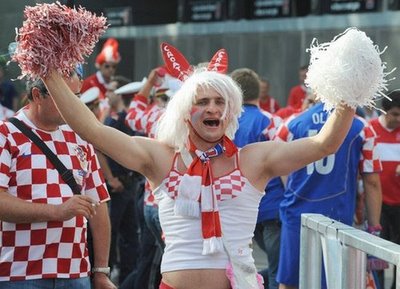
Alan's Halloween outfit was totally non-functional
The Court then turned to the first prong of the test on separability, meaning that the article would not be a useful one, but only conveys the items appearance.  As illustrated by the Court's discussion, both appellate and first instance courts have struggled to formulate a concise and uniform approach in determining what would amount to a 'useful article'. The Court moved on to applying what they considered to be the correct approach, which would be applying a number of questions based on the Copyright Act itself. These questions are effectively to ask whether the design is "…a pictorial, graphic, or sculptural work", and if so, whether the design is a useful article within the definition above. The Court would then have to ask "…[w]hat are the utilitarian aspects of the useful article", which can include several aspects (for example, aesthetic, functional and non-functional elements).
Once the Court has identified the relevant utilitarian aspects of the design, it would then finally move onto assessing whether "…the viewer of the design [can] identify pictorial, graphic, or sculptural features separately from... the utilitarian aspects of the useful article", and if these features could exist separately from the design itself (i.e. are removable from the design and don't impact its functionality). If either one, or both, of the final questions fails, the design is not protected by copyright.
The Court subsequently moved onto its consideration of the copyright protection for Varsity Brands' designs. They quickly answered the first two questions in the affirmative, expanding on the second question that the designs, represented in sketches of the uniforms, have an "intrinsic utilitarian function that is not merely to portray the appearance of [clothing] or to convey information". They then set out the particular utilitarian aspects of the designs, which were to "cover the body, wick away moisture, and withstand the rigors of athletic movements". The Court rejected Star Athletica's assertion that the uniforms, through a decorative function, would not be copyrightable, as, rightfully so, this would cause artworks and other similar works to not be protected by copyright by virtue of their decorative function
Finally, the Court sought to answer the final two questions. In determining the separability of the pictorial, graphic or sculptural features (particularly the arrangement of stripes, chevrons, zigzags, and color-blocking), the Court saw that they could indeed be separated, as they do not enhance the uniform's functionality, and the uniforms remain fully identifiable even in the absence of this stylisation due to its distinctive shape. Additionally, purchasers would be able to distinguish each style from each other, and choose accordingly, making the designs separate and individual and therefore protectable. Even so, would they still exist independently of the utilitarian aspects of the uniforms, even if separable? The Court said yes, as the features could be incorporated into a number of garment styles, even if they are not meant for cheerleaders (meaning the designs are transferable), and do not affect the uniform's functionality for those purposes even if used or not. Following the answers to the questions the Court ultimately determined that the designs were copyrightable.

The Court distinguished this from the design of a dress, which, through its shape rather than a mere graphical addition adorning its surface, as its shape, cut and other features are "…inextricably connected with the utilitarian aspects of clothing" and thus can't be identified separately. This illustrates the difference in protectability for fabric designs and dress designs.


As is clear the US courts desperately need a unifying precedent to determine what the correct test is in relation to useful articles and the extent of copyright protection thereof. The Supreme Court's decision is still forthcoming, and this writer will be curious to see whether they follow the Court of Appeal's test, or formulate a different one entirely.

04 May, 2013

Retrospective - Fair dealing in modern Canada

What are the limits to what you can do with copyrighted material that you've bought? The degree of freedom can vary quite a bit, even within the common law system itself, ranging from more restrictive (and, quite frankly, out-dated) levels of fair dealing such as in the UK, to the broad fair use of the United States. The position of fair dealing in common law countries took a huge leap in the beginning of the new millennium, in the frozen North of all places.

The land of maple syrup, lumberjacks, and apparently fair dealing
The hallmark case of the early 2000s in the development of fair dealing and its application in Canada was CCH Canadian Ltd v Law Society of Upper Canada which not only shaped subsequent legislation, but changed the approach taken to fair dealing within the judiciary. The case was one of several where the Supreme Court of Canada flexed its muscle and actively developed the interpretations of fair dealing provisions in Canada.

To provide the case with some exposition, fair dealing essentially is a set of categories through which copyrighted material can be used. In Canada, the UK and Australia fair dealing is restricted to fixed categories, such as criticism and review, study and research, and the reporting of news, with the US standing alone with a much broader, open-ended policy of fair dealing (in the US referred to as 'fair use'); leaving out set categories and opening up fair use to a much wider interpretation and application by the judiciary. One could describe the former jurisdictions as a feeding bowl approach, where the acts allowed are merely provided as exceptions as opposed to being intrinsically embedded in the copyright provisions or copyright itself as a concept. What this means is that essentially the exceptions are treated as leftovers, or in another sense inferior to that of the rights in copyright and their execution. The US legislation takes a much more lenient approach, evaluating the possibly infringing act through its nature and purpose, clearly allowing for more wiggle-room and judicial interpretation than its counterparts.

The case of CCH dealt with the copying of legal materials for practitioners and law firms within Ontario, seldom including other parts of Canada as well, where cases, legislation and other works were copied and sent to their customers for a fee. The Law Society also offered photocopying services for anyone wishing to copy the materials themselves. CCH Canadian took exception to this use of copyrighted material, some of which were owned by them, and sued the Law Society for copyright infringement. The matter went as far as the Supreme Court of Canada, where the case dealt with a number of issues, but the more influential of which considerations over fair were dealing under the Canadian legislation.

One quote in the case, albeit not directly related to the fair dealing discussed, from the case of Théberge v Galerie d'Art du Petit Champlain Inc by Justice Binnie, showcasing the Court's attitude towards copyright quite well:

"The Copyright Act is usually presented as a balance between promoting the public interest in the encouragement and dissemination of works of the arts and intellect and obtaining a just reward for the creator (or, more accurately, to prevent someone other than the creator from appropriating whatever benefits may be generated)... The proper balance among these and other public policy objectives lies not only in recognizing the creator’s rights but in giving due weight to their limited nature."

What this approach does differently is discuss the limited nature of the rights, whereas often the rights of authors and content creators alike is treated as absolute while fair dealing is purely annexed to those rights. The balancing of public interest and rights is imperative when considering fairness, which is an operative part of all fair dealing. If balance between people’s interests and their rights is not struck real fairness can never be attained.

In its deliberation of fair dealing the Court formulated the approach that should be taken when assessing proper fair dealing, more specifically fairness in that dealing, using both the US legislation discussed above and the English case of Hubbard v Vosper and set six factors that need to be assessed in determining the fairness in fair dealing; (1) the purpose of the dealing; (2) the character of the dealing; (3) the amount of the dealing; (4) alternatives to the dealing; (5) the nature of the work; and (6) the effect of the dealing on the work. In their decision the Law Society had not infringed copyright and their actions fell square within fair dealing. The purpose of the dealing refers to a possible commercial or defamatory use of the works, while its nature also plays a part in the deliberation, that being whether the work is published or confidential for example. Amount refers to how much of the work was copied, be it a page from a book or the entire work; the more copied, the more likely it will not be a fair amount. Would copying the work be something that has to be done, with no alternatives, or would other ways of accessing or using the same or similar material be available, and at what cost or effort would this come at. Finally whether the copying has a detrimental effect on the work or its sales has to be considered, with a satiric work clearly not affecting a factual work’s sales in the same market. The terms themselves are left relatively open, providing space for deliberation and interpretation on a case-by-case basis.
The vigilant guardians of copyright

Without diving too deep into the specific findings of the Court, one conclusion can be drawn from the outcome and the language used; the Court changed the approach often taken in copyright from a rights holder emphasized approach to a user-centric approach. As stated before showed a change of attitude within the judiciary, placing fair dealing not merely as an allowance provision, but as a set of intrinsic user rights that existed by virtue of the public's need to use their legally purchased material in ways which were not foreseen in the drafting of earlier laws. What the Canadian Supreme Court did was bring fair dealing closer to the 21st century, and brought it back into life. 

This case and ones after it spurred the Canadian Parliament to act and a piece of legislation was introduced, the Copyright Modernization Act, which brought the old laws more in line with the Internet, clarified the position of internet service providers and permitted certain acts of copying by consumers.

23 April, 2013

Can human genes be patented? The US Supreme Court starts its deliberation

Patents relating to medicine or medical treatments often don't come without controversy. Should we allow the patenting of essential medicines or treatments, which if provided cheap enough could save countless lives, or ease the suffering of many? What about the monetary interests of parties who've sunk millions into research and development, should we prevent them from recouping that investment? One of the more interesting, and possibly more important decisions in patents was put forth to the US Supreme Court on the 15th of April, when oral arguments for the case were heard.

Not the genes you were thinking of
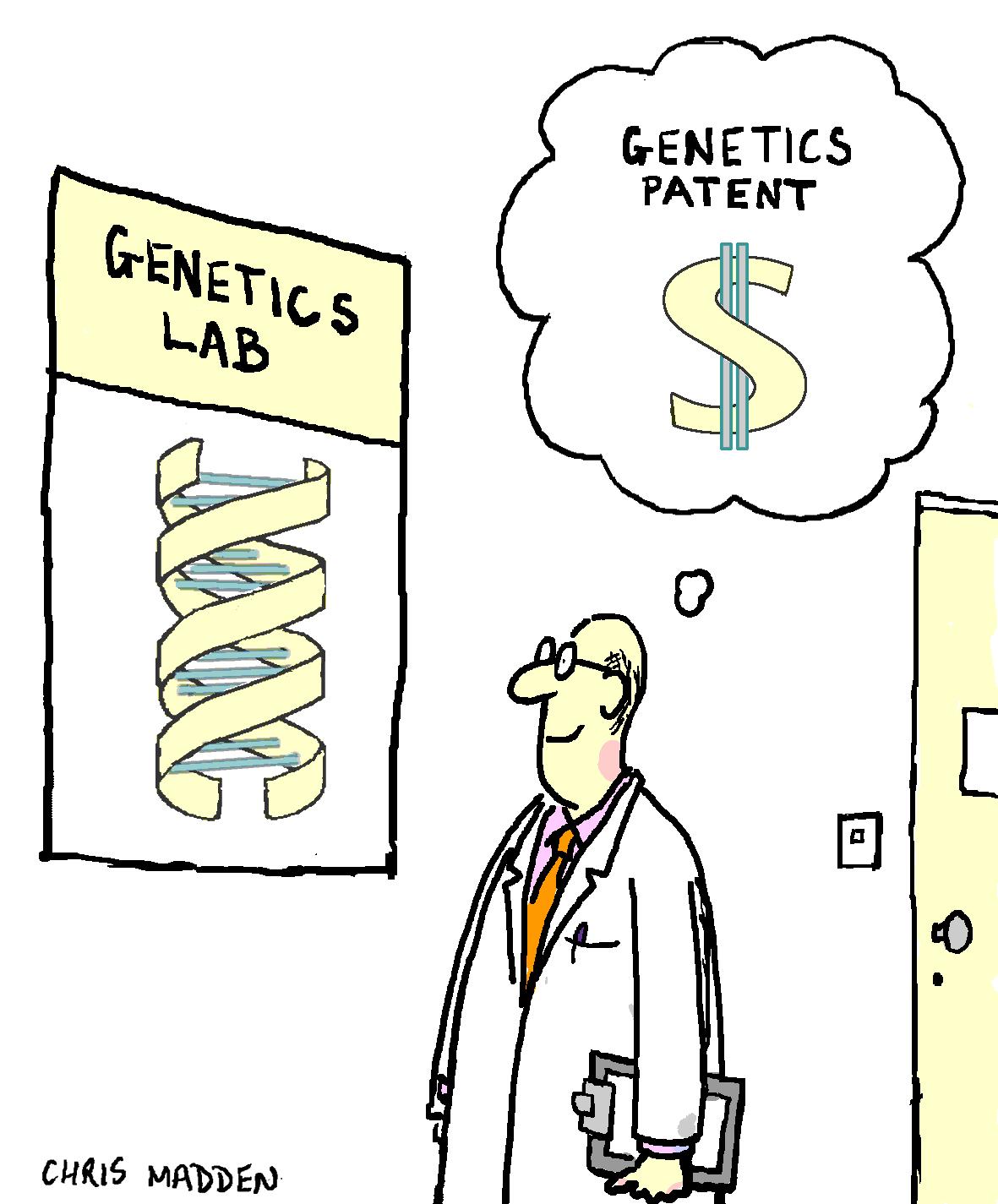
The case of Association of Molecular Pathology v Myriad Genetics put forward the question of whether human genes could be patented, more specifically, genes relating to the increased risk of both ovarian and breast cancer in women in mutated. Myriad Genetics sought to patent the genes after their discovery, which was subsequently contested. 

This presents an incredible dilemma where monetary interests clash with what is intrinsically a part of you; your own genes. Should the investment of billions of dollars go to waste, or should companies be allowed to patent something which is present in humans without any outside interference? Also would the patentability of genes hinder future cures or therapies related to those genes to prevent ovarian or breast cancer? At the end of the day the act of balancing interests is a tough one. If billions of dollars spent on research and development can be made useless due to gene patents being unpatentable, companies will have less incentive to go about this research, or might even cause serious financial harm to them. On the other side is companies having monopoly rights to something arguably occurring naturally; your genes. Should any legal entity have the exclusive rights to parts of the human genome? There are two ways of looking at this question: as a lawyer, I can say it is very possible that companies could patent genes, but as a human being, I’d want that type of information to be accessible to anyone, not under the supervision of a company.


Experts have stated that such patents have "...faded in importance" and that the law suit "...will be much more ideological than it will be practical". This is probably because there is very little use for an isolated gene or its analysis. The average consumer will never need the genes in question analyzed, and the few researchers that will use them probably will come few and far between. In addition the patents in question will expire in a few years, effectively rendering the nullification of the patents through litigation nothing but a matter of principle for the Association of Molecular Pathology. Precedent will surely prevent the future patenting of human genes, should the Supreme Court decide so, but the real monetary interests of companies lie in medicines, not genetics.

(Source)
What the court has to decide is whether an isolated gene would be patentable as an isolated item, being sufficiently different from the genes found in your individual cells, or that they are purely a product of nature. The New York Times indicated that a fifth of the 20,000 genes found in the human body are patented, clearly showing that this has been an accepted practice for a while in the US. The US Government presented the courts with a statement expressing their opinion that human genes should not be patentable, showing support for the idea that they are indeed a natural occurrence, or the very least a subject matter that should not be covered under patents.

Indeed this case will present the Justices an interesting subject matter to tackle, and I for one will be waiting for their judgment with excitement. What seems to be the more probable outcome is the allowance of the patents, as decisions in both the UK and Australia (subject to further appeal) have been decided to favor the patenting of genes. What the US Supreme Court decides will undoubtedly influence later decisions in other jurisdictions, giving the case still the clout it deserves. 

18 April, 2013

The First Sale Doctrine takes a hit - you can't resell digital music

The anticipation of whether the Kirtsaeng v John Wiley and Sons would change the way in which we're allowed to resell our legally purchased goods (discussed on this very blog here) was huge, both in the legal world, and in the minds of consumers just aching to sell off that CD collection bought in Europe. Well, it looks like we've taken the first step towards the limitations of the First Sale doctrine.

A US Federal Court handed down its judgment in the case of Capitol Records v ReDigi Inc at the end of last month. The case concerned the resale of digital music bought on iTunes or other digital marketplaces through the service offered by ReDigi, where users could sell their legally acquired smash hits to others who are looking for said music - much like a digital flea market if you will. The company was then sued by Capitol Records for copyright infringement.

The case in itself presents and interesting view of whether the First Sale doctrine could be applied in a digital world. Kirtsaeng dealt with the resale of physical goods, i.e. books, whereas the resale of digital goods would require the transfer of a new copy from the original music file through ReDigi's service. This is the reason which felled ReDigi's argument in the eyes of the court. The US Copyright Act  mentions a 'specific' phonographic record (a fancy way of saying a music recording), and making a copy from the original would not be within the remit of the doctrine. In ReDigi's defense they did argue that "technological change has rendered its literal terms ambiguous...", which in this writer's mind would be a valid point. If the copy could be traced to a legitimate copy, that should surely allow for it to be sold regardless of it being in a physical medium or not. Alas ReDigi's argument was rejected, and from a lawyer's perspective that holds to be true. The Court further noted a provision in the Digital Millenium Act which effectively prevents the redistribution of digital works. The Judiciary is not in the place to change laws, but to merely interpret them, and the approach taken by the Federal Court seems to be right in this case.

Spending all that money on vinyl finally paid off!
Here the law perfectly illustrates its dated approach to copyright law, having been enacted well before a time where such transfers of music or any other digital medium were even possible. Discussion in most common law countries over needed changes to the law, as noted on this blog as well, has been very active in the last few years, and cases such as this do highlight this fact very well. Should we be able to sell the goods we legally buy regardless of their tangible or intangible nature? Of course, especially when more and more music is being sold digitally than ever before. As it has been said before the gauntlet has been thrown to the legislatures of most common law countries to modernize their approach to copyright in current times. Whether they will act on this call to action remains to be seen, but as more and more commercial interests shift to the digital arena, the pressure for them to act will grow and change should come.

05 April, 2013

Grumpy Cat frowns at a possible trademark

Paris Fashion Week anyone?
As it has been said on this blog many times, the Internet has shaped the sphere where people can reproduce material easily as they see fit, regardless of its legality or not. There are websites dedicated to printing images onto t-shirts, coffee cups, plates and pretty much anything you can think of that just "needs" an image of something to make it worth your honest dollar. Merchandising often is a huge part of a brand's profits, after all, who doesn't find a Winnie the Pooh onesie an essential part of their wardrobe? Trademarks more often than not prevent people from profiting from the misuse of their trademarked image in the making and selling of products such as the above. But where does the line of what can be trademarked end?

Trademarks can be awarded to a potentially any image, and the latest and the greatest seeking one is the Internet's favorite upset kitty, Grumpy Cat. For the less informed, the cat oddly named Tardar Sauce, rose to fame over a year ago due to its constant look of disappointment at anything it might be in contact with. Its owners, rightfully so, launched a website dedicated to their aggravated feline companion, selling a number of items adorning its famous face. Without a trademark, others could potentially use the cat's image, create their own merchandise to sell, and thus benefit from the rise to fame that the cat has so thoroughly "enjoyed".

What the cat's owners are seeking is protection for both the name "Grumpy Cat" and its likeness for use in a very wide array of things, even kitchen utensils (why anyone would want to see the look of disappointment when eating their goulash, I don't know). The application is still pending, having been lodged in late January, we will have to wait and see whether the trademark is awarded. In this writer's opinion this will be an interesting result. Would the face of a cat be distinct enough for it to be trademarked? Surely cats' fur color and other details are fairly 'random', albeit controlled by genetics - however in this case the cat's facial features are incredibly uncommon (this writer has never seen a cat much like this one in his life), and might because of that be trademarkable. Come what may, Tardar Sauce will surely be unhappy with the outcome.

Grumpy Cat didn't approve of this blog post
The application in itself is not very important, but goes to show just how widely trademarks can be, and are, used in today's marketable world. Does it have worth in merchandising or otherwise? It might just be worth trademarking.

01 April, 2013

The Register’s Call for Updates to US Copyright Law

Not to be confused with a copyrighted seal
Being one of the biggest producers of copyrighted material in the World, the United States and its laws have clout all over, regardless of jurisdictions, through either free-trade agreements, or sheer market power. In a society where more material is accessed outside of the domestic market of a nation than ever, legislatures in all countries have to try and keep up with the constant change that we experience in the consumption of said material. In a call for copyright law reform, as reported by the Creative Commons blog, Maria Pallante of the US Register of Copyrights seeks to close the rift that exists between the consumer and the copyright holder's rights in the United States today.

In her statement Ms. Pallante says that:
"The law is showing the strain of its age... authors do not have effective protections, good faith businesses do not have clear roadmaps, courts do not have sufficient direction, and consumers and other private citizens are increasingly frustrated."
This can be applied, not only in the US, but in Europe as well. With a clear lack of proper guidelines and laws to govern both personal use by consumers, be it copying or sharing, and the courts stretch existing laws to cover areas which they were not meant to cover. Copyright laws in most common law jurisdictions are lagging behind, and there seem to be no efforts in trying to pull them towards a new era. Even in the United Kingdom there have been calls for reform, yet they seem to have fallen on deaf ears.

Orphaned works are a perfect example of the law failing to accommodate the needs and wishes of today's public. Orphaned works are effectively works which are still under copyright, where the author(s) or other copyright holders cannot be located or contacted. Google started the mass digitization of orphaned works, and faced litigation because of this, showcasing the clash of the interests of those holding the rights to the works and not utilizing them, going against the greater good through free access to these works. Should copyright prevent access to information not being used, or move towards an avenue more akin to that of trade marks, where the rights holder should actively use the work being protected? The current legal framework does not address this issue.

Ms. Pallante further expands that:
"...it is time for Congress to think about the next great copyright act, which will need
to be more forward thinking and flexible than before... A central equation for Congress to consider is what does and does not belong under a copyright owner’s control in the digital age. I do not believe that the control of copyright owners should be absolute, but it needs to be meaningful."
Flexibility is what the modern age requires. When technology moves at such a pace that it does these days, the new law would have to be flexible and maneuverable, both to protect the interests of copyright holders, and to help consumers use the content they have legally acquired. The path modern laws have taken in a variety of nations has been increasingly draconian, and in this writer's opinion, this trend needs to end.

The new law needs to be worded in anticipation of the ever more digital world, with the old laws concentrating on the physical mediums of copyright, the new law has to look forward to the intangible. The wording has to be open enough for the judiciary to easily apply it in a variety of situations, while being specific enough to protect the interests of rights holders. I will admit this will be a challenge for any legislature, but one where consultation needs to be sought from both sides, not merely from the ones with a clear monetary interest.

Ms. Pallante also brought up the main question that needs addressing in the new law:
"If Congress considers copyright revision, a primary challenge will be keeping the public interest at the forefront, including how to define the public interest and who may speak for it... Congress should look to the equities of the statute as a whole, and strive for balance in the overall framework. It is both possible and necessary to have a copyright law that combines safeguards for free expression, guarantees of due process, mechanisms for access, and respect for intellectual property."
Rounding up her argument, Ms. Pallante points out that:
"The issues of authors are intertwined with the interests of the public. As the first beneficiaries of the copyright law, they are not a counterweight to the public interest but instead are at the very center of the equation."
The Harlem Shake, an example of "proper" free use of copyrighted material
This writer fully agrees with Ms. Pallante in her call for reform - not just in the US, but all over the common law. The interests of the public, and rights holders, are of equal standing, and the shift towards a more common and level playing field for both parties needs to be taken. The consumer has to have rights in using the material they have rightfully acquired, yet still keeping them from freely copying and sharing that content to provide an illegal way for others to get that material. Whether this call for reform will result in any changes remains to be seen, but this writer will remain hopeful.

27 March, 2013

Retrospective - Where it all began

The history of IP law is a colorful one. The changes it has undergone and how the rapid evolution of both the creation and sharing of ideas and expression has made the landscape where the law operates very different to what it was when it all started.

Copyright

Queen Anne was a fan of books, and a snappy dresser
Great Britain was the first nation to enact a law which regulated copyright, instead of it being handled by the parties involved without any government interference, mainly the Stationers' Company. The law in question was the Statute of Anne 1710. The law sought to encourage learning and advance it through the limitation of certain rights in books, ones which echo even today's legislation, although very faintly: it gave the rights to print and copy published material to its creators, not the publishers of the books. This was a significant move from a system that lasted for almost 50 years. Copyright didn't exist automatically in any works, unlike like today, but all works needed to be registered for any rights to exist in that material. The Statute of Anne was a major piece of legislation until its repeal through the Copyright Act 1842, lasting for well over 100 years. The Americans largely followed the Statute, although it is still disputed whether they actually did. This lasted till the enactment of the US Constitution.

Patents

Most of the Commonwealth countries have their patents laws base on the Statute of Monopolies 1623. It is seen as the first real law dealing with patents, both in the United Kingdom, and through it subsequently adopted in one form or another in its former colonies. It both abolished old patents existing before the law, during and in the future. It also restricted the application of patents and set strict limits to who can give them. The Statute was a major change, and is one of the most important pieces of legislation in the history of patents. The US, yet again not wanting to conform, did not follow the Statute of Monopolies as such, however their use of patents in commerce is believed to have stemmed from the law. The US Constitution set out broad principles for all IP matters, which also dealt with patents, however more specific legislation was enacted both in individuals States, and finally on a Federal level in 1790. Patents have since gotten more specific and complex, yet the heart of the original laws still remain.

Trade Marks

A relatively late bloomer in the sphere of IP legislation, trade marks did not have any codified protection until the Merchandise Marks Act in 1862. The old law, much like copyright and patents, also echoes the sentiment of current legislation, although speaking of "defrauding", which is not used in today's laws. The United States, much like the UK and its colonies, protected trade marks through the common law (meaning no laws protected them specifically, but unwritten customs and precedent), until the enactment of the Trademark Act 1881

Designs

The first instance of designs protection was in the UK, with the enactment of the Designing and Printing of Linen Act in 1787. The Act, as its name so implies, dealt with the designs related to a number of different fabrics, and only offered protection for a measly two months after printing. The Act was expanded on almost 50 years later, in the Copyright and Design Act 1839, taking designs protection further than the textile industry alone, and introduced a system of registration for designs.

As you can see, the roots of IP law are deep in all common law countries. What it was a few centuries ago can still be seen in today's laws, and the impact their development has had, and continues to have, on people and their expression is profound. Most of them were protected well before the enactment of specific laws relating to them through the common law, so their roots go even further if you go beyond laws alone. 

25 March, 2013

You bought it, you own it - The First Sale doctrine in the US Supreme Court

The American Supreme Court delivered its judgment a few days ago on a case which was long anticipated to possibly change the landscape where copyright exists, both in the US and globally. And it possibly might have done just that.

Kirtsaeng v John Wiley & Sons set an interesting precedent in the world of reselling a copyright work you have legally purchased, once you're done with the item. The case itself dealt with the resale of College textbooks by Mr. Kirtsaeng, which he brought over from Thailand, having been sold there for significantly less than in the US, making this the perfect opportunity for him to make a quick buck, while retaining the moral high-ground of helping his fellow students saving said buck (to use on nice things, I'm sure).

In previous years, had you done just what Mr. Kirtsaeng did, you would've been sued for copyright infringement the moment you brought the books over into the US and attempted to sell them. How was this allowed, even if you legally bought the books and merely brought them over to sell what's yours? This is due to the interpretation of the First Sale doctrine in the US Copyright Act under section 109, which states that: "the owner of a particular copy [of a copyrighted work]... lawfully made under this title, or any person authorized by such owner, is entitled, without the authority of the copyright owner, to sell or otherwise dispose of the possession of that copy..." When looking at the language of the section in itself, one cannot understand why it would act exactly against what it plainly says; that a person can sell what he has legally purchased without asking the copyright holder's for permission to do so. The interpretation of the section limiting it only to copies bought within the US was yet another Supreme Court statement in a different case, Quality King v L’Anza Research International. In the case the Supreme Court found that the definition of section 109, albeit stated purely as dicta (a legal term meaning it was not a matter contended in the case itself, but is merely a statement of opinion as to what the law is, making it non-biding in future cases, but can be used as a persuasive argument), that it would prevent the sale of copies in the US bought outside of the US itself. This definition has since been used to do exactly what Mr. Kirtsaeng contended. The outcome allows a person to sell what's rightfully theirs, even if it was bought outside of the US (though the copy has to be a legally made one, authorized by the copyright holder - I'm looking at you, bootleg CDs, videos and the like!).


These kids paid nothing for their books
So what does this mean for the consumer or the media industry? It will remain to be seen. Whether it will change the pricing dynamic in the US, bringing prices more closer to foreign ones if cheaper, is something that only time will tell. Will consumers take this and run with it? Will companies act preemptively to undercut their own prices to match those in cheaper countries? Personally I can't really say. With college textbook prices increasing over 600% since the 1990s, one can only hope the benefit will be to the end consumer, even in other categories of media.