Showing posts with label supreme. Show all posts

09 August, 2023

A Can of Copyright - US Supreme Court Rules on Fair Use in Andy Warhol's Work

From the iconic lithographic cans of Campbell's soup to the Marilyn Monroe, Andy Warhol's art is iconic and one that most (if not everyone) recognises. However, with success and notoriety comes potential legal battles, particularly if artists "take inspiration" from works of other artists. In the US the doctrine of fair use is very broad and can encompass several acts, but it's remit in relation to more direct copying as 'inspiration' has been hazy. A recent, and rare foray into the realm of the US Supreme Court was set to make matters clearer, and the awaited decision was indeed handed down earlier this Summer. 

The case of Andy Warhol Foundation for the Visual Arts Inc. v Lynn Goldsmith concerned the aforementioned iconic art of Andy Warhol, namely his lithographs of the music artist Prince. The lithographs used a picture taken by a famous photographer in her own right, Ms Goldsmith, in 1984 for Vanity Fair magazine as an "artist reference". Ms Goldsmith had licenced the picture to Vanity Fair with the strict condition that it only be used once in the magazine. Mr Warhol created 15 lithographs of Prince in total, and later his Foundation licenced one of those works to Conde Nast for a story about Prince. Ms Goldsmith subsequently informed the Foundation that they had infringed her copyright in her picture, which then lead to the Foundation suing Ms Goldmith asserting fair use. The lower courts have reached differing outcomes on the matter, which lead to the case ending up in the Supreme Court for final decision.  

The Foundation did not challenge the conclusion made by the Court of Appeal that the lithograph and the series of works created by Warhol are substantially similar. This left the question of whether Mr Warhol's use of the photograph was 'fair use'. In addition, the only factor within the assessment of fair use remained the first factor, i.e. whether "the purpose and character of the use, including whether such use is of a commercial nature or is for nonprofit educational purposes" weighs in Ms Goldsmith's favor or if the work would be considered 'transformative'.

The first factor specifically looks at whether, as has been firmly established in Campbell v Acuff-Rose Music Inc: "an allegedly infringing use has a further purpose or different character, which is a matter of degree, and the degree of difference must be weighed against other considerations like commercialism". This means that even though the expression may be new (as the Foundation argued), it, by itself, is not enough to deal with the first factor. 

Justice Sotomayor, handing down the majority's decision, focussed on the meaning of the first factor at issue. She noted that it "considers the reasons for, and nature of, the copier’s use of an original work", and specifically asks "whether the new work merely ‘supersede[s] the objects’ of the original creation… (‘supplanting’ the original), or instead adds something new, with a further purpose or different character". In other words, does the new work 'substitute' the other work, or is its purpose the same or highly similar to that of the original work. 

The preamble to section 107 of the US Copyright Act does give helpful guidance on what may be included in this factor, which includes, but is not limited to: "criticism, comment, news reporting, teaching… scholarship, or research". The similarly will be a degree of similarity, rather than a clear cut similarly assessment, so the Court will not restrict itself to just these categories. 

If a use has a further purpose or different character it is deemed to be 'transformative', which is, yet again, a matter of degree. However, there is a minimum threshold for transformative use, specifically that the "degree of transformation required to make “transformative” use of an original must go beyond that required to qualify as a derivative". 

To summarize a very lengthy and detailed discussion of the minutiae of the definition of the first factor, Justice Sotomayor summarized it as: "the first fair use factor considers whether the use of a copyrighted work has a further purpose or different character, which is a matter of degree, and the degree of difference must be balanced against the commercial nature of the use. If an original work and a secondary use share the same or highly similar purposes, and the secondary use is of a commercial nature, the first factor is likely to weigh against fair use, absent some other justification for copying".

Justice Sotomayor then moved on to considering whether the particular 'use' of the protected works would be an 'infringement'. 

Ms Goldsmith's pictures were used in a variety of ways: (i) to create the Vanity Fair illustration and the other Prince Series works; (ii) Vanity Fair then used the photograph when it published Warhol’s illustration in 1984; and (iii) the Foundation used the photograph when it licensed an image of Warhol’s Orange Prince to Condé Nast in 2016. However, only the latter 2016 use has been argued to be infringing. 

Typically photographs, such as Ms Goldsmith's, are used accompanying articles relating to the given celebrity or subject. As such, the use by Condé Nast and the Foundation in 2016 was substantially the same. The use was also clearly of commercial nature, as the images were licenced from the Foundation, weighing against a finding of fair use. Taken together these factors weigh against fair use absent some other justification for copying, i.e. any transformative nature of Mr Warhol's work.

Justice Sotomayor then moved on to considering whether Mr Warhol's work was transformative. As described in the Campbell decision, as mentioned above, transformative use is one that "alter[s] the first [work] with new expression, meaning, or message". Agreeing with the Court of Appeals, Justice Sotomayor noted that "any secondary work that adds a new aesthetic or new expression to its source material is necessarily transformative", however, the courts should not attempt to evaluate the artistic significance of a particular work. 

The key, in the Court's view, is what the purpose of the new, potentially transformative work, really is and if the use is distinct from the original. In this case, the licensing of the lithographic image by Condé Nast is similar to the use of the original work, namely as illustrating a magazine about Prince (although acknowledging difference between them). 

Justice Sotomayor noted that "[t]o hold otherwise would potentially authorize a range of commercial copying of photographs, to be used for purposes that are substantially the same as those of the originals". 

Despite arguments made by the Foundation, the Court rejected their argument that the Warhol lithographic was commentary on the dehumanizing nature and effects of celebrity. According to Justice Sotomayor, the commentary could not stand on its own two feet, and the commercial use of it required compelling reasons to see otherwise.  

Ultimately, the Court held against the Foundation, determining that "Goldsmith’s original photograph of Prince, and AWF’s copying use of that photograph in an image licensed to a special edition magazine devoted to Prince, share substantially the same purpose, and the use is of a commercial nature[, and]  AWF has offered no other persuasive justification for its unauthorized use of the photograph". This means that the first factor would weigh in favor of Ms Goldsmith. 

The scathing dissent by Justice Kagan highlights the contentious nature of this decision, and its potential impact on both copyright holders and artists trying to take inspiration of other works. The decision does limit the scope of artistic inspiration in the world of fair use, and potentially may have a cooling effect on art creation (though this remains to be seen). It does, however, add further weight to the copyrights held by individuals and entities, which they will undoubtedly receive with open arms. As said, the impact of the decision will be interesting to see and whether more derivative, or 'inspired' works will be litigated in the future. 

18 July, 2017

Less Offensive - US Supreme Court Takes on Disparaging Trademarks

Issues surrounding race are incredibly difficult and complex things, and clearly have no single answer to address them fully. Many efforts have been made to address various nuances of race and racial negativity, one of which is the prevention of the registration of trademarks in the US that could disparage individuals of a given race. Even so, trademarks exist that could be deemed to be offensive and disparaging (more on which here and here), and this has created a great deal of discourse on their continued existence, and similarly on the registration of other potentially disparaging marks. Should these types of marks be allowed, or should society move on and reject all trademarks that might be considered disparaging? The US Supreme Court endeavoured to answer this question once and for all this summer.

The case of Joseph Matal v Simon Shiao Tam dealt with a rock band, The Slants, who sought to register their name as a trademark in the US. The term "slants" is a derogatory term for persons of Asian descent, and the band sought to, through the use of the negative term as their moniker of choice, to reclaim it and take away its negative meaning. After filing their application for the trademark, the USPTO denied the application on disparagement grounds under 15 USC section 1052(a). The band, under the name of its lead singer Mr Tam, challenged the ruling and took the matter all the way to the Supreme Court.

The crux of the case remained that would the clause preventing the registration of disparaging be unconstitutional, particularly in terms of the First Amendment right to free speech.

At first, after setting out the legislative history of trademarks, Justice Alito (delivering the majority's opinion) considered that, while there is a valid registration system for trademarks, one does not have to register a mark to enjoy its use. In the same vein, the marks can be protected on a federal level under the Lanham Act, particularly through common law rights in those marks. Even so, certain rights are conferred to the holders of the marks through registration, and it does therefore add value and further protections over those marks, making registration very important.

Justice Alito then moved onto the test of whether a trademark is disparaging. This is whether "…the likely meaning of the matter in question, taking into account not only dictionary definitions, but also the relationship of the matter to the other elements in the mark, the nature of the goods or services, and the manner in which the mark is used in the marketplace in connection with the goods or services… [and] whether that meaning may be disparaging to a substantial composite of the referenced group". Even if the applicant is of the 'disparaged' group of people does not negate any possible findings under the test. At first instance, both the USPTO and the Appeal Board determined that the mark sought was indeed disparaging.

Before discussing whether the clause is unconstitutional or not, the Court had to first look at whether the mark was, as determined at first instance, disparaging. Tam argued that, while the disparagement provision speaks of 'persons', it cannot apply to non-juristic entities such as ethnic groups, but only to natural and juristic persons (i.e. individuals and not undefined, albeit legally defined groups). The Court swiftly rejected this argument, as Tam's narrow construction does not match with that of the provision of USPTO's definitions, which set out much broader terms, speaking of not just 'persons', but also 'institutions' and 'beliefs'. Therefore, as the Court concluded, disparagement can apply to non-juristic entities just as well as juristic entities.

Justice Alito then moved onto the main focus of the case, i.e. the constitutionality of the disparagement clause itself.

Washington's newest football team's logo (trademarked of course)
The first arguments circled around whether trademarks are government speech, not private speech or a form of government subsidy. As a primer, all government speech is exempt from First Amendment scrutiny, and can therefore say whatever it pleases (at least in theory). Even though trademarks are registered by the USPTO, the office does not itself regulate what the message of each mark is, unless it is considered disparaging under the provision. The viewpoint of any particular mark is irrelevant, and registration does not mean approval of the mark by the government. Justice Alito rejected the cases referred to in the matter, and concluded that the registration of a mark is not government speech, but private speech. In her view: "…if the registration of trademarks constituted government speech, other systems of government registration could easily be characterized in the same way". She also aligned the matter with copyright registration as "…if trademark registration amounts to government speech, then copyright registration which has identical accoutrements would “likewise amount to government speech".

The US government also argued that precedent set shows that government programs that subsidized speech expression specific viewpoints are constitutional. Justice Alito quickly rejected this argument, since "…[t]he federal registration of a trademark is nothing like the programs at issue in these cases". While registration does, arguably at least, confer certain non-monetary benefits to registrants, it does not provide a direct monetary subsidy, which the cases discussed did.

Finally, the government argued that the disparagement clause should be sustained applying only in cases that involved 'government-programs'. Justice Alito, again, rejected this argument, setting out that "…the public expression of ideas may not be prohibited merely because the ideas are themselves offensive to some of their hearers". The Court deemed that you cannot discriminate against a particular viewpoint, and the disparagement clause does do so, even if the subject matter is potentially offensive to a given group of people. The Court therefore concluded that "…the disparagement clause cannot be saved by analyzing it as a type of government program in which some content- and speaker-based restrictions are permitted".

The Court then finally moved onto the question of constitutionality. whether trademarks are commercial speech, and therefore can be restricted under limited scrutiny under Central Hudson. The case allows for a restriction of free speech that has to "…serve a substantial interest and it must be narrowly drawn". Justice Alito concluded that the clause fails the Central Hudson scrutiny on the outset. It was also argued that it serves two interests, including protecting underrepresented groups from abuse in commercial advertising. The Court dismissed this interest, as the First Amendment protects even hateful speech. The second one is protecting the orderly flow of commerce, where the trademarks, through their offense, prevent or reduce commerce through their use. Justice Alito dismissed this argument as well, as the disparagement provision is not 'narrowly drawn' to prevent the registration of only trademarks that support invidious discrimination, while applying to a very broad type of people, including the dead. In her final view "…If affixing the commercial label permits the suppression of any speech that may lead to political or social “volatility,” free speech would be endangered". The Supreme Court therefore deemed that the disparagement clause violates the First Amendment.

The case is a hugely influential one, which opens the door for a myriad of trademarks, particularly those that are offensive or have the potential to cause offense. Free speech is a double-edged sword, and an American near free-for-all free speech is a source of pride, but can cause issues for those who face abuse or humiliation at the hands of those using that right. The case will also have a knock-on effect in the Redskins litigation, undoubtedly clearing the path for the mark to remain registered. In the end, the Supreme Court seems to be completely right here, but this writer, being a proponent of a more limited free speech (although only for very narrow and specific exceptions), can't help but feel that this will pave the way for more offensive marks in the long term.

11 July, 2017

Results Breakdown - Canadian Supreme Court Rules on Infringing Websites and Google Search Results

When reading this case this writer pondered what he would do in a world without Google (or search engines in general). Finding information on a web that's very close to an unrestricted space is both very useful, and can produce results you never expected, both in the good and the bad. Through the sheer power of the search engine, finding details online is quite easy, and can present an ingenius searcher with plenty of legitimate and illegitimate materials. This still poses the question: should search engines have to, or be forced to, restrict their results, to prevent the infringement of someone's rights? While this question often falls due to issues of jurisdiction, the Canadian Supreme Court endeavoured to answer it in a Canadian context only last week (with the BC Supreme Court decision having been discussed here).

The case of Google Inc. v Equustek Solutions Inc. dealt with the sale of devices that allow complex industrial equipment made by one manufacturer to communicate with complex industrial equipment made by another manufacturer. Equustek have developed, manufactured and sold such devices for some time. Former employees of Equustek, having left the company, started their own competing company, which developed and sold a similar device online, over which an injunction was granted by the Canadian courts. After a long legal battle, the respondents fled Canada and abandoned the proceedings, with Equustek subsequently pursuing Google to remove the website selling the infringing devices from their search results. Having initially received the injunction (limited only to Google.ca), Google pursued the matter further in the courts, ultimately ending up in the highest court in Canada.

What the case was all about was whether Equustek could pursue a worldwide interlocutory injunction through the Canadian courts against Google and its search results.

Initially, the Court set out the three-part test that determines whether a court should exercise its discretion to grant an interlocutory injunction: "...[1] is there a serious issue to be tried; [2] would the person applying for the injunction suffer irreparable harm if the injunction were not granted; and [3] is the balance of convenience in favour of granting the interlocutory injunction or denying it. The fundamental question is whether the granting of an injunction is just and equitable in all of the circumstances of the case".

Google agreed that there was a serious issue to be tried; however, they presented a multitude of arguments for the Court against the injunction. This included that the injunction is not necessary nor would it be effective; a third-party should not be bound by an order on another party (and therefore be subject to the injunction); and that issuing an interlocutory injunction with extraterritorial effect would be improper.


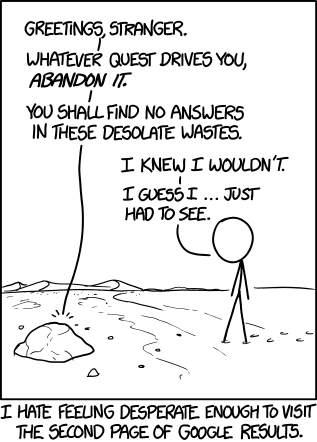
Search results - the great unknown (Source: xkcd)
Justice Abella considered that, due to the global nature of the Internet, any injunction involving multi-national, cross-border entities like Google would have to be applied globally. In short, as the majority of Google's business happens outside of Canada "...Purchasers outside Canada could easily continue purchasing from Datalink’s websites, and Canadian purchasers could easily find Datalink’s websites even if those websites were de-indexed on google.ca. Google would still be facilitating Datalink’s breach of the court’s order which had prohibited it from carrying on business on the Internet".

She also added that an interlocutory injunction, such as in this case, is therefore necessary to prevent the defendants' infringement online. Without Google's indexing of their site their business would not be feasible. Justice Abella also determined that there would be no issue with the freedom of expression, as no other nations' laws would be violated by the injunction.

The judge followed with the notion that this injunction would not affect Google's 'content neutral character', as it does not impose further monitoring obligations on the company, but merely the removal of the specified web addresses from its index. The same would not cause any undue expense on Google, which is something they already do for other illegal, more severe content online, and actively complies with DMCA notices over copyright infringement.

While the respondents' business can only thrive through Google's services, the court acknowledged that they are not responsible for the harm caused; however, Google has the power to end the harm by de-indexing the content. Ultimately, Justice Abella dismissed Google's appeal.

Two judges, Rowe and Côté, dissented from the majority's opinion, arguing that the injunction should not have been granted. In their view, the injunction's effects on Google would be final, with no recourse (unless to adjust its terms through the courts), and that Google is not a party to the dispute and should not be subjected to the injunction in question. Finally, the judges saw that the injunction is mandatory, with very little proven effect on its purpose, and the courts are presented with alternatives such as an asset freeze or injunctive relief against the ISPs preventing access to the website.

Ultimately, the case turns on the fact that it can open the floodgates for a stream of applications seeking similar injunctions, impacting both Google's business and the Canadian judicial system as a whole. The Court did leave the matter quite open, and this writer is confident that more applications will follow the decision, since, as the Court observed, Google already complies with similar obligations on a regular basis. Worldwide injunctions should not be a common weapon used, but an extraordinary one, so this writer does hope that the Canadian courts will restrict its application to only instances where they are truly needed.

22 June, 2017

Printing on the Wall - US Supreme Court Rules on Patent Exhaustion

Discussed on this blog only a few weeks ago, the US Supreme Court decision in Lexmark can have huge ramifications for both patent holders and sellers of those products all over the world. When and if at all patent rights exhaust after the sale of a product, be it in the US or abroad, is an important question and will set clear boundaries for both buyers and sellers, potentially impacting the price and availability of products and services all over the world. Many IP practitioners have been waiting for the decision by the Supreme Court, who released it only some weeks ago.

By way of a brief primer, the case of Impression Products Inc. v Lexmark International Inc. concerned the resale of printer ink cartridges, for which Lexmark owned several patents, which they also designed and manufactured. Impression Products bought used cartridges both abroad and in the US, refilled them and resold them; however, Lexmark set conditions on the cartridges during their sale, preventing their reuse and resale by other companies. Lexmark took Impression to court, and the matter ended up with the Supreme Court, who were set to decide a major point of patent law, as to when patent rights have been exhausted (if at all) after the sale of the product containing the patent rights.

The first question the Court tackled was whether the sale of the cartridges in the US did indeed exhaust their rights in the patented aspects of the goods. 35 USC section 154(a) confers the right to make and sell patented products, but the provision does not set any express limitations on the right. However, case law has established that "[w]hen a patentee chooses to sell an item, that product “is no longer within the limits of the monopoly” and instead becomes the “private, individual property” of the purchaser, with the rights and benefits that come along with ownership". The law therefore has limits on the control that a patent holder can exert on products within their monopoly. After discussing the historical context of patent exhaustion, the Court swiftly determined that "…Lexmark cannot bring a patent infringement suit against Impression Products to enforce the single-use/no-resale provision accompanying its Return Program cartridges. Once sold, the Return Program cartridges passed outside of the patent monopoly, and whatever rights Lexmark retained are a matter of the contracts with its purchasers, not the patent law".

This rationalisation makes sense to this writer, since a near perpetual, inexhaustible patent right in products, even post-sale, could have huge ramifications on the resale market, and potentially even anti-competitive uses (which the prevention of the resale of cartridges by a competitor could be construed as). The Court summarised its position on this: "…patent exhaustion is uniform and automatic. Once a patentee decides to sell—whether on its own or through a licensee—that sale exhausts its patent rights, regardless of any post-sale restrictions the patentee purports to impose, either directly or through a license".

The Court then moved onto the issue of the importation and sale of cartridges bought abroad. This question has not been addressed much under patent legislation, but has been discussed in the Supreme Court decision in Kirtsaeng, which established that the first sale of a copyright protected work would exhaust the rights in that work, even if imported from abroad and sold in the US (having been initially made and sold lawfully).

The Supreme Court faced the wrath of
patent holders after the decision
Under the common law concept of exhaustion, as discussed in Kirtsaeng, there is no territorial restriction on the fact. A sale abroad would be, arguably, exhaustion of rights within the US, and would therefore allow the importation of those goods into the US without infringement. According to the court, the copyright concept of exhaustion would not be distinguishable from patent exhaustion, as this would "…differentiating the patent exhaustion and copyright first sale doctrines would make little theoretical or practical sense [as] …the two “share a strong similarity and identity of purpose". The person buying the goods abroad is not buying the patented rights, according to the court, and that "…exhaustion is triggered by the patentee’s decision to give that item up and receive whatever fee it decides is appropriate". The court therefore concluded that Lexmark's rights were exhausted when the cartridges were sold abroad, and Impression would not be infringing their rights by importing the goods to the US.

Justice Ginsburg was the only judge to dissent. In her view, patent rights were purely territorial, and that "…[b]ecause a sale abroad operates independently of the US patent system, it makes little sense to say that such a sale exhausts an inventor’s US patent rights". This would open the door for competitors to potentially sell those patented products in the US with no legal recourse by the patent holder. Arguably, Justice Ginsburg's perspective is wholly justifiable, and this writer would raise concerns over this fact as well. If patent rights are fully exhausted in the event of a foreign sale, there would be very few restrictions on doing exactly the above by competitors. Finally, she disagreed with the majority's application of Kirtsaeng with patent rights, as "…[a]lthough there may be a “historical kinship” between patent law and copyright law… the two “are not identical twins". The legislative framework for copyright and patents does differ, and a straightforward application of copyright concepts to patents might not be possible as the law stands today.

The decision is a very important one, and will have clear and strong implications to patent holders who rely on the retention of rights in the US, irrespective of where the products were sold. Time will only tell whether this opens the Pandora's Box of reselling "infringing" products in the US; however, this writer is certain that other avenues will be used for the sale of patented products, such as contractual vehicles, rather than relying on pure rights retention.

23 May, 2017

A Lack of Patent Exhaustion - Discussing the Lexmark Case Ahead of US Supreme Court Hearing

Many IP rights give their owners a great deal or rights and capabilities to restrict the use of their rights by other parties, and arguably, rightfully so, as the creation is indeed theirs. Even though this might be the case at face value, the use and exploitation of those rights should still have certain limitations, for example, from preventing an author from allowing certain people from reading their book after they have purchased a copy. This doctrine is called the exhaustion of rights, which means that after a certain point, the rights held by the author or owner of a technology cease to apply, allowing for the party to use their products as they please. Exhaustion of rights is still a developing area of law, and an up-coming case in the US Supreme Court has been primed to tackle this in relation to patents, with the case having ramifications both ways irrespective of the decision. Looking ahead to the decision, it is important to discuss the Court of Appeal case decided over a year ago.

The case of Lexmark International Inc. v Impression Products Inc. dealt with the sale of refilled ink cartridges for computer printers by Impression, who purchased used cartridges from abroad to refill and resell in the US (having a third-party circumvent the protection mechanism preventing reuse in the cartridges). Lexmark holds patents in relation to these cartridges, and most of the cartridges had strict single-use/resale restrictions set by Lexmark both in the US and abroad. Impression had not sought permission to resell the cartridges in the US, and Lexmark subsequently took the company to court for patent infringement.

Under 35 USC section 271, only the patent holder is authorized to sell and import patented inventions in the US. Impression argued that the rights (undisputed to be valid and enforceable) had been exhausted after the first sale of the cartridges to the original consumer, and therefore their resale and importation would not be an infringement of the rights.  The Court disagreed, and saw that "...a patentee may preserve its § 271 rights when itself selling a patented article, through clearly communicated, otherwise-lawful restrictions, as it may do when contracting out the manufacturing and sale". This would therefore allow Lexmark to assert its rights post-sale as per the stickers on the cartridges.

The Court focussed on the aspect of the provision that restricts the sale of the patented 'without authorization', as the lack authorization of resale through the sticker clearly leaves the buyer without rights. Conversely, the sale of an article without the reservation of rights would, arguably, have the right to resale the item. It all comes down to the language used during the sale process. The Court summarized their position, where "...[a] sale made under a clearly communicated, otherwise-lawful restriction as to post-sale use or resale does not confer on the buyer and a subsequent purchaser the "authority" to engage in the use or resale that the restriction precludes", following the decision in Mallinckrodt Inc. v Medipart, Inc.. This means that the patent owning party would retain the rights in the item if expressly and clearly communicated at the time of purchase, provided that no law or policy is violated through the retention of rights.


Patent exhaustion is a real plight! (Source: Good Little Robot)
The legislative position is not any different, according to the Court, from the common law position as set out in Kirtsaeng v John Wiley & Sons (discussed more here), which restricted the rights in items that have been sold (albeit in relation to copyright and not patent rights). The ultimate seller of patent rights can retain some rights in the sold items, which differs from copyright that does not offer the same varying set of rights.

The second question the Court had to grapple with was whether the sale of the items abroad conferred any authority to Impression to import the cartridges to the US and sell them there. Ultimately, following the Jazz Photo Corp. v International Trade Commission case, the Court determined that no legal rule to this effect existed. For there to be an ability to do so, Impression would have to have a licence, implied or direct, to do so, which in the case they did not have. Similarly to the above, the decision in Kirtsaeng does not apply in this instance either (where copyright protected works were bought abroad and imported for sale in the US), as the law in copyright affords an equivocal right to resell the items, which patent legislation does not give.

Ultimately, Impression's case failed and the Court found that they had indeed infringed Lexmark's rights.

Both Judge Dyk and Hughes dissented from the judgment, raising opposing views on both the applicability of Mallinckrodt and Jazz Photo.

In their view, in relation to the first argument of patent exhaustion, the decision in Quanta Computer Inc. v LG Electronics Inc. applies, which sets out that "...the initial authorized sale of a patented item terminates all patent rights to that item". The moment the item involving the patent has been sold with authorization, all rights in the patented aspect cease to apply, even in relation to resale. Additionally, in relation to the second argument, once the item was sold abroad (with no restrictions as to US patent rights), the rights in the patent works are exhausted. This is even more poignant, according to the judges, due to the sale by the patent rightsholder, and not a mere licensee.

The case, once decided by the Supreme Court, could potentially have huge implications to the sale and resale of goods incorporation patent rights in the US. Should the Supreme Court side with Lexmark, it could cause a huge cooling on the resale of products in the US, and an upswing on the incorporation of stricter sale terms in relation to patent rights in any given goods. This could cause prices to rise and items to be less readily available to consumers. On the opposite side, should the Supreme Court agree with Impression, patent rights could be hugely devalued in the US, especially when it comes to the sale of goods at first instance. This could mean higher up-front costs to protect against the loss on resales, but also release a whole swathe of second-hand markets for patent goods, particularly from abroad should the rights have been exhausted. No matter which way the case goes, it will be very important to both consumers and patentees alike, and shape the future of patent exhaustion for years to come.

Source: Gizmodo

27 March, 2017

Gimme a C! - Cheerleader Outfit Designs Protected by Copyright, Says US Supreme Court

Having discussed the Varsity Brands case in the US Court of Appeals nearly 6 months ago, this writer was quite excited to hear the Supreme Court's decision in the same case. While cheerleader outfits and their designs touch on very few people's lives, the matter still will shed light on very seldom discussed aspects of copyright; something that many IP practitioners and academics will appreciate quite a bit. The Supreme Court handed down its decision only last week.

Without discussing the facts in too much detail, the case of Star Athletica LLC v Varsity Brands Inc. dealt with two companies that design and manufacture cheerleading outfits, which often incorporate fanciful designs and patterns to distinguish the cheerleaders from each other (and to bring in their respective schools' colors). Varsity had registered over 200 such designs, many incorporating "...combinations, positionings, and arrangements of elements that include chevrons, lines, curves, stripes, angles, diagonals, inverted [chevrons], coloring, and shapes". The designs at issue are registrations 299A, 299B, 074, 078, and 0815 (viewable at the Appendix to the judgment). Varsity took Star Athletica to court over copyright infringement, specifically relating to the designs above, with the matter ultimately ending in the Supreme Court.

The crux of the matter lies in whether the designs used by Varsity are protected by copyright under 17 USC 102(5) as pictorial, graphic of sculptural works, and whether they would be classed as a 'useful article' under the provision, meaning an article "…having an intrinsic utilitarian function that is not merely to portray the appearance of the article or to convey information", therefore not being protected by copyright. Useful articles would only be protected by copyright if they incorporate "...pictorial, graphic, or sculptural features that can be identified separately from, and are capable of existing independently of, the utilitarian aspects of the article". This would mean that the design used, and wished to be protected, needs to stand out on its own from the article its used on, otherwise it will be deemed as merely functional and won't be protected.

Justice Thomas, handing down the majority's opinion, then moved onto whether the designs actually can be identified separately from, and can exist independently, from the utilitarian aspects of the uniforms.

The Court set out the ordinary interpretation of the statute's text, in that for the design to be identified separately from the useful article, the decision-maker only needs to "...be able to look at the useful article and spot some two- or three-dimensional element that appears to have pictorial, graphic, or sculptural qualities". This is pretty much as simple as it gets, as the identification of a design in the article, so long as it doesn't blend into the article or isn't a part of its functionality, is most likely quite straightforward in many instances. The second part, the independent-existence of the design, is a determination of "...that the separately identified feature has the capacity to exist apart from the utilitarian aspects of the article". The design therefore has to retain its design value, i.e. remain a work capable of being protected under section 102(5); however, it still cannot be a useful article in itself even if separated from the original article it was applied to, nor will it give rise to rights in the useful article it was applied to even if it is protectable outside of that article.

In summary, "...a feature of the design of a useful article is eligible for copyright if, when identified and imagined apart from the useful article, it would qualify as a pictorial, graphic, or sculptural work either on its own or when fixed in some other tangible medium". What remains curious is the subjectivity involved in the test, where the decision-maker has to only identify the design and imagine is outside of the useful article for it to potentially be protected.

Some don't need fancy patterns to distinguish themselves in cheerleading
In applying the test to the designs in question, Justice Thomas determined that the decorations were features that had pictorial, graphic or sculptural qualities. They also, if removed from the outfits themselves, were separate from the useful article, possibly being usable in another medium, for example on a canvas as a two-dimensional work of art. The removal of the designs would not replicate the uniforms, but merely the designs used in them, therefore not making them a useful article in themselves. While the designs do include the outline of the uniform, Justice Thomas rejected the argument that this would reproduce the useful article as whole, as the artistic value in the work still remains, even recreated with the outline of where it would be applied to. This would not, as discussed above, create rights in the useful article or its construction, but merely the design.

Star Athletica put forth a wealth of arguments to contradict the above determination. Among them Justice Thomas rejected the assertion that, for protection to be afforded for the design, both the design and the useful article have to exist as such when separated (i.e. as a protectable design and a useful article in themselves), where the extracted design would solely be an artistic feature, as the focus is on the design rather than the article it was taken from and the end-result after separation for it is irrelevant. Applied art would be protected if separated, even if it fulfilled some useful aspect in the article.

The Supreme Court therefore held that the designs in the cheerleader outfits are protected by copyright, and rejected the appeal.

While the majority issued its, arguably at least, straightforward decision, there was some dissent from Justice Breyer and Justice Kennedy. The Justices, in their joint dissent, argued that the design and the dress (as depicted in the registrations) were not separable, and would merely reproduce the dress in the new 'separated' design. Due to this lack of both physical and conceptual separation, the design would not be protected under copyright. The dissent's viewpoint clearly stems from the depiction of the designs, but this writer would argue that their perspective would entail a great deal of splitting hairs. While it is clear one has to treat the design as it is presented in the registration, it is still possible to apply common sense when looking at the design from a subjective point of view, which affords this ability to both identify and imagine the design separate from the outline of a dress (or the three-dimensional depiction of the same).

The case if a very interesting one, and has finally set a clear test for the consideration of useful articles and designs in the same. While the subjectivity of the test can, and most likely will, ruffle some feathers, it seems to be the simplest and most logical approach to assessing the designs, but does leave the outcomes of cases in the hands of the respective judges and their subjective viewpoints. In its simplicity lies some level of concern, as it will undoubtedly impact the "knock-off" business, but rightsholders would argue this is the right, and desired outcome.

22 December, 2016

A Big Bite of the Apple - Supreme Court Decides the Fate of Design Patents

The two titans of technology, Apple and Samsung, have fought long and hard over many aspects of intellectual property law, especially ones relating to the design of the (now ancient, at least in smartphone terms) iPhone. The two companies have fought legal battles all over the world since 2011, with varying results for both parties. After a monstrous $1.05 billion award of damages to Apple in earlier cases by a jury, the matter ended up with the Supreme Court, who were destined to look at an aspect of design patents often overlooked by the judiciary, even if it was merely from a damages perspective. The Supreme Court handed down its judgment in early December.

The case of Samsung Electronics Co. v Apple Inc., dealt with design patents owned by Apple on aspects of the iPhone, in particular a black rectangular design (D618,677), the same with a bezel on a surrounding rim (D593,087), and a colourful grid of 16 icons on a black screen (D604,305). Samsung employed similar design aspects in its various smartphones (including the Galaxy S line), and Apple took them to court for infringement in the aforementioned design patents. What the Supreme Court were tasked to determine was the infringement, and subsequent award for damages for infringement, under section 289 of the US Patent Act.
The above section provides a remedy for damages when "[a] person who manufactures or sells “any article of manufacture to which [a patented] design or colorable imitation has been applied shall be liable to the owner to the extent of his total profit". While this is more straightforward in instances of whole infringement of a simple, single article, it is more difficult, as admitted by Justice Sotomayor (handing down the Court's unanimous judgment), in cases with complex, multi-component items and subsequent profits using the infringing elements.
Complexity comes with a need for introspection
What remains key is the liability for the infringing articles where the designs have been applied, which has been traditionally set at "…the extent of his total profit, but not less than $250". This then means you have to initially identify the 'article of manufacture' to which the infringed design has been applied, and then calculate the infringer's total profit made on that article of manufacture.  The Court therefore had to decide "…whether, in the case of a multicomponent product, the relevant “article of manufacture” must always be the end product sold to the consumer or whether it can also be a component of that product". This would either enable the patent holder to claim all profits made by selling the Samsung smartphones (i.e. the whole phone), or restrict the damages that can be claimed (i.e. only allowing damages for the particular designs used, and not the whole phone) by the rightsholder.

The Supreme Court left quite a bit unanswered in relation to the question of when an article of manufacture would be the whole product, or simply a component thereof, which, at least to this writer's mind, is a huge part of this matter and many others involving complex technology. Arguably, as the decision will be sent to the Federal Court for a rethink, the lower rungs will have to fill this space; however, there is a chance that an agreement will not be reached (yet again) by the lower courts, and the Supreme Court will have to address this matter in the future.

Justice Sotomayor saw that, after a simple reading of the term 'article of manufacture' that it would encompass both an individual component of a product, or the product as a whole. Design patents can be acquired for both, and while a component has to be embodied in an article, the designs can themselves only cover those components.p
The Supreme Court ended up saying very little in their judgment, and the future of design patents, especially in the smart device space, will remain very unclear. Whether the Federal Court comes up with a good test for the above remains to be seen, but this writer for one thinks the Supreme Court should've added more meat to their decision. Although they did highlight some issues with the parties' briefs, one would have concieved that some more guidance was to be given. Either way, the decision is important, and sets the scene for Apple and Samsung to compete more for the future of their devices and their designs.

Source: IPKat

02 November, 2016

Before the Supreme Court - Copyright Protection of the Design of Uniforms in the US Court of Appeal

In the light of the pending US Supreme Court decision regarding copyright protection in the design of cheerleaders' uniforms, this writer thought it would be good to set the scene for the decision by discussing the decision handed down by the Court of Appeal. The judiciary rarely takes on design copyright cases, as often their value is negligible or protection is not even sought (especially in the US where copyright registration is an important part of IP).

The case of Varsity Brands Inc. v Star Athletica LLC dealt with the design of a cheerleader uniform, comprising of several different designs, incorporating various colors that divide the uniform into specific shapes and segments (visible here). The designs themselves were of non-functional nature, and were only intended to be of aesthetic value. The original works were produced and sold by Varsity Brands, who noticed that a competitor, Star Athletica, also sold similar outfits in competition with Varsity's uniforms, and took the company to court for copyright infringement and a number of other civil claims in competition.

The Court of Appeal first took on the issue of whether Star Athletica has infringed Varsity Brands' copyright in the uniforms; the designs for which have been successfully registered at the US Copyright Office. After lengthy discussions, the Court did agree that successful registration at the Copyright Office could offer prima facie, although rebuttable, protection and acceptance of copyright in a given work. Star Athletica did, however, argue that the designs were in themselves useful article, and thus not protectable by copyright. The designs therefore would need to be "…identified separately from, and are capable of existing independently of, the utilitarian aspects of the article" for copyright protection to be afforded.
What amounts to a useful article is an article that has a utilitarian function that is not there merely to convey the appearance of the article (i.e. for aesthetic reasons). Following the above, the Court established that this would be determined by a two-prong test: "…first, whether the design for which the author seeks copyright protection is a 'design of a useful article,' and if so, second, whether the design of the useful article 'incorporates pictorial, graphic, or sculptural features that can be identified separately from, and are capable of existing independently of, the utilitarian aspects of the [useful] article'".
Alan's Halloween outfit was totally non-functional
The Court then turned to the first prong of the test on separability, meaning that the article would not be a useful one, but only conveys the items appearance.  As illustrated by the Court's discussion, both appellate and first instance courts have struggled to formulate a concise and uniform approach in determining what would amount to a 'useful article'. The Court moved on to applying what they considered to be the correct approach, which would be applying a number of questions based on the Copyright Act itself. These questions are effectively to ask whether the design is "…a pictorial, graphic, or sculptural work", and if so, whether the design is a useful article within the definition above. The Court would then have to ask "…[w]hat are the utilitarian aspects of the useful article", which can include several aspects (for example, aesthetic, functional and non-functional elements).
Once the Court has identified the relevant utilitarian aspects of the design, it would then finally move onto assessing whether "…the viewer of the design [can] identify pictorial, graphic, or sculptural features separately from... the utilitarian aspects of the useful article", and if these features could exist separately from the design itself (i.e. are removable from the design and don't impact its functionality). If either one, or both, of the final questions fails, the design is not protected by copyright.
The Court subsequently moved onto its consideration of the copyright protection for Varsity Brands' designs. They quickly answered the first two questions in the affirmative, expanding on the second question that the designs, represented in sketches of the uniforms, have an "intrinsic utilitarian function that is not merely to portray the appearance of [clothing] or to convey information". They then set out the particular utilitarian aspects of the designs, which were to "cover the body, wick away moisture, and withstand the rigors of athletic movements". The Court rejected Star Athletica's assertion that the uniforms, through a decorative function, would not be copyrightable, as, rightfully so, this would cause artworks and other similar works to not be protected by copyright by virtue of their decorative function
Finally, the Court sought to answer the final two questions. In determining the separability of the pictorial, graphic or sculptural features (particularly the arrangement of stripes, chevrons, zigzags, and color-blocking), the Court saw that they could indeed be separated, as they do not enhance the uniform's functionality, and the uniforms remain fully identifiable even in the absence of this stylisation due to its distinctive shape. Additionally, purchasers would be able to distinguish each style from each other, and choose accordingly, making the designs separate and individual and therefore protectable. Even so, would they still exist independently of the utilitarian aspects of the uniforms, even if separable? The Court said yes, as the features could be incorporated into a number of garment styles, even if they are not meant for cheerleaders (meaning the designs are transferable), and do not affect the uniform's functionality for those purposes even if used or not. Following the answers to the questions the Court ultimately determined that the designs were copyrightable.

The Court distinguished this from the design of a dress, which, through its shape rather than a mere graphical addition adorning its surface, as its shape, cut and other features are "…inextricably connected with the utilitarian aspects of clothing" and thus can't be identified separately. This illustrates the difference in protectability for fabric designs and dress designs.


As is clear the US courts desperately need a unifying precedent to determine what the correct test is in relation to useful articles and the extent of copyright protection thereof. The Supreme Court's decision is still forthcoming, and this writer will be curious to see whether they follow the Court of Appeal's test, or formulate a different one entirely.

16 June, 2016

Trunki Aftermath - UKIPO Issues Guidance on Design Applications

Since the Supreme Court's decision in Trunki, which this writer somewhat disagreed with, there has been some uncertainty as to the place of designs in the UK, particularly in relation to the question of lack of ornamentation and the illustration of designs in the applications. In the light of this uncertainty, the UK Intellectual Property Office recently sought to give applicants (and their legal advisers) some degree of clarity in this matter.

The UKIPO's note DPN 1/16 ("Guidance on use of representations when filing Registered Design applications") gives guidance on the filing of various illustrations and their implications; something many legal practitioners desperately needed since the above decision. The note is by no means legally binding, but certainly a very persuasive and important document when considering advise being given to potential applicants of registered designs in the UK.

The crux of this issue is the use of more simple designs that aim to protect shape alone, and more intricate ones, which seek to protect the shape and the look and/or ornamentation of the design. The former of the two offers a much wider scope of protection, whereas the more intricate a design is, arguably the harder it is to succeed in a like-for-like assessment of infringement. Case law has not settled this matter entirely, with line drawings possibly protecting only shape or to also include even minimalist ornamentation (as was seen in Trunki, i.e. a lack of ornamentation could be construed as a feature, weighing against included ornamentation in another product). The note does also acknowledge that a lack of ornamentation can be a feature (as opposed to the obiter comments presented in the Trunki decision, as mentioned above), which was a question that needed to be settled due to a lack of a referral to the CJEU by the Supreme Court.

Frustrations over design applications were palpable
Although not discouraging the use of CAD drawings, such as in Trunki, the UK IPO still highlights that "[w]hen using more detailed CAD-type representations, the visible presence of apparently-incidental features such as, for example, shading and light reflection, may still be taken into account by a Court or Tribunal, and may have the effect of limiting protection to shape ‘and more’. Therefore, when seeking to protect shape-only, applicants are advised to use simple line drawings, without any colour or tonal differences, and without any visible surface features or decoration". One can appreciate that, should an applicant want the broadest protection possible, they should seek to use line drawings rather than CAD imagery. The decision in Procter & Gamble does raise the possibility of this being an issue for any additional features, but this writer would hesitate a guess that most would want to aim for shape-only protection over uncertainty as to any 'incidental' features raised in opposition or infringement proceedings.

The UK IPO further highlights the possible use of disclaimers in filings, where features not intended for protection are excluded in the application, which can be done both in "...graphic form (for example, by circling those elements which are intended for protection, or by blurring-out those elements which are not), or in written form (by drafting and submitting a statement which explicitly states what is or is not intended for protection)". This is important in a CAD image context, where shading and color differences (e.g. a black handle) can be issues down the line, but can be remedied using these limitations.

The Office summarises their guidance at the end of the note, which sets out quite clearly that "Applicants should be careful when selecting representations to ensure that they accurately reflect what the design is intended to protect. Designers should always give thought as to how their design might be exploited by others, and ask themselves whether the features disclosed in their chosen representations accurately convey what they are seeking to protect. In all cases, the protection conferred is likely to be assessed by reference to features disclosed in the representation(s) submitted, rather than by reference to the ‘type’ or ‘format’ of representation used". As one can see, the format of the representation (i.e. whether a CAD image is used or a line drawing) will not be the determining factor limiting the protection of the design, but the features it discloses, including possibly a lack of ornamentation in a more fleshed-out image.

This writer applauds the UK IPO for taking on this important question, and offering applicants more guidance on what to do and how to do it, so as to avoid any unwanted decisions like in Trunki. Designs are an often overlooked feature within IP, not helped by many questions such as this swirling in its vicinity, and proactive addressing of issues such as here should help things progress into a more accepted and used space for applicants.

10 March, 2016

All Packed Up - UK Supreme Court Rejects Trunki Appeal

Community Registered Designs rarely get their time in the spotlight, but the Supreme Court's decision on the Trunki saga has been one that many intellectual property practitioners have been waiting for. The case is an important one, and sets the tone for the future of 3D registrations as designs, potentially impacting the vast amount of CRDs that use these types of illustrations (mainly through the use of CAD imaging) as their registration. With bated breath this writer awaited the decision, which was published yesterday.

The case of PMS International Group Plc v Magmatic Limited dealt with the Trunki travel case, designed by Robert Law in the late 1990s (at the time called the 'Rodeo'). The case is intended for kids, allowing them to ride the suitcase as well as use it in its traditional sense, incorporating child-friendly animal themes in its finished look. Mr. Law subsequently sought registration for the design, and attained his CRD in 2003 (No. 43427-0001), exclusively licencing the sale and manufacture of the design to Magmatic Limited, his own company. The registration used CAD imaging in the illustration of the Trunki suitcase, using a degree of tonal contrast to showcase the different components of the design (incorporating no decorations apart from the tonal differentiation of the wheels, "horns" and the strap at the top, for example). PMS International, having noted the success of the Trunki case, designed and manufactured its own version called the Kiddee Case, which incorporated a very similar design and child-friendly decorations (although, as the Court noted, with some distinct elements in the decorations and/or colors used). Magmatic then started the proceedings over the infringement of their design, ultimately culminating in the Supreme Court's decision.

What the Supreme Court had to answer was whether the Kiddee Case "...produce[s] on the informed user a different overall impression" from the registered Trunki design, therefore not infringing the design. This includes, to put it plainly, the appearance of the two products, especially in the light of the features shown in the CRD, reflecting the choices of the applicant at the time of filing (restricting or broadening the registration based on the inclusion or exclusion of features and/or ornamentation).

The Court had to deal with the disagreement between Justice Arnold and Lord Justice Kitchin in the first instance and appeal decisions, which dealt with the absence of ornamentation and the effect of the included two-toned coloring in the CRD documentation as detailed above. Lord Neuberger, handing down the unanimous decision of the Court, dealt with the disagreements in three parts, discussing each affecting element individually per the Court of Appeal's decision.

The horned animal appearance

In the judgment of the Court of Appeal, Lord Justice Kitchin considered that Justice Arnold had not fully given weight to the overall impression of the CRD as a 'horned animal', and the distinction between it and the more 'insect' appearance of the Kiddee Case, resulting in the Kiddee Case not infringing the design.

The Supreme Court agreed with Lord Justice Kitchin, and determined that Justice Arnold had not given proper weight to the overall appearance of the two cases. This is clearly a subjective assessment on Lord Neuberger's part, and this writer, although can see his point, will disagree that the judge did not consider the overall impression. Justice Arnold seemed to focus on the suitcase shape of the CRD, rather than its fanciful impression, and both perspectives can be accepted, however, he did not entirely dismiss the impression the design made as an animal or creature with 'horns'.

Decoration of the Kiddee Case

Similarly, Lord Justice Kitchin disagreed with Justice Arnold on the ornamentation of the Kiddee Case, and the lack thereof in the CRD. In his mind, the lack of ornamentation made the overall impression of the CRD seem more like a horned animal, whereas the ornamentation in the Kiddee Case highlighted its distinction from the former as a bug with antennae (or a tiger with ears), forming a wholly different impression on an informed user.

Intricate design or not, Trevor struggled with suitcases
The Supreme Court, again, agreed with Lord Justice Kitchin, confirming that "...the absence of decoration on the CRD reinforced the horned animal impression made by the CRD". Lord Neuberger did, however, consider that the inclusion of some ornamentation could potentially detract from the overall impression given as a horned animal, if sufficiently distinctive or eye-catching. This writer would wholly disagree with Lord Neuberger, and thinks that the lack of ornamentation should focus the inspection on the non-fanciful elements of the infringing product, and should not be included in the consideration of overall impression. What is important in the CRD is the shape or design of the product, and the lack of ornamentation should focus the assessment on just that, the design, rather than additional elements that can (arguably) be irrelevant to the design of an item, rather than its aesthetic appearance.

Lord Neuberger did address the appellant's concerns over the lack of ornamentation and its impact on a CRD (or in subsequent infringement actions), albeit obiter. In his mind the "... absence of decoration can, as a matter of principle, be a feature of a registered design" and that "...if absence of ornamentation is a feature of a registered design, that does not mean that because an item has ornamentation, it cannot, for that reason alone, infringe the registered design in question: it merely means that the fact that an allegedly infringing item has ornamentation is a factor which can be taken into account when deciding whether or not it does infringe that design".

His Lordship focused on the images as CAD images, rather than line drawings, and determined that the lack of ornamentation (although including colors and/or textures) would be treated as potentially distinguishing in the former, but not the latter. The inclusion of ornamentation reinforced the former point on distinction as different creatures, rather than be a full point of contention in its own right. He concluded that (again, obiter) "...the point of principle [is] that absence of ornamentation can be a feature of a Community Registered Design".

The two-toned coloring of the CRD

The final point of contention was Lord Justice Kitchin's disagreement in the use of tonal colors in the CRD, meaning the difference in color (gray and black) in some features, like the wheels or the strap on top. In his mind, the difference is an intention to include contrasting colors, rather than to simply distinguish the components, which implies a desire to use those contrasting colors in the actual registration as defining features. This brought into focus the color scheme of the Kiddee Case, further impacting the above assessment on its overall impression through these ornamental features. Arguably one can agree with the Supreme Court here, as the inclusion of different colors will be taken as that, even if the clear intention to differentiate the parts was not there at the time the application was drafted. Whether this is necessary or useful for the purposes of CAD drawings is beyond this writer's knowledge, but would be an interesting aspect of discussion if this is indeed the case.

Lord Neuberger agreed with Lord Justice Kitchin, and saw that the inclusion of contrasting colors in the registration (with or without the intent to do so) bares a need for the items to be compared in the same vein, i.e. through an assessment of not only shape, but color as well. He concluded that "...the design claimed in this case was for a wheeled suitcase in the shape of a horned animal, but that it was not a claim for the shape alone, but for one with a strap, strips and wheels and spokes in a colour (or possibly colours) which contrasted with that of the remainder of the product". The Supreme Court therefore upheld the decision of the Court of Appeal, and saw that the Kiddee Case did not infringe the CRD and made a different overall impression to the Trunki.

The Supreme Court also rejected a referral to the Court of Justice of the EU, determining that there is no question that requires answering, even in the light of the consideration that a lack of ornamentation could be a feature, which will remain a point of contention.

The case clearly will alter CRD practice, especially when CAD images are quite often used as the basis of the registration (with line drawings clearly being the preferred option from now on). What this writer finds perplexing is the lack of concrete answers, especially in the light of the question of a lack of ornamentation as a feature, and further laments the Supreme Court's rejection of a referral to the CJEU on these points. Lord Neuberger restricted his comments to obiter only, and a lack of referral will leave this question in the shade for the foreseeable future. Nevertheless, the Trunki saga has been an eventful one, and this writer has enjoyed the ride, but is saddened by the Supreme Court's lack of answers and an arguable wrong outcome.

25 February, 2016

Retrospective - Worldwide Injunctions on Search Results

Most of us, this writer included, take Internet search engines for granted, especially the research power they provide. Google, Yahoo and Bing offer a battery of tools to find nearly anything you'd want online, however, many of us would not be able to envision a world where their capabilities are restricted. The freedom of the Internet is one of its cornerstones, but it does cast a dark shadow through the very same freedom, for example, offering an avenue for those who wish to share, download and sell illegal materials with relative ease. In the same vein, those protecting their rights (or their online exposure, in lieu of any IP rights) undoubtedly would want to limit the capabilities offered by search engines, whether rightfully so or not. The question of injunctions over search results came to ahead in British Columbia, Canada, nearly two years ago, in a case that will be ultimately decided on by the Supreme Court of Canada in the near future.

The case of Equustek Solutions Inc. v Jack dealt with Equustek Solutions' technology that allows for industrial equipment made by two separate manufacturers to communicate with each other in a variety of ways. The defendants, Morgan Jack, Andrew Crawford, John Doe and Lee Ingraham (and their company Datalink), acted as distributors for Equustek's technology, ultimately conspiring to develop a competing piece of technology called the "GW1000", using their trade secrets attained through their role as distributors. Additionally, Equustek asserted that the competing technology used their logo and name, passing it off as the same (or similar) as the original. The use of the logo and the name (an the sale of GW1000) was conducted online by the defendants on their own website, selling the original product but switching it for their own equivalent once a sale had been concluded. Google, as a third-party, had nothing to do with the sale of the product, but they did display the infringing website as a part of their search results; however, refused to altogether block the defendants' website, voluntarily complying with only a part of the request made by Equustek. The plaintiff then sought a court order for the removal of the website from Google's search results altogether globally.

The Supreme Court of British Columbia then had to answer three questions: (i) Does this Court have territorial competence over a worldwide internet search provider such as Google?; (ii) if the answer to the first question is yes, should this Court decline to exercise jurisdiction on the basis that California is the more appropriate forum?; and (iii) Should the order sought be granted?

Roger Smith was preparing for the inevitable shut down of the Internet
The first question dealt with territorial competence, and whether the Court could rule in a worldwide capacity, especially against a US entity in Google Inc. (and its Canadian subsidiary). The starting point under Canadian law is to establish "...the existence of defined connections between the territory or legal system... and a party to the proceeding or the facts on which the proceeding is based". This, however, is assessed on a balance of probabilities based on submitted evidence, rather than a stricter evaluation of a connection. Due to the heart of the case being the misuse of intellectual property in British Columbia by Datalink, and the business therein, there would be a connection between the region and the proceedings (creating territorial competence under the Court Jurisdiction and Proceedings Transfer Act). Going against this, Google's operation of a website accessible in British Columbia would not, in itself, be enough to establish a firm connection. In the end, Justice Fenlon saw that, in the Court's assessment, Google had a connection with the jurisdiction through its advertising activities in British Columbia, and the active provision of tailored search results therein as well.

As jurisdiction was established, the Court moved onto the question of whether British Columbia would be the appropriate forum, or whether the Court would determine California to be more appropriate, as is allowed under section 11(1) of the CJPTA.

Justice Fenlon deemed that there was no out of court relief available to Equustek, as Google's takedown system was seen as inadequate and not an appropriate remedy to protect any future infringement or sale of infringing goods by the defendants. This established a firmer need to conduct the proceedings in British Columbia, but was not the only consideration contemplated by the Court, as section 11(2) of the CJPTA imposed further factors for considerations. While Justice Fenlon dealt with the majority of the factors briefly, however, she considered the likelihood of enforcement of an order in California at more length. What this writer has to note is the potential negative ramifications of this, and the excessive reach the reach of the question of jurisdiction. Justice Fenlon saw things differently, as, in her mind: "...[the order potentially] would give every state in the world jurisdiction over Google’s search services. That may be so. But if so, it flows as a natural consequence of Google doing business on a global scale". In the end the Court deemed that Google failed to prove that California would be the more appropriate forum for the dispute, and moved onto the final question on whether the order can be granted.

The final question hinged on two aspects: whether an order can be granted against a non-party (with Google being a third-party to the dispute), and whether this order should be made against Google in a worldwide capacity.

There are certain exceptions under Canadian law that allow for the making of an order against a third-party, namely if they have knowledge of a court order and deliberately disobey it, or if that order is necessary for the aiding of fact finding or the administration of justice in any given matter.

As Google were notified by the Court of an order to take down the websites in question, the first exception potentially applied. Although not deliberately done, Google had not complied with the order before the Court of Appeal proceedings due to an administrative oversight. Justice Fenlon also confirmed that the Court could potentially grant a Mareva order (a freezing injunction) in this instance under the second exception to enforce the order against Google. Concluding the Court's position in their ability to grant this order against Google, Justice Fenlon saw that: "...the Court has authority to grant an injunction against a non-party resident in a foreign jurisdiction in appropriate circumstances. The fact that an injunction has not before been made against an internet search provider such as Google is reason to tread carefully, but does not establish that the Court does not have subject matter competence".

The last question on whether the order ultimately should be granted remained as the Court's last point of contention.

The Court considered Google's submissions on why the order should not be granted, which focused on Google's role as a passive third-party and the sheer volume of material it indexes, making it difficult or nigh impossible to police it all effectively and efficiently. Additionally the removal of the websites (or websites in general) under an order would be tantamount to censorship, and that the order sought would be way too broad.

Justice Fenlon disagreed with Google, approving the order. In her judgment, the order would not require Google to monitor its online content or activities, but to simply comply with the order to remove the websites from its services. Google also have complied with the removal of offensive or other illegal content, such as child pornography, doing so at their own behest, clearly showcasing that the removal of the websites would not be censorship or go above and beyond what the service usually does. She also distinguished the potential effect of the order from the purpose of the order itself, even if it gives worldwide effect. The impact of an order is a valid consideration, however, it does not in itself prevent or affect the Court's ability to issue one (and often, this worldwide effect is needed, as in this instance). This would have to be assessed in the light of "...a strong prima facie... or a good arguable case... to cross the threshold, and then to balance the interests of the two parties, having regard to all the relevant factors in each case, to reach a just and convenient result". As Equustek clearly suffered irreparable damage due to the inclusion of the results, and subsequent sale of the goods, the order was deemed to be equitable under the circumstances.

The Court, as said above, issued the order, with Justice Fenlon summarizing the Court's final position succinctly: "The Court must adapt to the reality of e-commerce with its potential for abuse by those who would take the property of others and sell it through the borderless electronic web of the internet. I conclude that an interim injunction should be granted compelling Google to block the defendants’ websites from Google’s search results worldwide. That order is necessary to preserve the Court’s process and to ensure that the defendants cannot continue to flout the Court’s orders".

The case is an incredibly interesting one, with the up-coming Supreme Court decision adding an extra dimension of importance to this saga. The removal of search results is clearly a big point of contention, and should the Supreme Court follow the decision of the Supreme Court of British Columbia, Canada could become the next destination for intellectual property rights holders to better enforce their rights on the Internet. Although the decision will not necessarily change the Internet as we know it, it can have a major impact on the freedom in it (for better or worse) and this writer keenly awaits the decision of the Canadian Supreme Court.

04 August, 2014

Can You Infringe Copyright by Browsing the Internet?

Browsing the web can be full of pitfalls, both legally and in terms of your own safety. It's this world that we endeavor to navigate on our times surfing, but often don't think about the unknown issues or are blissfully unaware of the implications of our digital actions. It's because of this many things can slip through the cracks. Web browsers have made temporary copies of the content we read, look at and watch for years, more often than not without our knowledge, and this can present legal issues when dealing with copyrighted content, whether we want it or not. Whether just innocent surfing can infringe copyright is an interesting question, and this writer for one automatically thought the answer would be obvious, yet one would be surprised about the nuances behind the answer.

The case which dealt with this interesting conundrum was Public Relations Consultants Association Ltd v The Newspaper Licensing Agency Ltd, having been referred to the European Court of Justice by its UK counterpart earlier on in 2013. The Public Relations Consultants Agency (PRCA) is an association public relations professionals, who among other duties monitor the news for their clients, clearly to safeguard or preempt any potential PR disasters. The members of this association used a service provided by the Meltwater group of companies; one which used software to automatically compile an index of words used by newspapers in their content online. To better utilize this service Meltwater's clients provide them with a list of search terms which interest them, which are then used to create an index which is oriented around those key words. In the service's results the opening words of the article, the key word and a few surrounding words and a hyperlink are provided for the client, allowing them to find the article containing their desired content more easily. The service does not circumvent any paywalled articles, and the client will have to pay for that specific content should they wish to view it. The respondents of the appeal objected to this use of their content, and took the Agency to court, culminating in the UK Supreme Court in the earlier part of 2013.

The button that all internet users wished existed for certain purposes
The question faced by the ECJ therefore was, as iterated by the Supreme Court: "The question which arises on this appeal is whether [Internet users reading the an article online] are nonetheless infringing copies unless licensed by the rights owner [by creating temporary copies of those works]". More specifically whether this infringes Directive 2001/29/EC, and through which the Copyright, Designs and Patents Act 1988.

Under Article 5 of the Directive incidental copies are treated as not infringing copyright should they be "... temporary, transient or incidental, which are an integral and essential part of a technological process and whose sole purpose is to enable... a transmission in a network between third parties by an intermediary, or a lawful use... and has no independent economic significance". Arguably, on the face of it, the matter is quite clear-cut, as temporary copies are essential to how the internet functions and how we both conserve and make internet traffic more efficient. Nonetheless, the matter is still not that simple, at least from a legal perspective.

The court quickly saw that the temporary copies made through the viewing of websites indeed do satisfy the first requirement under Article 5, as the copies are lost once the user moves on from the website and other content is subsequently brought in to replace the temporary copies of the prior page. This makes those copies wholly temporary in nature. The court then moved on to the third requirement, under which the copies have to be essential for the technology to work properly; or as presented in Infopaq International v Danske Dagblades Forening: "...first, the acts of reproduction are carried out entirely in the context of the implementation of a technological process and, secondly, the completion of those acts of reproduction is necessary, in that the technological process could not function correctly and efficiently without those acts". As the user has to say (mostly) in the creation or deletion of these copies, the technology needs for those copies to be created in order to function as intended, as they are a part of its process. The copies are, as said above, essential to the internet's proper function and help prevent excess volumes of traffic, which would undoubtedly choke the internet beyond use. The court seemed quite satisfied with the technology satisfying the second requirement, meaning that the technology is needed for the process to function properly and efficiently, and therefore satisfies the third requirement.

Under the second requirement the copies have to be transient or incidental, and as the copies, as stated above, are deleted once the user switches to a different page, they are transient, even if there is some level of human intervention in their deletion. Finally, the copies are created as a part of the technology which uses them, and do not by themselves exist independent of it nor have a purpose outside of it, making the copies incidental for the purposes of Article 5. The court therefore saw that the temporary copies created during web browsing do not infringe copyright and are excluded as a part of Article 5.

As one can see the ECJ's decision was one of pragmatism and common sense. The prevention of transient copies in the viewing of content on the web would be detrimental to how the internet functions today, potentially even causing issues in its overall usability. As said above the answer to the question seemed obvious, and quite frankly, should not have even been argued in court this far. The matter will be passed onto the Supreme Court to decide on ultimately; however the ECJ's word is a powerful one and clearly demonstrates an unwillingness to compromise the net as we know it for the sake of copyright.

Source: The Guardian