Showing posts with label result. Show all posts

11 July, 2017

Results Breakdown - Canadian Supreme Court Rules on Infringing Websites and Google Search Results

When reading this case this writer pondered what he would do in a world without Google (or search engines in general). Finding information on a web that's very close to an unrestricted space is both very useful, and can produce results you never expected, both in the good and the bad. Through the sheer power of the search engine, finding details online is quite easy, and can present an ingenius searcher with plenty of legitimate and illegitimate materials. This still poses the question: should search engines have to, or be forced to, restrict their results, to prevent the infringement of someone's rights? While this question often falls due to issues of jurisdiction, the Canadian Supreme Court endeavoured to answer it in a Canadian context only last week (with the BC Supreme Court decision having been discussed here).

The case of Google Inc. v Equustek Solutions Inc. dealt with the sale of devices that allow complex industrial equipment made by one manufacturer to communicate with complex industrial equipment made by another manufacturer. Equustek have developed, manufactured and sold such devices for some time. Former employees of Equustek, having left the company, started their own competing company, which developed and sold a similar device online, over which an injunction was granted by the Canadian courts. After a long legal battle, the respondents fled Canada and abandoned the proceedings, with Equustek subsequently pursuing Google to remove the website selling the infringing devices from their search results. Having initially received the injunction (limited only to Google.ca), Google pursued the matter further in the courts, ultimately ending up in the highest court in Canada.

What the case was all about was whether Equustek could pursue a worldwide interlocutory injunction through the Canadian courts against Google and its search results.

Initially, the Court set out the three-part test that determines whether a court should exercise its discretion to grant an interlocutory injunction: "...[1] is there a serious issue to be tried; [2] would the person applying for the injunction suffer irreparable harm if the injunction were not granted; and [3] is the balance of convenience in favour of granting the interlocutory injunction or denying it. The fundamental question is whether the granting of an injunction is just and equitable in all of the circumstances of the case".

Google agreed that there was a serious issue to be tried; however, they presented a multitude of arguments for the Court against the injunction. This included that the injunction is not necessary nor would it be effective; a third-party should not be bound by an order on another party (and therefore be subject to the injunction); and that issuing an interlocutory injunction with extraterritorial effect would be improper.
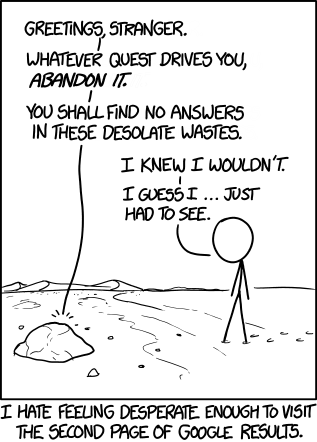

Search results - the great unknown (Source: xkcd)
Justice Abella considered that, due to the global nature of the Internet, any injunction involving multi-national, cross-border entities like Google would have to be applied globally. In short, as the majority of Google's business happens outside of Canada "...Purchasers outside Canada could easily continue purchasing from Datalink’s websites, and Canadian purchasers could easily find Datalink’s websites even if those websites were de-indexed on google.ca. Google would still be facilitating Datalink’s breach of the court’s order which had prohibited it from carrying on business on the Internet".

She also added that an interlocutory injunction, such as in this case, is therefore necessary to prevent the defendants' infringement online. Without Google's indexing of their site their business would not be feasible. Justice Abella also determined that there would be no issue with the freedom of expression, as no other nations' laws would be violated by the injunction.

The judge followed with the notion that this injunction would not affect Google's 'content neutral character', as it does not impose further monitoring obligations on the company, but merely the removal of the specified web addresses from its index. The same would not cause any undue expense on Google, which is something they already do for other illegal, more severe content online, and actively complies with DMCA notices over copyright infringement.

While the respondents' business can only thrive through Google's services, the court acknowledged that they are not responsible for the harm caused; however, Google has the power to end the harm by de-indexing the content. Ultimately, Justice Abella dismissed Google's appeal.

Two judges, Rowe and Côté, dissented from the majority's opinion, arguing that the injunction should not have been granted. In their view, the injunction's effects on Google would be final, with no recourse (unless to adjust its terms through the courts), and that Google is not a party to the dispute and should not be subjected to the injunction in question. Finally, the judges saw that the injunction is mandatory, with very little proven effect on its purpose, and the courts are presented with alternatives such as an asset freeze or injunctive relief against the ISPs preventing access to the website.

Ultimately, the case turns on the fact that it can open the floodgates for a stream of applications seeking similar injunctions, impacting both Google's business and the Canadian judicial system as a whole. The Court did leave the matter quite open, and this writer is confident that more applications will follow the decision, since, as the Court observed, Google already complies with similar obligations on a regular basis. Worldwide injunctions should not be a common weapon used, but an extraordinary one, so this writer does hope that the Canadian courts will restrict its application to only instances where they are truly needed.

19 March, 2014

Retrospective - Thumbnails and Inline Linking

The Internet has been the vocal point for most important developments regarding copyright since its emergence. Many cases have dealt with all manner of issues, such as ISP liability and over electronic scans of books, and there seems to be no end in sight as the law tries to adapt and mold itself to the electronic sphere. A staple feature of the world wide web is thumbnailing, where a smaller image is given to represent the real picture, often used in both search results and web pages when linking to said pictures, to make their identification and finding easier. The legality of this practice can be questioned, especially since it does, prima facie, create a copy of a work when it might not be sanctioned. However the determination of the aforementioned legal conundrum happened in the early years of the 21st century in the US Court of Appeals.

The case in question is Kelly v Arriba Soft Corporation, decided in 2002 initially, with an amended final decision being published in 2003. This concerned professional photographer Leslie Kelly, who posted some of his work on his website or others which duly licensed Mr. Kelly's works. The defendant, Arriba Soft, were the operators of an internet search engine called Ditto (which has since gone bankrupt), which displayed smaller versions of images as a part of their given search results as opposed to merely a text link to the image. Through this they amassed a database of pictures by copying the images from other websites such as Mr. Kelly's website or others which contained his works. Once Mr. Kelly found out that Arriba Soft had copied his works onto their database, he subsequently sued the corporation for copyright infringement. 

A very different thumbnail
In their judgment the Court of Appeals had to assess whether Arriba Soft's use of the images would fall under US fair use in section 107, as the reproduction of copyright protected images is only available to those who own the copyright or use the works under fair use. In their judgment the Court saw that the use of the works was both commercial and transformative, although regarding the former the use's nature was more incidental than purely for commercial gain, as Arriba Soft did not directly benefit from the displaying or selling of the images. Due to the smaller size and lower resolution of the images, their use of said images was clearly transformative from the more aesthetic nature of Mr. Kelly's work when displayed in full. As Justice Nelson stated: "The Copyright Act was intended to promote creativity, thereby benefitting the artist and the public alike... Arriba's use of Kelly's images promotes the goals... The thumbnails do not stifle artistic creativity because they are not used for illustrative or artistic purposes and therefore do not supplant the need for the originals. In addition, they benefit the public by enhancing information-gathering techniques on the internet". 

The nature of Arriba's use of Mr. Kelly's work was very different to their intended use, being more as aesthetically pleasing works of art as said above, which the thumbnails clearly were not. Even though Arriba Soft had copied the entire image into their database the Court saw that this was reasonable for their use and would not be substantially enough to merit infringement. Finally, the Court saw that Arriba Soft's use of the images did not harm Mr. Kelly's intended market, as clearly one can say that the arts market would be wholly different from that of search engines. In addition Justice Nelson stated well that: "By showing the thumbnails on its results page when users entered terms related to Kelly's images, the search engine would guide users to Kelly's web site rather than away from it". Clearly the thumbnails would only increase the potential market share of Mr. Kelly's work, directing traffic to his website all the while giving search engine users a preview of works quickly and potentially increasing their interest. As such the Court decided that Arriba Soft's use fell under fair use.

Thumbnails can be said to be very essential to modern uses of search engines, and create a great avenue from which both parties can benefit. Without them finding images would be exponentially harder. This is clearly demonstrated by the quick modification of the Court of Appeal's initial decision, which would have impeded such functions through its decision that displaying full-sized images would infringe copyright. Search engines are a complex beast, and will continually evolve, challenging the legislature and judiciary to adapt and potentially protect the free operation of the Internet and discovery of its content.