Showing posts with label europe. Show all posts

26 January, 2017

Question Solved - CJEU Rejected Rubik's Cube TM due to Technical Functionality

Trademarks are a very flexible tool to protect a variety of interests in goods, be it looks or the design of an object. One thing it cannot, and should not protect is technical functionality, which is better suited for protection through patents. Many have tried to use trademarks as quasi-patents that last forever, but the courts are quite reluctant to allow such registrations one challenged (if even registered in the first place). One such trademark has been the subject of a 10 year legal battle, namely the Rubik's Cube. The saga has finally come to its (current) conclusion, with a long-awaited decision handed down by the CJEU in late 2016.

The case of Simba Toys GmbH & Co. KG v EUIPO dealt with a registered trademark for the design of the Rubik's Cube (No. 162784), which is owned by Seven Towns Ltd. The mark consists of a 3D rendition of the Cube, showcasing the grid pattern on all sides of the Cube. Simba Toys challenged the mark in 2006, and ultimately alleged an infringement of Article 7(1)(a) to (c) and (e) of the old Community Trade Mark Regulation (No 40/94), which set out the absolute grounds of refusal for trademark applications.

While Simba Toys put forth six arguments, the CJEU focussed only on the first, which alleged a misapplication of Article 7(1)(e)(ii) of the Regulation (which prevents the registration of a shape of goods which is necessary to obtain a technical result), under which the General Court deemed that the essential characteristics of that shape do not perform a technical function of the goods at issue.

The CJEU first had to identify what the essential characteristics of the mark are, and the Court followed the General Court's rationale, setting them out as "...a cube and a grid structure on each surface of the cube". The essential characteristics then have to be assessed in the light of the technical function of the actual goods concerned, i.e. a three-dimensional puzzle. This has to be done using the representation given in the application, namely the drawing of the Cube, along with any descriptions of the same.

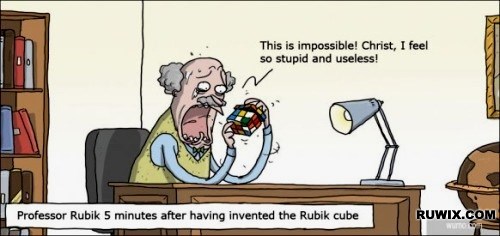
Solving a Rubik's Cube can be just as challenging as protecting it
The Court deemed that the General Court had erred in their assessment of the criteria in relation to the Cube that "...for the purpose of examining the functionality of the essential characteristics of the sign concerned, in particular the grid structure on each surface of the cube, the shape at issue, as represented graphically, should have been taken as a basis, without necessarily having to take into consideration any additional circumstances which an objective observer would not have been able to ‘fathom precisely’ on the basis of the graphic representations of the contested mark, such as the rotating capability of individual elements in a three-dimensional ‘Rubik’s Cube’-type puzzle". While these 'hidden circumstances' that are not fathomed precisely by an objective observer (i.e. the rotation is not, at least arguably, evident from the drawing of the Cube), this "...cannot preclude account from being taken of the technical function of the actual goods represented by the sign at issue for the purpose of examining the functionality of the essential characteristics of that sign, as the proprietor of that mark would otherwise be allowed to broaden the scope of the protection arising from the registration thereof to cover every type of puzzle with a similar shape, namely any three-dimensional puzzle with cube-shaped elements, regardless of the principles by which it functions".

What the CJEU therefore was concerned about was that these 'hidden' features could be used almost without limit to prohibit others from using the technical functionality of, for example, rotation for 3D puzzles, simply based on the look of the puzzle itself. This makes sense, as one can appreciate that the broadening of trademarks beyond their typical protection would mean a near monopoly on some features that are not immediately apparent based on a graphical representation. The CJEU therefore rejected the appeal, and didn't refer the matter back to the General Court.

The case sets a very important precedent, and rightsholders need to be more careful in their applications for trademarks, especially when they contain, or might contain, technical functionalities. Clearly one can appreciate the defence of legitimate trademarkable features; however, overextending your rights just might lead to the loss of your mark.

Source: IPKat

21 March, 2016

A Positive Signal - No Liability for Providers of Free WiFi, Says AG Szpunar

As discussed on this very blog over 6 months ago, free public WiFi is something we all take for granted, even if just a little. Having access to the worldwide web at most restaurants, coffee shops and even the Underground in London is nearly ubiquitous in the developed world, and one that presents both opportunity for its users and liability for those who provide it, especially when it comes to the infringement of intellectual property rights. The CJEU has been slated to answer the question of third-party liability for those who provide free WiFi in the case of copyright infringement, and awaiting that the opinion of Advocate General Szpunar has given their answer as to this highly important question.

The case of Tobias McFadden v Sony Music Entertainment Germany GmbH deals with Tobias McFadden, who owned a business selling and renting lighting and sound systems for various events, and offered free WiFi access at his store for any visiting patrons. The Internet connection offered had no password protection, nor did Mr. McFadden monitor the users taking advantage of the free WiFi. In early September 2010 such a user downloaded a song illegally using his WiFi connection, and Sony Music subsequently took him to court for copyright infringement as a liable third party.

The Regional Court of Munich referred the matter to the CJEU, who had to answer several questions relating to Article 12(1) of the E-Commerce Directive, pertaining to whether the provision of the WiFi would amount to the provider as being a mere conduit, or whether they would be liable for the infringement indirectly.

The Advocate General grouped the questions into two more specific references: "...whether a professional person... who, in the course of business, operates a free, public Wi-Fi network, falls within the scope of application of Article 12 [as a mere conduit]", and therefore is not liable for the infringement of any other parties using that WiFi (questions 1-3); and, if Article 12 does apply, the he needs to interpret the limitation of liability of intermediary service providers in that Article (questions 4-9).

The Scope of Article 12

The scope of Article 12 hinges largely on the potential economic nature of the provision of the service, as defined in Article 2(a) of the same Directive, and the meaning of 'providing' access to a network under Article 12.

A lack of WiFi would cause some issues
The Advocate General addressed the first point by concluding that the provision of free WiFi would indeed be an economic activity, as "...where, in the course of his business, an economic operator offers Internet access to the public, even if not against payment, he is providing a service of an economic nature, even if it is merely ancillary to his principal activity". The Advocate General added onto his point, setting out that the provision of the Internet access necessarily takes place in an economic context, that "[a]ccess to the Internet may constitute a form of marketing designed to attract customers and gain their loyalty. In so far as it contributes to the carrying on of the principal activity, the fact that the service provider may not be directly remunerated by recipients of the service is not decisive.". What remains key here is the ancillary nature of the free WiFi, and this writer agrees, since even if they WiFi is not the focal point of the business, it drives foot traffic and adds value to the provision of the main service, creating a service of economic nature (which is important, since nature does not necessarily mean direct economic benefit)

He then turned to the matter of the meaning of 'providing' access to a network, determining that it means "...that the activity in question enables the public to have access to a network and takes place in an economic context". The intent of projected role of the provider is not relevant, but merely the provision of the service in the above economic context.

The Advocate General then concluded that: "...Articles 2(a) and (b) and 12(1) of [the] Directive... must be interpreted as applying to a person who, as an adjunct to his principal economic activity, operates a Wi-Fi network with an Internet connection that is accessible to the public free of charge".

Interpretation of Article 12

Questions 4-9 concerned the specific interpretation of Article 12, and will be dealt with in more brevity below, although discussed quite extensively by the Advocate General. The questions are, specifically, whether a national court could penalize an intermediary service provider, in the event of infringement through their service, awarding damages, costs or an injunction as the form of the penalty (questions 4-5). Additionally, if this would not be generally possible, whether it would be possible to limit the extent of Article 12 (question 6), or through other unwritten requirements (questions 7-8). Finally, the last question asks for the limits of any injunctions that may be awarded against an intermediary service provider (question 9).

In answering question 4 and 5 the Advocate General saw that the limitations of liability for intermediary service provides would extend to damages and pecuniary claims, such as for costs. In his view this is precluded by Article 12(1), and would have an impact on the development of the service provider's business, irrespective of it being damages or punitive costs. He did, however, accepted the possibility of injunctive relief, and any ancillary penalties thereto. In summary to questions 4 and 5, he stated that "Article 12... precludes the making of any order against a provider of mere conduit services that entails a finding of civil liability against that service provider... [it] therefore precludes the making of orders against intermediary service providers not only for the payment of damages, but also for the payment of the costs of giving formal notice or other costs relating to copyright infringements committed by third parties as a result of the information transmitted. It does not preclude the granting of an injunction, non-compliance with which is punishable by a fine".

In relation to questions 6,7 and 8 (seeking to clarify the possible exclusion of actions taken against intermediary service providers), the Advocate General sought to strike a balance per recital 41 of the Directive. In his opinion, the Advocate General saw that there should be no limitations imposed on actions that can be taken against providers, though taking into account their actions when the infringement is brought to their attention. He also observed that the conditions under Article 12(1) are non-exhaustive, and could be added to with additional unwritten requirements.

Finally, he turned to the final 9th question, which asks whether national courts could impose injunctions on service providers against future infringement on their network. He saw that this was indeed possible, but this injunction could not impose a future obligation of monitoring the network or breach any other EU or national legislation (including the basic human rights afforded in the European Convention on Human Rights). He summarized that the injunction can only issued if the provider cannot, or will not, address the infringement in one of three measures: the termination of the internet connection (of the infringer); password-protection of the connection; or the monitoring the connection, but only to ensure the future infringement of rights using the same connection (observing time limitations on said monitoring).

The ultimate decision of the CJEU is pending, and will potentially impact the provision of free WiFi in the EU should they not follow the AG's opinion in this matter. This writer expects them to follow the opinion, as it clearly shows a practical and functional approach to a complex, and sensitive question. Should they not do so, the provision of free WiFi could be severely hindered, or even ended by some providers, which would be a big problem for those who cannot necessarily afford their own connections. Either way, this writer is anticipating the CJEU's decision with great interest.

Source: IPKat
21 January, 2016

Another Break - Justice Arnold Settles the Kit Kat Case After CJEU Decision

After quite an unsatisfying Court of Justice decision earlier in September in the Kit Kat case, many of us invested in the world of IP were waiting for the decision by the High Court of Justice in the UK applying the CJEU's considerations. The case has since been decided by Justice Arnold, finally settling (for now?) the debate around the the-dimensional marks.

By way of a short introduction, the case of Société Des Produits Nestlé SA v Cadbury UK Ltd dealt with the arguably iconic Kit Kat chocolate bar. The bars comprise four individual chocolate wafer fingers connected to each other with a solid chocolate base. Nestle applied to register the three-dimensional shape of the bar as a trademark without the Kit Kat logo embossed on the top of each finger, which was subsequently opposed by Cadbury. The case was referred to the CJEU by Justice Arnold (discussed more here), leading to the decision in question.

Justice Arnold post the CJEU decision (approximation)
The biggest issue in the case was the apparent mistranslation of Justice Arnold's question, who, in essence, asked whether an applicant needed to only prove recognition (and subsequent association to the applicant) of the mark by a significant portion the relevant public, or whether they have to rely on the mark to indicate the origin of the goods for a mark to have acquired distinctiveness. One has to note that this has to be in isolation of any other marks present in that product, and that particular feature has to identify the origin of the goods by themselves (i.e. the shape of the bar rather than the embossed logo on the top of it). The questions were, however, partially mistranslated during the proceedings, with the latter question being changed to a matter of perception rather than reliance.

Both the Opinion of Advocate General Wathelet and the judgment by the CJEU failed to address Justice Arnold's question in full, rejecting the first part of the question but leaving the matter of reliance unanswered.

Having considered the possible answer to his question, Justice Arnold summarized what he perceived the accurate consideration to be: "...in order to demonstrate that a sign has acquired distinctive character, the applicant or trade mark proprietor must prove that, at the relevant date, a significant proportion of the relevant class of persons perceives the relevant goods or services as originating from a particular undertaking because of the sign in question (as opposed to any other trade mark which may also be present)". (emphasis the court's)

Additionally, he concluded that "...when assessing whether the applicant has proved that a significant proportion of the relevant class of persons perceives the relevant goods or services as originating from a particular undertaking because of the sign in question, to consider whether such persons would rely upon the sign as denoting the origin of the goods if it were used on its own".

The focus on provenance is therefore on both perception of a particular mark as the indicator of the origin of certain goods or service, and whether the same public subsequently relied on that mark to indicate that very origin, irrespective of any other marks that might be present on those goods.

Justice Arnold then answered the question, agreeing the initial decision of the Hearing Officer. In his mind, although he referred to reliance on the mark, his rationale was in line with the CJEU decision. He correlated reliance with perception, which would fulfill the requirement set by the CJEU. Although survey evidence showed identification of the Kit Kat bar, it merely displayed recognition and not that they perceived it as the exclusive designation of the origin of the goods in question. Therefore he dismissed Nestle's appeal due to a lack of concrete evidence establishing acquired distinctiveness.

The Kit Kat saga has been a curious one, and does highlight some issues that surround CJEU referrals and linguistic nuances. Even so, this writer thinks Justice Arnold applied the law as well as he could in the light of the answer given by the CJEU. This does, however, raise questions on evidence, especially with the survey evidence shown by Nestle and the uncertainty as to what would be sufficient to establish 'perception' and subsequent reliance.

28 October, 2015

Impulsive Decisions - Reputation of a Trademark in Europe

In the world of trademarks the goodwill, or in other words reputation, of goods and services is paramount for their protection and enjoyment in a relevant territory. As commerce has become more and more global, with other territories seeing goods or services after their introduction to others, jurisdictional issues are even more poignant and relevant, providing a judicial headache for many attempting to benefit from those limitations (for example, in the recent NOW TV case, discussed here). Community Trade Marks, or CTMs for short, are registered as European-wide trademarks, but the goods or services' introduction to all of the Member States can sometimes differ, and potentially leave their registration open to challenge. Could, however, a proprietor prove goodwill in a Member State through use in other Member States, without actually having a commercial presence for that item in the Member State in question? Luckily, the European Court of Justice answered this question over a month ago.

The case of Iron & Smith v Unilever dealt with a national application for the mark "be Impulsive" in Hungary, lodged by Iron & Smith. The application was challenged by Unilever on he basis of their earlier mark "IMPULSE" (CTM 3116233); however they failed to demonstrate goodwill in Hungary, although Unilever had done so, arguably at least, in the UK and Italy.

The Court was asked four questions, the first three of which were distilled down by the Court as "...what conditions, in circumstances such as those at issue in the main proceedings, are to be met in order for a Community mark to be regarded as having a reputation in the European Union, pursuant to Article 4(3) of Directive 2008/95".

Extending beyond one's limitations can be a good thing
After a brief consideration of precedent relating to goodwill the Court quickly saw that "...if the reputation of an earlier Community mark is established in a substantial part of the territory of the European Union, which may, in some circumstances, coincide with the territory of a single Member State, which does not have to be the State in which the application for the later national mark was filed, it must be held that that mark has a reputation in the European Union". What this means is that you don't have to prove reputation all over Europe, but only in a substantial part of it (how ever that might be defined), in order to establish reputation in any Member State. This is a curious finding, as not all nationals of all Member States are aware of goods or services elsewhere in the Union, and effectively creates goodwill in those that have not, and might never, see those goods or services.

The final remaining question for the Court was also put in very succinct terms: "...in what circumstances Article 4(3)... is applicable if the earlier Community trade mark has already acquired a reputation in a substantial part of the territory of the European Union, but not with the relevant public in the Member State in which the registration of the later national mark concerned by the opposition has been applied for".

The Court, again, briefly considered earlier decisions, and concluded that "...if the earlier Community trade mark has already acquired a reputation in a substantial part of the territory of the European Union, but not with the relevant public in the Member State in which registration of the later national mark concerned by the opposition has been applied for, the proprietor of the Community trade mark may benefit from the protection introduced by Article 4(3)... where it is shown that a commercially significant part of that public is familiar with that mark, makes a connection between it and the later national mark, and that there is, taking account of all the relevant factors in the case, either actual and present injury to its mark, for the purposes of that provision or, failing that, a serious risk that such injury may occur in the future". The answer relates heavily to the above, as if goodwill is proved in a significant part of the Union, it is possible to rely on a CTM to invalidate a national mark, provided there is actual or potential damage to the CTM or its owner if the national mark were to be registered.

Overall the decision of the Court seems odd, effectively creating goodwill where none have existed in evidential terms, but aligns itself with earlier precedent. To prove goodwill or reputation in any European Member State one only has to prove it in a 'significant' portion of the European Union, which, to this writer's mind, expands the remit of an unused CTM beyond that for which it is intended (even if the mark is registered in the whole of Europe). Although the Court's rationale aligns itself with earlier decisions, it seems to give rights where no rights existed, potentially even hindering legitimate competition. Nevertheless, this writer will not purport himself to know better than the judges at the Court, but is puzzled by this outcome nonetheless.

Source: IPKat 

18 March, 2015

Lawyers Without Borders - Copyright Infringement Jurisdiction in the EU

With a globally interconnected web of information, and the (relatively) free exchange of information comes a great deal of questions alongside the masses of benefits it presents to the 21st century world. Discussion, the exchange of ideas, and the sharing of content has never been easier and more readily available, and admittedly, the infringement of intellectual property rights has also never been easier and "normal" (this writer, for one, has heard many conversations confirming the normality of especially copyright infringement). One can simply download a song, movie or a TV show with a few clicks of their mouse, irrespective of the rights holders' location, time or even the medium of the content (in some instances). This presents many challenges to the modern IP practitioner, amongst which is the conundrum that is jurisdiction. Can an entity or an individual enforce their rights even beyond their own borders, and if so, who has the jurisdiction over this infringement? Luckily, the highest court in the European Union has, yet again, graciously stepped up to the challenge to answer this question.

The case in question was Pez Hejduk v EnergieAgentur.NRW GmbH, decided only a bit over a month ago. What was at issue in the case were various pictures of architecture displaying works by Georg W. Reinberg, taken by the plaintiff in the case Pez Hejduk; a professional photographer of the aforementioned subject matter in her own right. A conference was organized by the defendants, EnergieAgentur, in 2004, during which Mr. Reinberg illustrated his works through Ms. Hejduk's photographs, which were wholly allowed by Ms. Hejduk to be used for. Afterwards, with no permission by Ms. Hejduk, the defendants then made the pictures available on their website for visitors to both view and download as they pleased, subsequently leading to Ms. Hejduk suing for copyright infringement (and a wallet-busting 4050 euros), ultimately leading to the European Court of Justice.

The question posed to the ECJ was, prima facie, a simple one: "Is Article 5(3) of [Regulation No 44/2001] to be interpreted as meaning that, in a dispute concerning an infringement of rights related to copyright which is alleged to have been committed by keeping a photograph accessible on a website, the website being operated under the top-level domain of a Member State other than that in which the proprietor of the right is domiciled, there is jurisdiction only: in the Member State in which the alleged perpetrator of the infringement is established; and in the Member State(s) to which the website, according to its content, is directed?"

What was asked effectively boils down to where the content lies, and whether jurisdiction lies within that country of origin (in the case the top-level domain, for example .co.uk) or in every Member State to which the content is directed. This was explained quite well in the judgment in different terms: "...whether Article 5(3)... must be interpreted as meaning that, in the event of an allegation of infringement of rights related to copyright which are guaranteed by the Member State of the court seised, that court has jurisdiction to hear an action for damages in respect of an infringement of those rights resulting from the placing of protected photographs online on a website accessible in its territorial jurisdiction".

Gregory asserted his jurisdiction no matter where he went
The Court's initial consideration related to the wording of the Article itself, i.e. where the harmful even occurred or may have occurred, deciding that, under established case law, it can be both the source of the infringement (where the website resides) or where the infringement or harm is caused (where the infringement occurs). Even though the defendant's action causing the potential damage was localized only to where their seat is (Germany), this does not prevent jurisdiction from the country in which the case was seised (i.e. filed, as Ms. Hejduk did so in Austria and not Germany). Lastly, the Court saw that there was no need for the infringement to have been directed to the jurisdiction in which the damage was caused, allowing for infringing content on foreign Member State website's to be brought into courts in different Member States where damage might have or did occur.

The Court finally summarized its position regarding the above question: "...Article 5(3) of Regulation No 44/2001 must be interpreted as meaning that, in the event of an allegation of infringement of copyright and rights related to copyright guaranteed by the Member State of the court seised, that court has jurisdiction, on the basis of the place where the damage occurred, to hear an action for damages in respect of an infringement of those rights resulting from the placing of protected photographs online on a website accessible in its territorial jurisdiction. That court has jurisdiction only to rule on the damage caused in the Member State within which the court is situated".

This case is an important statement of jurisdictional consideration, and allows for much more flexibility and freedom within the EU to bring forth claims of copyright infringement, even if that infringement occurs outside of your Member State. Any Member State's court can act as the judicator for damages, even if the court seised is different to the seat of the act of infringement. In an online world this is vastly important, and protects the interests of copyright holders much more effectively than through limitations allowing for claims only within the Member States where an alleged infringement has occurred.

Source: JDSupra

04 October, 2014

Cigarette Smoke and Olive Green - Australian Plain Packaging Law Challenged

Cigarettes and smoking have always been a controversial topic, especially in the last few decades. From misconceptions as to cigarettes' health benefits in the early-to-mid 1900s, to a more modern understanding, the topic often polarizes both sides of the discussion regardless if you smoke or not. Whether it is purely a deterrent ideology or a perspective from which you want to enforce and strengthen individual responsibility, smoking really has no answer for either side. A gallant effort at the reduction of smoking, especially in younger individuals, with nearly a third of 16 year olds having had at least tried smoking, is the plain packaging initiative, which has been either debated or even started in some countries in the last few years. One of these countries, Australia, instated their plain packaging laws, the Tobacco Plain Packaging Act 2011, some few years ago, showcasing a 15% drop in smoking rates between the Act's introduction and the year 2013.

The Act's life, albeit right now in its infancy still, has not been an easy one, and the Act has since been challenged at the WTO by several countries. The dispute, dubbed "Certain Measures Concerning Trademarks and Other Plain Packaging Requirements Applicable to Tobacco Products and Packaging" essentially deals with potential damage to the tobacco industry in Australia as a result of the Act, or as put forth in the complaint by the Ukraine: "...erode[s] the protection of intellectual property rights [and] impose severe restrictions on the use of validly registered trademarks". Arguably the Act does just that, but under proper justification; the denial of trademark usage can be balanced with a public interest health wise. This was countered by the Ukraine: "...[it] considers that governments should pursue legitimate health policies through effective measures without unnecessarily restricting international trade and without nullifying intellectual property rights as guaranteed by international trade and investment rules". What the Act does is not nullify the rights guaranteed by the Australian Trade Marks Act 1995, but skirts the law by preventing those marks' use. The marks themselves are still quite valid, just not usable in all instances.

When does 'plain' become 'too plain'?
Australia has protected its plain packaging law by stating that "...[it] is a sound, well-considered measure designed to achieve a legitimate objective — the protection of public health... nor is [it] more restrictive than necessary to fulfill its legitimate objective". Arguably, as said above, this is very true, yet the Ukraine does have a point in its argument, at least in relation to tobacco products. Trademarks, especially those relating to tobacco packaging (for example Marlboro and Camel), are quite valuable as they are predominantly how the products are distinguished among a myriad of similar of even identical flavors (as a non-smoker, this writer has no knowledge whether this holds true or not, so please correct me if I am wrong here). As such, rendering them useless in the sphere where they are used strips them of their usability and does impede on their use; however one has to still emphasize the public health concerns which underpin the legislation. Trademarks are a badge of origin relating to quality, authenticity and expertise, yet most tobacco products cause the same health issues regardless of origin or manufacturer, rendering the badge of origin quite useless in the face of health concerns or causation.

The legality, and the purpose behind the Act, was further defended by the High Court of Australia in JT International SA v Commonwealth of Australia, where the Court stated that "There are and always have been purposive elements reflecting public policy considerations which inform the statutory creation of intellectual property rights... [and] Australian trade marks law has 'manifested from time to time a varying accommodation of commercial and the consuming public's interests'". This varying accommodation is just that; the promotion of legitimate rights, but still keeping them in balance with public interests. Health considerations are one of the bigger interests in the public sphere, and are worth defending, even at the detriment to some commercial interests.

Do trademarks then confer a non-restrictable ability to use them? Arguably no, and this was supported by Justice Grummow in the JT International case: "...the TMA, like other trade mark legislation, does not confer on registered owners or authorised users a liberty to use registered trade marks free from restraints found in other statutes". This can be stated to be correct, but a balance still needs to be struck in the event of new legislation that might or might not impede intellectual property rights.

What the decision does, however, is establish a precedent which can be used for or against future plain packaging laws, such as in Ireland or France. The outcome of the WTO panel decision has yet to emerge, but the possible resolution of the dispute seems to lean towards Australia and the TPPA. As explained by Tania Voon and Andrew Mitchell: "...the law applies equally to all tobacco products from all countries, including Australia and New Zealand. The law is also based on years of research showing that standardised packaging will reduce the appeal of tobacco products and enhance the effectiveness of health warnings. Finally, the law implements Australia’s obligations under the WHO FCTC (Framework Convention on Tobacco Control). All these factors enhance Australia’s position in the WTO dispute". Should Australia lose the dispute, the fate of the TPPA would be suspect, and potentially would have to be repealed entirely, setting a precedent to other countries which are a part of the WTO.

This writer for one is intrigued by the prospects of this challenge, but believes that the TPPA will triumph and plain packaging will become more prevalent in the coming years. Its impact on trademarks will be negligible, bar the tobacco industry, which will have to revamp its approach to marketing. Maybe one day we will all reminisce the fancy cigarette packages of yore, or just recoil at the thought of smoking altogether.

Source: The Guardian

28 September, 2014

Chuckles or No - European Court of Justice Takes on Parody

European fair dealing is ever so slowly growing into its big boy shoes, and amidst that growth there are some growing pains that need to be sorted out by the guardians, the judiciary. With new fair dealing exceptions only days away from coming into force here in the United Kingdom, it seems only pertinent that the most influential court in Europe deals with an issue that is so close to this new set of fair dealing exceptions; parody and satire. Although the UK's cousins across the pond in the United States and Australia have accepted parody as a form of fair dealing or use prior to the old Kingdom, the UK will face challenges to this new regime in the coming years - for which European consideration is always welcome.

The case in question is Deckmyn v Vandersteen , decided only a few weeks ago, which dealt with a drawing relating to a recent election in Belgium, which was released in a calendar edited by Mr. Deckmyn, who is also a member of the Vlaams Belang party. During an event Mr. Deckmyn handed out the aforementioned calendars, on the cover of which was the picture at issue in the matter; an image which highly resembled that of the book "De Wilde Weldoener", an edition of the famed Suske en Wiske comic books. As explained by the court: "...[the] drawing is a representation of one of the comic book’s main characters wearing a white tunic and throwing coins to people who are trying to pick them up. In the drawing at issue, that character was replaced by the Mayor of the City of Ghent and the people picking up the coins were replaced by people wearing veils and people of colour". Subsequently the Vanderseteens, relatives of the comics' creator and holders of the copyright, among others, brought an action against Mr. Deckmyn asserting copyright infringement.

Under the Belgian Law on Copyright and Neighboring Rights, a copyright protected work is not infringed "[o]nce a work has been lawfully published, its author may not prohibit... caricature, parody and pastiche, observing fair practice". Mr. Deckmyn argued that his use of the comic's cover would be protected from infringement as a fair use under parody, yet the questions posed to the ECJ were:

"1. Is the concept of “parody” an autonomous concept of EU law? 
 2. If so, must a parody satisfy the following conditions or conform to the following characteristics: display an original character of its own (originality); 
display that character in such a manner that the parody cannot reasonably be ascribed to the author of the original work; 
seek to be humorous or to mock, regardless of whether any criticism thereby expressed applies to the original work or to something or someone else; 
mention the source of the parodied work? 
3. Must a work satisfy any other conditions or conform to other characteristics in order to be capable of being labelled as a parody?

The ECJ was faced with the definition of what amounts to parody, and whether this concept was truly autonomous within the EU law, more specifically Directive 2001/29.

The court quickly established that the concept of 'pardy' was indeed an autonomous concept in European law, as the Directive made no express mention of any national laws, giving the law a uniform interpretation within the Union, although Member States as still very much able to limit or extend the exception beyond its Union interpretation.

The second and third questions took the bulk of the ECJ's judgment, effectively determining the definition of a parody in European law. The court first established that, as the term is not defined in the Directive, that its interpretation would be "...determined by considering its usual meaning in everyday language, while also taking into account the context in which it occurs and the purposes of the rules of which it is part". This in the court's judgment, while agreeing with the Attorney General's definition, is "...first, to evoke an existing work while being noticeably different from it, and, secondly, to constitute an expression of humour or mockery". This writer would like to further add that, in most cases, national courts would also assess whether the parody itself, or the mockery or humor, is actually a genuine expression of mockery, rather than just a guise to prevent the courts from finding infringement.

Parodies can evoke a multitude of feelings
The court then assessed the conditions posed in the reference to the ECJ and whether they should be treated as a part of the exception in its application. As the provision is there to safeguard legitimate uses of copyrighted content, the court heavily empathizes that its scope "...of that provision... [should not be] restricted by conditions... which emerge neither from the usual meaning of ‘parody’ in everyday language nor from the wording of that provision". A much less restricted interpretation facilitates both the freedom of expression and a public interest in legitimate parody, as noted by the court.

The exceptions application has to be balanced, even in the light of its much less restricted interpretation, as noted by the court: "...the exception for parody... must strike a fair balance between, on the one hand, the interests and rights of persons... and, on the other, the freedom of expression of the user of a protected work who is relying on the exception for parody". This assessment has to take into account all circumstances in each instance, and should not be a mere prima facie 50/50 assessment.

The ECJ then relayed the final decision to the Belgian national courts, but did however express a need to assess the work on potential racial impacts, and negative connotations on such ground, as the work did indeed depict individuals of certain ethnic background in a very compromising light.

The UK government has already issued some guidance on the new exceptions coming into force next Wednesday, which helps in the future assessment of parody in this new regime. In their definition: "[t]he words “caricature, parody or pastiche” have their ordinary dictionary meanings. In broad terms, parody imitates a work for humorous or satirical effect, commenting on the original work, its subject, author, style, or some other target. Pastiche is a musical or other composition made up of selections from various sources or one that imitates the style of another artist or period. A caricature portrays its subject in a simplified or exaggerated way, which may be insulting or complimentary and may serve a political purpose or be solely for entertainment". Yet again this writer would have to point out that the use of a work under such a definition would still entail an assessment of whether the parody, pastiche or satire is well and truly such a work, and not just a faint attempt at parody purely to use the work at no cost.

All-in-all the ECJ's definition makes sense, at least to this humble writer, and does afford genuine parodies a wide shield in protecting their legitimate expression. Should conditions be set on the application of parody, such as in Belgium, the hurdles could become nearly insurmountable, and curb any real interest or willingness to create parody works. How the UK courts will apply this new exception remains to be seen; however the ECJ's considerations will undoubtedly serve as a great starting point.

Source: The 1709 Blog

04 August, 2014

Can You Infringe Copyright by Browsing the Internet?

Browsing the web can be full of pitfalls, both legally and in terms of your own safety. It's this world that we endeavor to navigate on our times surfing, but often don't think about the unknown issues or are blissfully unaware of the implications of our digital actions. It's because of this many things can slip through the cracks. Web browsers have made temporary copies of the content we read, look at and watch for years, more often than not without our knowledge, and this can present legal issues when dealing with copyrighted content, whether we want it or not. Whether just innocent surfing can infringe copyright is an interesting question, and this writer for one automatically thought the answer would be obvious, yet one would be surprised about the nuances behind the answer.

The case which dealt with this interesting conundrum was Public Relations Consultants Association Ltd v The Newspaper Licensing Agency Ltd, having been referred to the European Court of Justice by its UK counterpart earlier on in 2013. The Public Relations Consultants Agency (PRCA) is an association public relations professionals, who among other duties monitor the news for their clients, clearly to safeguard or preempt any potential PR disasters. The members of this association used a service provided by the Meltwater group of companies; one which used software to automatically compile an index of words used by newspapers in their content online. To better utilize this service Meltwater's clients provide them with a list of search terms which interest them, which are then used to create an index which is oriented around those key words. In the service's results the opening words of the article, the key word and a few surrounding words and a hyperlink are provided for the client, allowing them to find the article containing their desired content more easily. The service does not circumvent any paywalled articles, and the client will have to pay for that specific content should they wish to view it. The respondents of the appeal objected to this use of their content, and took the Agency to court, culminating in the UK Supreme Court in the earlier part of 2013.

The button that all internet users wished existed for certain purposes
The question faced by the ECJ therefore was, as iterated by the Supreme Court: "The question which arises on this appeal is whether [Internet users reading the an article online] are nonetheless infringing copies unless licensed by the rights owner [by creating temporary copies of those works]". More specifically whether this infringes Directive 2001/29/EC, and through which the Copyright, Designs and Patents Act 1988.

Under Article 5 of the Directive incidental copies are treated as not infringing copyright should they be "... temporary, transient or incidental, which are an integral and essential part of a technological process and whose sole purpose is to enable... a transmission in a network between third parties by an intermediary, or a lawful use... and has no independent economic significance". Arguably, on the face of it, the matter is quite clear-cut, as temporary copies are essential to how the internet functions and how we both conserve and make internet traffic more efficient. Nonetheless, the matter is still not that simple, at least from a legal perspective.

The court quickly saw that the temporary copies made through the viewing of websites indeed do satisfy the first requirement under Article 5, as the copies are lost once the user moves on from the website and other content is subsequently brought in to replace the temporary copies of the prior page. This makes those copies wholly temporary in nature. The court then moved on to the third requirement, under which the copies have to be essential for the technology to work properly; or as presented in Infopaq International v Danske Dagblades Forening: "...first, the acts of reproduction are carried out entirely in the context of the implementation of a technological process and, secondly, the completion of those acts of reproduction is necessary, in that the technological process could not function correctly and efficiently without those acts". As the user has to say (mostly) in the creation or deletion of these copies, the technology needs for those copies to be created in order to function as intended, as they are a part of its process. The copies are, as said above, essential to the internet's proper function and help prevent excess volumes of traffic, which would undoubtedly choke the internet beyond use. The court seemed quite satisfied with the technology satisfying the second requirement, meaning that the technology is needed for the process to function properly and efficiently, and therefore satisfies the third requirement.

Under the second requirement the copies have to be transient or incidental, and as the copies, as stated above, are deleted once the user switches to a different page, they are transient, even if there is some level of human intervention in their deletion. Finally, the copies are created as a part of the technology which uses them, and do not by themselves exist independent of it nor have a purpose outside of it, making the copies incidental for the purposes of Article 5. The court therefore saw that the temporary copies created during web browsing do not infringe copyright and are excluded as a part of Article 5.

As one can see the ECJ's decision was one of pragmatism and common sense. The prevention of transient copies in the viewing of content on the web would be detrimental to how the internet functions today, potentially even causing issues in its overall usability. As said above the answer to the question seemed obvious, and quite frankly, should not have even been argued in court this far. The matter will be passed onto the Supreme Court to decide on ultimately; however the ECJ's word is a powerful one and clearly demonstrates an unwillingness to compromise the net as we know it for the sake of copyright.

Source: The Guardian