Showing posts with label content. Show all posts

07 March, 2017

All Wrapped Up - Canadian Federal Court Decides on the Sharing of Pay-walled Copyright Works

While the European landscape has changed and clarified itself to a great degree in relation to the use of copyright protected content online (see more for example here, here and here), the rest of the world, comparatively at least, has stayed relatively quiet. One issue in particular, meaning the accessing of pay-walled or otherwise restricted content through sharing of that content to others without access to is is legal or not, has trickled through more than others. Many would argue that, while not definitive, the EU is quite established itself on where it stands on this, but our cousins across the pond in Canada have yet to fully cement themselves in this question, as can be illustrated by this recent decision in the Federal Court of Ontario.

The case of Ontario Ltd (Blacklock's Reporter) v. Canada (Attorney General) dealt with an online news agency, Blacklock's Reporter, which specializes in news surrounding, predominantly, the Canadian government. The Department of Finance, a part of the Canadian government, distributed two articles from Blacklock' within the Department without seeking consent. The contents of the article are largely irrelevant to the case, but Blacklock's does keep all of its contents behind a paywall, with a DOF employee accessing the relevant articles through a single subscription, subsequently sharing them internally within the DOF. Blacklock's then took the DOF to court over copyright infringement.

The Federal Court had to assess whether the rights in those works had been infringed, and if that use then was protected by fair dealing.

The court did not dispute the copyright in the works under section 29 of the Canadian Copyright Act (nor did the parties), but did raise questions as to whether Blacklock's assertion of their rights could amount to an abuse of those rights. The question therefore focussed on the aspect of fair dealing.

Canadian fair dealing covers only a narrow set of exceptions in section 29, particularly for research, private study, education, parody or satire. The DOF argued that their use was for research purposes and didn't therefore infringe Blaclock's rights.

Section 29 was further expanded on in the milestone case of CCH (discussed more here), which set a two-part test on whether a use was protected by fair dealing: 1. Whether the dealing is for the purpose of “research” or “private study”, also known as an allowable purpose; and 2. Whether the dealing is “fair”. The latter, whether a particular use is fair, involved certain factors that the courts ought to consider:

"1. The purpose of the dealing, where an objective assessment is made of the “real purpose or motive” behind using the copyrighted work, such as for commercial purposes versus charitable purposes; 2. The character of the dealing, examining how the works were dealt with, such as whether multiple copies of works are being widely distributed, or whether a single copy of a work is used for a legitimate purpose; 3. The quantity or amount of the dealing, including the importance of the work allegedly infringed; 4. Alternatives to the dealing, such as whether there is a non-copyrighted equivalent of the work that could have been used instead; 5.  The nature of the work, such as whether the work has been published or is confidential; and 6. The effect of the dealing on the work, such as whether a reproduced work is likely to compete with the market of the original work."

While the above two categories relate more directly to the research exception put forth by, a more nuanced approach has been adopted for research in the SOCAN case, which were distilled by the court in the case at hand:

Research can be more 'challenging' than you'd expect
"Research does not need to be undertaken for the purpose of the user engaging in its own act of authorship or creativity; Research is not limited to creative purposes but can be “piecemeal, informal, exploratory, or confirmatory”, and can be undertaken for no purpose except personal interest; The first step in the fair dealing analysis is a relatively low threshold and does not require the creation of a new work; and The analysis should be undertaken from the perspective of the user or consumer’s purpose". Here the court gives a very wide definition of research, potentially including mere personal interests, even if not 'academic' research, which can include much of the information used to support the purpose. This writer is encouraged by this finding, since a more narrow, limiting definition would deter private researchers (such as this 'researcher') and the potential sharing of that knowledge with others.

The Court quickly, without giving the above much consideration, determined that the DOF's use was indeed fair dealing. This included the fact that, for example, the materials were acquired legally through a licence, the use was for legitimate business reasons internally in the DOF, no commercial advantage was sought and that it was limited to only 6 individuals. Even though the terms and conditions were breached as a result, the court rejected that this would prohibit or prevent fair dealing from applying in those instances. They, however, have to be brought to the attention of the subscriber, which Blacklock's had not done (albeit the terms did exist, but were never formally accepted by the individuals signing up). The defendant was therefore never aware of the terms, and of their own breach as a result.

Judge Barnes determined that fair dealing did apply in this case, and noted that "...Absent consent, subscribers and downstream users are subject to the obligations imposed on them by the Act. But at the same time they enjoy the considerable protection afforded to them under the statutory fair dealing provisions". He further highlighted that, as contested by Blacklock's, that subscriber services like this would suffer very little detriment to their business model, but it does not allow for a carte blanche for users to share the content, which is restricted to genuine fair dealing either way.

The case shows that, provided the uses are legitimate, fair dealing should be afforded a broad and inclusive definition, especially when it comes to research. One can agree with this, since a strict interpretation would act counter-intuitively to the sharing and dissemination of information. The decision also highlights a potential need for the UK to adopt a similar 'fair use' policy, which broadens and protects legitimate uses in a more effective way than restrictive categories.

Source: Barry Sookman

25 November, 2016

All Checked Out - CJEU Decides on e-Lending of Books by Libraries

As previously discussed on this very blog, the issue of e-lending has come up in the European courts recently, specifically relating to whether it is allowed under EU law. While one would think the question is quite straight-forward, especially when specific restrictions have been put in place to prevent any abuse, the matter isn't necessarily answered in one word. Advocate General Szpunar handed down his opinion during the Summer, with many awaiting the ultimate decision of the CJEU; however, the wait is now over, and the Court has handed down its judgment on the future of e-lending a couple of weeks ago.

By way of a brief exposition for those who have not read the previous article above, the case of Vereniging Openbare Bibliotheken v Stichting Leenrecht dealt with the lending of electronic copies of books by libraries in the Netherlands, and the remuneration of collection societies in the country for those activities (given for the lending of physical books). Per government policy, e-lending did not fall under the legislation entitling the authors to be remunerated for the lending of their works, but this was disputed by Stichting Leenrecht, ultimately ending up in the CJEU.

The Court dealt with each question posed by Stichting Leenrecht in turn.

The first question posed, as summarized by the Court, asked "...whether Article 1(1), Article 2(1)(b) and Article 6(1) of Directive 2006/115 [Lending Right Directive] must be interpreted as meaning that the concept of ‘lending’, within the meaning of those provisions, covers the lending of a digital copy of a book".

The Court looked at whether the legislation would cover both electronic copies of books, and the concept of 'lending' could apply to the same. They concluded that, after considering all the applicable authorities, that "...intangible objects and non-fixed copies, such as digital copies, must be excluded from the rental right, governed by Directive 2006/115, so as not to be in breach of the agreed statement annexed to the WIPO Treaty, neither that treaty nor that agreed statement preclude the concept of ‘lending’, within the meaning of that directive, from being interpreted, where appropriate, as also including certain lending carried out digitally". The Lending Right Directive expressly applied to physical books, and thus excluded electronic copies of the same; however, the concept of lending under Article 2(1)(a) of the Directive applied to a more abstract, open interpretation of rights (rather than a right, potentially restricting it to only one form), allowing for the inclusion of digital copies as well as their physical counterparts.

This applies to considerations that the Directive should adapt to "...new economic developments such as new forms of exploitation", and clearly the exclusion of any future forms of media would be short-sighted and undesired, and would limit the protection offered to authors through copyright. The Court also considered the derogation from the rights afforded in the Directive by Member States, and concluded that it could potentially apply in order to protect the public interests underlying the lending of books through libraries.

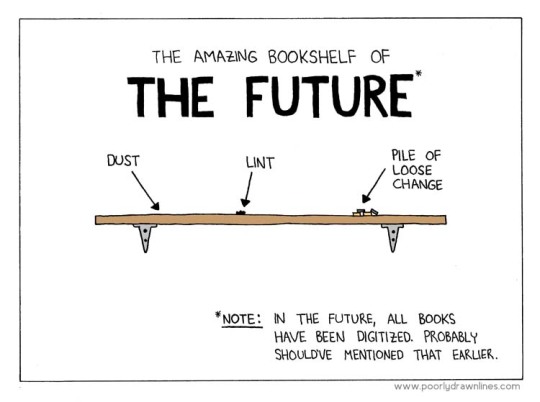
Also the library of the future?
The Court summarized their findings in relation to question one as "...[the texts of the Articles above] must be interpreted as meaning that the concept of ‘lending’, within the meaning of those provisions, covers the lending of a digital copy of a book, where that lending is carried out by placing that copy on the server of a public library and allowing a user to reproduce that copy by downloading it onto his own computer, bearing in mind that only one copy may be downloaded during the lending period and that, after that period has expired, the downloaded copy can no longer be used by that user". The restrictions set a clear dividing line between lending and selling and/or distribution of the content, since this makes it very much akin to that of lending a physical book.

They then moved onto the second question dealt with the possibility of derogating under Article 6(1) of the Directive, and subjecting it to the condition that the digital copy of a book made available by the public library must have been put into circulation by a first sale or other transfer of ownership of that copy in the European Union by the holder of the right of distribution to the public or with his consent. Quickly dealing with the second question, the Court saw that Article 6 did not preclude Member States from making the application of the provision subject to the above condition, since the condition would reduce the risks of prejudicing the authors of those works.

This was followed by the third question, which asked whether Article 6 precludes "...the public lending exception laid down [in Article 6(1)] from applying to the making available by a public library of a digital copy of a book in the case where that copy was obtained from an unlawful source". Even though the Article is quiet on the legitimacy of the sources of those works, the Court dismissed the possibility, as this would "...amount to tolerating, or even encouraging, the circulation of counterfeit or pirated works and would therefore clearly run counter to [the] objective". This makes perfect sense, since the allowance of the use of illegal copies would be tantamount to legalising copyright infringement, at least in cases such as this. Article 6 therefore was seen to preclude the above possibility.

The Court deemed the fourth question to not require an answer.

The case is a very positive step towards accepting and embracing technological change, whether it is in the context of libraries or the use of digital content as a whole. The decision also leaves quite a bit of wiggle room for Member States to implement the Lending Right Directive, which allows for a more nuanced control of copyright protected works in e-lending.

Source: IPKat

30 September, 2016

Change is Scary - The EU Commission Sets Out Proposals for New Copyright Changes

Copyright seems to have been immersed in a perpetual sea of change in the last couple of years, especially here in the UK and the EU as a whole. While this change is hugely important, including for the harmonization of aspects in technological change that have profoundly shaped the sphere in which copyright operates. With the EU's recent dive into a new perspective on the Single Digital Market having been published a little over a years ago (more on which here), future, more concrete changes have yet to be released; however, this changed only a few days ago.

As said, the EU Commission just recently published its propositions to modernize copyright in the wake of the Digital Single Market strategy. While the documents themselves are quite extensive, this writer would aim to discuss the proposed changes more in the broader sense, hopefully to encapsulate the main points of the propositions themselves.

Better choice and access to content online and across borders

As outline in the DSM strategy, access to online content within the EU is paramount to the Commission, with intentions to stop geo-blocking and allow for access to domestic content even abroad (i.e. using the BBC iPlayer when on vacation in the EU). This was expanded on in the proposition as an introduction of "...a legal mechanism for broadcasters to obtain more easily the authorisations they need from right holders to transmit programmes online in other EU Member States". Clearly this seems to envision a cross-EU licencing scheme, or the broadening of existing licences to cover more than their origin country. Initially, as outlined in the proposal, this would be done through a dialogue with the audiovisual industry on licencing issues; however, this writer would not see it as an impossibility that this would be legislated on somehow in the future if progress is not made as desired.

This is expanded on in the Commission's communication, which sets out measures to be taken in relation to access to online content, copyright exceptions and a more efficient enforcement regime.

Improving copyright rules on research, education and inclusion of disable people

Change is scary, so lets manage it!
There are also desires to improve the rules surrounding research, education and inclusion of disable people, particularly broadening access to protected materials for these types of uses. The proposal would include "...a new exception to allow educational establishments to use materials to illustrate teaching through digital tools and in online courses across borders", with additional provisions dealing with cultural heritage institutions (and their preservation of that heritage, as well as access to the content for citizens). While research and access to cultural heritage are very important, the EU sets out the desire to implement the Marrakesh Treaty, which aims to "...facilitate access to published works for persons who are blind, have other visual impairments or are otherwise print disabled", as well as adding measures that will allow for the full participation of disabled individuals in society by providing access to materials (or ways to convert such materials, presumably) that are protected by copyright.

Some of the proposed provisions include an exception for the use of works and other subject-matter in digital and cross-border teaching activities and the copying of cultural heritage materials without infringing copyright. Especially considering the former, the activities must be legitimate, and will undoubtedly be prescribed to certain situations and contexts, much like existing exceptions for research.

A fairer and sustainable marketplace for creators and press

Lastly, the Commission's proposed Directive on Copyright in the Single Market aims to (including the above) "...reinforce the position of right holders to negotiate and be remunerated for the online exploitation of their content on video-sharing platforms such as YouTube". The Directive would impose an obligation on the service providers to have an automatic system that tags and/or removes illegal content, much like YouTube's Content ID system already does (irrespective of its controversial nature). One can imagine this will be a treacherous and unpredictable imposition on service providers, and would remain to be seen how it is genuinely implemented, and whether the providers would face sanctions for lax or non-existent enforcement.

The EU Commission's proposals are quite interesting, and pose, at least in theory, a possible modernization of copyright in the Digital Single Market. As an individual with an international background, I welcome more access to content when abroad, and the expansion of teaching opportunities and the preservation of cultural heritage. What will be interesting are the measures deployed against large service providers, whose users might upload large or small quantities of illegal content on their systems. The provisions, however, in this regard seem to be aimed at cooperation and coexistence, but can pose a problem if presented as one-sided affairs for rights-holders.

Source: IPKat

29 December, 2015

A Rosey Future Ahead? - EU Commission Addresses Copyright for 2016

As the year is nearly coming to a close, this writer thought it would be pertinent to set our sights for the coming year. 2016 will hopefully be one of further advancement, change and full of cases detailing the law in more intricate, nuanced and better ways. It is always interesting to get perspectives on future changes from the legislature, and such thoughts were shared by the EU Commission and its initiatives on copyright for copyright.

A more modern, more European copyright framework

The framework where copyright operates has gone through a massive sea of changes, not only in terms of the media covered and people's interaction with that media, but also the technological advancements that have effectively redefined human interaction, media consumption and our perception of the world. With this change a strong, but malleable approach to reform would need to be adopted, and as countries have taken their steps towards a newer copyright regime, a EU-centric change was also needed. The EU Commission, as stated above, has brought forth several points of reform, introduced in their press release only a handful of days ago, aiming to modernise the copyright rules in the Union.

Widening access to content across the EU

The Commission envisions the enablement of EU citizens to take their paid-for (or subscribed-to) content with them in the Union, or as the press release states: "[the] aim[] [is] to allow a better circulation of content, offer more choice to Europeans, to strengthen cultural diversity and provide more opportunities for the creative sector". Arguably this would be a tremendous improvement and a move for the harmonization of copyright within the EU, accessibility to content, and to expand the markets beyond their respective national borders.

This, per the proposal released some time ago, would be achieved through an obligation on Member States to enable their citizens to access online content services (defined the same as in Directive 2010/13/EU or as a service, both paid for or not, whose main feature is the provision of access and use of copyright works) when they are temporarily out of the country the service originally is provided.

How this is implemented in each Member State, and whether any restrictions will be added to post-proposal, will remain to be seen, but this writer believes this would be a huge leap forward in harmonizing the internal market, and to enable paying customers to access the services and/or content they have duly paid for.

Exceptions to copyright and creating a fairer marketplace

The Commission also sets out an intent to assess the exceptions that apply to copyright protected works, specifically in relation to education, research (data mining, specifically) and the use of such works by disabled individuals. They also aim to provide further clarity to the legal standing of images uploaded by internet users of monuments (this issue discussed more here).

It was the day that Sally had foreseen, and was dreading, all along
It is hard to say what the Commission is set to change or clarify, but this writer will express his concern for the latter point on images featuring monuments and their possible status as infringing or non-infringing works. The spread and dissemination of information is important, as well as individual expression through photographical works, and the dissuasion or illegality of such expression would be worrisome.

The Commission also wants to tackle the remuneration of content creators in the online sphere, specifically in relation to news aggregators, and will "...analyse whether solutions are needed at EU level to increase legal certainty, transparency and balance in the system that governs the remuneration of authors and performers in the EU, taking EU and national competences into account".

This was addressed in more detail in their communication as an examination of "...whether action is needed on the definition of the rights of ‘communication to the public’ and of ‘making available’... [and] whether any action specific to news aggregators is needed, including intervening on rights". This area of the law is still quite murky, and further clarification and potential legislation might be needed to balance the current arguable free-for-all in the online space regarding news aggregation.

Fighting piracy

Finally, the Commission wants to go further in the enforcement of copyright against possible pirates, engaging in a public consultation on the matter with all stake-holders (focusing on the efficacy of Directive 2004/48/EC). Additionally it will include considerations on "...how to make the removal of illegal content by online intermediaries more efficient".

Their objective is clearly a 'follow-the-money' approach, however a strict, DMCA style weaponry could leave legitimate entities and/or fair dealing without proper protection. As their communication states: "...the Commission will assess options and consider by autumn 2016 the need to amend the legal framework focussing on commercial-scale infringements, inter alia to clarify, as appropriate, the rules for identifying infringers, the application of provisional and precautionary measures and injunctions and their cross-border effect, the calculation and allocation of damages and legal costs".

This writer hopes that the review process proposed by the Commission above remains fair and balanced, and remains hopeful things will be fine down the line. Nevertheless, 2016 should be an exciting time for copyright, and we will all undoubtedly stay interested in the proposed regulations that will be put forth.

Source: IPKat  

18 March, 2015

Lawyers Without Borders - Copyright Infringement Jurisdiction in the EU

With a globally interconnected web of information, and the (relatively) free exchange of information comes a great deal of questions alongside the masses of benefits it presents to the 21st century world. Discussion, the exchange of ideas, and the sharing of content has never been easier and more readily available, and admittedly, the infringement of intellectual property rights has also never been easier and "normal" (this writer, for one, has heard many conversations confirming the normality of especially copyright infringement). One can simply download a song, movie or a TV show with a few clicks of their mouse, irrespective of the rights holders' location, time or even the medium of the content (in some instances). This presents many challenges to the modern IP practitioner, amongst which is the conundrum that is jurisdiction. Can an entity or an individual enforce their rights even beyond their own borders, and if so, who has the jurisdiction over this infringement? Luckily, the highest court in the European Union has, yet again, graciously stepped up to the challenge to answer this question.

The case in question was Pez Hejduk v EnergieAgentur.NRW GmbH, decided only a bit over a month ago. What was at issue in the case were various pictures of architecture displaying works by Georg W. Reinberg, taken by the plaintiff in the case Pez Hejduk; a professional photographer of the aforementioned subject matter in her own right. A conference was organized by the defendants, EnergieAgentur, in 2004, during which Mr. Reinberg illustrated his works through Ms. Hejduk's photographs, which were wholly allowed by Ms. Hejduk to be used for. Afterwards, with no permission by Ms. Hejduk, the defendants then made the pictures available on their website for visitors to both view and download as they pleased, subsequently leading to Ms. Hejduk suing for copyright infringement (and a wallet-busting 4050 euros), ultimately leading to the European Court of Justice.

The question posed to the ECJ was, prima facie, a simple one: "Is Article 5(3) of [Regulation No 44/2001] to be interpreted as meaning that, in a dispute concerning an infringement of rights related to copyright which is alleged to have been committed by keeping a photograph accessible on a website, the website being operated under the top-level domain of a Member State other than that in which the proprietor of the right is domiciled, there is jurisdiction only: in the Member State in which the alleged perpetrator of the infringement is established; and in the Member State(s) to which the website, according to its content, is directed?"

What was asked effectively boils down to where the content lies, and whether jurisdiction lies within that country of origin (in the case the top-level domain, for example .co.uk) or in every Member State to which the content is directed. This was explained quite well in the judgment in different terms: "...whether Article 5(3)... must be interpreted as meaning that, in the event of an allegation of infringement of rights related to copyright which are guaranteed by the Member State of the court seised, that court has jurisdiction to hear an action for damages in respect of an infringement of those rights resulting from the placing of protected photographs online on a website accessible in its territorial jurisdiction".

Gregory asserted his jurisdiction no matter where he went
The Court's initial consideration related to the wording of the Article itself, i.e. where the harmful even occurred or may have occurred, deciding that, under established case law, it can be both the source of the infringement (where the website resides) or where the infringement or harm is caused (where the infringement occurs). Even though the defendant's action causing the potential damage was localized only to where their seat is (Germany), this does not prevent jurisdiction from the country in which the case was seised (i.e. filed, as Ms. Hejduk did so in Austria and not Germany). Lastly, the Court saw that there was no need for the infringement to have been directed to the jurisdiction in which the damage was caused, allowing for infringing content on foreign Member State website's to be brought into courts in different Member States where damage might have or did occur.

The Court finally summarized its position regarding the above question: "...Article 5(3) of Regulation No 44/2001 must be interpreted as meaning that, in the event of an allegation of infringement of copyright and rights related to copyright guaranteed by the Member State of the court seised, that court has jurisdiction, on the basis of the place where the damage occurred, to hear an action for damages in respect of an infringement of those rights resulting from the placing of protected photographs online on a website accessible in its territorial jurisdiction. That court has jurisdiction only to rule on the damage caused in the Member State within which the court is situated".

This case is an important statement of jurisdictional consideration, and allows for much more flexibility and freedom within the EU to bring forth claims of copyright infringement, even if that infringement occurs outside of your Member State. Any Member State's court can act as the judicator for damages, even if the court seised is different to the seat of the act of infringement. In an online world this is vastly important, and protects the interests of copyright holders much more effectively than through limitations allowing for claims only within the Member States where an alleged infringement has occurred.

Source: JDSupra

26 January, 2015

Framed Questions - ECJ Takes on Content Framing

As social media has changed how we interact with one another, it also has profoundly changed the culture and environment where copyright (and other intellectual property rights) reside. Videos, pictures and other content can very easily go 'viral', especially through sharing via Facebook, Twitter and other websites, even sans the original source of the content. This aggressive sharing and consumption of content can clearly yield huge benefits, both monetary and other positive outcomes; however it presents a much darker side to the sharing of this content, more specifically the copying and distribution of infringing content. Whether it be re-hosting a video originally on YouTube, or copying and watermarking other people's popular images, the Internet is full of opportunistic people rearing and ready to cash in on the next 'viral' hit. Not all sharing is bad, and often websites can host content and rightfully attribute the content to its source, or just link directly to it - which presents a question: can you share copyrighted content, especially through what is called 'framing' (placing someone else's content within the confides of your own website, but not directly hosting the content), or are you infringing on the rights through linking to this content and placing in within your own website?

The case, which endeavored to answer this question, was BestWater International GmbH v Michael Mebes (judgment only available in German or French). BestWater International are a company in the business in making and selling water filtration systems, and in an effort to boost their sales, made a 2-minute promotional video and uploaded it to YouTube, undoubtedly attempting to reach the droves of water filtration enthusiasts using the site. Michael Mebes and his co-defendant Stefan Potsch are independent agents for BestWater's competitor, who embedded a video link to BestWater's promotional video on YouTube (which they themselves uploaded onto the service). BestWater subsequently sued the pair for copyright infringement, and the case finally culminated in the European Court of Justice late last year. In the absence of a judgment in English (which this writer was waiting for) the information conveyed in this post has been parsed from several sources; however hopefully represents an accurate reading of the case.

The question posed to the Court was simple: "Does the embedding, within one’s own website, of another person’s work made available to the public on a third-party website... constitute communication to the public within the meaning of Article 3(1) of Directive 2001/29/EC, even where that other person’s work is not thereby communicated to a new public and the communication of the work does not use a specific technical means which differs from that of the original communication?" In a lot of ways the case is similar to one discussed on this very blog on an earlier note; Svensson v Retriever. Even so, Svensson merely discussed the distribution of content, which is freely available on another website, when BestWater's focus is on framing that content within your own site, arguably presenting it, in a roundabout way, as your own. 


One should always be careful when framing things
Thinking back to Svensson, the decision in the case established, quite firmly, that if a work is communicated to the public, and is freely available, distributing that content without actually making new copies of it, does not constitute a communication to a new public and infringe copyright. Unceremoniously the Court saw that "[t]he embedding in a website of a protected work which is publicly accessible on another website by means of a link using the framing technology … does not by itself constitute communication to the public within the meaning of [Directive 2011/29/EC] to the extent that the relevant work is neither communicated to a new public nor by using a specific technical means different from that used for the original communication"

What is key in the BestWater decision, much like in Svensson, is the authorization of the party who communicates the original work to the public. If the content is beyond the reach of most Internet users, framing the content clearly infringes copyright; however, should the party provide the content for all Internet users (i.e. freely available through services like YouTube), it will not infringe copyright. Should a third-party, without the consent of the copyright holder, upload a video to YouTube, and then promptly frame it on their website, they will be infringing copyright within the meaning of BestWater and Directive 2001/29/EC.

The two decision reflect a clear need for change in attitudes of copyright holders when posting content online. Framing applies just as well to images and sound files as it does to video, potentially causing issues to those who are not careful in their communication of their copyrighted content. This writer, for one, believes this approach is correct, even with the hazards it potentially presents. Should you choose to share content with very little regard to its restrictions, you choose to share your content with more people that you might have intended to, and for users to be punished for your mistake seems highly inequitable. Nevertheless, individuals and companies should be more careful in their content sharing, especially when considering the openness of the Internet, and the potential benefits more open sharing can give you.

Source: IPKat

21 January, 2014

Public Consultation on EU Copyright Law

Copyright reform seems to be on everyone's mind, with reviews being or having been undertaken in the United Kingdom, Australia and Ireland in the past year. Even in this writer's mind copyright has been in dire reform in many jurisdictions, and the calls for change are a welcome change of pace. In conjunction with the aforementioned two EU common law jurisdictions' reform thoughts, the Union itself has set up consultations on the review of its copyright rules. The harmonization of copyright across the EU is something that is desired, especially in the current copyright climate, which is seeking to fit the laws with modern uses of copyrighted material.

According to the European Union's press release this is in response to "...the completion of its on-going efforts to review and modernise the EU copyright legislative framework as announced in the Intellectual Property Strategy "A Single Market for Intellectual Property Rights", while facilitating practical industry-led solutions through the stakeholder dialogue Licences for Europe to issues on which rapid progress was deemed necessary and possible". What this revision will change will ultimately be left to the EU; however the consultation does indicate certain desired changes or directions which the Union may take in the future.

In setting out the reasons for the consultation, the EU was very clear in the background and needs for reform:
"Over the last two decades, digital technology and the Internet have reshaped the ways in which content is created, distributed, and accessed. New opportunities have materialised for those that create and produce content... for new and existing distribution platforms, for institutions such as libraries, for activities such as research and for citizens who now expect to be able to access content... regardless of geographical borders... This new environment also presents challenges. One of them is for the market to continue to adapt to new forms of distribution and use. Another one is for the legislator to ensure that the system of rights, limitations to rights and enforcement remains appropriate and is adapted to the new environment."
Indeed the changes in the environment where copyright functions on a day-to-day basis have drastically changed since the emergence of the Internet and a heavier emphasis on the consumption of digital goods as opposed to their physical counterparts. How the aforementioned issues will be tackled leaves a lot of room for discussion in submissions; however this writer will endeavor to give his insight on some of the solutions or questions posed by the Union.

The EU in this process would want to unify the approach to copyright within all of its territories; which currently is a process which takes place in each nation individually, hindering licencing or forcing partial or separate EU-whole licences to be created. Arguably such a licencing scheme would be desirable, but whether this requires legislative action is questionable. The Union should offer an easy way to licence content all over Europe, providing all of its citizens access to the same or most of the content others have access to. The Single Market in this regard needs to be encouraged, not necessarily further legislated on.

The EU also wants to further clarify the position the law holds with digital content; more specifically the making available of content and what that entails; the rights relating to the making available of content (its reproduction and the right to make it available) and their split nature between different parties; the complexity of linking on the Internet and browsing content on it (and issues that might arise relating to temporary copies thereof); and the ownership of downloaded content. Some of these questions, as pointed out by the consultation paper, have been referred to the Court of Justice of the European Union, and those decisions will undoubtedly influence the changes that might be needed after, if at all.

The paper also seeks to further clarify, and potentially unify, the approaches taken by Member States to exceptions in relation to copyrighted content and their use. Although several a Directive has been issued pertaining to exceptions particularly, for example in terms of research and teaching, there is a clear need for uniformity and the extension of new exceptions in this regard, at least in this writer's opinion. A clear and concise regime of legitimate use of copyrighted content all over the EU would be beneficial to users, and enable the Single Market to function more consistently and easier. As the paper points out, user-generated content is an important consideration, which is yet to be legislated on, among a few other exceptions. As said, this is one area where the EU should step up and give further guidance and unification, purely due to the international nature of digital content especially, easing the modern markets and unifying their approaches within the Union.

The consultation paper contains much more than what has been discussed above, and all parties which can participate in this process should voice their opinions. Although the EU has been far from complacent in recent years in terms of copyright review, this process gives the ability for others to directly influence this process, and therefore improve the current Single Market. Copyright has been a hot-button topic, and seems to keep as such for the foreseeable future.

Source: TorrentFreak

21 May, 2013

Thoughts on the Canadian Copyright Modernization Act 2012

In the wake of highly impacting cases in the Canadian courts, one of which was discussed on this very blog not too long ago, the Canadian Parliament enacted a piece of legislation aiming to bring the Canadian copyright laws to the 21st century; the Copyright Modernization Act 2012.

The worst copyright abusers of them all
The Act made several changes to the existing Copyright Act, adding a categorical exception for educational use, one which is absent from its Australian counterpart for example. This exception bares significant weight in today's world, providing a means for schools to give students copied materials from copyrighted works and to teach more efficiently and broadly. There clearly is no competing interest in doing so, and allows for both poorer schools and students alike to utilize materials otherwise not in their means to acquire.  Several copyright collectives opposed the education provisions, and much to their chagrin, they were enacted and the breadth of the provisions is quite substantial. The addition of this exception makes sense both from a legal and a human perspective. After the decision of Alberta (Education) v Canadian Copyright Licensing Agency, which extended the previous fair dealing exceptions to cover educational purposes through some clever legal argumentation, there seemed to be no reason to attempt to prevent this exception from being enacted. Also looking at things from the perspective of a potential parent some day, the freer use of material in an educational setting will enable future generations to learn more effectively.

The second exception added in the Act is one which is yet to see an equal in any legislature in the world; the use of copyrighted material in non-commercial content made by users. What the provision allowed was the creation of new works using older copyrighted material such as songs, videos etc, so long as the the use of those works is for non-commercial purposes. Often cited as the "mash-up" provision, it provides a great tool for users to create a variety of works without the fear of legal repercussions. Some questions do remain however:

What is a non-commercial purpose, and could the purpose of the work change over time? A perfect example of this would be videos on YouTube. One might initially make a hilarious video of your cat meowing along to a popular song or yourself hilariously singing along to one, for the purpose of sharing your pet's or your own escapades with that of a select few or just the comedy appreciating populous at large. When posting that video your intention was probably not commercial, or at least you didn't believe or think you'd make money off of that video. But what if it goes viral and all of a sudden you have the opportunity to make a few bucks? Would the purpose of that video change at that point and become a commercial one, even after it would explode in terms of viewership years later? This presents a scenario that would clearly be one for judges to look at pertaining to each given situation, but it does present some ambiguity as to the application of this particular exception.

High Schoolers mashing it up
Second is the effect that websites have as the sharing platforms for content, potentially impacting its commerciality. Lets look at another scenario: A new start-up website encourages and helps distribute disseminated content, using the Canadian provision as the means to allow users to do so. The users themselves don't get paid for the content, but the large amounts of shared content containing copyrighted works used in user-created works does spur and increase in website traffic, profiting the website and its owners. The purpose for the videos was not, much like in the YouTube example, commercial in itself, but purely one where other users wished to share their videos with other users in that platform. Would that purpose constitute as a commercial one if it profits the website? Would the encouragement to disseminate and share content change their purpose in itself? Again, questions like this would remain for the judiciary to decide should they become contested in the courts.

Overall the Copyright Modernization Act does expand and allow for better and wider uses of content, both on a personal user level and on a wider scale. It does address issues which have evolved through the use of mediums such as the Internet, but still some ambiguity remains. There have been no cases dealing with the shiny new provisions, but with content sharing being such a big part of modern Internet interaction, they undoubtedly will be litigated on in the future.