Showing posts with label collection. Show all posts

25 November, 2016

All Checked Out - CJEU Decides on e-Lending of Books by Libraries

As previously discussed on this very blog, the issue of e-lending has come up in the European courts recently, specifically relating to whether it is allowed under EU law. While one would think the question is quite straight-forward, especially when specific restrictions have been put in place to prevent any abuse, the matter isn't necessarily answered in one word. Advocate General Szpunar handed down his opinion during the Summer, with many awaiting the ultimate decision of the CJEU; however, the wait is now over, and the Court has handed down its judgment on the future of e-lending a couple of weeks ago.

By way of a brief exposition for those who have not read the previous article above, the case of Vereniging Openbare Bibliotheken v Stichting Leenrecht dealt with the lending of electronic copies of books by libraries in the Netherlands, and the remuneration of collection societies in the country for those activities (given for the lending of physical books). Per government policy, e-lending did not fall under the legislation entitling the authors to be remunerated for the lending of their works, but this was disputed by Stichting Leenrecht, ultimately ending up in the CJEU.

The Court dealt with each question posed by Stichting Leenrecht in turn.

The first question posed, as summarized by the Court, asked "...whether Article 1(1), Article 2(1)(b) and Article 6(1) of Directive 2006/115 [Lending Right Directive] must be interpreted as meaning that the concept of ‘lending’, within the meaning of those provisions, covers the lending of a digital copy of a book".

The Court looked at whether the legislation would cover both electronic copies of books, and the concept of 'lending' could apply to the same. They concluded that, after considering all the applicable authorities, that "...intangible objects and non-fixed copies, such as digital copies, must be excluded from the rental right, governed by Directive 2006/115, so as not to be in breach of the agreed statement annexed to the WIPO Treaty, neither that treaty nor that agreed statement preclude the concept of ‘lending’, within the meaning of that directive, from being interpreted, where appropriate, as also including certain lending carried out digitally". The Lending Right Directive expressly applied to physical books, and thus excluded electronic copies of the same; however, the concept of lending under Article 2(1)(a) of the Directive applied to a more abstract, open interpretation of rights (rather than a right, potentially restricting it to only one form), allowing for the inclusion of digital copies as well as their physical counterparts.

This applies to considerations that the Directive should adapt to "...new economic developments such as new forms of exploitation", and clearly the exclusion of any future forms of media would be short-sighted and undesired, and would limit the protection offered to authors through copyright. The Court also considered the derogation from the rights afforded in the Directive by Member States, and concluded that it could potentially apply in order to protect the public interests underlying the lending of books through libraries.
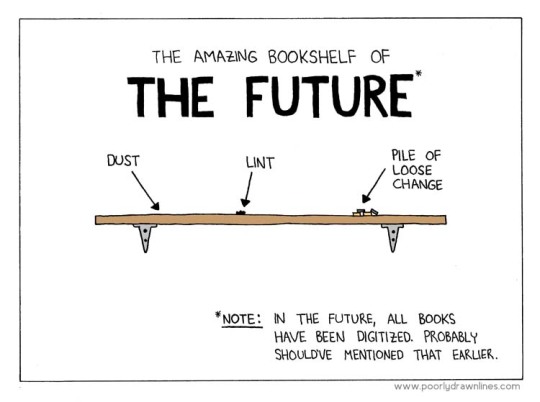
Also the library of the future?
The Court summarized their findings in relation to question one as "...[the texts of the Articles above] must be interpreted as meaning that the concept of ‘lending’, within the meaning of those provisions, covers the lending of a digital copy of a book, where that lending is carried out by placing that copy on the server of a public library and allowing a user to reproduce that copy by downloading it onto his own computer, bearing in mind that only one copy may be downloaded during the lending period and that, after that period has expired, the downloaded copy can no longer be used by that user". The restrictions set a clear dividing line between lending and selling and/or distribution of the content, since this makes it very much akin to that of lending a physical book.

They then moved onto the second question dealt with the possibility of derogating under Article 6(1) of the Directive, and subjecting it to the condition that the digital copy of a book made available by the public library must have been put into circulation by a first sale or other transfer of ownership of that copy in the European Union by the holder of the right of distribution to the public or with his consent. Quickly dealing with the second question, the Court saw that Article 6 did not preclude Member States from making the application of the provision subject to the above condition, since the condition would reduce the risks of prejudicing the authors of those works.

This was followed by the third question, which asked whether Article 6 precludes "...the public lending exception laid down [in Article 6(1)] from applying to the making available by a public library of a digital copy of a book in the case where that copy was obtained from an unlawful source". Even though the Article is quiet on the legitimacy of the sources of those works, the Court dismissed the possibility, as this would "...amount to tolerating, or even encouraging, the circulation of counterfeit or pirated works and would therefore clearly run counter to [the] objective". This makes perfect sense, since the allowance of the use of illegal copies would be tantamount to legalising copyright infringement, at least in cases such as this. Article 6 therefore was seen to preclude the above possibility.

The Court deemed the fourth question to not require an answer.

The case is a very positive step towards accepting and embracing technological change, whether it is in the context of libraries or the use of digital content as a whole. The decision also leaves quite a bit of wiggle room for Member States to implement the Lending Right Directive, which allows for a more nuanced control of copyright protected works in e-lending.

Source: IPKat

16 September, 2015

Retrospective - Incidental Inclusion of Copyright Protected Material

Not all infringement is necessarily wilful or intended, whether it is accidentally sharing a copyright protected image to a wider audience when it was intended to be shared to simply a small audience (albeit still, arguably, infringing copyright) or including works in your own that were not duly licensed as a matter of omission. As such the law does exclude liability for potential accidental inclusion, protecting those who have not intended to infringe copyright, but nevertheless have done so. How the law protects those who've incidentally included material in their works has been unclear due to the ambiguity of the provision in the Copyright, Designs and Patents Act 1988, but more clarity was shed on the provision in the early 2000s by the Court of Appeal.

The case dealing with incidental inclusion was Football Association Premier League Ltd & Ors v Panini UK Ltd, which dealt with collectible football stickers; a staple in many persons' youths (although this writer was more of the ice hockey disposition). Panini sold stickers, along with an album that you could collect them into, within the UK. The sticker collection comprised of nearly 400 football players from the English Premier League and other leagues, and the images used in the stickers contained the player wearing their respective club shirt. In many pictures the clubs' logos are fully visible, also sometimes including the Premier League logo on the sleeve of the football shirt. After a licence was issued to Topps Europe Limited (a tendering process that Panini was involved with) they created a similar sticker collection and accompanying album, and the Premier League too Panini to court for copyright infringement in relation to the club logos and the Premier League logo.

The main focus of the case was on whether Panini's inclusion of the logos in their stickers was copyright infringement, or whether it was protected under section 31 of the Copyright, Designs and Patents Act 1988. The provision allows for a finding of non-infringement in the event of a work's "...incidental inclusion in an artistic work, sound recording, film or broadcast"; however, what exactly amounted to an 'incidental' inclusion was uncertain.

Several draft stickers were rejected for good reason
Lord Justice Chadwick saw that the determination of whether a work does or does not infringe copyright has to be made "...considering the circumstances in which the relevant artistic work... was created". The circumstances would involve the relevant artist's mindset and potential reasons for the inclusion of a potentially infringing work in their work, as well as both commercial and aesthetic reasons for its inclusion. Emphasis is placed on the why, which undoubtedly will take into account any inclusions that are done merely feigning an incidental inclusion, when the true reason was to benefit from its inclusion.

In concluding the case Lord Justice Chadwick saw that, as the reason for the inclusion of the relevant club shirt was to make the images, and therefore the stickers, the most attractive to a would-be collector, it would be important for the shirts to be authentic and contain all logos. Due to this their inclusion could not have been purely incidental, as the objective of the images was to display the logos, although not prominently, but visibly enough for an informed collector to note them. His promptly then dismissed the appeal by Panini.

As can be seen incidental inclusion is by no means a straightforward assessment using bright line rules, but involves a more nuanced, objective assessment of a potentially infringing work's inclusion. Should the Premier League logo just have been present in an on-field advertising board in the background, or on a truck outside, arguably its inclusion would have been incidental. The reason why they were in the image was to give an aura of legitimacy, value and to effectively identify each player, team and league in the sticker set. Incidental inclusion doesn't come up often in IP, and this writer would love to see it applied in an Internet context somehow.

14 May, 2013

Retrospective - Sweaty brows, no reward?

One of the most influential cases formulating our understanding of what can be protected by copyright all over the World was the US case of Feist Publications Inc v Rural Telephone Services Co. The case concerned a telephone service provider, Rural Telephone Services. As the company provided said services, it had to collect and compile listing information, publishing the collection in a directory annually. The directory was in itself an alphabetical listing of people, their numbers, addresses and so forth, much like the Yellow Pages. Rural Telephone Services was one of over a dozen phone services providers in Kansas. Feist Publication sought to publish an area-wide directory, having bought the data and required rights from the other providers in order to do so, falling short when Rural Telephone refused to sell them their data. Not being ones to fail, Feist Publication took Rural Telephone's data anyway and used it without their consent, utilizing roughly 3% of their data without any modifications and a substantial part more with some amendments and changes. Upon noticing this Rural Telephone proceeded to sue Feist Publication for infringement.

The question falling ever so graciously on the US Supreme Court's lap was whether there was a copyright work to protect to begin with, without which the case would fall flat. The Supreme Court did consider other matters, such as fair use, substantiality (amount copied) etc., but the most influential of which was the consideration over the existence of copyright.

All that work for naught
In their decision the Supreme Court saw that the directory in itself, should it show sufficient originality, could potentially be protected by copyright as a whole; however the raw data - phone numbers, addresses etc. - could not be protected as it isn't an original work. If there is no originality, the work cannot fall under the protection of copyright and is thus free for all to use. To put it in simpler terms, the presentation of the facts is something that can be protected, but not the information. What the case changed significantly was the "sweat of the brow" or "industrious collection" test used by lowers courts which extended protection of compilations from only its presentation to the data as well, which the Supreme Court subsequently repealed. The Court in its decision saw that the test had wrongly interpreted the 1909 Act and thus skewed the main principle of copyright: one cannot copyright ideas or facts.

Sweat of the brow has been used by the courts prior as a means to extend copyright to collections of data purely through the laborious efforts of the person compiling the information, creating value in that work through the sheer efforts they have put into it. English courts have accepted the notion of sweat of the brow, although not in the same fashion as its counterparts over the pond.

Essentially what the Court iterated in its decision was the fact that there was no element of creativity. No work will attain copyright protection, regardless of the amount of work put into it. The compilation of lists, directories or other factual information, with no element of creativity in its presentation, will not be protected under copyright. As said, the presentation, layout of information for example, could be protected, but the information presented will not be a copyright work. It could've taken you decades of meticulous work, however that it itself doesn't not make it protectable.

The law has moved on from Feist, often taking smaller or larger leaps, but the case still remains at the heart of copyright law, having influenced both US and foreign cases even today. If monopolies were allowed in raw data, a lot of the things we have right now could not be possible, and this would clearly impact modern applications of phone directories and such on the Internet. The disapproval of the sweat of the brow principle was a logical change in the law going forward and has enabled innovation through the use of data in other applications.