Showing posts with label digital. Show all posts

25 November, 2016

All Checked Out - CJEU Decides on e-Lending of Books by Libraries

As previously discussed on this very blog, the issue of e-lending has come up in the European courts recently, specifically relating to whether it is allowed under EU law. While one would think the question is quite straight-forward, especially when specific restrictions have been put in place to prevent any abuse, the matter isn't necessarily answered in one word. Advocate General Szpunar handed down his opinion during the Summer, with many awaiting the ultimate decision of the CJEU; however, the wait is now over, and the Court has handed down its judgment on the future of e-lending a couple of weeks ago.

By way of a brief exposition for those who have not read the previous article above, the case of Vereniging Openbare Bibliotheken v Stichting Leenrecht dealt with the lending of electronic copies of books by libraries in the Netherlands, and the remuneration of collection societies in the country for those activities (given for the lending of physical books). Per government policy, e-lending did not fall under the legislation entitling the authors to be remunerated for the lending of their works, but this was disputed by Stichting Leenrecht, ultimately ending up in the CJEU.

The Court dealt with each question posed by Stichting Leenrecht in turn.

The first question posed, as summarized by the Court, asked "...whether Article 1(1), Article 2(1)(b) and Article 6(1) of Directive 2006/115 [Lending Right Directive] must be interpreted as meaning that the concept of ‘lending’, within the meaning of those provisions, covers the lending of a digital copy of a book".

The Court looked at whether the legislation would cover both electronic copies of books, and the concept of 'lending' could apply to the same. They concluded that, after considering all the applicable authorities, that "...intangible objects and non-fixed copies, such as digital copies, must be excluded from the rental right, governed by Directive 2006/115, so as not to be in breach of the agreed statement annexed to the WIPO Treaty, neither that treaty nor that agreed statement preclude the concept of ‘lending’, within the meaning of that directive, from being interpreted, where appropriate, as also including certain lending carried out digitally". The Lending Right Directive expressly applied to physical books, and thus excluded electronic copies of the same; however, the concept of lending under Article 2(1)(a) of the Directive applied to a more abstract, open interpretation of rights (rather than a right, potentially restricting it to only one form), allowing for the inclusion of digital copies as well as their physical counterparts.

This applies to considerations that the Directive should adapt to "...new economic developments such as new forms of exploitation", and clearly the exclusion of any future forms of media would be short-sighted and undesired, and would limit the protection offered to authors through copyright. The Court also considered the derogation from the rights afforded in the Directive by Member States, and concluded that it could potentially apply in order to protect the public interests underlying the lending of books through libraries.

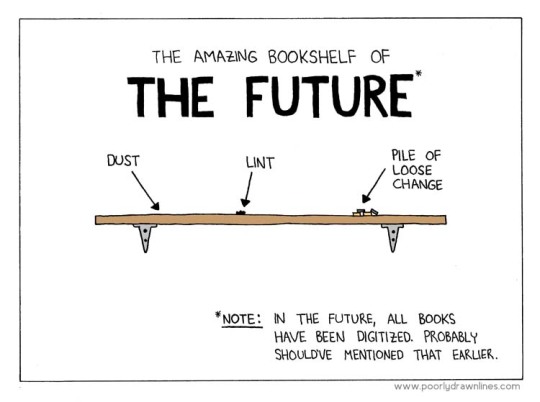
Also the library of the future?
The Court summarized their findings in relation to question one as "...[the texts of the Articles above] must be interpreted as meaning that the concept of ‘lending’, within the meaning of those provisions, covers the lending of a digital copy of a book, where that lending is carried out by placing that copy on the server of a public library and allowing a user to reproduce that copy by downloading it onto his own computer, bearing in mind that only one copy may be downloaded during the lending period and that, after that period has expired, the downloaded copy can no longer be used by that user". The restrictions set a clear dividing line between lending and selling and/or distribution of the content, since this makes it very much akin to that of lending a physical book.

They then moved onto the second question dealt with the possibility of derogating under Article 6(1) of the Directive, and subjecting it to the condition that the digital copy of a book made available by the public library must have been put into circulation by a first sale or other transfer of ownership of that copy in the European Union by the holder of the right of distribution to the public or with his consent. Quickly dealing with the second question, the Court saw that Article 6 did not preclude Member States from making the application of the provision subject to the above condition, since the condition would reduce the risks of prejudicing the authors of those works.

This was followed by the third question, which asked whether Article 6 precludes "...the public lending exception laid down [in Article 6(1)] from applying to the making available by a public library of a digital copy of a book in the case where that copy was obtained from an unlawful source". Even though the Article is quiet on the legitimacy of the sources of those works, the Court dismissed the possibility, as this would "...amount to tolerating, or even encouraging, the circulation of counterfeit or pirated works and would therefore clearly run counter to [the] objective". This makes perfect sense, since the allowance of the use of illegal copies would be tantamount to legalising copyright infringement, at least in cases such as this. Article 6 therefore was seen to preclude the above possibility.

The Court deemed the fourth question to not require an answer.

The case is a very positive step towards accepting and embracing technological change, whether it is in the context of libraries or the use of digital content as a whole. The decision also leaves quite a bit of wiggle room for Member States to implement the Lending Right Directive, which allows for a more nuanced control of copyright protected works in e-lending.

Source: IPKat

30 September, 2016

Change is Scary - The EU Commission Sets Out Proposals for New Copyright Changes

Copyright seems to have been immersed in a perpetual sea of change in the last couple of years, especially here in the UK and the EU as a whole. While this change is hugely important, including for the harmonization of aspects in technological change that have profoundly shaped the sphere in which copyright operates. With the EU's recent dive into a new perspective on the Single Digital Market having been published a little over a years ago (more on which here), future, more concrete changes have yet to be released; however, this changed only a few days ago.

As said, the EU Commission just recently published its propositions to modernize copyright in the wake of the Digital Single Market strategy. While the documents themselves are quite extensive, this writer would aim to discuss the proposed changes more in the broader sense, hopefully to encapsulate the main points of the propositions themselves.

Better choice and access to content online and across borders

As outline in the DSM strategy, access to online content within the EU is paramount to the Commission, with intentions to stop geo-blocking and allow for access to domestic content even abroad (i.e. using the BBC iPlayer when on vacation in the EU). This was expanded on in the proposition as an introduction of "...a legal mechanism for broadcasters to obtain more easily the authorisations they need from right holders to transmit programmes online in other EU Member States". Clearly this seems to envision a cross-EU licencing scheme, or the broadening of existing licences to cover more than their origin country. Initially, as outlined in the proposal, this would be done through a dialogue with the audiovisual industry on licencing issues; however, this writer would not see it as an impossibility that this would be legislated on somehow in the future if progress is not made as desired.

This is expanded on in the Commission's communication, which sets out measures to be taken in relation to access to online content, copyright exceptions and a more efficient enforcement regime.

Improving copyright rules on research, education and inclusion of disable people

Change is scary, so lets manage it!
There are also desires to improve the rules surrounding research, education and inclusion of disable people, particularly broadening access to protected materials for these types of uses. The proposal would include "...a new exception to allow educational establishments to use materials to illustrate teaching through digital tools and in online courses across borders", with additional provisions dealing with cultural heritage institutions (and their preservation of that heritage, as well as access to the content for citizens). While research and access to cultural heritage are very important, the EU sets out the desire to implement the Marrakesh Treaty, which aims to "...facilitate access to published works for persons who are blind, have other visual impairments or are otherwise print disabled", as well as adding measures that will allow for the full participation of disabled individuals in society by providing access to materials (or ways to convert such materials, presumably) that are protected by copyright.

Some of the proposed provisions include an exception for the use of works and other subject-matter in digital and cross-border teaching activities and the copying of cultural heritage materials without infringing copyright. Especially considering the former, the activities must be legitimate, and will undoubtedly be prescribed to certain situations and contexts, much like existing exceptions for research.

A fairer and sustainable marketplace for creators and press

Lastly, the Commission's proposed Directive on Copyright in the Single Market aims to (including the above) "...reinforce the position of right holders to negotiate and be remunerated for the online exploitation of their content on video-sharing platforms such as YouTube". The Directive would impose an obligation on the service providers to have an automatic system that tags and/or removes illegal content, much like YouTube's Content ID system already does (irrespective of its controversial nature). One can imagine this will be a treacherous and unpredictable imposition on service providers, and would remain to be seen how it is genuinely implemented, and whether the providers would face sanctions for lax or non-existent enforcement.

The EU Commission's proposals are quite interesting, and pose, at least in theory, a possible modernization of copyright in the Digital Single Market. As an individual with an international background, I welcome more access to content when abroad, and the expansion of teaching opportunities and the preservation of cultural heritage. What will be interesting are the measures deployed against large service providers, whose users might upload large or small quantities of illegal content on their systems. The provisions, however, in this regard seem to be aimed at cooperation and coexistence, but can pose a problem if presented as one-sided affairs for rights-holders.

Source: IPKat

21 May, 2015

The EU Single Digital Market - 16 Initiatives to Success?

As diligent readers of this blog have probably noted, the last 12 months have been vary favorable to those who are inclined to law reforms, especially in the field of copyright. This writer, for one, enjoys the rapid changes being introduced, and has awaited the next step of the reform process, which was leaked not long ago; the European Union Single Digital Market strategy. The strategy encompasses much more than just IP within it in attempts to combat the issues plaguing the internal digital market, and this post shall endeavor to touch upon the most relevant parts, divided by the "pillars" they're under.

Pillar I - Better Access For Consumers and Businesses to Online Goods and Services Across Europe

Along with the introduction of changes to e-commerce regulation, delivery systems and VAT within the European Digital Economy, the strategy also proposes some key changes into the landscape in which copyright resides.

Geo-blocking has, and will be, a contentious issue, especially in this global world where not all consumers are created equal in their access to media. The strategy states that: "[b]y limiting consumer opportunities and choice, geo-blocking is a significant cause of consumer dissatisfaction and of fragmentation of the Internal Market", and while arguably true to a certain extent, the statement does not reflect the commercial nature of geo-blocking. Often it is used to ensure either the locking in of content to regions, or to secure proper negotiations for wider, more lucrative licensing agreements (whether you agree with this notion or not is an entirely different matter). The strategy discusses 'unjustified' geo-blocking, but as to what amounts to an unjustified use remains unclear. Nevertheless the strategy proposes that "[a]ction could include targeted change to the e-Commerce framework and the framework set out by Article 20 of the Services Directive". Arguably a relaxing of geo-blocking within the EU would harmonize the market, especially with the emergence of prominent internet based media services; however, it still leaves the abuse of cheaper pricing (or conversely, the pricing out of poorer regions) in the market in the light of this potential change.

The first pillar also includes a proposal to allow for a more fluid, easier access to content within the EU in terms of its legislative base. The strategy notes that "[b]arriers to cross-border access to copyright-protected content services and their portability are still common, particularly for audiovisual programmes. As regards portability, when consumers cross an internal EU border they are often prevented, on grounds of copyright, from using the content services (e.g. video services) which they have acquired in their home country". This can be argued to relate to the point above quite heavily, with copyright ensuring the effective enforcement of geo-blocking, or any curtailment thereof. Some issues to persist, such as the inaccessibility to content for which you have rightfully paid for outside of some jurisdictions, as has been noted in the strategy as well, but these issues, at least in this writer's anecdotal experience, don't seem to be too prevalent.

The strategy also discusses a lack of clarity within copyright in the EU, but does not state as to what is unclear and how it is proposed to be remedied. Ending the first pillar, it is suggested that "...the Commission will propose solutions which maximise the offers available to users and open up new opportunities for content creators, while preserving the financing of EU media and innovative content". While this is all well and good, no actual legislative measures are proposed, and the aim of the strategy in relation to copyright seems foggy at best.

The first pillar clearly envisions a freer, more affordable digital market within the EU, but omits the actual regulatory structures, or changes thereto, leaving the strategy with more questions than have been answered.

Pillar II - Creating the Right Conditions for Digital Networks and Services to Flourish

The second pillar builds on the first, with the proposal of a more robust, free and functional network, with basic rights and the assurance of content enforcement, especially in relation to third party operators such as ISPs. After discussions on the introduction of wider rules for telecoms, and the potential expansion of the Audiovisual Media Services Directive, the strategy moved onto discussions on improving the online environment.

Some pillars hold more than others
The strategy brings up the restriction of certain players in the online world, such as search engines (Google, anyone?) and media services. Issues raised "...include a lack of transparency as to how they use the information they acquire, their strong bargaining power compared to that of their clients, which may be reflected in their terms and conditions (particularly for SMEs), promotion of their own services to the disadvantage of competitors, and non-transparent pricing policies, or restrictions on pricing and sale conditions". In this regard one has to agree to a certain extent, as e-commerce and other online giants become even bigger, their monopolies become harder to detect, and has the ability to curtail competition. How and when these issues would be tackled was also left out of the strategy, allowing for nothing but mere speculation at this point.

Illegal content online has been, and will be, a contentious issue, and the strategy does not leave it out either. Discrepancies with online enforcement of the removal of infringing content, and the blocking of such sources, can be said to be a thorn on the EU's side, and as the strategy points out: "[d]ifferences in national practices can impede enforcement (with a detrimental effect on the fight against online crime) and undermine confidence in the online world". For the first time the strategy does bring up concrete steps as to how to deal with the issue of infringing content online: "In tandem with its assessment of online platforms, the Commission will analyse the need for new measures to tackle illegal content on the Internet, with due regard to their impact on the fundamental right to freedom of expression and information, such as rigorous procedures for removing illegal content while avoiding the take down of legal content, and whether to require intermediaries to exercise greater responsibility and due diligence in the way they manage their networks and systems - a duty of care". Again, although more clear in its intent, the measures proposed have been left quite convoluted, a 'duty of care' on ISPs (and other third parties, possibly) could become too onerous, especially with more and more infringing content popping up online daily. With a sufficient allowance for flexibility, yet robustness, a duty of care system, or something akin or related to, could allow for the better enforcement of intellectual property rights online, while still allowing for its dissemination, sharing and other uses that fall within the scope of any exceptions.

All in all the EU digital environment, at least prima facie, would seem to have a bright future, but with a substantially sized caveat included. How intermediaries are treated in this new environment, with the expansion of rules on telecoms, could hinder the sharing and dissemination of content online, as has been seen with the DMCA in the US, if left too broad. This means any legislative initiatives would have to take both interests, being end-users' and commercial interests, into account when moving forward with any new legislative frameworks.

Pillar III - Maximising the Growth Potential of our European Digital Economy

Finally, the third pillar aims to add the last piece to the puzzle built on the two other pillars by creating more standardized platforms and technologies within the EU, and the improvement of digital skills and e-governance in the internal market. While largely irrelevant to a IP-heavy discussion, they still seem to add to the strategy in allowing for a more developed online network where these rules can operate. This article won't delve into the third pillar much, as it mostly does not relate directly to IP, but it is worth a read for anyone interested in the more practical aspects of the digital market.

Conclusion

While this writer can air nothing but his disappointment in the content of the strategy above, he is left to wonder why the proposal lacks so much in substance when the earlier leak seemed to offer more concrete terms of operation and improvement. With so much uncertainty in its future application, the Digital Single Market leaves with a whimper, and it remains to be seen how its final incarnation will impact on the EU and its legal (and practical) framework. The removal of barriers to enjoyment, and the possible harmonization of pricing and/or licensing in the EU seems, at least from a very superficial interpretation, a very welcomed change, how and when this would be done is still a big question as well.

As said, the strategy left much to be desired, but this writer remains hopeful.
30 March, 2014

Google v Viacom Legal Marathon Ends

Seven years is a long time, both for canines and in litigation, and one such marathon has just come to a close as Google and Viacom have agreed to settle their prolonged clash. Having started in 2007 the legal struggle has shown just how valuable copyrighted content and its use for other purposes is for both parties involved.

The initial proceedings were brought on by Viacom over the use of its content, which was uploaded onto the video sharing website YouTube; one which has been owned by Google since 2006. Viacom sought over 1 billion dollars worth of damages, pertaining to over 100,000 different clips on the website. Google argued that per the safe harbor provisions (more in-depth discussion on this particular area can be found here) in the Digital Millennium Copyright Act the search engine giant could not be liable for the infringement of its users who upload said content onto their website.

Rover was puzzled by the process entirely
Three years later the District Court of New York ruled in its summary judgment that Google was protected by the safe harbor provisions, much to the chagrin of Viacom. The decision was subsequently appealed, and took another two years for the matter to face its second decision by the Court of Appeal's revival of Viacom's appeal. The matter was yet again brought to the District Court the following year, where Justice Stanton upheld his previous decision three years earlier.

This is where the situation has stood, and as said the parties have agreed to finally put the matter to rest and settle. The terms of the agreement were not released, however it has been noted by ReCode that no money has been exchanged. Arguably this is a sensible approach by both parties, and brings one of the more gargantuan claims in copyright's modern history to an end. As has been speculated the settlement could also relate to newer sharing models by Google and content owners, where part of the revenue made through their videos, uploaded legally or not, and thus gives Viacom the monetary incentive they want for their content.

The parties released a joint statement declaring that "[t]his settlement reflects the growing collaborative dialogue between our two companies on important opportunities, and we look forward to working more closely together", clearly showing a more amicable ending to the saga. This further strengthens the relevance of the DMCA safe harbor provisions in relation to video streaming websites, and clears the potential hazard that a ruling against Google would have caused for the Internet.

Source: BBC

27 February, 2014

Australian Copyright and the Future - The Digital Economy

As was discussed on this blog some 8 months ago, the Australian Law Review Commission released its Discussion Paper on the future of copyright in Australia as a precursor to its final report on the topic. Finally, after what seems forever to this writer, the Commission has released its report titled Copyright and the Digital Economy, discussing its recommendations for future legislation in Australia.

The report is very thorough, and clearly focuses on fair use and exceptions to copyright infringement, signaling a well-needed change to the law in light of changes which have taken place in the last 20 years, especially within the scope of copyright. This is illustrated well by the Committee's intention for this review: "The law must be relevant to a complex and changing digital environment, but must also be clear and broadly understood in the community. The law must produce reasonably certain and predictable outcomes, but should be flexible and not inhibit innovation". Due to the report's extensiveness, as usual, this writer will only discuss certain aspects of it. Should you wish to, please read the report in full for a much broader and detailed understanding of the reforms proposed.

Introduction of Fair Use?

A principle which has been well established in the United States, fair use, has been discussed in terms of implementation in a number of common law countries. Fair use can be said to be very flexible, and mouldable, to a variety of technologies and uses in relation to copyrighted works. The ALRC has been discussing the introduction of fair use into Australian copyright legislation, and finally has put forth a recommendation to do so. In their view "...a fair use exception with a non-exhaustive list of four fairness factors to be considered in assessing whether use of another’s copyright material is fair and a non-exhaustive list of eleven illustrative purposes" should be implemented into Australian law.

The importance of introducing fair use can be argued to be sensible, and as the ALRC express: "...fair use differs from most current exceptions to copyright in Australia in that it is a broad standard that incorporates principles, rather than detailed prescriptive rules". Utilizing more broader, less defined principles allows for fair use to apply to newer, more advanced uses of copyright today and in the future. This writer agrees fully with the ALRC and their recommendation, especially in light of changes in the field of copyright in recent years. What copyright, and fair dealing, has been yearning is just that, and would bring copyright into the 21st century.

The proposed provision would be very similar to the aforementioned US provision, taking into account the the purpose and nature of the work's use, while assessing both the availability of the work and the use's effect on the work's market share. The provision would clearly take more direction from US precedent, while still allowing for Australian courts to adapt it in a more Australian context.

New Fair Dealing

Although fair dealing has been used under Australian legislation for a number of years, the provision has fallen behind on what can be deemed to potentially be included within it in modern times. The new proposed additions to the provision would add six new categories included under fair dealing: quotation, non-commercial private use, incidental or technical use, library or archive use, education, and access to people with disabilities. How fair dealing differs from fair use is explained well by the ALRC: "Under fair use, the list of purposes, or types of use, is merely illustrative. The fact that a particular use is not for one of the illustrative purposes does not mean that the use cannot be found to be fair. Fair use essentially asks one question: Is this use fair, considering the fairness factors? The new fair dealing exception, on the other hand, can only apply to a use of copyright material if the use is for one of the prescribed purposes. If a given use does not fall into one of the categories of use, then it cannot be found to be fair". In this writer's opinion the former suggestion would work much more effectively and flexibly in modern copyright, and even though a proposed newer fair dealing provision could fulfill the needs of copyright as uses stand right now, it still does not provide an equal exception in comparison to fair use.

Other Changes

Orphan works have been a thorn in copyright's side for a long time, with provisions only being introduced to mitigate infringement over works where the copyright owner cannot be found. As the ALRC sees that the introduction of such  reforms would "...facilitate the use of orphan works to enable their beneficial uses to be captured in the digital economy, without creating harm to the copyright holder". Arguably this is something that copyright needs, and changes to the laws governing orphan works are necessary.

While the report goes into more specific details in relation to the aforementioned potential changes to both fair use and fair dealing, the report does also provide other changes which it endorses. Due to the report's extensive dealing of these changes, this writer cannot simply fill discussion of all of the rest.

All in all the report is thorough and recommends changes which have been long overdue, and not just in Australia. How and if these recommendations are implemented will be left to the Australian legislature, but the introduction of fair use should merit some haste. The 21st century has been a challenging one for copyright, and not just from a copyright holders' perspective, but as the reform recommendations keep rolling in, it seems the law might finally catch up to what it should have been some time ago.

21 January, 2014

Public Consultation on EU Copyright Law

Copyright reform seems to be on everyone's mind, with reviews being or having been undertaken in the United Kingdom, Australia and Ireland in the past year. Even in this writer's mind copyright has been in dire reform in many jurisdictions, and the calls for change are a welcome change of pace. In conjunction with the aforementioned two EU common law jurisdictions' reform thoughts, the Union itself has set up consultations on the review of its copyright rules. The harmonization of copyright across the EU is something that is desired, especially in the current copyright climate, which is seeking to fit the laws with modern uses of copyrighted material.

According to the European Union's press release this is in response to "...the completion of its on-going efforts to review and modernise the EU copyright legislative framework as announced in the Intellectual Property Strategy "A Single Market for Intellectual Property Rights", while facilitating practical industry-led solutions through the stakeholder dialogue Licences for Europe to issues on which rapid progress was deemed necessary and possible". What this revision will change will ultimately be left to the EU; however the consultation does indicate certain desired changes or directions which the Union may take in the future.

In setting out the reasons for the consultation, the EU was very clear in the background and needs for reform:
"Over the last two decades, digital technology and the Internet have reshaped the ways in which content is created, distributed, and accessed. New opportunities have materialised for those that create and produce content... for new and existing distribution platforms, for institutions such as libraries, for activities such as research and for citizens who now expect to be able to access content... regardless of geographical borders... This new environment also presents challenges. One of them is for the market to continue to adapt to new forms of distribution and use. Another one is for the legislator to ensure that the system of rights, limitations to rights and enforcement remains appropriate and is adapted to the new environment."
Indeed the changes in the environment where copyright functions on a day-to-day basis have drastically changed since the emergence of the Internet and a heavier emphasis on the consumption of digital goods as opposed to their physical counterparts. How the aforementioned issues will be tackled leaves a lot of room for discussion in submissions; however this writer will endeavor to give his insight on some of the solutions or questions posed by the Union.

The EU in this process would want to unify the approach to copyright within all of its territories; which currently is a process which takes place in each nation individually, hindering licencing or forcing partial or separate EU-whole licences to be created. Arguably such a licencing scheme would be desirable, but whether this requires legislative action is questionable. The Union should offer an easy way to licence content all over Europe, providing all of its citizens access to the same or most of the content others have access to. The Single Market in this regard needs to be encouraged, not necessarily further legislated on.

The EU also wants to further clarify the position the law holds with digital content; more specifically the making available of content and what that entails; the rights relating to the making available of content (its reproduction and the right to make it available) and their split nature between different parties; the complexity of linking on the Internet and browsing content on it (and issues that might arise relating to temporary copies thereof); and the ownership of downloaded content. Some of these questions, as pointed out by the consultation paper, have been referred to the Court of Justice of the European Union, and those decisions will undoubtedly influence the changes that might be needed after, if at all.

The paper also seeks to further clarify, and potentially unify, the approaches taken by Member States to exceptions in relation to copyrighted content and their use. Although several a Directive has been issued pertaining to exceptions particularly, for example in terms of research and teaching, there is a clear need for uniformity and the extension of new exceptions in this regard, at least in this writer's opinion. A clear and concise regime of legitimate use of copyrighted content all over the EU would be beneficial to users, and enable the Single Market to function more consistently and easier. As the paper points out, user-generated content is an important consideration, which is yet to be legislated on, among a few other exceptions. As said, this is one area where the EU should step up and give further guidance and unification, purely due to the international nature of digital content especially, easing the modern markets and unifying their approaches within the Union.

The consultation paper contains much more than what has been discussed above, and all parties which can participate in this process should voice their opinions. Although the EU has been far from complacent in recent years in terms of copyright review, this process gives the ability for others to directly influence this process, and therefore improve the current Single Market. Copyright has been a hot-button topic, and seems to keep as such for the foreseeable future.

Source: TorrentFreak

10 August, 2013

Copyright and Social Media - Viacom takes on YouTube

As people use various social media outlets more and more, their relation to copyright and possible issues they present become ever more prevalent. Could social media websites such as YouTube and Facebook be infringing copyright through their users' submitted content? With YouTube receiving over 100 hours of video every minute, some of which clearly being copyrighted material, it was only a matter of time before the courts had to address this issue. Media giant Viacom took it upon themselves to bring this matter forth, suing the video hosting service for copyright infringement.

The lengthy legal battle began back in 2010, when the matter was taken to the New York District Court in the case of Viacom v YouTube. The defendant argued, in their application for summary judgment, that they were protected from being held liable under the safe harbor provisions in the Digital Millennium Copyright Act. Should YouTube have lacked actual knowledge of any infringing material or acts being conducted in their service; would not be aware of any facts or circumstances making such activity apparent; and have acted promptly on any knowledge of such acts or materials being published by removing them, they would be exempt from liability. In Viacom's argument, for partial summary judgment, YouTube had actual knowledge and were aware of facts and circumstances which made such acts apparent, but did not act upon that knowledge to stop it; they received financial benefit from this infringing activity and could control it; and did not result solely from providing storage and direction of a user in their facilitation of that content as specified in the section. In the court's conclusion YouTube did not infringe copyright and were safe under the provisions as a service provider. Even though the site did contain infringing material, YouTube's prompt removal of that content when notified of it prevented it from being liable. Should they have not acted upon the knowledge of the material, they could have been liable.

In taking things further, Viacom appealed, and their case was heard in late 2012 in the New York Court of Appeals. In the decision the court saw that the judge at first instance had not considered the issues of YouTube's awareness of the material or had actual knowledge of any specific infringements; whether they had 'willfully blinded' themselves, in other words ignored, the infringements; whether they had the right and ability to control that activity; and whether the content was syndicated, in other words controlled, by a third party (the user), only using the service as a means of storage and direction. In that light the case was sent back to the District Court for final summary judgment.

A plethora of possibilities
In its final decision the District Court saw that YouTube was indeed safe under the DMCA safe harbor provisions. The service had not willfully blinded itself to the infringing content, which was found through evidence in the form of internal emails between executives. Even though the exchanges did identify specific content that was infringing and discussed their removal, in themselves they were not enough to showcase any level of ignorance through choice. The site also did not have the right and ability to control users activities, as this would have meant an ability to do something beyond the mere typical control of a website. Finally their potential financial gain was not seen as an issue, as they did not encourage the uploading of infringing material, nor did they have active control over the content which was uploaded (pre-screening the videos etc.) In its judgment the court threw out Viacom's case and found in favor of the defendant.

So after years of litigation, what can we say about the relationship between copyright and social media? The relationship does still remain a complex one, and the nuances of each service provide different aspects that need to be assessed. What can be taken away from the Viacom litigation is the potential issue of "willful blindness", as websites cannot simply abuse the DMCA provision in the guise of not knowing that infringing acts are occurring. In short, ignorance is no defense if it's through choice. Websites don't have to take an active role necessarily in screening everything that is posted, but do have to act once informed of any misuses. As social media grows and evolves, it will provide newer challenges and potential issues going forward, but as it stands, the Viacom case gives us a great illustration of how social media and copyright interact.

28 April, 2013

Safe Harbors and 70s Music

Online services in the United States, such as websites where content is shared, have relied heavily on the protection of the Safe Harbor provisions in the Digital Millennium Act to protect themselves from infringement through their services. The provision itself excludes online service providers from liability should the users of their services do so, on the condition that they are unaware of this activity and should they be notified of any infringements, take immediate action to stop the infringements or remove any infringing material. As one can see, the legislation encourages service providers to take a proactive stance, and limits their liability should their services be misused in a way which they're unaware of. From a provider's stand-point not only does this allow for start-ups to engage in their respective service provision, but it also prevents them from being immediately swamped by law suits and therefore never getting off the starting line. The matter of whether service providers, specifically music streaming services, would be protected from liability for sound recordings made before protection was awarded to them through Statute in 1972 (albeit still existed through common law) was deliberated by the New York State Appeals Court a mere few days ago in the case of UMG Records Inc v Escape Media Group Inc.

The grooviest of all sharks
The case concerned the website Grooveshark, where users could stream content that uploaded by other users,creating playlists or listening to selected artists, with revenue coming through user subscriptions or advertisements during streaming. The claimant, UMG Records argued that the Safe Harbor provisions did not offer escape from liability for service providers, due to the DMCA amending the prior Copyright Act which expressly set out that any sound recordings made before 1972 would not be covered under the Federal legislation. This would in turn mean that the amendments made in the DMCA would not apply to those songs, rendering the Safe Harbor provisions unusable to protect service providers, as liability would still exist through the common law.

In their decision the court stated that the provisions would not apply to songs made before 1972, causing the service provider to potentially be liable under common law. The decision went against a District Court decision a few years before, Capitol Records v MP3tunes, where Judge Pauley saw that there was no indication that the legislation would exclude sound recordings made prior to 1972. The decision in the NY Court is one of strict interpretation, and in this writer's honest opinion, lacks the common knowledge and application to today's needs for service providers. The legislation does not expressly limit its scope, and applying pre-Internet legislation in its interpretation would undermine what the Safe Harbor provisions set out to achieve; to offer protection for service providers in an age where millions have access to services, making their full control and prevention of infringement an arduous and difficult undertaking. The case will be appealed and hopefully rectified in higher courts.

The case itself shows yet again, as has been discussed in this blog several times, the datedness of copyright legislation in the US. Without express and clear provisions dealing with subject matters such as this, bringing copyright legislation to the 21st century, both users and service providers will end up fighting an uphill battle trying to protect their rights and ability to utilize the Internet to its fullest. Whether action will be taken will remain to be seen, but there clearly is a need for reform.

Source: Thomson Reuters

18 April, 2013

The First Sale Doctrine takes a hit - you can't resell digital music

The anticipation of whether the Kirtsaeng v John Wiley and Sons would change the way in which we're allowed to resell our legally purchased goods (discussed on this very blog here) was huge, both in the legal world, and in the minds of consumers just aching to sell off that CD collection bought in Europe. Well, it looks like we've taken the first step towards the limitations of the First Sale doctrine.

A US Federal Court handed down its judgment in the case of Capitol Records v ReDigi Inc at the end of last month. The case concerned the resale of digital music bought on iTunes or other digital marketplaces through the service offered by ReDigi, where users could sell their legally acquired smash hits to others who are looking for said music - much like a digital flea market if you will. The company was then sued by Capitol Records for copyright infringement.

The case in itself presents and interesting view of whether the First Sale doctrine could be applied in a digital world. Kirtsaeng dealt with the resale of physical goods, i.e. books, whereas the resale of digital goods would require the transfer of a new copy from the original music file through ReDigi's service. This is the reason which felled ReDigi's argument in the eyes of the court. The US Copyright Act  mentions a 'specific' phonographic record (a fancy way of saying a music recording), and making a copy from the original would not be within the remit of the doctrine. In ReDigi's defense they did argue that "technological change has rendered its literal terms ambiguous...", which in this writer's mind would be a valid point. If the copy could be traced to a legitimate copy, that should surely allow for it to be sold regardless of it being in a physical medium or not. Alas ReDigi's argument was rejected, and from a lawyer's perspective that holds to be true. The Court further noted a provision in the Digital Millenium Act which effectively prevents the redistribution of digital works. The Judiciary is not in the place to change laws, but to merely interpret them, and the approach taken by the Federal Court seems to be right in this case.

Spending all that money on vinyl finally paid off!
Here the law perfectly illustrates its dated approach to copyright law, having been enacted well before a time where such transfers of music or any other digital medium were even possible. Discussion in most common law countries over needed changes to the law, as noted on this blog as well, has been very active in the last few years, and cases such as this do highlight this fact very well. Should we be able to sell the goods we legally buy regardless of their tangible or intangible nature? Of course, especially when more and more music is being sold digitally than ever before. As it has been said before the gauntlet has been thrown to the legislatures of most common law countries to modernize their approach to copyright in current times. Whether they will act on this call to action remains to be seen, but as more and more commercial interests shift to the digital arena, the pressure for them to act will grow and change should come.

01 April, 2013

The Register’s Call for Updates to US Copyright Law

Not to be confused with a copyrighted seal
Being one of the biggest producers of copyrighted material in the World, the United States and its laws have clout all over, regardless of jurisdictions, through either free-trade agreements, or sheer market power. In a society where more material is accessed outside of the domestic market of a nation than ever, legislatures in all countries have to try and keep up with the constant change that we experience in the consumption of said material. In a call for copyright law reform, as reported by the Creative Commons blog, Maria Pallante of the US Register of Copyrights seeks to close the rift that exists between the consumer and the copyright holder's rights in the United States today.

In her statement Ms. Pallante says that:
"The law is showing the strain of its age... authors do not have effective protections, good faith businesses do not have clear roadmaps, courts do not have sufficient direction, and consumers and other private citizens are increasingly frustrated."
This can be applied, not only in the US, but in Europe as well. With a clear lack of proper guidelines and laws to govern both personal use by consumers, be it copying or sharing, and the courts stretch existing laws to cover areas which they were not meant to cover. Copyright laws in most common law jurisdictions are lagging behind, and there seem to be no efforts in trying to pull them towards a new era. Even in the United Kingdom there have been calls for reform, yet they seem to have fallen on deaf ears.

Orphaned works are a perfect example of the law failing to accommodate the needs and wishes of today's public. Orphaned works are effectively works which are still under copyright, where the author(s) or other copyright holders cannot be located or contacted. Google started the mass digitization of orphaned works, and faced litigation because of this, showcasing the clash of the interests of those holding the rights to the works and not utilizing them, going against the greater good through free access to these works. Should copyright prevent access to information not being used, or move towards an avenue more akin to that of trade marks, where the rights holder should actively use the work being protected? The current legal framework does not address this issue.

Ms. Pallante further expands that:
"...it is time for Congress to think about the next great copyright act, which will need
to be more forward thinking and flexible than before... A central equation for Congress to consider is what does and does not belong under a copyright owner’s control in the digital age. I do not believe that the control of copyright owners should be absolute, but it needs to be meaningful."
Flexibility is what the modern age requires. When technology moves at such a pace that it does these days, the new law would have to be flexible and maneuverable, both to protect the interests of copyright holders, and to help consumers use the content they have legally acquired. The path modern laws have taken in a variety of nations has been increasingly draconian, and in this writer's opinion, this trend needs to end.

The new law needs to be worded in anticipation of the ever more digital world, with the old laws concentrating on the physical mediums of copyright, the new law has to look forward to the intangible. The wording has to be open enough for the judiciary to easily apply it in a variety of situations, while being specific enough to protect the interests of rights holders. I will admit this will be a challenge for any legislature, but one where consultation needs to be sought from both sides, not merely from the ones with a clear monetary interest.

Ms. Pallante also brought up the main question that needs addressing in the new law:
"If Congress considers copyright revision, a primary challenge will be keeping the public interest at the forefront, including how to define the public interest and who may speak for it... Congress should look to the equities of the statute as a whole, and strive for balance in the overall framework. It is both possible and necessary to have a copyright law that combines safeguards for free expression, guarantees of due process, mechanisms for access, and respect for intellectual property."
Rounding up her argument, Ms. Pallante points out that:
"The issues of authors are intertwined with the interests of the public. As the first beneficiaries of the copyright law, they are not a counterweight to the public interest but instead are at the very center of the equation."
The Harlem Shake, an example of "proper" free use of copyrighted material
This writer fully agrees with Ms. Pallante in her call for reform - not just in the US, but all over the common law. The interests of the public, and rights holders, are of equal standing, and the shift towards a more common and level playing field for both parties needs to be taken. The consumer has to have rights in using the material they have rightfully acquired, yet still keeping them from freely copying and sharing that content to provide an illegal way for others to get that material. Whether this call for reform will result in any changes remains to be seen, but this writer will remain hopeful.