Showing posts with label right. Show all posts

01 May, 2018

Monkey Snap, Monkey Don't - US Court of Appeals Rules Out Animal Ownership of Copyright in Monkey Selfie Case

The rights of animals, whether it is simply to extend human rights to them or even legal rights, are a very contentious and often emotionally charged topic of conversation. A good example of this is the recent monkey selfie legal saga, which grappled with the vesting of intellectual property rights in a monkey (discussed more on this blog here and here). The parties settled the matter out of court late last year, but the Court of Appeals saw to still rule on the matter, irrespective of this settlement (which is within their powers to do). This is very important, since it will set the legal position of animals' rights in IP firmly on one camp; yes or no. This writer has been waiting for the ruling with baited breath, which was published only last week.

By way of a brief primer, the case of Naruto v David Slater concerned a series of photographs taken by a crested macaque in 2011 (named Naruto by its Next Friends in the litigation, PETA). The monkey took the photograph using Mr Slater's camera, which he had configured and left for the monkeys in the area to play with. One such picture became an Internet sensation, leading to Mr Slater asserting his rights in the picture as its author. PETA took the matter to court, claiming the monkey had rights in the picture, and that Mr Slater had infringed its copyrights by publishing it. Even though the parties settled the matter, as discussed above, the Court saw it fit to decide on it anyway due to its importance as a developing area of the law.

Naruto's representatives were aghast at the ruling
Judge Bea, handing down the majority's judgment, started off with determining whether PETA could represent Naruto as its next friends in the case. This is established through showing that "…(1) that the petitioner is unable to litigate his own cause due to mental incapacity, lack of access to court, or other similar disability; and (2) the next friend has some significant relationship with, and is truly dedicated to the best interests of, the petitioner". The Court agreed that Naruto would indeed fulfil the first requirement, but needed to assess whether PETA had a significant relationship with the animal. PETA agreed that it had does not claim to have a relationship with Naruto that is any more significant than its relationship with any other animal, and thus fails the second requirement.

The Court emphasised that animals do not have authorisation by the courts to be represented by a next friend. In other words "…if animals are to be accorded rights to sue, the provisions involved therefore should state such rights expressly".

Judge Bea then moved onto the matter of whether Naruto itself has standing under Article III of the Constitution. Under a previous Court of Appeals decision in Cetacean Community v Bush, the court rejected standing for "…all of the world's whales, porpoises, and dolphins" under environmental protection laws as animals were not expressly included within the provisions. In short, the court concluded that the test for animal standing as "…if an Act of Congress plainly states that animals have statutory standing, then animals have statutory standing. If the statute does not so plainly state, then animals do not have statutory standing".

Under the Copyright Act there is no express mention of any animal rights for intellectual property. The provisions do, however, imply a requirement of humanity or the possibility of marital relations. The Court did conclude that, based on the statute and the Cetacean decision, "…that Naruto - and, more broadly, animals other than humans - lack statutory standing to sue under the Copyright Act".

The case is a very important one, not only for the unusual nature of judgments being issued after settlement, but it puts the rights of animals under copyright to bed once and for all. Clearly, animals cannot have rights, and this writer considers this to be the most logical outcome, even without an express mention to that effect in the legislation. One can therefore finally see a conclusion to all of this monkey business.

23 January, 2018

Problem Fixed - CJEU Decides on IP and the Right to Repair Goods

Tinkering with old gadgets or cars is a beloved pastime for many, and often prolongs the life of the goods you own even beyond their warranty periods. Many manufacturers are making it increasingly difficult to repair items, particularly high-end electronics, and with discussions heating up relating to Apple's slow-down of their devices due to hardware aging, it is conceivable even more important for people to fix their old items. We've discussed IP issues relating to repairing or tinkering with tractors, but there has been very little judicial consideration around it. In that vein, what are the limits of IP and peoples' right to repair their goods? The CJEU took this question on late last year.

The case of Acacia Srl v Pneusgarda Srl and Audi AG concerned the sale of alloy rims for cars, for which Audi owns several registered community designs (e.g. RCD 132899 and 207667). Acacia manufactured rims under the brand WSP Italy, sold on their website, which are identical to the rims registered by Audi. The rims made by Acacia were clearly stamped as not made by the OEM, and were sold exclusively as replacement parts for the purpose of making repairs. Audi took Acacia to court over design infringement, with the matter ending up with the CJEU. Porsche had a similar matter joined with the Audi case against Acacia.

The Court joined the questions from both matters, which, essentially inquired about EU law in relation to repairs and design infringement.

The first combined question dealt by the Court asked whether "…Article 110(1) of Regulation No 6/2002 must be interpreted as meaning that the ‘repair’ clause in it makes the exclusion of protection as a Community design for a design which constitutes a component part of a complex product which is used for the purpose of the repair of that complex product so as to restore its original appearance subject to the condition that the protected design is dependent upon the appearance of the complex product".

The restoration of a vehicle's appearance is important, especially in a crash situation, and without the exception this wouldn't be possible. The Article 110 exception allows for this, and the CJEU had to therefore consider the provision's remit.

The CJEU rejected the condition that the exception only operates where the design is dependent upon the appearance of the complex product due to the absence of this phraseology in the legislation. The provision also protects against captive markets, where only the design holder can produce certain spare parts, allowing for consumers to purchase less expensive alternatives and not be tied to one particular provider. The Court therefore set out that "…Article 110(1)… must be interpreted as meaning that the ‘repair’ clause in it does not make the exclusion of protection as a Community design for a design which constitutes a component part of a complex product which is used for the purpose of the repair of that complex product so as to restore its original appearance subject to the condition that the protected design is dependent upon the appearance of the complex product".

The Court then moved onto the second combined question, which asked "…to which conditions the ‘repair’ clause in Article 110(1)… subjects the exclusion of protection as a Community design for a design which constitutes a component part of a complex product which is used for the purpose of the repair of a complex product so as to restore its original appearance".

The CJEU quickly set out that the provision is subject to three conditions: (i) the existence of a Community design; (ii) the presence of a ‘component part of a complex product’; and (iii) to the need for ‘[use] within the meaning of Article 19(1) for the purpose of the repair of that complex product so as to restore its original appearance’.

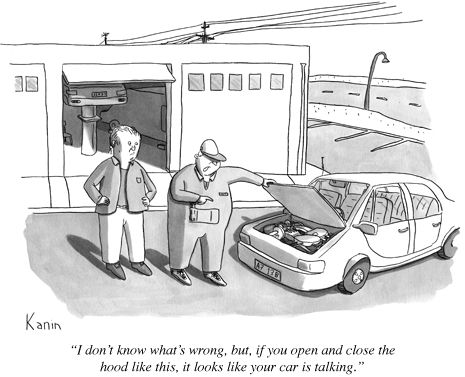
It's not just sellers who struggle with auto repairs
In specifying these conditions, the Court first observed that the second condition (as rights exist in the wheel rims) covers "…multiple components, intended to be assembled into a complex industrial or handicraft item, which can be replaced permitting disassembly and re-assembly of such an item, without which the complex product could not be subject to normal use", and that a wheel rim would indeed fall under this definition.

With regards to the third condition, the CJEU saw that 'use' of that product for the purpose of repairing that product includes making, offering, putting on the market, importing, exporting or using of a product in which the design is incorporated or to which it is applied, or stocking such a product for those purposes. This use, however, has to be with the aim to 'permitting the repair of the product', which encompasses the situation where, if that part were faulty or missing, this would prevent the product's normal use.

In short, the 'use' of the product, set out above, needs to be necessary for the repairing of that product if it has become defective through damage or lack of original parts. Purely aesthetic repairs wouldn't be covered by the provision, as it's only for convenience. Even still, the repairing would have to be done ‘so as to restore its original appearance’.

What this amounts to is that "…the component part must be used so as to restore the complex product to the appearance it had when it was placed on the market". The CJEU also added that the clause only applies to component parts of a complex product that are visually identical to the original parts.

In short, the CJEU saw that "…the ‘repair’ clause in it makes the exclusion of protection as a [RCD] for a design which constitutes a component part of a complex product which is used for the purpose of the repair of that complex product so as to restore its original appearance subject to the condition that the replacement part must have an identical visual appearance to that of the part which was originally incorporated into the complex product when it was placed on the market".

The Court then moved onto the final combined question, which asked "…whether Article 110(1)... must be interpreted as meaning that, in order to rely on the ‘repair’ clause in that provision, the manufacturer or seller of a component part of a complex product must ensure and, in that case, how it must ensure, that the component part can be purchased exclusively for repair purposes".

As detailed above, the repair clause is subject to a number of conditions, and in particular ones that emphasises a genuine need for repairs. This imposes compliance on part of the downstream user, not just the seller. This means that the seller needs to inform the buyer that "…the component part concerned incorporates a design of which they are not the holder and, on the other, that the part is intended exclusively to be used for the purpose of the repair of the complex product so as to restore its original appearance". Similarly, this needs to be ensured and enforced through contractual means with the buyer. Finally, "…the manufacturer or seller must refrain from selling such a component part where they know or, in the light of all the relevant circumstances, ought reasonably to know that the part in question will not be used in accordance with the conditions laid down in Article 110(1)".

In summary, the CJEU stated that "…Article 110(1)… must be interpreted as meaning that, in order to rely on the ‘repair’ clause contained in that provision, the manufacturer or seller of a component part of a complex product are under a duty of diligence as regards compliance by downstream users with the conditions laid down in that provision".

The case is a very important one, and clarifies the provisions surrounding the repairing of vehicles or goods owned by an individual and in particular the sale of those goods for repair. The onus is clearly on the seller, which makes sense, as they are the ones likely to benefit from the sales of the goods for repair, rather than the rightsholder.

Source: D Young

07 November, 2017

Database Error - UK High Court Takes on Copyright Infringement of Cloud Databases

Databases are a curious creature within the world of IP, existing on the fringes of protectability, at least when considering from the perspective of originality. Specific rights attach to databases outside of mere copyright protection, and the remit of those rights has been debated by the courts for some time. Since the advent of cloud computing, database rights in purely 'cloud-based' technologies haven't been debated much in the courts, and the question therefore arises: do you have database rights in a cloud database? The High Court took on this issue in a recent decision handed down in late August 2017.

The case of Technomed Ltd v Bluecrest Health Screening Ltd concerned electrocardiograms and the analysis of the data created through the ECG measurements. An ECG measures the movement of electricity through a patient's heart, giving details of its health to varying degrees based on the ECG technology used. Technomed supplied ECG equipment, systems and services, including an online ECG analysis and reporting system called "ECG Cloud". The platform allows for ECG information to be analysed externally (the information itself is reviewed remotely by a qualified cardiologist) when taking the readings, offering a simplified analysis using three colors to indicate the heart's health status. The analysis is done using resources in Technomed's database, including characteristics of ECG readings and their associated issues. Technomed licenced its technology to Bluecrest, and after a relationship breakdown proceedings were initiated to protect the rights in the database and its reporting format, which were passed onto a competitor (the second Defendant in the case) by Bluecrest.

The crux of the case revolved around sui generis rights in the database (protection of the money, time and effort put into the database, rather than), copyright in the database, copyright in the reporting software that produces the results from ECG Cloud in XML format, and copyright in various other peripheral elements of the system, e.g. images and explanatory materials.

After assessing the decision of Fixtures Marketing Limited v OPAP, Deputy Judge Stone concluded that Technomed's database was a database as defined under the Database Directive, meaning "…a collection of independent works, data or other materials arranged in a systematic or methodical way and individually accessible by electronic or other means". Even so, Technomed still had to establish a sui generis right in that database.

Sui generis rights are afforded to a database under the Directive, in essence, when the maker shows substantial investment in obtaining, verifying and presenting the data in the database, derived from pre-existing information. The Court quickly determined that there had been substantial investment in the above by Technomed (taking hundreds of hours to do so), affording them a sui generis right in the database.

Infringement of sui generis rights in databases falls under the Directive as well, happening when the data is 'extracted' and 're-utilized' by another party. As Bluecrest had extracted the whole database, which was then provided to the competitor, it infringed Technomed's right in the database. Additionally, should a party repeatedly and systematically reproduce the database, it will also infringe on the sui generis rights afforded. Bluecrest repeatedly produced the XML reports from the database, prejudicing Technomed's legitimate interests in the database until the reports were updated to no longer infringe in 2016.

Even databases have feelings
The Court then moved onto the matter of copyright in the database under section 3A of the Copyright, Designs and Patents Act 1988. As both parties agreed that the assessment for copyright protection is the same as for the sui generis right (as set in Football Dataco v Brittens), Judge Stone quickly concluded that the database had copyright in it. Similarly, as the sui generis right was infringed, the copyright in the database was also infringed. While he didn't need to address the alternate pleading in infringement of a literary work in the database, Judge Stone nonetheless concluded that the database was a literary work (a PDF copy of it) and that it was infringed by Bluecrest by copying the same.

Judge Stone then moved onto the other works, including the XML report format. For them to qualify as protected works, the works will have to be the "…author's own intellectual creation". Even though no rights were claimed in the XML format itself, the reports did, as agreed by Judge Stone, contain the personal stamp of its authors, and was protected by copyright. As Bluecrest had the report format copied by a competitor, it clearly was infringed as well.

The Court also decided that further documents, such as explanatory materials and patient definitions were also protected by copyright, but only the explanatory materials were infringed, as the patient definitions were only used as a starting point to create new definitions by the defendants.

Bluecrest did combat the infringement claims through an argument against causation, i.e. that they didn't cause any damage to Technomed through their alleged infringement. Judge Stone dismissed this out of hand, as through the clear infringement detailed above there would have been loss caused to Technomed.

Judge Stone concluded that all of the rights in the works had been infringed, but there would be no continuing threat of infringement.

While the case is by no means a landmark one, it is still a continuing reminder in database rights and their infringement, including copyright and sui generis rights. This writer always seems to forget about the strength of these rights, particularly as databases don't come across ones desk too often, so the case was an interesting and refreshing read.

25 November, 2016

All Checked Out - CJEU Decides on e-Lending of Books by Libraries

As previously discussed on this very blog, the issue of e-lending has come up in the European courts recently, specifically relating to whether it is allowed under EU law. While one would think the question is quite straight-forward, especially when specific restrictions have been put in place to prevent any abuse, the matter isn't necessarily answered in one word. Advocate General Szpunar handed down his opinion during the Summer, with many awaiting the ultimate decision of the CJEU; however, the wait is now over, and the Court has handed down its judgment on the future of e-lending a couple of weeks ago.

By way of a brief exposition for those who have not read the previous article above, the case of Vereniging Openbare Bibliotheken v Stichting Leenrecht dealt with the lending of electronic copies of books by libraries in the Netherlands, and the remuneration of collection societies in the country for those activities (given for the lending of physical books). Per government policy, e-lending did not fall under the legislation entitling the authors to be remunerated for the lending of their works, but this was disputed by Stichting Leenrecht, ultimately ending up in the CJEU.

The Court dealt with each question posed by Stichting Leenrecht in turn.

The first question posed, as summarized by the Court, asked "...whether Article 1(1), Article 2(1)(b) and Article 6(1) of Directive 2006/115 [Lending Right Directive] must be interpreted as meaning that the concept of ‘lending’, within the meaning of those provisions, covers the lending of a digital copy of a book".

The Court looked at whether the legislation would cover both electronic copies of books, and the concept of 'lending' could apply to the same. They concluded that, after considering all the applicable authorities, that "...intangible objects and non-fixed copies, such as digital copies, must be excluded from the rental right, governed by Directive 2006/115, so as not to be in breach of the agreed statement annexed to the WIPO Treaty, neither that treaty nor that agreed statement preclude the concept of ‘lending’, within the meaning of that directive, from being interpreted, where appropriate, as also including certain lending carried out digitally". The Lending Right Directive expressly applied to physical books, and thus excluded electronic copies of the same; however, the concept of lending under Article 2(1)(a) of the Directive applied to a more abstract, open interpretation of rights (rather than a right, potentially restricting it to only one form), allowing for the inclusion of digital copies as well as their physical counterparts.

This applies to considerations that the Directive should adapt to "...new economic developments such as new forms of exploitation", and clearly the exclusion of any future forms of media would be short-sighted and undesired, and would limit the protection offered to authors through copyright. The Court also considered the derogation from the rights afforded in the Directive by Member States, and concluded that it could potentially apply in order to protect the public interests underlying the lending of books through libraries.

Also the library of the future?
The Court summarized their findings in relation to question one as "...[the texts of the Articles above] must be interpreted as meaning that the concept of ‘lending’, within the meaning of those provisions, covers the lending of a digital copy of a book, where that lending is carried out by placing that copy on the server of a public library and allowing a user to reproduce that copy by downloading it onto his own computer, bearing in mind that only one copy may be downloaded during the lending period and that, after that period has expired, the downloaded copy can no longer be used by that user". The restrictions set a clear dividing line between lending and selling and/or distribution of the content, since this makes it very much akin to that of lending a physical book.

They then moved onto the second question dealt with the possibility of derogating under Article 6(1) of the Directive, and subjecting it to the condition that the digital copy of a book made available by the public library must have been put into circulation by a first sale or other transfer of ownership of that copy in the European Union by the holder of the right of distribution to the public or with his consent. Quickly dealing with the second question, the Court saw that Article 6 did not preclude Member States from making the application of the provision subject to the above condition, since the condition would reduce the risks of prejudicing the authors of those works.

This was followed by the third question, which asked whether Article 6 precludes "...the public lending exception laid down [in Article 6(1)] from applying to the making available by a public library of a digital copy of a book in the case where that copy was obtained from an unlawful source". Even though the Article is quiet on the legitimacy of the sources of those works, the Court dismissed the possibility, as this would "...amount to tolerating, or even encouraging, the circulation of counterfeit or pirated works and would therefore clearly run counter to [the] objective". This makes perfect sense, since the allowance of the use of illegal copies would be tantamount to legalising copyright infringement, at least in cases such as this. Article 6 therefore was seen to preclude the above possibility.

The Court deemed the fourth question to not require an answer.

The case is a very positive step towards accepting and embracing technological change, whether it is in the context of libraries or the use of digital content as a whole. The decision also leaves quite a bit of wiggle room for Member States to implement the Lending Right Directive, which allows for a more nuanced control of copyright protected works in e-lending.

Source: IPKat

08 July, 2016

The Digital Realm - Lending of e-Books is Allowed under the Rental and Lending Right Directive, Says AG Spuznar

The days of the library seem to have been over for some years now, with e-book sales reaching £2,1 billion in 2015, and most young people are blissfully unaware of that wonderful place where books are free and (nearly) endless. While modern media consumption has clearly been a catalyst in this paradigm shift, e-lending was touted as the next big thing, especially since many consume their literary share exclusively in electronic form. With this change in consumption, the question of whether libraries can indeed lend out electronic copies of books was dealt with by the Advocate General prior to a ruling by the CJEU.

The case of Vereniging Openbare Bibliotheken v Stichting Leenrecht involved two stakeholders in relation to the above question. VOB are an association representing of all of the public libraries in the Netherlands, who argued that electronic lending should apply equally to physical lending under Netherlands' (and EU) law, specifically through the Rental and Lending Right Directive. The other side, Stichting Leenrecht, are a collection society for authors in relation to the public lending derogation under Article 6 of the Directive, and argue that e-lending does in fact fall under the scope of the lending right. According to VOB, this lending would be done similarly to physical copies, i.e. one copy for one user, making it inaccessible to others during this period, therefore being covered by the derogation; a position that Stichting Leenrecht contest.

The first question, summarized by the Advocate General, asked whether Article 1 of the Directive "...is to be interpreted as meaning that the making available to the public, for a limited period of time, of electronic books by public libraries falls within the scope of the lending right enshrined in [the Article]".

Will was thrilled about the opinion for the sake of his arms
Advocate General Spuznar discussed the evolution of the technology after the setting of the legislation (having its origins in legislation from 1992), and saw that "...at that time, the EU legislature did not contemplate the inclusion of the lending of electronic books within the concept of lending of Directive 92/100, if for no other reason than because the technology for commercially viable electronic books was then only in its infancy". Clearly, the Advocate General's position here is one of pragmatism, and this writer concurs with his thoughts here, since technological evolution, even when not contemplated by the legislature at the time, should be included when possible. His continued, in a similar vein to this writer's thoughts, that the courts should "...take[] into account developments in technology, markets and behaviour and not to fix such acts in the past by adopting too rigid an interpretation... An interpretation of this kind, which might be described as ‘dynamic’ or ‘evolving’... [and is important] particularly in fields where technological progress has a profound effect, such as copyright". His opinion concludes that the borrowing of library books in electronic form illustrates the phenomenon perfectly, and a looser, inclusionary interpretation would lead to a better enforcement of the law in the new technological world. This adaptation is also in the interests of the authors and the public at large in being able to access culture and scientific knowledge more readily.

In short: "...Article 1 includes the making available to the public of electronic books by libraries for a limited period of time".

The Advocate General then discussed the wording and structure of the Directive, quickly dismissing any claim as to it being contrary to the Directive in allowing for electronic books from benefitting from the derogation. Similarly, he addressed possible issues with the copyright system in Europe and international obligations, concluding that there are no issues with neither provisions in the light of the above. 

In answering questions 2 to 4, he determined that should a Member State wish to introduce provisions enshrining the derogation in Article 6 in national law, they, however, are free to preclude the derogation from applying prior to initial circulation by the author and/or without proper consent from the same as to the lending of a given work. This cannot unduly restrict the derogation, but can be applied within reason.

The opinion in the case, as stated above, is one of pragmatism and reason, allowing for the development of technologies and new ways of distributing lawful copies to those who otherwise might not be able to access them. New technologies are being created all the time, and the law's rigidity would only deter the proper application of those technologies, often to the detriment of the general public. We remain to see whether the CJEU follow the Advocate General's opinion, and this writer for one, hopes they do.

Source: IPKat

04 August, 2015

Icons Gone - Photography of Landmarks to be Prevented Through Copyright?

Memories are an important part of life, especially when it comes to travels to far-away lands or places, filled with culture, icons and landmarks that dot human history's timeline. As an avid traveler, this writer has taken his share of photos, both digital and of the physical, film variety, and often looks back at them with fondness and nostalgia. Pictures also form a part of the fabric of visual heritage of different cultures, and their importance cannot be overstated. Nevertheless, as a part of the InfoSoc Directive's implementation report, specifically relating to Article 5 of the Directive, any EU Member State could introduce restrictions to rights conferred in Articles 2 and 3 of the Directive.

To expand on this a bit more, the Freedom of Panorama enables individuals to take pictures of sculptures or other permanent installations and publish them without a need to consult the original creator or architect to do so. Currently the legal landscape for Freedom Of Panorama is very scattered, with some countries in the EU allowing all uses of such pictures (some with certain limitations, such as non-commercial use), while others, such as France and Italy, allow for no publication of images of this nature. Arguably the ability to publish one's vacation photos should be a 'right' in itself, with potential restrictions on commercial utilization being a viable option (although, one can imagine, costly to enforce effectively).

Frank was a savant in monument photography
In the proposed amended report put forth by Julia Reda (with the initial report discussed on this very blog here) Freedom Of Panorama was curtailed somewhat, as a recommendation set forth that "...the commercial use of photographs, video footage or other images of works which are permanently located in physical public places should always be subject to prior authorisation from the authors or any proxy acting for them". Ms Reda's initial report had a very different view, proposing that photographs of such places would always be permitted. This writer would promote striking a balance between the allowance of sharing photographs with their commercial utilization with no licence contribution. Arguably, enforcement and ensuring that all images were actually taken for the commercial purposes would be challenging, and potentially nigh impossible, yet it still remains an important consideration in this context. People should be able to share their vacation photos with no need to seek permission, but should not be able to sell those images as postcards, for example, willy-nilly.

The measure has since been rejected, which is a great development; however, one has to note that the resolution is non-binding, potentially leaving the door open for the restriction of Freedom Of Panorama in the future. This writer doubts any substantial restrictions would ever be introduced, and even if they would be, their enforcement would be their downfall. Online services like Facebook and Picasa would have to restrict the displaying of photos that would infringe on this potential provision, bearing the brunt of the enforcement of any takedown notices from subsequent rights' holders.

This discussion surrounding the Freedom of Panorama highlights the persisting importance of copyright in everyday life, even regarding mundane, more obvious 'rights'. Should a restriction be implemented monuments around the world would probably have stewards requesting payment after a photograph is taken, affecting the magic of amazing sights that people have wanted to see on their journeys. Nevertheless, as the measure has been rejected it seems highly unlikely, but this writer will follow any developments with interest.

Source: The Times

17 July, 2015

Online Blasphemy - YouTube Wins Round Two of Performance Right Kerfuffle

After the decision in Garcia v Google (discussed on this very blog here) last year the question of whether an actor (or actress) has a copyright interest in their respective performance, no matter how short, has been debated hotly. The decision was appealed, and the Court of the Ninth Circuit decided to hear the matter again en banc; a decision that many of us involved in IP have waited for with anticipation. The decision was finally handed down nearly two months ago, and this writer, in shame, only now had time to discuss the case.

For the uninitiated Garcia v Google dealt with a low-budget independent movie called "Desert Warrior", in which Ms. Garcia appeared. Post filming the title and narrative of the movie was drastically changed, finally being called the "Innocence of Muslims"; a movie that arguably was quite blasphemous and offensive towards those of the Islamic faith. Ms. Garcia's appearance was a brief 5 second clip, and her performance was dubbed over in post-production. The movie incited violence and disapproval in the Middle East, with Ms. Garcia also facing several death threats as a result of her appearance in the movie.

The main crux of the case lies in Ms. Garcia's claim in a copyright interest in her performance, allowing for an injunction to be issued against Google for the movie's broadcast on their YouTube platform (and potential other platforms as well). This injunction was issued at first instance.

The Court raised the alarm right from the start, stating that "...Garcia’s theory of copyright law would result in... splintering a movie into many different “works,” even in the absence of an independent fixation", or in other words, every actor or actress in a given movie would have a copyright claim in it. Also, Ms. Garcia's part in the movie would fall under the work-for-hire doctrine, which passes on the copyright interest to the employer, leaving her with no copyright claim in the work. Ms. Garcia did not, as a final barrier to her copyright claim, fix her work in any tangible form; a requisite element under copyright in the United States for an interest in the work to arise. Through the Court's rationale, albeit quite aggressive as such, Ms. Garcia's claim was quickly dissected and dismissed and she was deemed to have no copyright claim in the work.

Free speech online; a precious commodity
Finally, the Court addressed Ms. Garcia's claim under irreparable harm. Her claim does not manifest itself through any tort-based cause of action, but through copyright and her interest in the work as an author. The Court did have sympathy for Ms. Garcia, but her action was rotten at the root, as the Court described: "This relief is not easily achieved under copyright law. Although we do not take lightly threats to life or the emotional turmoil Garcia has endured, her harms are untethered from -and incompatible with - copyright and copyright’s function as the engine of expression". One has to agree with the Court's judgment, as rightfully so copyright protects expression and not human life or its safety. While one has to appreciate that the movie has brought a significant amount of distress to her, and as such those problems should be addressed, but the way to address them is not through copyright. In the end, her claim failed under irreparable harm, as no harm was caused to the work or her claimed interest in the work as an author.

Judge Kozinski, who gave the judgment at first instance, handed down a dissenting judgment, as he saw there indeed was a claim under copyright in Ms. Garcia's small part in the movie. Through his Honor's argument, Ms. Garcia's claim stems from the acting itself, and its fixation on film. Without this, in judge Kozinski's mind "[i]f Garcia’s scene is not a work, then every take of every scene of, say, Lord of the Rings is not a work, and thus not protected by copyright, unless and until the clips become part of the final movie". This writer, in his humble opinion, argues against judge Kozinski here, as the mere recording of an actor or actress does not necessarily create a 'work' unto its own under copyright. Should one follow this logic the movie in question could consist of hundreds, if not thousands of distinguishable works, which would lead to copyright being untenable in the film industry.

Judge Kozinski further argues that Ms. Garcia has an interest as an author, and thus should be protected from irreparable harm. Although, under precedent, an author does not themselves have to affix the work to be considered as such, an actor or actress plays no part in the fixation of a work, but merely act as a part of its fixation for another. This does not create an interest as an author, or a separate author within one work. As she is not an author she cannot face irreparable harm, even if her life is at stake, as his Honor points out at the end of his dissenting judgment.

Overall the case has been a very interesting one, and whether it goes on further remains to be seen; however, this author does not see a need for it to go beyond its current route. Whether Ms. Garcia has a copyright interest in the work is, at least arguably, an equivocal no, and her case, although very serious in nature, would create an overreaching right in copyright beyond its intended purpose.

Source: BBC News