Showing posts with label works. Show all posts

13 April, 2023

Keeping Their AI on the Ball - US Copyright Office Issues Guidance on the Copyright Protection of AI Generated Works

At this point there probably is no one on Earth that has not heard of, or even tested, various AI content generation systems, including ChatGPT, Google Bard and Midjourney. The tools are already impressive and are only slated to get better, so many legislatures and national bodies are (finally!) getting to grips with AI, its implications, and legal issues around the technology. One such aspect is whether AI generated works can, or will be protected by copyright, as the area remains firmly hazy as the law stands, including in the common law. One of the first off the blocks is the US Copyright Office which recently released guidance on the protection of AI generated works. 

The guidance, titled "Copyright Registration Guidance: Works Containing Material Generated by Artificial Intelligence" is brief and to the point, covering most of the issues to give better light on copyright protection on these emerging works.

The guidance initially starts with the basics, noting that for works to be protected by copyright they must have human authorship. The main decision in this regard is Burrow-Giles Lithographic Co. v Sarony where the US Supreme Court confirmed that  an author is “he to whom anything owes its origin; originator; maker; one who completes a work of science or literature”, which specifically can only be a human author. Subsequent decisions have confirmed the position to be the same, with precedent being clearly set in stone since 1886.

The same requirement is extended to the registration of copyright protected works by the Copyright Office, with its Compendium noting this position clearly. Any works created by AI systems are treated as the result of “mechanical reproduction” instead of an author’s “own original mental conception, to which [the author] gave visible form”, so the authorship of AI generated works will depend on the circumstances, e.g., how the AI tool operates and how it was used to create the final work. 

The Copyright Office notes that this includes simply giving the AI system a prompt and it then produces a new work, which is how most of the systems operate currently, as then the "'traditional elements of authorship' are determined and executed by the technology". What users would have to do is exercise ultimate creative control how such systems interpret any given prompts and then generate the material for them to have human authorship. 

Human authorship is possible, however, if a user "select[s] or arrange[s] AI-generated material in a sufficiently creative way that “the resulting work as a whole constitutes an original work of authorship", or if an artist modifies the works created by the AI systems to meet authorship requirements. 

The guidance is a clear sign that legislation is behind the times and legal requirements for authorship would need to be updated to reflect the new paradigm of AI generation of works and their protection in some form. The protection would still have to balance the remuneration of artists whose works are used in the training data and/or source of any derivative works, while encouraging the development of these AI systems and to remunerate them accordingly. This will be a difficult balance to strike, especially since legislatures across the world are woefully behind the development of these technologies.  

25 November, 2016

All Checked Out - CJEU Decides on e-Lending of Books by Libraries

As previously discussed on this very blog, the issue of e-lending has come up in the European courts recently, specifically relating to whether it is allowed under EU law. While one would think the question is quite straight-forward, especially when specific restrictions have been put in place to prevent any abuse, the matter isn't necessarily answered in one word. Advocate General Szpunar handed down his opinion during the Summer, with many awaiting the ultimate decision of the CJEU; however, the wait is now over, and the Court has handed down its judgment on the future of e-lending a couple of weeks ago.

By way of a brief exposition for those who have not read the previous article above, the case of Vereniging Openbare Bibliotheken v Stichting Leenrecht dealt with the lending of electronic copies of books by libraries in the Netherlands, and the remuneration of collection societies in the country for those activities (given for the lending of physical books). Per government policy, e-lending did not fall under the legislation entitling the authors to be remunerated for the lending of their works, but this was disputed by Stichting Leenrecht, ultimately ending up in the CJEU.

The Court dealt with each question posed by Stichting Leenrecht in turn.

The first question posed, as summarized by the Court, asked "...whether Article 1(1), Article 2(1)(b) and Article 6(1) of Directive 2006/115 [Lending Right Directive] must be interpreted as meaning that the concept of ‘lending’, within the meaning of those provisions, covers the lending of a digital copy of a book".

The Court looked at whether the legislation would cover both electronic copies of books, and the concept of 'lending' could apply to the same. They concluded that, after considering all the applicable authorities, that "...intangible objects and non-fixed copies, such as digital copies, must be excluded from the rental right, governed by Directive 2006/115, so as not to be in breach of the agreed statement annexed to the WIPO Treaty, neither that treaty nor that agreed statement preclude the concept of ‘lending’, within the meaning of that directive, from being interpreted, where appropriate, as also including certain lending carried out digitally". The Lending Right Directive expressly applied to physical books, and thus excluded electronic copies of the same; however, the concept of lending under Article 2(1)(a) of the Directive applied to a more abstract, open interpretation of rights (rather than a right, potentially restricting it to only one form), allowing for the inclusion of digital copies as well as their physical counterparts.

This applies to considerations that the Directive should adapt to "...new economic developments such as new forms of exploitation", and clearly the exclusion of any future forms of media would be short-sighted and undesired, and would limit the protection offered to authors through copyright. The Court also considered the derogation from the rights afforded in the Directive by Member States, and concluded that it could potentially apply in order to protect the public interests underlying the lending of books through libraries.

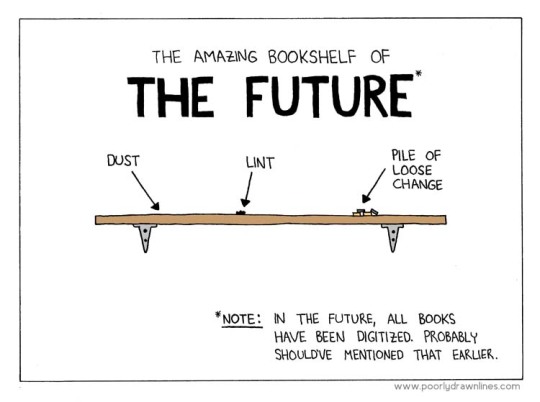
Also the library of the future?
The Court summarized their findings in relation to question one as "...[the texts of the Articles above] must be interpreted as meaning that the concept of ‘lending’, within the meaning of those provisions, covers the lending of a digital copy of a book, where that lending is carried out by placing that copy on the server of a public library and allowing a user to reproduce that copy by downloading it onto his own computer, bearing in mind that only one copy may be downloaded during the lending period and that, after that period has expired, the downloaded copy can no longer be used by that user". The restrictions set a clear dividing line between lending and selling and/or distribution of the content, since this makes it very much akin to that of lending a physical book.

They then moved onto the second question dealt with the possibility of derogating under Article 6(1) of the Directive, and subjecting it to the condition that the digital copy of a book made available by the public library must have been put into circulation by a first sale or other transfer of ownership of that copy in the European Union by the holder of the right of distribution to the public or with his consent. Quickly dealing with the second question, the Court saw that Article 6 did not preclude Member States from making the application of the provision subject to the above condition, since the condition would reduce the risks of prejudicing the authors of those works.

This was followed by the third question, which asked whether Article 6 precludes "...the public lending exception laid down [in Article 6(1)] from applying to the making available by a public library of a digital copy of a book in the case where that copy was obtained from an unlawful source". Even though the Article is quiet on the legitimacy of the sources of those works, the Court dismissed the possibility, as this would "...amount to tolerating, or even encouraging, the circulation of counterfeit or pirated works and would therefore clearly run counter to [the] objective". This makes perfect sense, since the allowance of the use of illegal copies would be tantamount to legalising copyright infringement, at least in cases such as this. Article 6 therefore was seen to preclude the above possibility.

The Court deemed the fourth question to not require an answer.

The case is a very positive step towards accepting and embracing technological change, whether it is in the context of libraries or the use of digital content as a whole. The decision also leaves quite a bit of wiggle room for Member States to implement the Lending Right Directive, which allows for a more nuanced control of copyright protected works in e-lending.

Source: IPKat

10 August, 2015

Tweets Stolen - Further Thoughts on Tweets and Copyright

The impact of social media on today's social interaction is undeniable, with people turning to Instagram, Facebook and Twitter for more and more of their entertainment, social and news needs. As this new interaction space has grown, and seemingly keeps growing, the value of the content within it has grown as well. This writer recently noted newly emerged discussion surrounding Twitter and reusing jokes and/or content lifted from Tweets, especially in the light of having discussed this on a very superficial level some time ago, I thought it merited expanding more in detail.

In a recent development it has come to light that Twitter hides certain tweets it deems to be infringing copyright, pending a response from the copyright holder as to their respective fates. This is expanded on in Twitter's Copyright and DMCA Policy: "Twitter will respond to reports of alleged copyright infringement, such as allegations concerning the unauthorized use of a copyrighted image as a profile photo, header photo, or background, allegations concerning the unauthorized use of a copyrighted video or image uploaded through our media hosting services, or Tweets containing links to allegedly infringing materials". One has to note that, although the policy does focus on images and videos, it does leave its definition of "copyright infringement" as open-ended, potentially catching tweets themselves.

This begs the question, is a tweet protected by copyright? As discussed in my previous article, the UK Copyright, Designs and Patents Act 1988 does not set a limit on what can amount to a copyright protected literary work, which allows for even tweets to be potentially protected under the provision. As long as the work originates from the author and contains a certain level of originality. The ECJ decision in Infopaq International A/S v Danske Dagblades Forening further elaborated on what amounts to originality, with the court deciding that a work is protected by copyright if it is "...the expression of the intellectual creation of [the] author". So long as you have put in effort and some level of choice and creativity into your work, even a tweet, it would arguably be protected by copyright within the UK and the EU, irrespective of the tweet's length (140 characters or fewer).

Twitter can be serious business
In the US things can potentially be a little different. Under 17 USC section 102 copyright protection extends, much like in the UK, to literary works. The provision itself does not prescribe any length requirements no works for copyright to be applicable, and section 101 offers no further assistance in answering the above question. The Electronic Code of Federal Regulations aids somewhat, as section 202 of the Regulations stipulates that works that will not (necessarily) be protected by copyright are "[w]ords and short phrases such as names, titles, and slogans" - although, the CFR merely sets these out as examples, not definitive limitations. Whether a tweet would count as a "short phrase" and therefore is not protected would remain an assessment of its creativity (as was discussed in Arica Institute Inc v Palmer, for example), as if the phrase exhibits a minimal amount of creativity, it would arguably be protected by copyright in the US.

As can be seen Twitter and tweets do pose a challenge to copyright and whether its protection extends to them within the common law. Although literary works are nearly universally protected all over the world, their length and specific content does dictate the protection afforded, especially when its creativity or originality comes into question. One big consideration is the monetization of tweets and whether they would ever merit protection to the point where they would be challenged in court. This writer would love to see a tweet or a series of tweets be evaluated by the courts at some point, but heavily doubts the likelihood of this ever happening. Without judicial consideration one can still very much appreciate the creativity of tweets and their content, as the character limitations present a unique obstacle to comedic delivery; something when achieved can be powerful.

Source: The Verge

27 February, 2014

Australian Copyright and the Future - The Digital Economy

As was discussed on this blog some 8 months ago, the Australian Law Review Commission released its Discussion Paper on the future of copyright in Australia as a precursor to its final report on the topic. Finally, after what seems forever to this writer, the Commission has released its report titled Copyright and the Digital Economy, discussing its recommendations for future legislation in Australia.

The report is very thorough, and clearly focuses on fair use and exceptions to copyright infringement, signaling a well-needed change to the law in light of changes which have taken place in the last 20 years, especially within the scope of copyright. This is illustrated well by the Committee's intention for this review: "The law must be relevant to a complex and changing digital environment, but must also be clear and broadly understood in the community. The law must produce reasonably certain and predictable outcomes, but should be flexible and not inhibit innovation". Due to the report's extensiveness, as usual, this writer will only discuss certain aspects of it. Should you wish to, please read the report in full for a much broader and detailed understanding of the reforms proposed.

Introduction of Fair Use?

A principle which has been well established in the United States, fair use, has been discussed in terms of implementation in a number of common law countries. Fair use can be said to be very flexible, and mouldable, to a variety of technologies and uses in relation to copyrighted works. The ALRC has been discussing the introduction of fair use into Australian copyright legislation, and finally has put forth a recommendation to do so. In their view "...a fair use exception with a non-exhaustive list of four fairness factors to be considered in assessing whether use of another’s copyright material is fair and a non-exhaustive list of eleven illustrative purposes" should be implemented into Australian law.

The importance of introducing fair use can be argued to be sensible, and as the ALRC express: "...fair use differs from most current exceptions to copyright in Australia in that it is a broad standard that incorporates principles, rather than detailed prescriptive rules". Utilizing more broader, less defined principles allows for fair use to apply to newer, more advanced uses of copyright today and in the future. This writer agrees fully with the ALRC and their recommendation, especially in light of changes in the field of copyright in recent years. What copyright, and fair dealing, has been yearning is just that, and would bring copyright into the 21st century.

The proposed provision would be very similar to the aforementioned US provision, taking into account the the purpose and nature of the work's use, while assessing both the availability of the work and the use's effect on the work's market share. The provision would clearly take more direction from US precedent, while still allowing for Australian courts to adapt it in a more Australian context.

New Fair Dealing

Although fair dealing has been used under Australian legislation for a number of years, the provision has fallen behind on what can be deemed to potentially be included within it in modern times. The new proposed additions to the provision would add six new categories included under fair dealing: quotation, non-commercial private use, incidental or technical use, library or archive use, education, and access to people with disabilities. How fair dealing differs from fair use is explained well by the ALRC: "Under fair use, the list of purposes, or types of use, is merely illustrative. The fact that a particular use is not for one of the illustrative purposes does not mean that the use cannot be found to be fair. Fair use essentially asks one question: Is this use fair, considering the fairness factors? The new fair dealing exception, on the other hand, can only apply to a use of copyright material if the use is for one of the prescribed purposes. If a given use does not fall into one of the categories of use, then it cannot be found to be fair". In this writer's opinion the former suggestion would work much more effectively and flexibly in modern copyright, and even though a proposed newer fair dealing provision could fulfill the needs of copyright as uses stand right now, it still does not provide an equal exception in comparison to fair use.

Other Changes

Orphan works have been a thorn in copyright's side for a long time, with provisions only being introduced to mitigate infringement over works where the copyright owner cannot be found. As the ALRC sees that the introduction of such  reforms would "...facilitate the use of orphan works to enable their beneficial uses to be captured in the digital economy, without creating harm to the copyright holder". Arguably this is something that copyright needs, and changes to the laws governing orphan works are necessary.

While the report goes into more specific details in relation to the aforementioned potential changes to both fair use and fair dealing, the report does also provide other changes which it endorses. Due to the report's extensive dealing of these changes, this writer cannot simply fill discussion of all of the rest.

All in all the report is thorough and recommends changes which have been long overdue, and not just in Australia. How and if these recommendations are implemented will be left to the Australian legislature, but the introduction of fair use should merit some haste. The 21st century has been a challenging one for copyright, and not just from a copyright holders' perspective, but as the reform recommendations keep rolling in, it seems the law might finally catch up to what it should have been some time ago.

26 November, 2013

Retrospective - Breach of Trust in Intellectual Property

Intellectual property, in essence, carries its worth and value in the knowledge or ingenuity of the inventor, or the creation of the author of a work, not necessarily in the tangible (or at times, intangible) property that is created from that. With this comes a great deal of risk, in modern days in terms of industrial espionage or the accidental or intentional leaking of details related to books etc, which renders the subsequent intellectual property much less valuable or even worthless. Through this one can understand that a great deal of trust is often placed on those with special access to particular information or details, which can be broken and cause potential damage to the creator. The modern doctrine of breach of trust is well-established, but it stems its roots from the mid-19th century.

One of the first cases that dealt with breach of trust in relation to intellectual property was Prince Albert v Strange all the way back in 1849. The case concerned a collection of etchings and drawings made by both Queen Victoria and Prince Albert of various domestic subjects for their own enjoyment, subsequently being commissioned to be printed as a collection. These etchings were made in a private press, due to their personal nature and thus Prince Albert's wish was for them to remain fully private. William Strange was a printer and publisher in London who somehow obtained copies of some of the etchings, allegedly through the aforementioned private press where the etchings were commissioned from. The prints made by Mr. Strange were made from plates held by Prince Albert and Her Majesty, thus bringing their acquisition into question. Mr. Strange (and the other defendants) wished to print a catalog of the etchings under the title of "A Descriptive Catalogue of the Royal Victoria and Albert Gallery of Etchings", which contained detailed descriptions of 63 etchings with additional critique of those works. Mr. Strange argued that he had the right to publish the works, even though disapproved by the Royal plaintiffs, and the Court of Chancery had to decide whether he was indeed entitled to do so, thus dissolving the initial injunction granted to the plaintiffs.

The case brought about the consideration of property and trust in relation to that property. This is best illustrated by the comments of Lord Chancellor Cottenham, where his Lordship stated that "[t]he property of an author or composer of any work, whether of literature, art or, science, in such work unpublished and kept for his private use or pleasure, cannot be disputed". What his Lordship is clearly saying is a property right of trust (or privacy in a sense) in personalty which is created by someone. This applied, prior to the case, for example to personal correspondence in the form of letters. The defendant did not contest the ownership of the property by the plaintiffs, but still argued that any person who obtains such property would still have the right to publish it. Even though the defendant merely intended to publish descriptions of the works, the Court saw that this would be akin to the publishing of the etchings themselves from imprints, which the defendant would not be entitled to do.

Lord Cottenham agreed that the right of privacy in property did exist and that the defendant would not have the right to use and publish them even if he had acquired copies of those works. Although an interesting notion, what is of importance for us in the case at hand is whether there would be a breach of trust should the defendant have published the catalog; this being the need for the injunction itself.

An artist's rendition of the Royals' etchings
The potential breach of trust related to the actual possession of the etchings, which were potentially obtained through illicit means. Mr. Strange's possession of the etchings, in his Lordship's mind, had to have originated in a breach of trust, confidence or contract on part of the printer's employees or the printing press' owner (one of the other defendants in the case). How the etchings were obtained remains unknown, but as his Lordship observed, this would not matter as mere possession by Mr. Strange was enough to establish that fact. This was further expanded on by his Lordship, demonstrating this very point, using the case of Tipping v Clarke: "If the Defendant has obtained copies of [artistic works], it would very probably be by means of some clerk or agent of the Plaintiff; and if he availed himself surreptitiously of that information, which he could not have had except from a person guilty of a breach of contract in communicating it, I think he could not be permitted to avail himself of that breach of contract". Mr. Strange was subsequently denied the dissolving of the injunction due to this breach of trust.

The Court's observations do match a common law notion of copyright in unpublished works (something which even exists today); however the Court's observations could potentially extend to a right of privacy over property of confidential nature, irrespective of it being copyrighted work or not. Although the case is of little relevance in the sphere of modern breach of trust or confidentiality, it goes to show the importance of certain types of works, especially in relation to intellectual property.