Showing posts with label amount. Show all posts

22 March, 2017

A Gentleman's Code - The Copying of Software Code and Copyright

Computer programming, especially to the layman, can be both incredibly daunting and very confusing, as the languages, while logical, can be quite impenetrable. Since computers and computing have become near ubiquitous in modern society, so has programming become a part of our lives, even if not directly. Due to this, the value of code and programs can be substantial, especially for ones that are lucky enough to become standards, or just plain popular. Code and copyright rarely meet, but in the vein of the above, can code be construed as a copyright protected work, and if so, how much can you copy before you're infringing the rights attached to the code?

The case of IPC Global Pty Ltd v Pavetest Pty Ltd (No 3) dealt with equipment used to test asphalt and construction materials, built by IPC, which included custom programming to enable the user to test said materials and view results. This piece of software was installed on the users' computer. Two individuals, Con Sinadinos and Alan Feeley, worked at IPC (with the latter working as a consultant as a part of Alueta). The pair then resigned from IPC in 2012, establishing a competitor company, Pavetest, which launched competing testing products. Mr Feeley had in his possessions copies of IPC's programs on his computer that he took with him when leaving IPC. He then provided them for a programmer who made copies of the programs, leaving some parts of the Pavetest identical to that of IPC's programs. IPC then took Pavetest (and the individuals) for, among other claims, copyright infringement and breach of confidence.

Although Justice Moshinsky had a wide array of issues to decide, focus for the purposes of this article will remain on the question: "...did Pavetest infringe copyright in the UTS software by the creation of version 1 of the TestLab software? In particular, did version 1 of the TestLab software reproduce a substantial part of the UTS software?"

After discussing, at length, the companies and the development of the two competing pieces of software, the court focussed on the matter of copyright infringement.
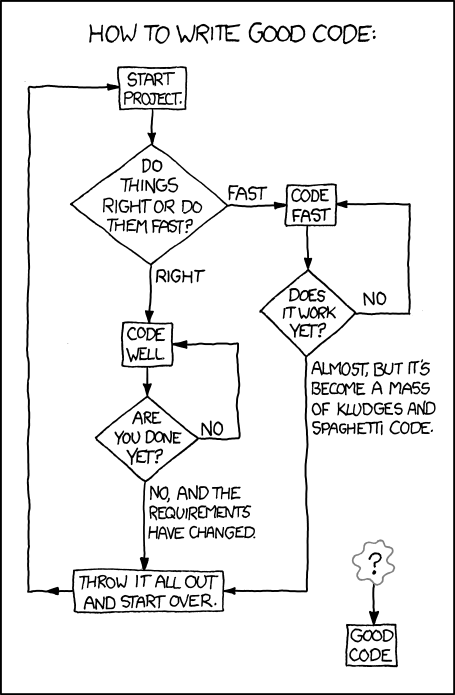
Original code? Nah... (Source: xkcd)
The courts have struggled with defining what amounts to a 'substantial amount', as per section 14 of the Copyright Act 1968, which was discussed by the High Court of Australia in IceTV: "The case law does disclose that special difficulty has been encountered in considering the relationship between the phrase “a substantial part” in s 14(1) of the Act and the definition in s 10(1) of that species of “literary work” which is a “computer program”, being: “a set of statements or instructions to be used directly or indirectly in a computer in order to bring about a certain result.” (Emphasis added) The phrase emphasised suggests the importance of function, although this is usually encountered in patent and designs law, rather than in the “traditional” law of copyright respecting original literary works".

The courts have developed a test to determine whether a computer program has been infringed, there is ‘the need for some process of qualitative abstraction of the material features of the computer program in question’, and the copying of those features in the potentially infringing program (i.e. of a program calculates figures based on data, the program features of the calculation would be more important than the aesthetic function of the same under this context).

While the respondent conceded that the code is a copyright protected work, that substantial parts of the code were copied (but not to the degree of being a substantial part under section 14), and that this was done on behalf of Pavetest with the authorization of the individuals above, the court still had to consider whether the copying was indeed substantial under the law.

Due to the coder working for Pavetest to be able to rewrite the code so as the new version didn't infringe IPC's copyright, there clearly was a wide margin of expression in how the code could be implemented, while still having the same functionality. The writing of the code therefore included a degree of choice and judgment, making the expression of that functionality original under copyright. While some parts of the code would not be essential, Justice Moshinsky still upheld that they were original works equally to those parts that were essential. Finally, the amount of code, albeit a small amount (roughly 10,000 lines of code from about 250,000 lines), the copying was substantial, according to the judge, due to its necessity to achieve the desired functionality, rather than just simply through a quantitive measure. Pavetest had subsequently infringed the rights in the code.

The case is a very interesting one, and highlights a need for anyone copying others' code (which seems to be an industry standard, albeit only in parts of programming) to be cautious, and to rewrite anything that could be deemed to be a substantial copying. Software creation is incredibly complex and difficult, and one can appreciate the adoption of shortcuts, but the courts will clearly combat any abuses of others copyright works, even if it's just 'meaningless' code.

Source:  IP Whiteboard

14 May, 2013

Retrospective - Sweaty brows, no reward?

One of the most influential cases formulating our understanding of what can be protected by copyright all over the World was the US case of Feist Publications Inc v Rural Telephone Services Co. The case concerned a telephone service provider, Rural Telephone Services. As the company provided said services, it had to collect and compile listing information, publishing the collection in a directory annually. The directory was in itself an alphabetical listing of people, their numbers, addresses and so forth, much like the Yellow Pages. Rural Telephone Services was one of over a dozen phone services providers in Kansas. Feist Publication sought to publish an area-wide directory, having bought the data and required rights from the other providers in order to do so, falling short when Rural Telephone refused to sell them their data. Not being ones to fail, Feist Publication took Rural Telephone's data anyway and used it without their consent, utilizing roughly 3% of their data without any modifications and a substantial part more with some amendments and changes. Upon noticing this Rural Telephone proceeded to sue Feist Publication for infringement.

The question falling ever so graciously on the US Supreme Court's lap was whether there was a copyright work to protect to begin with, without which the case would fall flat. The Supreme Court did consider other matters, such as fair use, substantiality (amount copied) etc., but the most influential of which was the consideration over the existence of copyright.

All that work for naught
In their decision the Supreme Court saw that the directory in itself, should it show sufficient originality, could potentially be protected by copyright as a whole; however the raw data - phone numbers, addresses etc. - could not be protected as it isn't an original work. If there is no originality, the work cannot fall under the protection of copyright and is thus free for all to use. To put it in simpler terms, the presentation of the facts is something that can be protected, but not the information. What the case changed significantly was the "sweat of the brow" or "industrious collection" test used by lowers courts which extended protection of compilations from only its presentation to the data as well, which the Supreme Court subsequently repealed. The Court in its decision saw that the test had wrongly interpreted the 1909 Act and thus skewed the main principle of copyright: one cannot copyright ideas or facts.

Sweat of the brow has been used by the courts prior as a means to extend copyright to collections of data purely through the laborious efforts of the person compiling the information, creating value in that work through the sheer efforts they have put into it. English courts have accepted the notion of sweat of the brow, although not in the same fashion as its counterparts over the pond.

Essentially what the Court iterated in its decision was the fact that there was no element of creativity. No work will attain copyright protection, regardless of the amount of work put into it. The compilation of lists, directories or other factual information, with no element of creativity in its presentation, will not be protected under copyright. As said, the presentation, layout of information for example, could be protected, but the information presented will not be a copyright work. It could've taken you decades of meticulous work, however that it itself doesn't not make it protectable.

The law has moved on from Feist, often taking smaller or larger leaps, but the case still remains at the heart of copyright law, having influenced both US and foreign cases even today. If monopolies were allowed in raw data, a lot of the things we have right now could not be possible, and this would clearly impact modern applications of phone directories and such on the Internet. The disapproval of the sweat of the brow principle was a logical change in the law going forward and has enabled innovation through the use of data in other applications.