Showing posts with label No 3. Show all posts

22 March, 2017

A Gentleman's Code - The Copying of Software Code and Copyright

Computer programming, especially to the layman, can be both incredibly daunting and very confusing, as the languages, while logical, can be quite impenetrable. Since computers and computing have become near ubiquitous in modern society, so has programming become a part of our lives, even if not directly. Due to this, the value of code and programs can be substantial, especially for ones that are lucky enough to become standards, or just plain popular. Code and copyright rarely meet, but in the vein of the above, can code be construed as a copyright protected work, and if so, how much can you copy before you're infringing the rights attached to the code?

The case of IPC Global Pty Ltd v Pavetest Pty Ltd (No 3) dealt with equipment used to test asphalt and construction materials, built by IPC, which included custom programming to enable the user to test said materials and view results. This piece of software was installed on the users' computer. Two individuals, Con Sinadinos and Alan Feeley, worked at IPC (with the latter working as a consultant as a part of Alueta). The pair then resigned from IPC in 2012, establishing a competitor company, Pavetest, which launched competing testing products. Mr Feeley had in his possessions copies of IPC's programs on his computer that he took with him when leaving IPC. He then provided them for a programmer who made copies of the programs, leaving some parts of the Pavetest identical to that of IPC's programs. IPC then took Pavetest (and the individuals) for, among other claims, copyright infringement and breach of confidence.

Although Justice Moshinsky had a wide array of issues to decide, focus for the purposes of this article will remain on the question: "...did Pavetest infringe copyright in the UTS software by the creation of version 1 of the TestLab software? In particular, did version 1 of the TestLab software reproduce a substantial part of the UTS software?"

After discussing, at length, the companies and the development of the two competing pieces of software, the court focussed on the matter of copyright infringement.
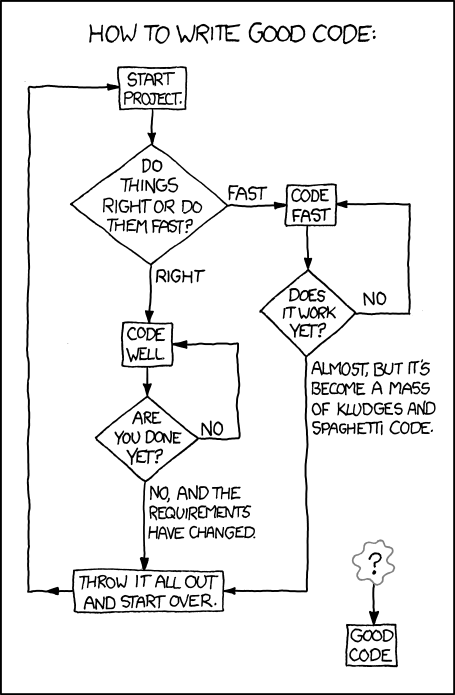
Original code? Nah... (Source: xkcd)
The courts have struggled with defining what amounts to a 'substantial amount', as per section 14 of the Copyright Act 1968, which was discussed by the High Court of Australia in IceTV: "The case law does disclose that special difficulty has been encountered in considering the relationship between the phrase “a substantial part” in s 14(1) of the Act and the definition in s 10(1) of that species of “literary work” which is a “computer program”, being: “a set of statements or instructions to be used directly or indirectly in a computer in order to bring about a certain result.” (Emphasis added) The phrase emphasised suggests the importance of function, although this is usually encountered in patent and designs law, rather than in the “traditional” law of copyright respecting original literary works".

The courts have developed a test to determine whether a computer program has been infringed, there is ‘the need for some process of qualitative abstraction of the material features of the computer program in question’, and the copying of those features in the potentially infringing program (i.e. of a program calculates figures based on data, the program features of the calculation would be more important than the aesthetic function of the same under this context).

While the respondent conceded that the code is a copyright protected work, that substantial parts of the code were copied (but not to the degree of being a substantial part under section 14), and that this was done on behalf of Pavetest with the authorization of the individuals above, the court still had to consider whether the copying was indeed substantial under the law.

Due to the coder working for Pavetest to be able to rewrite the code so as the new version didn't infringe IPC's copyright, there clearly was a wide margin of expression in how the code could be implemented, while still having the same functionality. The writing of the code therefore included a degree of choice and judgment, making the expression of that functionality original under copyright. While some parts of the code would not be essential, Justice Moshinsky still upheld that they were original works equally to those parts that were essential. Finally, the amount of code, albeit a small amount (roughly 10,000 lines of code from about 250,000 lines), the copying was substantial, according to the judge, due to its necessity to achieve the desired functionality, rather than just simply through a quantitive measure. Pavetest had subsequently infringed the rights in the code.

The case is a very interesting one, and highlights a need for anyone copying others' code (which seems to be an industry standard, albeit only in parts of programming) to be cautious, and to rewrite anything that could be deemed to be a substantial copying. Software creation is incredibly complex and difficult, and one can appreciate the adoption of shortcuts, but the courts will clearly combat any abuses of others copyright works, even if it's just 'meaningless' code.

Source:  IP Whiteboard

18 November, 2015

Retrospective - Groundless Threats in Intellectual Property Law

A big aspect of intellectual property law is the possible threat of infringement, even when you might not know it. With strong legal protective measures comes a great deal of responsibility in wielding that capability, especially in the light of competition. IP can be used to stifle those aiming to compete with you, as well as those who blatantly want to benefit from your hard-work and intellectual output. A balance has to therefore be struck, and certain legal tethers have been placed to restrict the unwarranted use of IP rights without due cause. Groundless threat provisions exist in relation to all registrable IP rights (trademarks, patents and designs) under the Patents Act 1977Trade Marks Act 1994Registered Designs Act 1949 and Copyright, Designs and Patents Act 1988. What amounts to a groundless threat is not entirely clear under all of the provisions above (which act fairly similarly to each other), however the High Court endeavored to answer this at the cusp of the 21st century.

The case of Brain v Ingledew Brown Bennington & Garrett (No 3), decided in 1997, dealt with Patrick John Brain, who, in the early 90s, set up a consulting business in an effort to exploit new technologies and inventions all over the world, particularly in the Far East. Upon meeting Jørgen Jensen, the Head of Chemistry at Risø National Labratory (the second defendant), a Danish research company, the pair struck a deal to utilize a patented technology developed at Risø by a number of individuals called "Wet Oxdiation" (e.g. patents US5053142A and EP0284754) in foreign markets. The pair started a company called Intox Corporation Limited, and successfully marketed the process to a company in Canada, which included passing on technical documents attained by Mr. Jensen. Risø found out about Intox Corporations' activities, and initiated court proceedings against Mr. Jensen in Denmark. During the proceedings Risø also instructed UK lawyers, Ingledew Brown Bennington & Garrett, to pursue Intox Corporation. Mr. Brain argued that, in correspondence between him and lawyers at Ingledew, several threats were included, and as a result, the projects incorporating the above technology did not come to fruition, causing him a great deal of monetary loss. He then initiated proceedings for groundless threats under the Patents Act 1977.

Under the above Act, in section 70: "...a person (whether or not the proprietor of, or entitled to any right in, a patent) by circulars, advertisements or otherwise threatens another person with proceedings for any infringement of a patent, a person aggrieved by the threats (whether or not he is the person to whom the threats are made) may... bring proceedings in the court against the person making the threats".

Rory was aggrieved by threats made in relation to his cap
Justice Laddie, handing down the judgment of the High Court, had to therefore first determine whether Mr. Brain was a 'person aggrieved', allowing him to bring forth his claim. For a person to be considered as such there has to be clear damage, not just hurt feelings. As Justice Laddie described it: "...a trader's chosen route to exploitation of his product or process is interfered with by the threat, that is damage in the broad sense and makes him a person aggrieved". Reliance on the threat, and subsequent action causing detriment, is key, not just annoyance or mere displeasure. Even if loss is prevented or mitigated in the event of a threat does not mean the person cannot be seen as a person aggrieved. What the person has to show is "...that his commercial interests are or are likely to be adversely affected in a real as opposed to a fanciful or minimal way". The Court saw that, as the threats were made to Mr. Brain directly, that he would fall under the definition of a 'person aggrieved'.

Justice Laddie then had to assess what the meaning of the letters were, and whether they actually constituted a threat. This assessment has to be done "...in accordance with how they would be understood by an ordinary reader", and what the initial impression would be to a reasonable addressee. In the light of the three letters discussed as a whole, Justice Laddie saw that their purpose would be reasonably understood as a threat to initiate patent proceedings.

Arguments as to the available defence under section 70(4), preventing any proceedings under section 70 for "...a threat to bring proceedings for an infringement alleged to consist of making or importing
a product for disposal or of using a process" (defined in section 60), failed, as the correspondence targets a much broader base of infringement, not just the ones exempted under section 60. Justice Laddie found that the defendants had made groundless threats against Mr. Brain, and ordered an inquiry into damages.

The law in relation to groundless threats has since moved on, and more leeway has been given in terms of bringing information as to any existing IP rights to the attention of the potentially infringing party. The Patents Act 2004 made significant changes to section 70, however the above does still apply to all groundless threat cases, giving the courts the basis for their determination for a cause of action under these provisions.