Showing posts with label patentable. Show all posts

18 October, 2021

An Unusual Inventor - Australian Federal Court Gives Green Light for AI Inventors of Patents

Having spoken about whether artificial intelligence could be deemed to be an inventor was something that was discussed on this blog over a year ago, with both the UK, the US and the EU, currently, not allowing for AI to be considered as an 'inventor' and therefore any inventions created by the AI would not be patentable. While this position seems to remain in those jurisdiction, an interesting development has emerged in Australia which seems to go counter to what the above jurisdictions have decided. 

The case Thaler v Commissioner of Patents concerned a patent application for a patent by Stephen Thaler (application VID108/2021) for a patent for two inventions, created by DABUS (Mr Thaler's AI system), for an improved beverage container and a flashing beacon to be used for emergencies. The case focused on whether the AI system could be an inventor under the Patents Act 1990. The Deputy Commissioner of Patents initially rejected the application as, in their view, the application didn't comply with specific requirements and that under s. 15 of the Patents Act an AI could not be treated as an inventor. Mr Thaler then sought a judicial review of the decision, which ended up in the Federal Court.

The Court first discussed the issue generally, noting that: (i) there is no specific provision in the Patents Act that expressly refutes the proposition that an artificial intelligence system can be an inventor; (ii) there is no specific aspect of patent law, unlike copyright law involving the requirement for a human author or the existence of moral rights, that would drive a construction of the Act as excluding non-human inventors; (iii) the word "inventor" has not been expressly defined and under its ordinary meaning it can include any 'agent' which invents, including AI; (iv) the definition of an "inventor" can be seen to potentially evolve and change with the times, potentially to include non-human authors; and (v) the object of the Act is to promote the economic wellbeing of the country, which should inform the construction of the Act. 

To include AI as an inventor would, according to the Court, help in promoting innovation and the promotion of economic wellbeing in Australia. But the problem of who the ultimate legal owner of the rights still remains. This would indeed promote the objective of s. 2A of the Act, which sets out the object of the Act as discussed above. 

The Court highlighted the need for a human applicant, on behalf of the AI system, for any inventions that these systems might come up with, who would then also have the rights to any patents granted for that AI system. 

The Court also discussed the notion of the "inventive step" under s. 18 of the Act, which is a legal requirement for patentability. Both s. 18 and 7, which elaborates more on the meaning of the "inventive step", don't require an inventor per say, nor that such an inventor, if even required, would be legal person. The Court concluded that, for there to be an inventive step, a legal person isn't required as the inventor at all, even though the Act does refer to "mental acts" and "thoughts".

The Court then moved onto discussing the various dictionary definitions for what an "inventor" is. This was quickly dismissed as a grounds to limiting inventors to legal persons, as the Court noted that the definitions, as set out, have moved on from the historical meanings given to them and can't be limited in the same way. 

The next issue was who the patent would be granted to under s. 15 of the Act (but focusing on still who could be classed as an "inventor"). The section includes four different classes of person to whom a patent can be granted. 

The first is if the inventor is a person. The Court quickly determined that, as DABUS is not a person that the section won't apply in this instance, but also discussed that this does not demonstrate that the concept of a "person" would be different to that of an "inventor". An AI system could indeed be the inventor, but not able to be granted a patent as they don't fulfill the requirements of s. 15. 

The second one is a person who would, on the grant of a patent for the invention, be entitled to have the patent assigned to them. This will be discussed in more detail following the other classes. 

The third one is a person who derives title to the invention from the inventor or a person mentioned in the second class. Again, this will be discussed further in the context of the second class. 

Finally, the fourth one is a person who is the legal representative of a deceased person in one of the earlier named classes, which, unsurprisingly, the Court determined to not apply here.

Returning to the question of the second and third classes, the Court first highlighted that Mr Thaler could indeed fall under the second class as the programmer and operator of DABUS, through which he could acquire title in any inventions that may be granted patents over. The title in the patent flows through to Mr Thaler automatically, so wouldn't require the assignment of any rights by the inventor (here DABUS) to Mr Thaler. Additionally, the Court determined that s. 15 doesn't require an inventor at all, but only requires that an applicant is entitled to have a patent assigned to them. 

Also, Mr Thaler, according to the Court, would fall under the third class as he, on the face of it, he has derived title to the invention from DABUS. As the AI system cannot legally assign any inventions to Mr Thaler, however, the language of s. 15 does allow for one to derive rights in an invention even outside of legal assignment of those rights. All of Mr Thaler's rights in any invention become his by virtue of his ownership and operation of the inventor, DABUS. 

The Court succinctly summarised the matter as "generally, on a fair reading of ss. 15(1)(b) and 15(1)(c), a patent can be granted to a legal person for an invention with an artificial intelligence system or device as the inventor".

Ultimately what the case focused on is whether a valid patent application has been made, rather than who will own any patent that might be granted in the future. 

What the Court determined was that "...an inventor as recognised under the Act can be an artificial intelligence system or device. But such a non-human inventor can neither be an applicant for a patent nor a grantee of a patent". This still leaves the ownership of a patent in the air, but, focusing on what was discussed by the Court, it is more than likely that ownership in any AI inventions would automatically pass to the owner and operator of that AI system. 

The Australian Court's approach to this question has hugely departed from the viewpoints of that of the US, UK and the EU, where AI systems have been rejected as potential inventors. It will be very interesting to see the law change and evolve in this in the years to come, in particular any decisions on the granting of a patent to the owner of an AI system, but so far at least Australia seems to be on the vanguard of allowing for AI systems to potentially push the envelope on innovation and to protect those innovations in the process. 

24 April, 2014

US Supreme Court to Take on Software Patents

Software patents have been a somewhat controversial topic within the IP community for some time now, especially due to their heavy association with patent trolls. These Non-Practicing Entities (NPEs) or otherwise known as Patent Assertion Entities (PAEs) exist for the sole or primary reason of enforcing patents which they own with no actual intention to ever use them themselves for the development of goods or services. As such these practices are highly questionable, at least on an ethical standpoint. The Goodlatte Innovation Act is attempting to curb these practices; however has yet to pass through the legislature and become law in the United States, following a similar approach to their Kiwi brothers in New Zealand who have since, potentially at least, ended software patents in late 2013. Software patents have been disputed in the long-going case of Alice Corporation v CLS Bank, which is being heard in the US Supreme Court, and will undoubtedly address the current state of software patents and their use in the US.

The case concerns several patents owned by Alice Corporation relating to the facilitation of securities trading, and more specifically, the reduction of risks for parties not fulfilling their part in their contractual obligations such as patent number 7725375. Independently from Alice CLS Bank developed their own software which fulfilled a similar function, potentially infringing Alice's patents. Due to this CLS sought a declaratory judgment from the courts intending for Alice's patents to be invalidated, as per their argument, the patents would not be patent eligible due to them being merely abstract ideas, not falling under the requirements of 35 USC section 101. CLS' argument asserts that what Alice have patented merely covers basic economic concepts; however Alice argue that abstract ideas should only be interpreted narrowly, including things such as facts of nature. Ultimately the Supreme Court face the dilemma of deciding how far the abstract patent doctrine extends, potentially impacting a large industry of software patents.

Soft wares can be quite nice during Winter
Abstract ideas, although expressly prohibited by the Supreme Court in their decision in Diamond v Chakrabarty, are still assessed on a case-by-case basis, still leaving ideas which seem abstract potentially within the remit of section 101. As such the Supreme Court has stated that "...Congress took this permissive approach to patent eligibility to ensure that ingenuity should receive a liberal encouragement", allowing for a wide margin of flexibility within this scope. The rationale behind the rejection of abstract ideas is because "...abstract intellectual concepts are not patentable, as they are the basic tools of scientific and technological work".

In the District Court of the District Columbia Justice Collyer saw that Alice's patents were not eligible as they sought to patent, in her Honor's mind, fundamental concepts and were therefore abstract ideas. Subsequently in the Court of Appeals the decision of the District Court was reversed, deciding that "[t]he asserted claims appear to cover the practical application of a business concept in a specific way", noting their extensive implementation through computers. The limitations the patents' implementations faced was, in the Court's view, integral to their patentability, therefore not merely encompassing abstract ideas which could be implemented quite easily. CLS sought an en banc (all of the judges of a particular court reside as opposed to only a select few) rehearing of the decision. With the Court of Appeals rehearing the case en banc, the majority of the Court of Appeals' judges saw that the patents were not patentable due to their abstract nature, concurring with the initial District Court decision.

As one can very well see the case is very complex and while this article aimed to set out the basics of the case as an informative starting-point prior to the Supreme Court decision, some specifics had to be omitted. This writer would welcome any and all interested in this case to read the included source material thoroughly if you want a more nuanced understanding of the case as a whole.

The case ultimately boils down to how the Supreme Court balances a much narrower definition, preventing partly or mostly the definition of more general ideas in software, against a broad-ended, much vague definition of an abstract idea, potentially inhibiting future innovation as a result. Justice Breyer touched on this, preferring a much narrower allowance of abstractivity: "...instead of having competition on price, service and better production methods [if software patents are not allowed or restricted], we'll have competition on who has the best patent lawyer". Arguably Justice Breyer does have a point, and the backlash against software patents in the past several years would only indicate such a direction as well. But again, the issue is not that simple, and this writer for one awaits the Supreme Court's decision with interest.

Source: The Guardian

15 January, 2014

Medical Treatments Patentable in Australia

Patents related to medicine or treatments carry quite the oomph when discussed in the public sphere. The recent examples of genetics patents, or even the potential to choose your future child's genetic traits, always spark a conversation about patents and whether certain areas of research should even be allowed to be patentable. In Australia medical treatment methods have been assumed to be patentable, but this has never been judicially tested. Finally, the High Court of Australia had to decide whether this was the case under law.

The case in question was Apotex Pty Ltd v Sanofi-Aventis Australia Pty Ltd, which concerned the drug Leflunomide, which is used for the treatment of psoriatic and rheumatoid arthritis. A patent for leflunomide's composition and preparation were owned by Aventis, which had expired almost 10 years ago. A subsequent patent was also held by Sanofi-Aventis (after its merger in 2004), which utilized the drug in the treatment of the aforementioned conditions; or as is worded in the application: "A method of preventing or treating a skin disorder, wherein the skin disorder is psoriasis, which comprises administering to a recipient an effective amount of a pharmaceutical composition containing as an active ingredient a compound of the formula I or II". After the expiration of the initial composition and preparation patent, Apotex proceeded to manufacture and sell its generic version of the drug, selling it as a treatment for both psoriatic and rheumatoid arthritis. Subsequently they were sued for patent infringement by Sanofi-Aventis for allegedly infringing their medical treatment patent. 

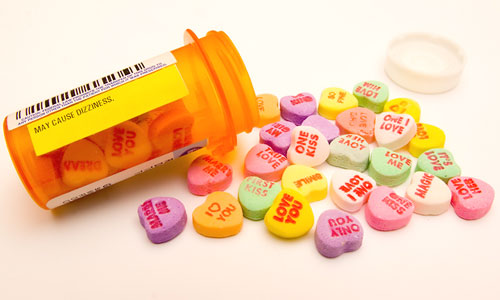
Some treatments are much more enjoyable than others
What the High Court had to answer was whether medical treatments would fall under the definition of a manner of manufacture in the Statute of Monopolies 1623 (a more in-depth discussion of what a 'manner of manufacture' is can be found here). This entails that the invention would have to be a vendible product, and has to provide economic utility through a possible new function or effect. The current position of the law, as was accepted by the courts, was cited in the case of Anaesthetic Supplies Pty Limited v Rescare Limited by Justice Lockhart: "If a process which does not produce a new substance but nevertheless results in 'a new and useful effect' so that the new result is 'an artificially created state of affairs' providing economic utility (emphasis added), it may be considered a 'manner of new manufacture' within s 6 of the Statute of Monopolies". The Patents Act 1990 does not expressly exclude methods of treatment, and the courts have struggled in distinguishing methods of treatment and the drugs which produce the same results, with Justices Black and Lehane discussing "the difficulty ... of drawing any logical distinction between a method of treatment and a patentable pharmaceutical product that produces the same beneficial results" in Bristol-Myers Squibb Co v F H Faulding & Co Ltd. A method of treatment can introduce a new function of effect which provides economic utility; however the question is not necessarily that easily answered.

The High Court, in its deliberation, came to the conclusion that methods of treatment could be patented under Australian law. Their emphasis was clearly in economic utility: "It could not be said that a product claim which includes a therapeutic use has an economic utility which a method or process claim for a therapeutic use does not have". Finally the Court summarized its position with relation to methods of treatment: "Assuming that all other requirements for patentability are met, a method (or process) for medical treatment of the human body which is capable of satisfying the NRDC Case test, namely that it is a contribution to a useful art having economic utility, can be a manner of manufacture and hence a patentable invention within the meaning of s 18(1)(a) of the 1990 Act". As the Court accepted that these methods can be patented, Apotex's claim for the revocation of Sanofi-Aventis' patent failed. However, the Court did not find that Apotex had infringed Sanofi-Aventis' patent, as they merely provided the generic version of the drug without the provision of the treatment itself.

As one can see the Australian High Court almost unanimously accepted the patentability of methods of treatment, bar the dissenting judgment of Justice Hayne. Patents relating to methods of treatment are important, and do not in themselves necessarily provide a barrier for innovation. Whether the Australian legislature will take the initiative and legislate on this matter in more express terms will remain to be seen.

Source: JDSupra

07 September, 2013

New Zealand Bans Software Patents - Or Did They?

As we have turned towards an ever-more computerized world, software has arguably become almost as valuable as the hardware it runs on. Without effective protection through patents for innovative software products, the field would be a free-for-all of copying, using others' methods and creating an environment where innovation would not persist. Some have argued, and rightfully so to an extent, that the field has lead to a culture of abuse and 'patent trolls' where software patents are merely a conduit for quick cash-in schemes for companies who have no intention of ever using the patented software. Due to this clear misuse there have been calls for reform or the full fledged abolishing of software patents in the common law, and finally those calls have been answered by the far-away land of New Zealand.

Software engineers' collective disappointment
In mid-2008 the New Zealand Parliament had the Patents Bill introduced, which sought to "...update the New Zealand patent regime to ensure that it continues to provide an appropriate balance between providing adequate incentives for innovation and technology transfer". The Bill introduces a cavalcade of changes to the old Patents Act 1953, being one of the biggest modifications of the New Zealand patent legislation in 60 years. The Bill introduces an exception to patentability for computer programs in very express terms. Although the exclusion provision states that computer programs are not patentable, this is not the case entirely. 

Under a Supplementary Order Paper to the Patents Bill computer programs are not patentable "...as such if the actual contribution made by the alleged invention lies solely in it being a computer program" (emphasis added). The first two words highlighted in the quote above prove integral to the interpretation of this new provision; software patents are not allowed as such, but should they be a way to implement a patentable process, they can be patentable. The SOP provides an example of a chip in a washing machine, through which a computer program in the chip improves the washing machine's operation. In such instances the software in the chip could be patentable. What is important is the interconnection between the software and the improved process.

In interpreting this the new provision employs a similar approach to that of the European Union and the United Kingdom. This approach was set out in the case of Aerotel Ltd v Telco Holdings Ltd (and others) and Macrossan's Application, intepreting section 1(2) of the UK Patents Act 1977 dealing with the subject matter of what is not an invention. The New Zealand provision's wording, albeit slightly different, still encompasses the heart of the Aerotel considerations, while adding specifics pertaining to their own legislation, and arguably using the Aerotel test would prove beneficial for the New Zealand judiciary.
Kiwis are very apt with technology

In assessing a patent and whether it is excluded from patentability under the Aerotel approach, the courts would have to properly construe the claim; identify its actual contribution; ask whether it falls solely within the excluded subject matter; and check whether the actual or alleged contribution is technical in nature. The first factor is purely a standard assessment of the patent claim, deciding what the monopoly would be before considering its possible exclusion. The second factor is deciding whether the inventor has really added anything to the stock of human knowledge, emphasizing the substance of the invention (what it actually contributes) above the form of the claim itself (what is argued it contributes). The third factor is assessing whether the contribution is solely an unpatentable subject matter. Should the invention be a patentable subject matter, the final consideration is if it is of a technical nature. 

The New Zealand approach is assessing the substance of the claim (rather than its form and the contribution alleged by the applicant) and the actual contribution it makes; what problem or other issue is to be solved or addressed; how the relevant product or process solves or addresses the problem or other issue; the advantages or benefits of solving or addressing the problem or other issue in that manner; and any other matters the Commissioner or the court thinks relevant. Clearly this echoes the approach given above, and would be served well should the New Zealand judiciary consider the Aerotel test.

So as one can see New Zealand has effectively banned software patents, but only to the extent that they exist independently. Calling this a blanket ban is merely hyperbolic, but the potential abuses that have been experienced with pure software patents have been remedied, and it remains to be seen whether the rest of the world will follow suit. Calls have been made for the US to do the same, but with vast amounts of money being tied into software innovation in the US, it can be argued that a ban over software patents in the US is still well behind the horizon.

Source: ZDNet

03 September, 2013

Retrospective - Novelty in Patents

Invention is often building on older inventions or techniques, adding, changing or modifying it to suit a new application. As Isaac Newton poignantly pointed out in his thoughts about his progress in many fields: "If I have seen a little further it is by standing on the shoulders of Giants." As said, invention often needs a springboard to be able to jump to new heights, although this should not enable the abuse of older inventions and claiming it as your own. A preventative measure in the world of patents is the requirement of 'novelty' which mandates that the invention one is seeking to patent has to not have existed in any prior art; to put it bluntly it has to be new. Different countries in the common law take different approaches to novelty, which merit some explanation.

An inventor's motto
In Australia novelty is a requirement under the Patents Act 1990, which sets out that any patentable invention has to be novel when compared to prior art that existed before the invention was being patented. It will only be compared to publicly available information, although legislation pertaining to trade secrets might still apply. This is determined through the 'reverse infringement' test, formulated in Meyers Taylor Pty Ltd v Vicarr Industries Ltd. In the judgment Justice Aickin saw that "[t]he basic test for anticipation or want of novelty is the same as that for infringement and generally one can properly ask oneself whether the alleged anticipation would, if the patent were valid, constitute an infringement". This would have to be assessed based on all of the integers of any one of the patent claims and whether they would infringe any existing patents. If none of the claims infringe any existing patents, it can be deemed to be novel and therefore patentable. Should all, or the essential, features of the invention which the patent is sought for be disclosed in any prior art which is publically accessible, the invention would be deemed to not being novel and would not be patentable.

In Canada the test for novelty is set out in the Canadian Patent Act, where an invention is defined as "any new and useful art, process, machine, manufacture or composition of matter, or any new and useful improvement in any art, process, machine, manufacture or composition of matter". As stated in the Act, the invention cannot have been disclosed to the public in Canada or anywhere else. This requirement is essentially the same as the one relating to prior art in Australia. As said above, this does not mean the invention has to be wholly new, but can be built on older inventions should it fill the other requirements for patentability. 

Necessity is the mother of all invention
In the United Kingdom the concept of novelty is set out in the Patents Act 1977. Under the 1977 Act an invention is new "...if it does not form part of the state of the art". This, again, would be the case should the invention be made available to the public prior to the lodging date of the patent application. The case of Synthon BV v Smithkline Beecham plc set out the test for novelty, distinguishing between two requirements which have been accepted by the judiciary; prior disclosure and enablement. These two requirements were treated as a single matter, however were separated by Lord Hoffman in Synthon. Prior disclosure echoes the same principle as Australia's approach to novelty, being an assessment of potential infringement due to any possible prior disclosures to the public. In Lord Hoffman's mind however, this could not merely be a matter of possibilities  but infringement would have to be entiled; or in other words, the invention would be an infringement. If other possibilities exist, for example an accident as to the same invention, infringement would not be entiled. Enablement, in Lord Hoffman's assessment, meant that if any ordinary skilled person could create the invention which has been disclosed prior. If the invention does not fall into either, the invention can be seen as novel under the 1977 Act.

In the United States novelty is defined under 35 USC § 102. The American approach is much akin to the Australian and British approach; one which relies on prior art. If your invention has not been patented before, published in a printed publication, in use or sale, or made available otherwise, the invention is eligible for a patent and considered novel. Since the introduction of the America Invents Act, the US has moved from a first-to-invent system to a first-to-file system, This in itself does not change how novelty is assessed in patents in the US, but has changed the dynamic significantly within the system regarding new inventions.


As one can clearly ascertain, novelty is not a simple concept, and can be a time consuming consideration for any given patent handling body. The novelty of any patent can be contested if it is later found out prior art existed, even if the patent is given after the patent body's assessment. From a common sense perspective it is completely sensible, and does protect the legitimate interests of all inventors in attempting to keep all new inventors from merely rehashing old inventions in the guise of novelty.

23 April, 2013

Can human genes be patented? The US Supreme Court starts its deliberation

Patents relating to medicine or medical treatments often don't come without controversy. Should we allow the patenting of essential medicines or treatments, which if provided cheap enough could save countless lives, or ease the suffering of many? What about the monetary interests of parties who've sunk millions into research and development, should we prevent them from recouping that investment? One of the more interesting, and possibly more important decisions in patents was put forth to the US Supreme Court on the 15th of April, when oral arguments for the case were heard.

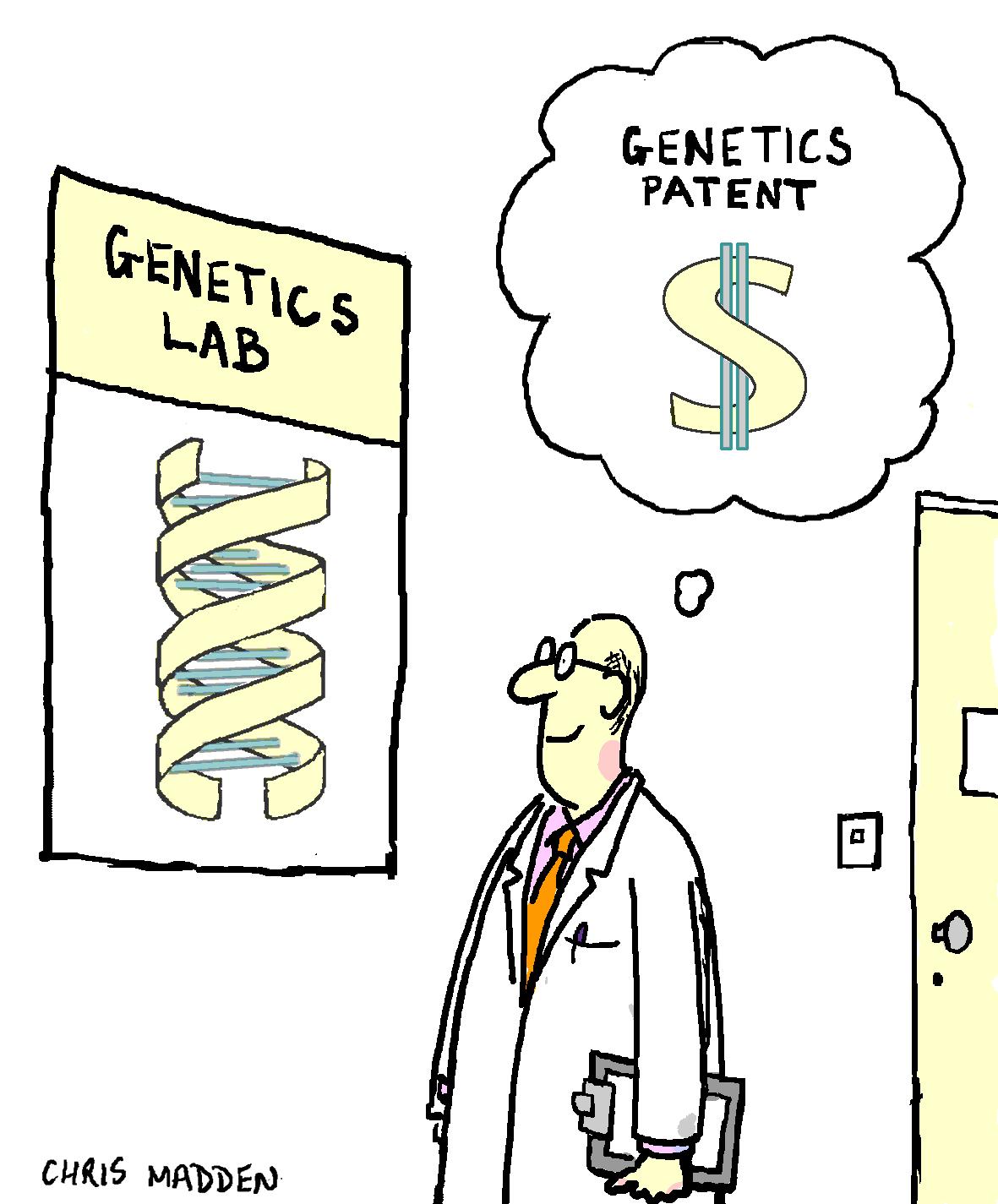
Not the genes you were thinking of
The case of Association of Molecular Pathology v Myriad Genetics put forward the question of whether human genes could be patented, more specifically, genes relating to the increased risk of both ovarian and breast cancer in women in mutated. Myriad Genetics sought to patent the genes after their discovery, which was subsequently contested. 

This presents an incredible dilemma where monetary interests clash with what is intrinsically a part of you; your own genes. Should the investment of billions of dollars go to waste, or should companies be allowed to patent something which is present in humans without any outside interference? Also would the patentability of genes hinder future cures or therapies related to those genes to prevent ovarian or breast cancer? At the end of the day the act of balancing interests is a tough one. If billions of dollars spent on research and development can be made useless due to gene patents being unpatentable, companies will have less incentive to go about this research, or might even cause serious financial harm to them. On the other side is companies having monopoly rights to something arguably occurring naturally; your genes. Should any legal entity have the exclusive rights to parts of the human genome? There are two ways of looking at this question: as a lawyer, I can say it is very possible that companies could patent genes, but as a human being, I’d want that type of information to be accessible to anyone, not under the supervision of a company.


Experts have stated that such patents have "...faded in importance" and that the law suit "...will be much more ideological than it will be practical". This is probably because there is very little use for an isolated gene or its analysis. The average consumer will never need the genes in question analyzed, and the few researchers that will use them probably will come few and far between. In addition the patents in question will expire in a few years, effectively rendering the nullification of the patents through litigation nothing but a matter of principle for the Association of Molecular Pathology. Precedent will surely prevent the future patenting of human genes, should the Supreme Court decide so, but the real monetary interests of companies lie in medicines, not genetics.

(Source)
What the court has to decide is whether an isolated gene would be patentable as an isolated item, being sufficiently different from the genes found in your individual cells, or that they are purely a product of nature. The New York Times indicated that a fifth of the 20,000 genes found in the human body are patented, clearly showing that this has been an accepted practice for a while in the US. The US Government presented the courts with a statement expressing their opinion that human genes should not be patentable, showing support for the idea that they are indeed a natural occurrence, or the very least a subject matter that should not be covered under patents.

Indeed this case will present the Justices an interesting subject matter to tackle, and I for one will be waiting for their judgment with excitement. What seems to be the more probable outcome is the allowance of the patents, as decisions in both the UK and Australia (subject to further appeal) have been decided to favor the patenting of genes. What the US Supreme Court decides will undoubtedly influence later decisions in other jurisdictions, giving the case still the clout it deserves.