Sometimes people seeking patents just seem to want to be the focus of hatred or controversy, especially when it comes to newer areas of medicine or scientific progression. Although this blog has discussed more unsavory topics, such as patenting clones or the method of selecting desirable traits for your child, the field constantly brings forward more interesting questions posed to the judiciaries of various countries. It so happens yet another such a question has been posed, this time pertaining to the potential patenting of embryonic stem cells; a topic which has been discussed at length by our neighbors across the pond in the US.
The case in question is International Stem Cell Corporation v Comptroller General of Patents, initially having been dealt with in the High Courts of the UK, having since been referred to the European Court of Justice for clarification. Although the opinion delivered is of the Advocate General Cruz Villalon's, it still remains an important indication of the potential direction of the ECJ's ultimate decision on the question, but is no way binding.
What the matter dealt with were two patent applications filed by the International Stem Cell Corporation, namely GB2431411 and GB2440333 (application numbers GB0621068.6 and GB0621069.4 respectively), which effectively sought to patent certain applications for the use of human stem cells taken from embryos. Upon first inspection the patents were rejected by the UK Intellectual Property Office, based on the ECJ's previous decision in Oliver Brüstle v Greenpeace almost three years ago, which sought to decide what the definition of a 'human embryo' was under Directive 98/44/EC. This decision was important for the case in hand as it effectively limits the patentability of embryos, through which embryonic stem cells, for commercial or industrial purposes. The decision in Brüstle was why the patents were rejected at first instance, and serves as a platform from which the Advocate General formulated his view on the case.
To give more exposition on the patents at hand, as said above, they both deal with specific applications involving human stem cells extracted from embryos. Application GB0621068.6, titled "Parthenogenic activation of human oocytes for the production of human embryonic stem cells", to put in incredibly simplistic terms, deals with the production and cultivation of stems cells from unfertilized oocytes (female egg cells) through the manipulation of oxygen tension. These cells are often referred to as "parthenotes", which can turn into practically any cell type in the human body. Application GB0621069.4 deals with the use of said parthenotes to produce synthetic corneas. What is worth noting is that the ECJ saw, in Brüstle, that "...any human ovum after fertilisation, any non-fertilised human ovum into which the cell nucleus from a mature human cell has been transplanted, and any non-fertilised human ovum whose division and further development have been stimulated by parthenogenesis constitute a ‘human embryo’". This would, through superficial assessment, include Stem Cell Corporation's inventions and therefore prevent them from being patented.
The distinguishing factor for the Stem Cell Corporation, in their argument, is that the cells harvested have been modified so that they cannot continue human development; a reason under which the UK IPO rejected the application: "...Brüstle was intended to exclude from patentability only organisms capable of commencing the process of development which leads to a human being". This would run contrary to Schedule A2 of the Patents Act 1977 and the Directive it implements. According to the Stem Cell Corporation "...the inventions in question concern parthenogenetically-activated oocytes [ which are] not 'capable of commencing the process of development of a human being...' due to the phenomenon of genomic imprinting" and are therefore beyond the interpretation of Brüstle and the legislation.
The Advocate General's opinion is an interesting one, as he argues that "[t]he wording of Article 6(2) [of the Directive] itself makes clear that the list of prohibitions is non-exhaustive", which leads to an issue of whether the Directive would therefore include a non-developmentally capable parthenote. Mr. Villalon proposed that "[t]he non-exhaustive character of the list in Article 6(2) of the Directive implies that the exclusion of a parthenote from the concept of human embryo contained in Article 6(2)(c) of the Directive, does not prevent a Member State from excluding parthenotes from patentability based on Article 6(1) of the Directive".
Mr. Villalon furthered this point by arguing that the Directive is not one which is meant to be the 'law of bioethics'. Interpreting the Directive can lead to a discussion of morality and public impression; a discussion the judiciary will have to address to a degree. He leaves the matter more for Member States to decide, to see whether they deem the prohibition of embryonic patents a necessity in light of morality of public order.
Discussing submissions from the UK, France, Sweden and the Stem Cell Corporation, in addition to his understanding of the Brüstle case, Mr. Villalon did come up to a conclusion where he saw that the term 'human embryo' should not include developmentally incapable parthenotes: "Unfertilised human ova whose division and further development have been stimulated by parthenogenesis are not included in the term ‘human embryos’ in Article 6(2)... of [the] Directive... as long as they are not capable of developing into a human being and have not been genetically manipulated to acquire such a capacity".
Whether the ECJ sees things like the Advocate General will remain to be seen, but the opinion at least leaves the option of embryonic patents relating to cells which are not able to develop into a human being. This is a promising sign in light of future developments in the field of using stems cells to treat humans, yet still limiting it to ones where there is a lesser issue of morality, i.e. the development of a human being. This writer for one is quite keen on reading the Court's opinion upon its publications, along with a healthy amount of others I am sure.
Source: PatentlyO
Showing posts with label cells. Show all posts
Showing posts with label cells. Show all posts


23 April, 2013
Can human genes be patented? The US Supreme Court starts its deliberation
Patents relating to medicine or medical treatments often don't come without controversy. Should we allow the patenting of essential medicines or treatments, which if provided cheap enough could save countless lives, or ease the suffering of many? What about the monetary interests of parties who've sunk millions into research and development, should we prevent them from recouping that investment? One of the more interesting, and possibly more important decisions in patents was put forth to the US Supreme Court on the 15th of April, when oral arguments for the case were heard.
The case of Association of Molecular Pathology v Myriad Genetics put forward the question of whether human genes could be patented, more specifically, genes relating to the increased risk of both ovarian and breast cancer in women in mutated. Myriad Genetics sought to patent the genes after their discovery, which was subsequently contested.
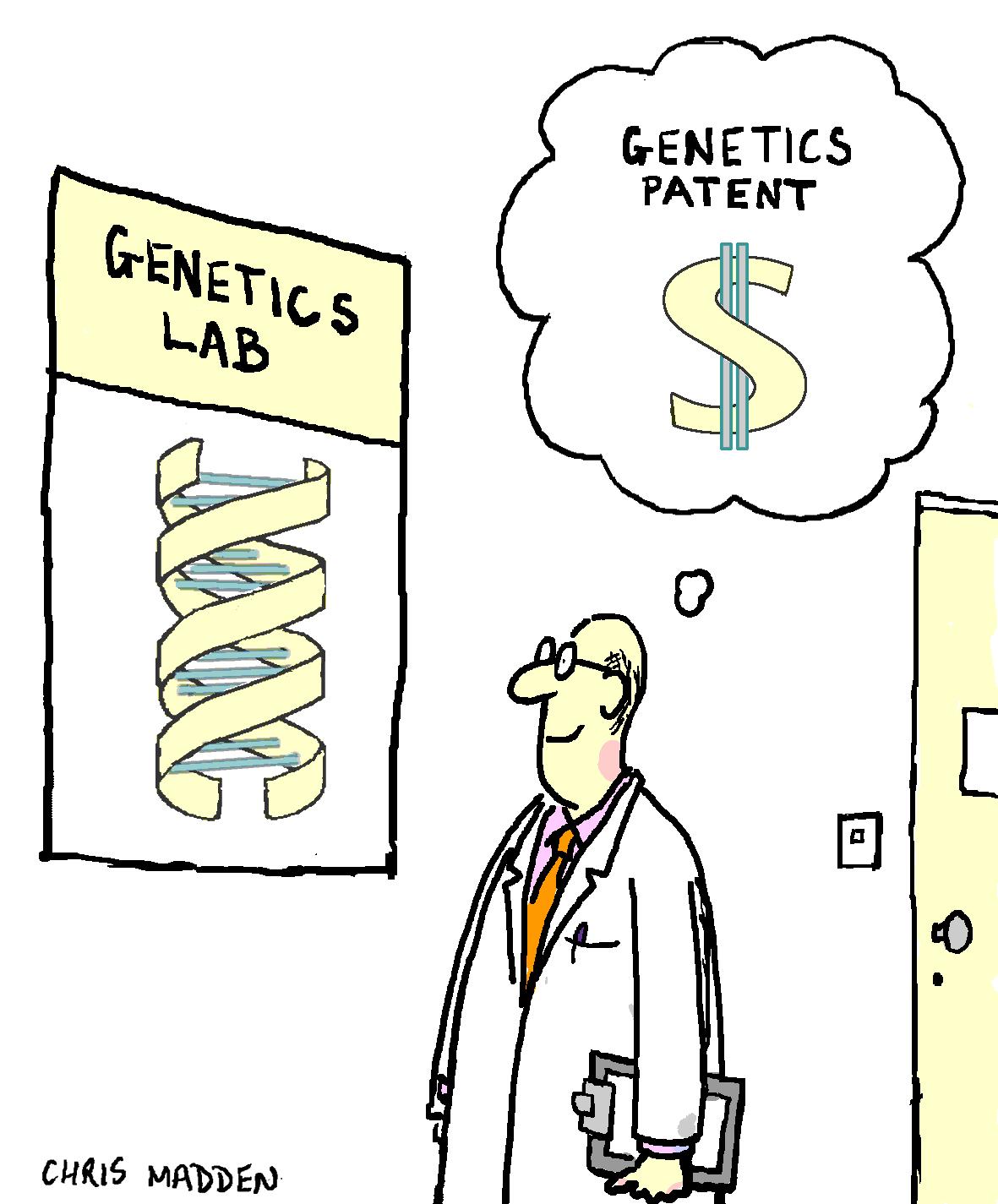
This presents an incredible dilemma where monetary interests clash with what is intrinsically a part of you; your own genes. Should the investment of billions of dollars go to waste, or should companies be allowed to patent something which is present in humans without any outside interference? Also would the patentability of genes hinder future cures or therapies related to those genes to prevent ovarian or breast cancer? At the end of the day the act of balancing interests is a tough one. If billions of dollars spent on research and development can be made useless due to gene patents being unpatentable, companies will have less incentive to go about this research, or might even cause serious financial harm to them. On the other side is companies having monopoly rights to something arguably occurring naturally; your genes. Should any legal entity have the exclusive rights to parts of the human genome? There are two ways of looking at this question: as a lawyer, I can say it is very possible that companies could patent genes, but as a human being, I’d want that type of information to be accessible to anyone, not under the supervision of a company.
Experts have stated that such patents have "...faded in importance" and that the law suit "...will be much more ideological than it will be practical". This is probably because there is very little use for an isolated gene or its analysis. The average consumer will never need the genes in question analyzed, and the few researchers that will use them probably will come few and far between. In addition the patents in question will expire in a few years, effectively rendering the nullification of the patents through litigation nothing but a matter of principle for the Association of Molecular Pathology. Precedent will surely prevent the future patenting of human genes, should the Supreme Court decide so, but the real monetary interests of companies lie in medicines, not genetics.
What the court has to decide is whether an isolated gene would be patentable as an isolated item, being sufficiently different from the genes found in your individual cells, or that they are purely a product of nature. The New York Times indicated that a fifth of the 20,000 genes found in the human body are patented, clearly showing that this has been an accepted practice for a while in the US. The US Government presented the courts with a statement expressing their opinion that human genes should not be patentable, showing support for the idea that they are indeed a natural occurrence, or the very least a subject matter that should not be covered under patents.
Indeed this case will present the Justices an interesting subject matter to tackle, and I for one will be waiting for their judgment with excitement. What seems to be the more probable outcome is the allowance of the patents, as decisions in both the UK and Australia (subject to further appeal) have been decided to favor the patenting of genes. What the US Supreme Court decides will undoubtedly influence later decisions in other jurisdictions, giving the case still the clout it deserves.
 |
| Not the genes you were thinking of |
This presents an incredible dilemma where monetary interests clash with what is intrinsically a part of you; your own genes. Should the investment of billions of dollars go to waste, or should companies be allowed to patent something which is present in humans without any outside interference? Also would the patentability of genes hinder future cures or therapies related to those genes to prevent ovarian or breast cancer? At the end of the day the act of balancing interests is a tough one. If billions of dollars spent on research and development can be made useless due to gene patents being unpatentable, companies will have less incentive to go about this research, or might even cause serious financial harm to them. On the other side is companies having monopoly rights to something arguably occurring naturally; your genes. Should any legal entity have the exclusive rights to parts of the human genome? There are two ways of looking at this question: as a lawyer, I can say it is very possible that companies could patent genes, but as a human being, I’d want that type of information to be accessible to anyone, not under the supervision of a company.
Experts have stated that such patents have "...faded in importance" and that the law suit "...will be much more ideological than it will be practical". This is probably because there is very little use for an isolated gene or its analysis. The average consumer will never need the genes in question analyzed, and the few researchers that will use them probably will come few and far between. In addition the patents in question will expire in a few years, effectively rendering the nullification of the patents through litigation nothing but a matter of principle for the Association of Molecular Pathology. Precedent will surely prevent the future patenting of human genes, should the Supreme Court decide so, but the real monetary interests of companies lie in medicines, not genetics.
 |
| (Source) |
Indeed this case will present the Justices an interesting subject matter to tackle, and I for one will be waiting for their judgment with excitement. What seems to be the more probable outcome is the allowance of the patents, as decisions in both the UK and Australia (subject to further appeal) have been decided to favor the patenting of genes. What the US Supreme Court decides will undoubtedly influence later decisions in other jurisdictions, giving the case still the clout it deserves.
Subscribe to:
Posts (Atom)