Showing posts with label issues. Show all posts

08 June, 2017

A Collective Effort - The Impact of the GDPR on Collective Management Societies

This article was kindly drafted by Axel Beelen, who writes the blog IP News (focusing on EU and Belgian IP developments). He can also be found on Twitter here. He is also a data protection specialist.

The rules surrounding personal data are about to change on 25 May 2018 when the new General Data Privacy Regulation (GDPR) will enter into force. Because collective management organisations (CMOs) process their members' personal data, they will have to be compliant with the GDPR next year. Fines can be very high in the case of non-compliance. Below you will find the key points introduced in the GDPR concerning CMOs.

Data-subjects’ rights enlarged and more defined

The processing of personal data is lawful only if, and to the extent that, it is permitted under the GDPR. If the data controller (here the CMO) does not have a lawful basis for a given data processing activity (and no exemption or derogation applies) then that activity is prima facie unlawful. A lawful basis would be the consent of the data subject to do so, contractual necessity, compliance with legal obligations, the vital interests of the data subject, necessary for public interest or the legitimate interests of the data controller.

The "legitimate interests" lawful basis, under Article 6, is the more difficult to understand. It requires the balancing of the legitimate interests of the CMO against the interests and fundamental rights of the data subject (the rightholder).

To be a member of a CMO, rightholders (for example, authors, publishers, artists and producers) enter into an agreement with the CMO. This contract will generally be the lawful basis for the future processing of the rightholder’s data.

Members must be informed before any processing

The GDPR requires that the members of the CMOs have to be clearly and fully informed about their set of rights, including new rights that have been introduced, before the collection and processing of their personal data. CMOs are strongly advised to adapt their privacy provisions, communications and information to meet the requirements of the GDPR.

CMOs will also need to ensure that they have effective systems in place to enable them to give effect to these rights without any costs to the rightsholders. In the case of non-compliance, fines can be very steep: €20 million or up to 4% of the total worldwide annual turnover of the CMO for the preceding financial year.
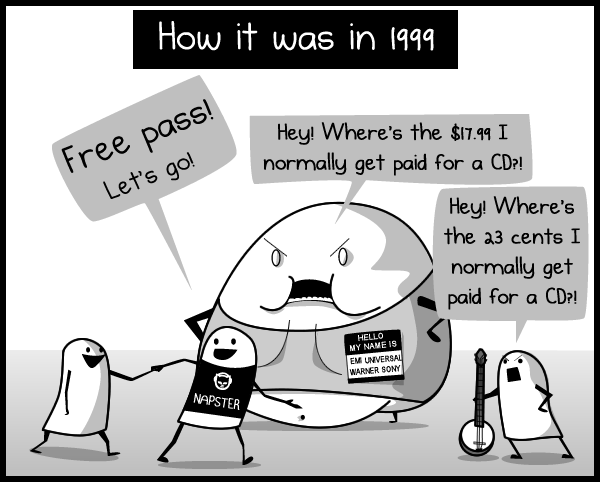
CMSs have gone through quite the change,
even before the GDPR (Source: Oatmeal)
The GDPR expands the existing set of rights provided in the 1995 Data Protection Directive, and creates several entirely new rights increasing the ability of members of CMOs to better control their personal data. CMOs must provide any requested information in relation to any of the rights of their members within one month of receiving such a request. Only where CMOs receive large numbers of requests, or especially complex requests, may the time limit be extended by a maximum of two further months. Internal policy enabling the CMO to quickly reply to a member request will need to be written.

Members’ rights under the new GDPR

In a nutshell, members have the following rights under Articles 12-22:

  • Right of access: members of CMOs (as data subjects) have the right to obtain information relating to (i) confirmation of whether, and where, CMOs are processing their personal data, (ii) the purposes of the processing, (iii) the categories of data being processed, (iv) the categories of recipients with whom the data may be shared, (v) the period for which the data will be stored, (vi) the existence of the rights of erasure, rectification and restriction of processing and to object to processing, (vii) the existence of the right to complain to the DPA, (viii) the existence of, and an explanation of the logic involved in, any automated processing that has a significant effect on data subjects. Additionally, members may request a copy of the personal data being processed by their CMO;
  • Right of rectification regarding any inaccurate personal data possessed by the CMO;
  • Right to erasure (the "right to be forgotten"): following the Google Spain ECJ ruling of 2014, the GDPR now allows data subjects to request that their personal data be erased if (e.g.) the data are no longer needed for their original purpose (and no new lawful purpose exists) or the data subject exercises the right to object, and the controller has no overriding grounds for continuing the processing;
  • Right to restrict processing;]
  • Right of data portability: members will now have the right to receive a copy of their personal data in a commonly used machine-readable format, and request that these data are transmitted directly to another data controller (which could be another CMO). This new right has been the subject of Guidelines written by the Article 29 Working Party (Article 29 WP consists of representatives of the national supervisory authority in data protection);
  • Right to object to processing for the purposes of direct marketing (including profiling); and
  • Right to not be evaluated on the basis of automated processing: members have the right not to be subject to a decision based solely on automated processing which significantly affects them (including profiling). Such processing is permitted where (i) it is necessary for entering into or performing a contract with the data subject provided that appropriate safeguards are in place, (ii) it is authorised by law or (iii) the data subject has explicitly consented and appropriate safeguards are in place.
CMOs shall provide the data subject with all of this information at the time when personal data of the members are obtained.

A DPO to supervise the personal data activities

CMOs will have to appoint a Data Protection Officer (DPO) to supervise their personal data processing activities. CMOs will have to involve the DPO properly and in a timely manner in all issues which relate to the protection of personal data.

Each CMO will ensure that its DPO does not receive any instructions regarding the exercise of those tasks. The DPO cannot be dismissed or penalised by his CMO for performing his tasks. The DPO will directly report to the highest management level of his company. A DPO can be an employee of the CMO or an outside consultant.

The DPO may be contacted by the members with regard to all issues relating to processing of their personal data and to the exercise of their rights under the GDPR.

Conclusion

 For many collective management organisations, compliance with this new GDPR will be very challenging and expensive. They would be well advised to urgently carry out a legal assessment of the current status of their compliance in order to ascertain any gaps. CMOs will then need to implement adequate solutions and monitor their suitability. All of that before May 25th next year.

11 June, 2014

Copyright in Space - The Space Oddity

The worries of the 21st century artist are ones which no other before them has ever had to contemplate, nor even conceive. Due to this some interesting results can unfold in the world of copyright. Unbeknownst to most of us, our outer terrestrial conquests just might impact our creative output, or at least limit it to some extent.

Major Chris Hadfield, a Canadian astronaut who recent spent almost a half a year in space, recorded and shared his take on the David Bowie song "Space Oddity", receiving well over 22 million views on YouTube for the duration of the video's existence on the site. This particular video was made while he was on board the International Space Station, and thus leads us to a peculiar question begging an answer: does copyright apply in space?

The ISS is regulated under the International Space Station Intergovernmental Agreement, which sets out the framework in which the Station and the law operates. Although many other agreements expand on the framework outside of the ISSIA, it is the more important one within this context. As space is potentially beyond any particular jurisdiction, with the added complication of the ISS moving at 7,6 kilometers per second over most countries at any given time, which laws would apply to govern Mr. Hadfield's rendition? According to Article 5 of the ISSIA: "...each [country] shall retain jurisdiction and control over the elements [of the ISS] it registers". This means that any modules, parts of the ship and so forth (called elements), will be under the jurisdiction of the country which owns it (including The United States, Russia, Japan, and Europe respectively). It has been determined by The Economist that the elements in which Mr. Hadfield recorded his famous video would be ones owned by the US and Japan, subjecting his video to the copyright laws of those particular countries.

Phil was busy filming his modern interpretive dance video
Mr. Hadfield's music video does not in itself present much of a legal issue, as the rights for the distribution and recording of the song were duly negotiated between all interested parties; however it still remains a curiosity in the field. The licence for the YouTube distribution of the song has since ended, yet a new agreement is being sought for the continuation of said agreement to satiate our extra terrestrial musical needs.

Nevertheless, space still remains a big question mark, especially in the emerging markets of space tourism and our conquest for Mars or other planets. As J.A. Sterling discusses more in-depth in his article "Space Copyright Law: the new dimension", copyright will face challenges when being applied to our future outside of our blue planet. More specifically, which country's or countries' laws will apply if the work in question is created wholly or partially on another terrestrial body, such as Mars? If the work is created on a space ship or station, much like in Mr. Hadfield's situation, the application of laws is much easier, or at least potentially so; however should you film a video on Mars, it is uncertain which country's laws would apply. This only scratches the surface in relation to the difficulties space can cause in relation to the creation of copyrighted works, and I would advise anyone interested in the topic to read the article above.

In the end the loss of Major Hadfield's song, no matter how eloquent and beautiful it is, is but a temporary bump in the video's existence, which will undoubtedly continue soon (or so one can hope). Space is, indeed, the final frontier - or is it? Only out future beyond the comforts of our home planet will show where copyright will go, or how far at least.

Source: IP Brief

29 August, 2013

Free Textbooks for All?

Anyone who's ever been in higher education, be it in law or any other subject, will vividly remember just how expensive textbooks are. This applies to both new and used ones, with some easily exceeding the 100 dollar mark. In the course of several years of education this can amount to a very large sum of money. Textbook prices have increased over 80% in the last ten years alone, while continuing to increase at a 6% annual pace. In a negative economic climate it is no surprise students are against this constant increase, and are using every avenue possible to mitigate the financial dent textbooks make. A new movement has emerged on the students' part which seems to make a questionable move to change things.

A familiar sight to most University students
The movement in question is the Textbook Liberation Project, which aims to give access to all students at the University of South Florida to textbooks for free. The project's founder, Tristan Lear, has stated that his aim is to "...take down the publishing industry and replace it with an alternative open source system". While arguably hyperbolic in its goal, the movement can be said to have the right motives, however their approach is wholly wrong from a legal perspective.

What Mr. Lear is doing is providing free PDF copies of textbooks for certain classes, while encouraging others to share their books in an equal fashion. He has also passed on flyers which contain scannable links to copies of textbooks which students can download directly onto their phones, tablets and computers. This, in Mr. Lear's mind, is purely an action against both the publishing industry and the book stores which provide legitimate copies of books both on and off-campus.

So what could Mr. Lear be liable for? Under US copyright legislation there is no particular provision which imposes secondary liability, although there are provisions which protect from it. The courts in Intellectual Reserve v Utah Lighthouse Ministry saw that the situation is not completely black and white even though there are no provisions for secondary liability: "Although the copyright statute does not expressly impose liability for contributory infringement, the absence of such express language in the copyright statute does not preclude the imposition of liability for copyright infringements on certain parties who have not themselves engaged in the infringing activity".

Indeed one could argue that Mr. Lear could be liable for contributory infringement through inducement, due to the fact that he is fully aware that the people he distributes the information and links to can infringe copyright, and arguably do so when presented with the option. He actively participated in his cohorts' infringement, knowing full well that they are using his methods to create infringing copies of textbooks (cases which deal with the subject matter more extensively are Sony Corporation v Universal Studios and Metro-Goldwyn-Mayer Studios v Grokster). In his own words he intends to utilize mass infringement as a means to overthrow the current copyright system for another, clearly presenting a motive to compel others to infringe copyright.

The world of academia is harsh and unforgiving, both financially and intellectually. Although one can be sympathetic to the financial hardship that modern students face, having personally experienced it for the last few years myself, Mr. Lear's approach and mentality are not ones which harbor a healthy and open forum of discussion and change. Should students be able to contravene long-standing copyright laws and practices purely to save money? The answer from a legal stand-point is a simple no, but arguably there is room for improvement on part of both the publishers and institutions of higher education. Whether Mr. Lear will be taken to court remains to be seen, but should his movement start spreading into the wider United States publishers would have incentive to do so to nip the issue at the bud.

Source: TorrentFreak