Showing posts with label london. Show all posts

14 November, 2017

Indistinct Taxi Service - London Taxi Design not Distinctive, says UK Court of Appeal

Shape trademarks have always been a difficult issue for the courts. The balancing act of trying to protect the general shape of something while being distinctive to get protection is a difficult line to tread, as the recent Kit Kat cases have shown among other decisions. One such saga that is currently being waged is over the design of the London black taxi, which many, this writer included, have used on a regular basis in the city. After a defeat at first instance, The London Taxi Company pursued the matter further into the Court of Appeal, who rendered their decision very recently.

The case of The London Taxi Corporation Ltd (t/a the London Taxi Company) v Frazer-Nash Research Ltd dealt with, as mentioned above, EU and UK trademarks over the design of the London black taxi (EUTM 951871 and UKTM 2440659). Frazer-Nash Research, a vehicle research and design company, designed and were ready to launch a new London taxi called the Metrocab (a hybrid electric car). In anticipation of infringement, LTC sued FNR for trademark infringement and passing off.

The Court had to look at 8 different points of appeal focusing on the validity of the trademarks and infringement of the trademarks if deemed valid.

The first point dealt with the definition of the average consumer in the case, particularly whether it would be the taxi driver who purchases the taxi or the same together with members of the public who hire taxis. Having extensively considered case law on the definition of 'average consumer', Lord Justice Floyd saw that the 'average consumer' is "…any class of consumer to whom the guarantee of origin is directed and who would be likely to rely on it". It followed from this that the 'average consumer' could include both the purchaser and the hirer of the services, but the Court didn't make a full decision on this point.

The second point dealt with the trademarks' inherent or acquired distinctive character.

In terms of inherent distinctive character, Lord Justice Floyd observed that the test for assessing distinctiveness for 3D trademarks, as set in Freixenet, is whether "…the appearance of the product itself [is] no different from those applicable to other categories of trade mark". Additionally, the trademark has to depart significantly from the norm of the customs of the sector would have distinctive character. Lord Justice Floyd then set out his test for determining whether a mark departs significantly from the norms and customs of the sector (1) determine what the sector is; (2) identify common norms and customs, if any, of that sector; and (3) whether the mark departs significantly from those norms and customs. Following this test, Lord Justice Floyd determined that the trademarks didn't have inherent distinctive character, since none of the features in the design registered were a significant departure from features in other taxis in the sector.

Therefore, the only way for the trademarks to have distinctive character is for them to have acquired it through use. As set in the recent Court of Appeal judgment in Nestle (see more in the link above), the test for acquired distinctiveness is that "…the mark must have come to identify the relevant goods as originating from a particular undertaking and so to distinguish those goods from those of other undertakings". In other words, the London Taxi Company's taxis would have to be distinguishable from other taxis through their design.
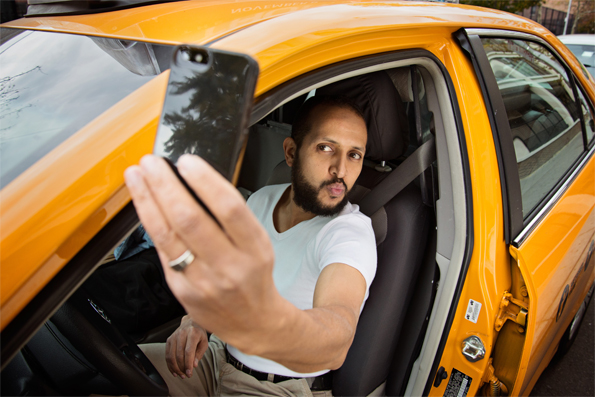
Blake loved the design of his taxi a little too much
Following the decision of Justice Arnold at first instance, Lord Justice Floyd decided that the trademarks had not acquired distinctive character among taxi drivers, and that consumers were not concerned with the origin of the taxis they hired and therefore the trademarks wouldn't have acquired distinctive character in the mind of the average consumer. Lord Justice Floyd ultimately considered the marks to be invalid, but still went through the other points of appeal for the sake of clarity.

The third point is whether the shape of the mark gives substantial value to the goods, exclusive of any goodwill in the shape. Lord Justice Floyd found the guidance on this point unclear, and would have referred the matter to the CJEU if this point would still have been relevant.

The fourth point was revocation for a lack of use of the EUTM. If the mark hasn't been used in five years within the EU, the trademark is revoked. The only activity that LTC had undertaken in the EU in relation to the marks was to sell them second-hand, as production had ceased some time ago (the EUTM model was an older model of the taxi). Lord Justice Floyd, in his hypothetical answer, saw that the mark had been used in the EU, although only through the later models that were sold.

The fifth and sixth points dealt with infringement of the trademarks under Article 9(1)(b) and 5(1)(b), and Articles 9(1)(c) and 5(2). As the Metrocab and the trademark designs differed significantly, there would likely be no infringement on the marks under the former two Articles, according to Lord Justice Floyd. With regards to the latter two, there could be infringement, had distinctive character been established in the marks, as the Metrocab would've caused detriment to the trademarks' distinctiveness.

The seventh point concerned a defence of using an EUTM as an indication of, among others, quality, quantity and geographical origin. As set in Maier v ASOS, the legitimacy of the use is considered looking at "…whether there exists a likelihood of confusion; whether the trade mark has a reputation; whether the use of the sign complained of takes advantage of or is detrimental to the distinctive character or repute of the trade mark; and whether the possibility of conflict was something which the defendant was thought to have been aware".

Having considered the matter briefly, Lord Justice Floyd accepted LTC's assertion that there would be no defence of legitimate use, as the rights of a trademark holder should not be trumped by the conveying of a message that the vehicle is a licenced London taxi. This would be possible to be displayed otherwise, without infringement (although none happened in the matter).

Finally, the Court looked at the point of passing off. Lord Justice Floyd swiftly dismissed the claim of passing off, as, similarly to acquired distinctiveness above, LTC would struggle to prove goodwill in the design of the trademark. Even so, the design of the Metrocab is very different to LTC's design, and therefore wouldn't infringe even if goodwill were present in the case. The Court ultimately dismissed the appeal.

The case is yet another painful reminder of the difficulty in registering and particularly maintaining 3D trademarks. Distinctiveness is the hurdle most fall on, and the LTC taxi was no different. LTC have indicated that they might appeal to the Supreme Court, so the fight over taxis might not be over just yet.

18 October, 2013

Retrospective - How Much is 'Substantial'?

An essential component of copyright infringement in all of the common law is that the infringement, be it copying or other restricted acts, has to be done in relation to the work as a whole or a 'substantial' part of that work (Australia, UK, and Canada). The former is more than self-explanatory; however the latter has always been an abstract concept, as what can be deemed to be a 'substantial' amount can be anything between 99% of the work or a fraction of it. Due to this ambiguity the duty to define what a 'substantial' amount would be fell on the courts, being settled in the UK courts in the 1930s.

The defining case of what a 'substantial' amount is is Hawkes & Son (London) Ltd v Paramount Film Service Ltd, which concerned the song "Colonel Bogey". The plaintiffs in the case were the owners of the copyright to the song in question, a march written in 1914, often used in military settings. The song was subsequently used by Paramount Film Service in a newsreel of the opening of the new Naval College. The reproduced part of the march lasted for an approximate 20 seconds in the newsreel, with the entire march being roughly 4 minutes long. The incidental inclusion of the song was also considered; however our main focus would be on whether that 20 second snippet from the song could amount to a 'substantial' part of the song, therefore infringing the plaintiff's copyright.

The UK Court of Appeal tackled the matter after it was initially dismissed by Justice Eve at first instance. In the Court of Appeal's view the matter boiled down to assessing the copied material not merely based on quantity, but other factors as well, or as presented by Lord Hanworth MR: "...we must look into the question of degree and what was the nature of the reproduction". Agreeing with Lord Hanworth, Lord Justice Slesser further developed the Court's view on the matter:
"I agree with my Lord that this reproduction is clearly a substantial part of 'Colonel Bogey', looked at from any point of view, whether it be quantity, quality, or occasion. Any one hearing it would know that it was the march... [and] it is clearly, in my view, a substantial, a vital, and an essential part which is there reproduced."
Not that Colonel
Now what can be taken from Lord Slesser's view is that a 'substantial' part of a work can be any amount, not merely a large part of it through a purely quantitative analysis. His Lordship talks about recognition, and although one can argue that this view is a particularly weak one, one can say this would be much akin to what was stated in Harper & Row Publishers v Nation Enterprises; the "heart" of the work. The part which was copied has to be essential and vital to the work as whole, and recognition plays a part in that. For example a very  recognizable introduction to a song or a particularly memorable riff in the middle can be a substantial part if deemed sufficiently vital to the work as a whole.

As can clearly be seen what is 'substantial' is purely subjective and assessed by the court according to each instance, not providing a clear-cut rule which applies to all works. What is deemed 'substantial' in each instance will vary depending on the type of work in question, how it has been modified (if at all), and whether it is sufficiently important to the work as a whole. Under modern laws there are exceptions aplenty for a variety of uses, which did not exist under the UK Copyright Act 1911 at the time of the case, but the case still remains an important part of the common law system in copyright infringement.

14 September, 2013

Retrospective - What is Original?

Much like novelty in patents (discussed more in depth on this very blog here), copyright only protects works which can be considered 'original'. If you merely copy another person's work by adding nothing new to it, it can be said to not be original and therefore not merit protection. After all, copyright endeavors to enable further creation and protect the interests of those who dare to do so. The bigger question at the heart of all of this then is a very simple one: what is originality?

Math - the bane of many students' existence
One of the milestone cases in the history of copyright, University of London Press Ltd v University Tutorial Press Ltd, came about in the early part of the 1990s where the United Kingdom courts had to tackle the question of what can be considered an original work within the then in force Copyright Act 1911. The case dealt with examination papers which were written for the University of London back in 1915. Under the University of London's senate's decision all examination papers created by appointed examiners would belong to the University, aside from drawings, and the University reserved all rights to reproduce those exams without any extra compensation to the examiners who had written them. Subsequently examiners were appointed for the exam period held in September of that year, among which were Mr. Jackson and Professor Lodge who were in charge of creating the exam papers for mathematics. After the exam papers had been created, the University entered into a contract with University of London Press, assigning it the copyrights and rights of publication to any specific exams for a fixed period of 6 years. University of London Press were then issued the rights to publish the exams written in the previous year, which were then published by University of London Press in early 1916. In the same month University Tutorial Press published exam from the previous year as well, containing 16 out of 42 exams from January 1916, which were attained from students rather than the published copies made by the University Press. Among the 16 exams were three which were written by Mr. Jackson and Professor Lodge. Along with the published exams University Tutorial Press also published the answers to some of the questions in those exams, including some critique of those particular questions as well. Subsequently University of London Press sued University Tutorial Press for copyright infringement over the published exams.

In his assessment of what an original literary work would be, Justice Peterson stated that "[t]he word "original" does not in this connection mean that the work must be the expression of original or inventive thought. Copyright Acts are not concerned with the originality of ideas, but with the expression of thought". As one can see from his Honor's view, copyright protects expression, not ideas (more of which was discussed in this blog here). One can copy ideas, yet how those ideas are conveyed has to be different. This is where arguably the layman's perception of what original is differs from that of the legal view of originality.

In further consideration Justice Peterson saw that "...the Act does not require that the expression must be in an original or novel form, but that the work must not be copied from another work - that it should originate from the author". Albeit seemingly obvious when thinking of originality, this point by Justice Peterson is imperative with regards to originality. For a work to be considered original it has to originate from the author themselves. What this is is an assessment on a case-by-case basis as to whether the work which is being contended did in fact originate from the author. In the case the authors of the exam questions, Mr. Jackson and Professor Lodge, had thought of the questions themselves, only drawing from the stock of knowledge in mathematics which existed at the time. It was seen by Justice Peterson that these works were indeed original. In his final thoughts Justice Peterson laid out a rough test for originality, which has fallen under some critique in modern times: "...what is worth copying is prima facie worth protecting". In the decision University Tutorial Press were found to have infringed the University of London Press' copyright.

What 'originality' boils down to is independent creative effort. If the work which is sought to be protected was the result of independent creation, it most likely will fall under copyright and be protected. Ideas themselves are not protected, but the expression of those ideas through individual creative effort would be. Although seemingly a given when presented as such, it is still a core tenant that needs to be understood and applied when dealing with potential copyright infringement.