Showing posts with label trade-mark. Show all posts

06 February, 2017

All the Right Words - The British Columbia Court of Appeal Decides on Keyword Advertising and Passing Off in Canada

While the Internet's vastness and accessibility seems like a given for those who've seen it grow over the years, finding what you need can still be quite the struggle, especially when you're looking for more niche or specific information or services. Search engines like Google have made this a breeze in most cases, but unbeknownst to most, there is a war going on underneath the surface of search engines and websites. Due to the sheer amount of competition in most sectors, being the top result in a search query, or at least making it to the first page and above your competitors, pushes website administrators and creators to rely on less 'nice' methods to push their results ahead of others. One way is through the use of website metadata, particularly the keywords associated with your website. In the light of this specific feature, could you use your competitors' name or trademarks in your own website's keywords? The Canadian Court of Appeal looked to settle this point after a first instance decision sometime in late 2015.

The case of Vancouver Community College v. Vancouver Career College (Burnaby) Inc. dealt with the use of the acronym VCC, which has been used by Vancouver Community College for some time, which had also registered the abbreviation and its full name as trademarks in Canada (marks 0910482 and 0916687). Vancouver Career College also aimed to use the same acronym with or in place of their name, in their domain name, incorporating it into their marketing materials and in social media, and also purchased the keyword advertising rights to it on Google and Yahoo. Vancouver Community College subsequently took Vancouver Career College to court under claims of passing off and trademark infringement.

The Court first dealt with the claim of passing off, which is enshrined in the Canadian Trade-marks Act in section 7. Similarly to the concept of passing off, a claim in Canada needs to consist of three components: "… the existence of goodwill, deception of the public due to a misrepresentation and actual or potential damage to the plaintiff ".

The first component is goodwill in the name 'Vancouver Community College' and 'VCC', which, putting it into more simple terms, amounts to "…the positive association that attracts customers towards the owner’s wares or services rather than those of its competitor". In particular to names, this requires specific recognition in a primary sense of the name in the relevant marketplace as distinctive to that entity. The Court rejected the notion from the Supreme Court of BC had erred in required an additional secondary meaning, as only the primary meaning would be needed to establish goodwill in 'VCC'. Having considered the evidence submitted at first instance, the Court determined that the Supreme Court had erred in their finding of no goodwill (overstating the scope of evidence to the contrary, and failing to consider a body of evidence to the positive), and that there indeed was goodwill in the acronym at the relevant time.
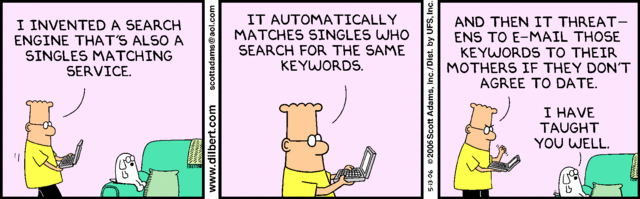

Keywords can be quite "persuasive" (Source: Dilbert)
The second component is confusion, i.e. deception through misrepresentation to the relevant public causing confusion in the minds of the public as a likely consequence of the impugned actions. Justice Saunders, handing down the Court's unanimous decision, saw that the Supreme Court erred in their assessment of confusion in the case, as "… confusion is fully established by proof that the respondent’s domain name is equally descriptive of the appellant and contains the acronym long associated to it". The Supreme Court determined that confusion was only achieved when the searcher arrived at the website's landing page, and not before the fact. While Justice Saunders did see that the mere existence of the acronym was enough to cause confusion, the bidding for keywords containing the full name or the acronym would not cause confusion as "… the critical factor in the confusion component is the message communicated by the defendant. Merely bidding on words, by itself, is not delivery of a message. What is key is how the defendant has presented itself, and in this the fact of bidding on a keyword is not sufficient to amount to a component of passing off".

The Court then moved on to consider damage caused to the plaintiff, which, according to Justice Saunders, can include damage to one's goodwill or loss of control of that same goodwill (i.e. there is not necessarily a need for actual monetary damage). Concluding her judgment on passing off, Justice Saunders did indeed confirm that Vancouver Community College had suffered damage to their goodwill, and that Vancouver Career College had passed off their services.

Finally, the Court looked at whether the registered trademarks had been infringed under section 9 and section 11 of the Trade-marks Act. Justice Saunders dealt with this matter briefly, and saw that "… there are too many factual determinations and outstanding issues" for the Court to determine and that the matter is best remitted back to the Supreme Court for fresh consideration.

Ultimately, the Court of Appeal issued a permanent injunction against Vancouver Career College for the use of the acronym 'VCC' and 'VCCollege' in its Internet presence. The matter of damages and the breach of the trademarks were to be looked at by the Supreme Court.

The case is quite the interesting one, and the Court's considerations in terms of confusion seems to focus on the searcher's viewing of the results page, rather than the viewing of the landing page after clicking a link. It did, however, entrench the determination that the purchasing of keywords incorporating others' marks would be wholly acceptable in Canada, which does leave rightsholders somewhat exposed.

Source: JDSupra

27 January, 2016

Metatags and IP Rights, Eh - Infringement of Rights Through Metatags in Canada

The Internet has spawned a great deal of new issues when it comes to intellectual property, even outside of the more obvious problems of piracy and sale of counterfeit goods from overseas. One issue that most would not think about in the context of infringement would be metatags. For the uninitiated, metatags are words or phrases placed in the code of a website that indicate the content of the website and aid in the site's search engine listings when certain terms and words are searched. They can be quite powerful in pulling traffic to a particular site, and are hidden from plain view unless the website's underlying code is observed. As such, metatags can incorporate trademarks or other protected works without displaying them, but resulting in that website appearing when those words are searched (or potentially improving their ranking when non-registered words are searched). With this in mind, could one infringe another's rights through metatags, and if so, to what extent? This question was answered recently by the Canadian Court of Appeal.

The case of Red Label Vacations Inc. (Redtag.ca) v 411 Travel Buys Limited dealt with two competing travel service companies; Red Label, established in 2004, and 411 Travel Buys, established four years later in 2008. 411 Travel Buys, upon their establishment, embarked on the creation of a website for the business, hiring a student as an intern to do so, directing her to look at other more established site for inspiration and guidance on what worked (including Red Label's website Redtag.ca). As a result some metatags were copied over from Red Label's website onto the 411 Travel Buys' site, incorporating some of Red Label's registered trademarks (including the phrases "redtag.ca vacations" and "Shop. Compare. Pay less!! Guaranteed"). The phrases were not visible on the page, but were incorporated in the site's metatags in their entirety, among many other words and phrases. Upon discovering this in 2009, Red Label took 411 Travel Buys to court, asserting copyright infringement in the phrases and the infringement of their registered trademarks.

Metadata can be surprisingly revealing
The Court first dealt with Red Label's claim of trademark infringement under section 20 of the Canadian Trade-marks Act. Justice Webb, handing down the judgment of the Court, initially discussed the 'use' of Red Label's trademarks in their incorporation in the metatags, and whether that would indeed be a use under the section. Affirming the judgment at first instance (which can be found here), he saw that the use of the trademarks in the metatags would not, in this instance, amount to infringement, as they were not used for the purpose of distinguishing or identifying 411 Travel Buys' services on their website in connection with Red Label's services. He did, however, accept that there can be the possiblity of such, but rejected it in the case at hand: "...in some situations, inserting a registered trade-mark (or a trade-mark that is confusing with a registered trade-mark) in a metatag may constitute advertising of services that would give rise to a claim for infringement". This needs to be illustrated through further evidence, and specifically in connection with the services provided by both parties (411 Travel Buys did not offer their services online, only via the phone, whereas Red Label did). Justice Webb did not discuss the extent of use or degree of use in any detail, but this writer believes his interpretation might be in the right direction.

The second point (as Justice Webb easily dismissed any claims on passing off, again affirming the first instance judgment) dealt with copyright. The point was brief, agreeing with the Federal Court Judge, who saw that "[w]hile in some cases there may be sufficient originality in metatags to attract copyright protection when viewed as a whole, the substance of the metatags asserted by the Plaintiff in this case does not meet the threshold required to acquire copyright protection in Canada". What the Federal Court Judge deemed was a lack of any degree of skill or judgment used by Red Label, or sufficient originality, to afford the metatags any level of protection through copyright. The Court therefore rejected the appeal as a whole.

Initial interest confusion was discussed in more detail by the judge at first instance, and Justice Dawson, in her concurrent judgment to Justice Webb, briefly touched on this: "The extent to which a trademark may be used in metatags without infringing the trademark is, of necessity, fact specific. These reasons ought not to be read as endorsing the Judge’s remarks relating to “initial interest confusion” or as endorsing every alternate basis on which the Judge dismissed the action".

In the UK metatags have been discussed, although not in many cases, most recently in Interflora Inc v Marks and Spencer Plc, where the High Court (after a CJEU referral) deemed the use of a competitor's trademarks as metatags would infringe their rights in those marks. Going contrary to the Canadian Court of Appeal, they endorsed the initial interest confusion theory, potentially adding an additional lawyer of complexity to metatag cases in the UK. The Court of Appeal disagreed, and remitted the case back to the High Court for retrial (currently still pending). This leaves the situation with metatags unclear in the UK, but remains as insight into the application of IP rights in metatags for the time being.

In the United States the question has not been answered definitely, with different Circuit Courts taking different approaches. In Brookfield Communications, Inc v West Coast Entertainment Corporation metatags were seen as infringing a registered trademark (constituting a use of the mark), even though the tags are not communicated to the public as a part of the website. On the other hand, in S&L Vitamins, Inc v Australian Gold, Inc, it was deemed this was the case, and that the incorporation of metatags would not constitute a use of a mark and therefore infringe it.

As can be seen, the status of metatags and trademarks is quite uncertain, although the Canadian perspective seems a lot more clear. In any event, the use of such tags is a big part of the operation of the Internet and search engines like Google, and thus do carry a great deal of value if used properly. This writer would be for more stricter approaches in protecting certain terms in metatags; however, there should be no monopoly on the use of more 'generic' terms to facilitate a more functional and competitive online marketplace.

Source: JDSupra