31 October, 2017

Needs Formatting - TV Show Formats Potentially Protected by Copyright

As companies like Netflix and Hulu are entering the fray of traditional TV production, creating their original content and licensing others, the value of more typical TV competition for eyeballs on particular timeslots has become negligible. Grabbing the attention of viewers are a fixed time, competing with other networks for the same slot, used to be a competition of outsmart and 'outcreate', giving TV formats incredible value if done right. Even if the specific production of 'prime time' TV has diminished due to the shift towards on-demand, TV formats still have value under IP laws. The matter rarely sees the light of day in a court room, but a recent UK High Court decision discussed whether a TV format can be protected under copyright.

The case of Banner Universal Motion Pictures Ltd v Endemol Shine Group Ltd & Anor concerned a TV gameshow called "Minute Winner", which was created by Derek Banner, the owner of Banner Universal Motion Pictures. Allegedly Mr Banner had disclosed a document detailing the format of the show to Friday TV (the second defendant in the matter), a Swedish TV production company at a meeting in 2005. Mr Banner also claimed that the defendants had misused confidential information to create and broadcast a show called "A Minute to Win It" in 2011, infringing on BUMP's rights in the format, breaching confidence in the same and passing off. The defendants contested the rights in the format document, that a breach of confidence claim was estopped due to a decision earlier by the Swedish courts and the passing off claim.

The Court first addressed the issue of whether the format document was a copyright protected work, specifically as a dramatic work under section 1 of the Copyright, Designs and Patents Act 1988.

As discussed, for example in SAS Institute Inc. v World Programming Ltd, a work has to be 'original', i.e. "…the work must be an expression of the author's own intellectual creation". This is assessed by looking at the whole of the work, not just its constituent parts, including both novel and non-novel parts. A dramatic work itself is defined as "…a work of action, with or without words or music, which is capable of being performed before an audience".

There has been some degree of case law on TV formats; however, only in the far-away land of New Zealand. The leading authority is Green v Broadcasting Corporation of New Zealand, where the New Zealand Court of Appeal considered that merely the idea of a TV format is not sufficient to be a dramatic work protected by copyright. This was in that "…because [the format] could not be acted or performed, being no more than a general scheme for a proposed entertainment", and "…in what way the underlying idea has been distilled out and translated into an expression thereof in a material form sufficiently identifiable to be copied". Due to this lack of tangible expression, bar an idea, leaves the subject matter unclear and therefore not protectable.

Brad was truly captivated by the TV format
Justice Snowden disagreed with the New Zealand authorities, and set out that TV show formats could arguably be protected by copyright under certain criteria. These would be, as a minimum: "…(i) there are a number of clearly identified features which, taken together, distinguish the show in question from others of a similar type; and (ii) that those distinguishing features are connected with each other in a coherent framework which can be repeatedly applied so as to enable the show to be reproduced in recognisable form". Under the criteria, Justice Snowden concluded that BUMP had a low likelihood of success to meet them for an arguable case of infringement, due to a lack of "…a coherent framework or structure which could be relied upon to reproduce a distinctive game show in recognisable form". All of the features of the show were commonplace and indistinguishable from other similar shows (including its name). Even if there were copyright in the work, the show that was produced differed from the BUMP work in many ways, and there would be no infringement.

The second matter was of breach of confidence. Having considered the principles of estoppel and res judicata, Justice Snowden determined that the action would fail due to Mr Banner being estopped from pursuing the claim as it is res judicata or an abuse of process. The legislation in the UK and Sweden is sufficiently similar so as to not require further determination.

Finally, the Court considered the matter of passing off. As discussed in Starbucks (HK), to establish a claim under passing off the claimant has to "…establish that it has actual goodwill in this jurisdiction, and that such goodwill involves the presence of clients or customers in the jurisdiction for the products or services in question". Even without a physical presence in the country it is possible to have goodwill. Justice Snowden swiftly dismissed this argument, as Mr Banner never had any customers in the UK who purchased the rights to the TV show. He did have a website displaying his formats, but the TV show in question was only one of several on that site, and it was nonetheless one of many sent to ITV by email after the meeting in 2005. No goodwill was therefore established in the UK, and the passing off claim failed.

The case has opened the door for claims on TV show formats, but clearly sets a high threshold to establish actual rights in that format. As no UK authorities have dealt with this subject matter, the case is a welcome one, even though the matter is a very niche one. A good TV show format is still very valuable, and protection should be offered, but not willy-nilly.

Source: IPKat

18 October, 2017

Citation Needed - CJEU Decides on Use of Registered Designs as Citations for the Sale of Goods Online

Marketing your goods online can be very tricky, especially if you are in the business of making proprietary goods or accessories relating to well-known brands or goods. Using the name, image or design of the goods your items relate to is almost necessary to communicate the relationship of the goods to the consumer, but without proper authorisation this can be a thorny issue. The law does allow for the use of registered designs for some purposes, but could the use of a design for the sale of goods be allowed under EU law? The CJEU took on this question in late September, giving some clarity to those wishing to do so.

The case of Nintendo Co. Ltd v BigBen Interactive GmbH dealt with the manufacture sale of remote controls and other accessories for the Nintendo Wii gaming console by BigBen, selling them online to consumers in France, Belgium and Luxembourg, and to its German subsidiary. The German entity sold the goods, manufactured by BigBen in France, to consumers in Austria and Germany. The German entity in itself does not hold any stock, but orders them when needed from the French entity. Both companies used images of the Wii and its official accessories (protected by registered designs, e.g. here and here) in the sale of these goods. Nintendo took both entities to court in Germany for design infringement.

The CJEU faced three questions in the matter, specifically dealing with whether the court of a Member State has jurisdiction over the matter where the infringement happened elsewhere; is this use allowed as citation under EU law; and how the place of infringement would be determined.

The first question, as summarized by the court, asked in essence whether the Community Designs Regulation (along with Article 6(1) of the Jurisdiction Regulation) gives jurisdiction to a court to impose an injunction against a party who is supplied by another party in another Member State for infringement of a registered design.


The CJEU first dealt with the issue of jurisdiction. Article 82 of the Community Designs Regulation sets out that "…claims fall primarily within the international jurisdiction of the courts of the Member State in which the defendant is domiciled or, if he is not domiciled in any of the Member States, in any Member State in which he has an establishment". This can also include the Member State where the act of infringement has been committed or is threatened. For Article 6 of the Jurisdiction Regulation to apply there has to be a connection between various defendants in different jurisdictions "…that it is expedient to determine those actions together in order to avoid the risk of irreconcilable judgments resulting from separate proceedings". The court also highlighted that, under case law, two companies in the same group acting in an identical or similar manner would constitute the same situation of fact.

According to the CJEU, "…the territorial jurisdiction of a Community design court seised of an action for infringement within the meaning of Article 81(a)… extends throughout the European Union also in respect of the defendant who is not domiciled in the Member State of the forum". This means that there would be no jurisdictional issue with regards to pursuing a company in a different Member State through a national court within the EU.

The court then moved onto the second issue of use of the design as a citation. The question posed to the court, in short, asked whether Article 20 of the Community Designs Regulation meant that the use of a registered design by a third party, without authorisation, to demonstrate goods being sold online would be use as a citation and therefore allowed.

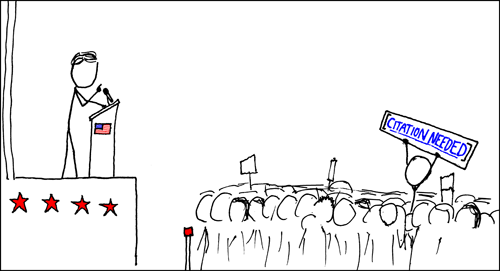
Burt definitely needed a citation (Source: xkcd)
The CJEU first looked at the meaning of 'citation'. They emphasised the designs' use for an illustrative purpose, in that "…a third party that lawfully sells goods intended to be used with specific goods corresponding to Community designs and reproduces the latter in order to explain or demonstrate the joint use of the goods it sells and a product corresponding to a protected design carries out an act of reproduction for the purpose of making ‘citations'". The use, however, would be assessed using three cumulative conditions: "…the compatibility of the acts of reproduction with fair trade practice, the absence of undue prejudice to the normal exploitation of the design on account of such acts and mention of the source".

The first condition look at whether the reproduction of the design falls within 'honest practices in industrial or commercial matters', i.e. should the design be reproduced in such a way as to create an impression of a commercial connection between the two entities, it would not be made for the purpose of citation. The second condition concerns the reproduction of the design that negatively affects the economic interest or their normal exploitation by the rightsholder. The third condition is simply attribution, so that a reasonable and observant consumer will know the design's commercial origin.

The court concluded that in the matter at hand the reproduction would be for the purpose of citation if it fulfils all of the above conditions.

Finally, the court addressed the last question of where the infringement would be committed between the two group companies, as the group companies reside and have committed infringements in several EU Member States. The CJEU, having considered the legislative framework, considered that "…the ‘country in which the act of infringement was committed’ within the meaning of Article 8(2) of that regulation must be interpreted as meaning that it refers to the country where the event giving rise to the damage occurred, namely the country on whose territory the act of infringement was committed". This hones down the legislation as applying to where the act was committed, rather than the damage occurring (i.e. infringement in Germany damaging a country in France).

As acknowledged by the court, IP does leave this interpretation as difficult, since the act could happen in a variety of locations in one time. In the light of this, the CJEU set out that "… where the same defendant is accused of various acts of infringement falling under the concept of ‘use’ within the meaning of Article 19(1) of [the Community Designs Regulation] in various Member States, the correct approach for identifying the event giving rise to the damage is not to refer to each alleged act of infringement, but to make an overall assessment of that defendant’s conduct in order to determine the place where the initial act of infringement at the origin of that conduct was committed or threatened". In the situation in the current matter, the place where the goods were put on sale online would be where the infringement took place.

 The CJEU's decision is a very interesting one, and while they made no assessment on the particular infringements in the case, it still gives national courts the tools to do so themselves in a more flexible manner rather than just designating each infringement in its respective country. This will make the assessment of infringement, and similarly of citation, much clearer for the future.

10 October, 2017

Shared by a Little Bird - Does Retweeting Protected Works Infringe IP?

Social media has made the near-thoughtless sharing of content a part of everyday life, whether it is sharing an article you liked or a picture you found somewhere. Even though the sharing of the content seems innocuous and more often than not will drive views towards the original creator, the possible legal issues of sharing without actually seeking permission or checking whether, for example, a Creative Commons licence exists. One such platform that might not come to people's mind at first is Twitter, where users can 'retweet' content that someone else has posted on their Twitter account (more on Twitter in general here and here) with very little effort. In the light of this, could the retweeting of content infringe on someone's rights?

This question will soon potentially get an answer, after a claim was commenced in the District Court of the Middle District of Pennsylvania, as reported on JDSupra. In the complaint Keith Bell, a well-known sports psychologist and author, sued King's College (a Pennsylvanian private educational institution) and Jeffrey Knarr (the head coach of American football at King's College) for both copyright and trademark infringement. Mr Knarr had retweeted two images of pages from Mr Bell's book "Winning Isn’t Normal", which were originally shared by a separate Twitter account operated by Northeastern State University's baseball team. While the baseball team removed their tweet after being approached by Mr Bell, Mr Knarr didn't do so, and his retweet had garnered some degree of interest. Mr Bell had registered copyright and trademark rights in his book well before the claim.


Sharing is caring?
As a starting point, Twitters TOS set out that "[b]y submitting, posting or displaying Content on or through the Services, you grant us a worldwide, non-exclusive, royalty-free license (with the right to sublicense) to use, copy, reproduce, process, adapt, modify, publish, transmit, display and distribute such Content in any and all media or distribution methods (now known or later developed). This license authorizes us to make your Content available to the rest of the world and to let others do the same". Clearly this is simply to protect Twitter's position in the event that an author of a work posts their content on the platform, but it doesn't offer a safe harbour for those who post material they have no rights in (or equally, further sharing that material through retweets). Clearly there would be no protection offered by the TOS to any users sharing materials without ensuring its legitimacy.

Case law doesn't shed light on this issue much, as most cases dealing with social media have yet to hit the scene in a big way. For example, a similar claim to the above was filed in 2015, but the case settled before being decided.

Even so, the case of Agence France Presse v Morel offers some guidance. In the case a photographer claimed copyright infringement after a picture they took was copied from their Twitter account and used in newspaper reporting. Among many other observations, the District Court of the Southern District Court of New York saw that the Twitter TOS didn't protect copying the works from the service, as the artists retained the rights in the works even when posted (but Twitter could put them on the website and display them on the artist's account). No licence is therefore given to the copier, even if the TOS state terms that might indicate as such. The retention of rights and the work's subsequent copying are therefore the important considerations around Twitter and copyright infringement.

Arguably, by retweeting e.g. a picture of a work you are creating a copy of that work, and should it be substantial enough it can be copyright infringement. There can be an argument under fair use in the US, which would be, in this writer's mind, a good one, but in the UK fair dealing would be more difficult to argue. A claim of trademark infringement would also be very viable, as the full name of the book (a registered trademark) is included in the Twitter post with the body of the text.

Overall it seems that retweeting material can be risky, particularly if the content is not attributed at all. This writer is a large proponent of sharing content on social media, and believes that the more sharing the better (with proper attribution, of course); however, users need to keep in mind that not everyone wants that to happen. It will be interesting to see where the law develops in terms of social media in the coming years, but it seems that the rights in an author's works would still very much remain and be enforceable.

03 October, 2017

Hungry for a Fight - Are There Rights in a Recipe How-to Video?

Food has become incredibly trendy in recent years (not that people didn't eat in years before), and many aspiring home cooks and chefs alike have moved onto modern platforms to share their know-how and passion with others. Sites like YouTube are filled with instructional and entertaining cooking videos, garnering millions of views from all over the world. Because of this, there is tremendous value in these videos and their viewers, and competition can get heated. This blog has discussed IP and food before (more here and here), and this writer has just come across a very interesting dispute over a how-to video involving cupcakes.

While the case has only recently begun, it still shows an interesting facet of copyright, particularly surrounding recipe videos.

The case of Elizabeth Labau v Food Network (complaint accessible here) concerns a recipe video made by Ms Labau for her website SugarHero. After a very successful online recipe that went viral, Ms Labau created a how-to video showing how to make her recipe step-by-step, following the success of her recipe article, which was subsequently published in December 2016. Sometime later in December 2016, the Food Network had published a video illustrating their take on the snow globe cupcake, and according to Ms Labau, copied numerous elements from her video, including "...choices of shots, camera angles, colors, and lighting [and] textual descriptors". Ms Labau has since complained to the District Court of the Central District of California, alleging copyright infringement.


Alex's take on cupcakes was a little "unique"
Although the decision from the District Court is still pending, the case will face its share of problems along the way. Ms Labau has not asserted copyright infringement in the recipe for the snow globe cupcakes, but only in the video showing how to make the cupcakes themselves. As discussed on this blog before, recipes are incredibly difficult to protect, and the only thing one can pursue in relation to them is the expression of that recipe, i.e. pictures or video. A simple list of ingredients won't be protectable.

It'll be interesting to see where the case goes, and whether the Food Network has actually copied elements of Ms Labau's video. Due to the proximity on posting the videos it is likely that one took inspiration from another, but as long as the expression of the recipe differs from Ms Labau's video, it'll be difficult for an argument for infringement to be established. This writer thinks Ms Labau could have a case, but this would require a near exact shot-for-shot recreation to have much strength in a court of law.

This writer does think that the case will most likely settle out of court, but a proper inspection of how-to videos and copyright would be very interesting, considering the generic nature of these types of videos. The style of many cooking how-to videos are only distinguished through choices of lighting and general filmography, and this writer thinks it would be interesting to see whether a sequence of steps could attract copyright protection, and how close would one have to get to infringe those rights, seeing as the style of these types of videos if widely established. Should the court side with Ms Labau, it could open the floodgates for many claims involving simple step-by-step videos of the same, or similar recipes to fight for the scrupulous viewership of today's Internet populace.

Source: Hollywood Reporter

26 September, 2017

Side by Side - AG Mengozzi Sets Out the Rules Around Parallel Importation and TM Infringement

Many brands don't only compete in a domestic market these days, but a larger global market where individual countries can be incredibly valuable in addition to the country of origin. In these instances parallel importation can be a thorny subject, particularly when the rights to particular goods (or the IP in them) has been licensed or even sold on from the original proprietor. Parallel importation also shares the field with exhaustion, potentially leaving the original seller without recourse as their rights have expired, but the matter hasn't been addressed in the EU courts for over 20 years. In the light of this silence, a case has recently been referred to the CJEU, and ahead of its decision an Advocate General stepped in to provide some well-needed insight into the law and its interpretation.

The case of Schweppes SA v Red Paralela SL related to the sale of soda water. The Schweppes brand of soda water has been sold since the late 18th century by Schweppes. The company also registered the name as a trademark in all European countries as national marks, e.g. the UK (TM 508257). In 1999 Schweppes sold the rights to the name to the Coca-Cola Company in 13 EU Member States (including the UK), keeping their rights in 18 other countries in the EU, among which was Spain. Red Paralela started to import bottles of Schweppes from the UK to Spain, after which Schweppes took Red Paralela to court for trademark infringement, with Red Paralela defending the matter under exhaustion.

The referring court asked four questions, which revolve around Article 7 old Trade Mark Directive and Article 15 of the new Trade Mark Directive relating to the exhaustion of rights in registered trademarks.

Advocate General Mengozzi set out to considered all of the questions together, summarising them as asking "…whether Article 36 TFEU and Article 7(1) of Directive 2008/95 preclude… the licensee of the proprietor of a national trade mark from invoking the exclusive rights enjoyed by the latter under the law of the Member State in which the trade mark is registered in order to oppose the importing into and/or marketing in that State of goods bearing an identical trade mark which come from another Member State, one in which that trade mark, which was once owned by the group to which both the proprietor of the mark in the importing State and its licensee belong, is owned by a third party which has acquired the rights to it by assignment".

In essence, the questions ask whether it is possible for the original owner of trademark rights, having since sold them in some jurisdictions, to prevent a seller from importing legally sources goods from another country to another where the rights don't exist for those goods.

The AG started off with setting out what the exhaustion of rights under EU law looked like.

Parallel imports provide "great" opportunities for young adults
In order for exhaustion to operate, two conditions have to be met: (1) the goods bearing the trade mark must have been put on the market in the EEA; and (2) the proprietor of the trade mark must, if it has not itself put the goods on the market, have consented to their being put on the market. The first condition is only met when the goods are sold, not merely imported on the market. The second condition requires consent, which can be, according to case law, derived from when the goods are put on the market by an operator that is economically linked to the trade mark proprietor, such as, inter alia, a licensee. This stems from the protection of the free movement of goods under EU law. Consent can also be implied in the absence of an economic link through circumstances and facts before, during or at the same time of placing the goods on the market, which demonstrate an unequivocal renouncement of rights.

The next point was the fragmentation of rights and the exhaustion of those rights through the distribution of exclusive rights for the goods.

National trademarks, according to EU case law, operate independently. If the importing entity and the owner of the national trademark in that country are the same or economically linked, the rights are exhausted. This does require that the goods were manufactured under the control of a single body, and that there was a possibility of control over the quality of the goods. In the event of assignment, there is no control over the quality of the goods by the original owner of the rights, and exhaustion therefore wouldn't apply.

In the light of the above, the AG then considered whether the importation of Schweppes from the UK to Spain would infringe on Schweppe's rights.

The AG looked at the economic link between the parties, specifically in the instance of parallel importation after the assignment of rights in different countries. Exhaustion, in the AG's view, can also exist not only where the two entities are strictly dependant on each other, but also where the trademark is under 'unitary control' in the circumstances of a matter. This would also be the case where the two parties that own national rights have 'joint control' over the exportation and importation process, or if the marketing and manufacturing of the goods happens under unitary control. Joint control would have to entail an agreement as to "…determining directly or indirectly the goods to which the trade mark may be affixed and of controlling their quality". In other words, exhaustion can apply where two companies "…coordinate their commercial policies with a view to exercising joint control of the use of their respective marks".

From an evidentiary standpoint, the burden of proof on the relationship between the companies and their business relating to the relevant marks falls on the parallel importer (Coca-Cola in this instance), showcasing the exhaustion of rights. Should there be enough evidence to potentially prove exhaustion; the original proprietor has to prove that they have no agreement in place, or collaboration, with the importer on unitary control, which exhausts their rights.

In short, the AG set out his opinion on the questions asked: "… Article 36 TFEU and Article 7(1) of [the] Directive… preclude the licensee of the proprietor of a national trade mark from invoking the exclusive rights enjoyed by the latter under the law of the Member State in which the trade mark is registered in order to oppose the importing into and/or marketing in that State of goods bearing an identical trade mark which come from another Member State, one in which that trade mark, which was once owned by the group to which both the proprietor of the mark in the importing State and its licensee belong, is owned by a third party which has acquired the rights to it by assignment where, given the economic links existing between the proprietor of the mark in the importing State and the proprietor of the mark in the exporting State, it is clear that the marks are under unitary control and that the proprietor of the mark in the importing State has the possibility of determining directly or indirectly the goods to which the trade mark in the exporting State may be affixed and of controlling their quality".

The opinion does set the tone for the decision by the CJEU in the near future, and it will be an important landmark on the law surrounding parallel importation. The simple assignment of some rights, at least in the mind of this writer, shouldn't preclude the restriction of importation by a competitor in the absence of clear acquiescence through either agreement or a joint relationship relating to those goods. The division of rights sets a clear marker on the retention of rights in key jurisdictions, and the ignorance of that purely through assignment would be short-sighted and effectively remove the possibility of doing so anywhere in the fear of losing global rights elsewhere.  In the end the CJEU will set the test for this, but the AG's opinion seems like a realistic and common sense approach to the issue at hand.

19 September, 2017

Throwing a Flag - The Use of an Amazon Listing can be TM Infringement and Passing Off

With more sales of goods being conducted online, it is often very difficult to distinguish your goods from a cascade of others, particularly on third-party selling platforms like Amazon. How these platforms often work is either by listing individual sales in isolation, therefore potentially swarming the website with similar, isolated sales of the same goods, or by lumping them together in one entry, promoting the best price for the consumer from all of the sellers on that listing (how Amazon works, for example). But with this mixing of sellers on a given listing could there be trademark infringement or passing off in these instances over the original goods being sold? A recent Intellectual Property Enterprise Court decision looked at this very question.

The case of Jadebay Ltd & Ors v Clarke-Coles Ltd (t/a Feel Good UK) dealt with the sale of aluminium flagpoles on Amazon. Jadebay sold the flagpoles under the trademark "Design Elements" (UKTM 2653159) on the platform through a licensor, which were listed under the seller "DesignElements" on the website. The defendant, Feel Good, listed their equivalent flagpole, with a lower price, under the sale Amazon listing, ultimately becoming the default seller of the goods on the listing. The claimants took Feel Good to court, alleging both trademark infringement and passing off due to Feel Good's use of the listing for inferior, non-identical goods, also excluding the trademark as above.

Judge Clarke, the presiding IPEC judge for the case, first considered the matter of trademark infringement. Under section 10(2) of the Trade Marks Act 1994, a trademark is infringed if, in short, it is used in the course of trade and there is a likelihood of confusion on part of the public, including association with the registered trademark.

The use of a sign in the course of trade includes "…offering or exposing goods for sale, putting them on the market or stocking them for those purposes under the sign", or simply used "…in the context of commercial activity with a view to economic advantage and not as a private matter". A variety of principles are applied when considering a likelihood of confusion, set out in more detail in the decision of Comic Enterprises Ltd v Twentieth Century Fox Film Corporation (discussed more here).

An alternate claim under section 10(3) of the TMA sets out that a trademark is infringed when it a person "…uses in the course of trade, in relation to goods or services, a sign which is identical with or similar to the trade mark, where the trade mark has a reputation in the United Kingdom and the use of the sign, being without due cause, takes unfair advantage of, or is detrimental to, the distinctive character or the repute of the trade mark".

Finally, the claim of passing off concerns the elements set out in Reckitt & Colman Product v Borden (discussed more here), which look at goodwill or reputation, misrepresentation leading to deception or a likelihood of deception, and damage resulting from the misrepresentation.

Judge Clarke then turned to analysing the issues at hand, starting with trademark infringement.

In her view, the average consumer would be an average flagpole-buying consumer, purchasing it for their home or commercial setting. The purchase would be driven by considerations of utility, quality and price rather than aesthetics or design, and that his purchase will be a considered one, rather than a whimsical or impulsive one, leading to an inclination of looking at the details and specifications of the listing used.

In terms of the use of the sign that was complained about, i.e. the name "Design Elements", the judge saw that it had been used by the Defendant. I her view "…[w]hether the sign complained of appears in the listing title itself, or in the descriptor 'by DesignElements', it still acts to indicate the origin of the goods for sale on the listing". The descriptor isn't merely a shop name, but an indicator of manufacturing origin, and a sign of their quality to the consumer.

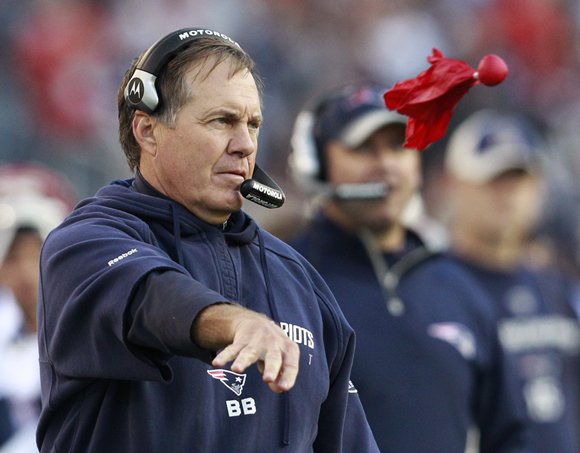
Throwing your flags away isn't a viable option to avoid infringement
Looking at the actual similarities of the signed complained of and the registered trademark above, the judged had to consider their visual, aural and conceptual similarities (does it sound the same, look the same and cover the same or similar good/services). Their aural and conceptual similarities were not disputed by the defendant, so the judged quickly determined them to be identical. As to their visual similarity, the judge concluded that, as the trademark and the sign complained of share the same words in the same order, and while they are connected as one word, they are nonetheless separated by the capitalization of both words. Lastly, stylistically there were few differences between the two. Judge Clark therefore decided that the sign and the trademark had a high degree of similarity.

The judge then moved onto the next components in infringement. She swiftly determined that the sign is clearly used in the course of trade, and that it was used in relation to similar goods (i.e. the sale of flagpoles).

The next step is to establish a likelihood of confusion on the part of the average consumer. In her view, after a review of all of the circumstances, there was a high probability of a likelihood of confusion. This included factors such as the similarity of the sign and the trademark, careful consideration by the average purchasing consumer and the likelihood that the average consumer would think the product came from Design Elements. While she considered the lack of evidence of actual confusion, this didn't change the ultimate determination.

The judge concluded that there was therefore trademark infringement under section 10(2).

Judge Clark moved onto infringement under section 10(3). In looking at the trademark's reputation in the UK, the first limb of the test under the subsection, the judge saw that reputation in relation to the trademark only existed with the people who had bought a flagpole bearing the trademark. Without proper evidence as to the relevant public judge Clark couldn't establish that the trademark would have a reputation amongst a significant part of the relevant public. Infringement under section 10(3) therefore failed.

Finally, the judge turned to the claim of passing off, and determined that the defendant had passed off their goods as the claimant's.

It was quickly established that the claimant's business did have goodwill in the UK (albeit at a very low threshold on non-triviality). According to the judge, the sale of many flagpoles of a number of years, including garnering positive reviews, clearly demonstrated goodwill. The judge also agreed that a substantial number of members of the public would be misled by the defendant's listing, especially once the consumer would dive deeper into the details of the listing and the flagpoles themselves. Finally, the judge saw that almost every sale the defendant made would have been a lost sale to the claimant, and they had suffered damage as a result.

The case is quite the curious one, since it has, in effect, created a new type of trademark offense. Should someone use a pre-existing Amazon listing, they could potentially infringe on any associated trademarks, and would have to be careful to sell goods under that particular brand. The decision does set the bar quite high, and anyone selling authentic goods for a lower price would be safe, but anyone trying to ride the coat tails of a more well-known brand, selling inferior or different branded goods, might just fall foul of the precedent set.

12 September, 2017

A Point of Direction - UK Supreme Court Considers Direct and Indirect Patent Infringement

Due to the limited monopoly period in patents, infringement can be very problematic for the rightsholder, and would need to be dealt with as quickly as possible to maintain the competitive edge the patent provides. What remains tricky is establishing whether a competing product infringes on the patent, be it directly or indirectly. Drawing the line in the sand for the two types of infringement is very important, and judicial consideration on both might not be as clear as one hopes. In an attempt to clarify the position, the UK Supreme Court took on a case that involves two rivals in the pharmaceutical business.

The case of Eli Lilly v Actavis UK Ltd dealt with the chemical Pemetrexed, developed by Eli Lilly, used for the treatment of cancerous tumors. Used solely by itself the drug can be harmful, even fatal, and hence is not used as an anti-cancer drug. The side-effects of the drug could, however, be negated by using it in combination with vitamin B12 or folic acid and used for its original purpose. Eli Lilly has sold the combination drug, called Alimta, since 2004. The company also patented this combination drug in the EU (patent no. 1313508) including designations in France, Italy and Spain. Actavis proposed the launch of competing products that used pemetrexed together with vitamin B12, but, instead of using the same active ingredient Actavis would've used a different, albeit similar combination (differing from the patent claims). Eli Lilly alleged that the products would directly or indirectly infringe on their patent, with the matter ultimately reaching the Supreme Court in July.

The focal point of the matter is the use of a particular pemetrexed diacid or a pemetrexed salt with vitamin B12, which is specified in claim 1 of the patent, while Actavis uses a slightly different salt. Article 69 of the European Patent Convention sets out the extent of a patent's protection, which "…shall be determined by the claims. Nevertheless, the description and drawings shall be used to interpret the claims". A combination of the claims and its associated description should be used to determine the patent's remit of protection, i.e. could it include more compounds than the one set out in claim 1. The relevant provision for the infringement of patents in the UK is section 60 of the Patents Act 1977, which is governed by the above provision in the EPC.

After discussing the precedential history of patent infringement in both the UK and Europe, Lord Justice Neuberger, handing down the Court's unanimous decision, set out the proper test on patent infringement. In his view, to assess patent infringement matters, one has to look at two issues through the eyes of the person skilled in the relevant art. Namely, "...(i) does the variant infringe any of the claims as a matter of normal interpretation; and, if not, (ii) does the variant nonetheless infringe because it varies from the invention in a way or ways which is or are immaterial". He further specified that the second issue should viewed as not merely identifying what the words of the claim would mean to the skilled person, but also considering the extent if any to which the scope of protection afforded by the claim should extend beyond that meaning.

Lord Justice Neuberger then moved onto discussing the two issues above in more depth.

The first issue, in his view, is a straightforward application of claim interpretation, considering that the ingredients used by Actavis would not fall within the expression "pemetrexed disodium" in claim 1.

Steve wasn't a big fan of taking Pemetrexed 
The second issue proved to be trickier. Lord Justice Neuberger saw that, to determine what would amount to an 'immaterial' variation of the invention, it would be helpful to look at the three questions set out in Improver Corpn v Remington Consumer Products Ltd. These ask "i) Notwithstanding that it is not within the literal meaning of the relevant claim(s) of the patent, does the variant achieve substantially the same result in substantially the same way as the invention, ie the inventive concept revealed by the patent? ii) Would it be obvious to the person skilled in the art, reading the patent at the priority date, but knowing that the variant achieves substantially the same result as the invention, that it does so in substantially the same way as the invention? iii) Would such a reader of the patent have concluded that the patentee nonetheless intended that strict compliance with the literal meaning of the relevant claim(s) of the patent was an essential requirement of the invention?"

The judge then turned to answering the above three questions.

For the first question Lord Justice Neuberger quickly determined that both drugs work in the same way as the patented invention, ultimately comprising of a medicament containing the pemetrexed anion and vitamin B12. The drug will achieve substantially the same result, in the same way, as the invention.

In the light of the second question, Lord Justice Neuberger considered that the skilled person would appreciate that each of the Actavis products would work in precisely the same way as pemetrexed disodium when included in a medicament with vitamin B12. The use of different free acids or salts would not change this outcome, as they were clearly established as at the priority date of the patent, and the skilled person would clearly investigate their effects as a part of routine. A test for knowing whether the drugs work or not would, in his mind, is too strict.

In answering the third question, Lord Justice Neuberger diverged from the Court of Appeal's decision. He considered that the skilled person would understand that the use of ' pemetrexed disodium' would not limit infringement to only that particular salt – this just happened to be the one used during experimentation. He concluded that it is unlikely that any other pemetrexed salts or pemetrexed free acid would have been excluded from the scope of protection.

Lord Justice Neuberger ultimately saw that the patent had been directly infringed by Actavis. He affirmed his position even in the light of the patent's prosecution history, as reliance on it should be reserved to limited instances and not every matter concerning infringement. The judge also considered direct infringement in France, Italy and Spain, and concluded that the patent had been infringed in these jurisdictions as well.

Finally, the Court looked at whether the patent had also been indirectly infringed had they determined the patent to not have been directly infringed, also set out in section 60 of the Patents Act 1977. The parties argued about the manufacture and administration of the drugs, diverging on whether both contribute to infringement or not. Ultimately Lord Justice Neuberger determined that Actavis would have indirectly infringed Eli Lilly's patent if they knew, or it was obvious given the circumstances, that the drug would be used by dissolving it into a saline solution

The Supreme Court's decision in the case will be very influential, and redefines how direct infringement in particular is assessed. It'll be interesting to see how the new tests are applied to different types of patents, not just pharmaceuticals, and whether it will make proving infringement easier or more difficult.