10 August, 2015

Tweets Stolen - Further Thoughts on Tweets and Copyright

The impact of social media on today's social interaction is undeniable, with people turning to Instagram, Facebook and Twitter for more and more of their entertainment, social and news needs. As this new interaction space has grown, and seemingly keeps growing, the value of the content within it has grown as well. This writer recently noted newly emerged discussion surrounding Twitter and reusing jokes and/or content lifted from Tweets, especially in the light of having discussed this on a very superficial level some time ago, I thought it merited expanding more in detail.

In a recent development it has come to light that Twitter hides certain tweets it deems to be infringing copyright, pending a response from the copyright holder as to their respective fates. This is expanded on in Twitter's Copyright and DMCA Policy: "Twitter will respond to reports of alleged copyright infringement, such as allegations concerning the unauthorized use of a copyrighted image as a profile photo, header photo, or background, allegations concerning the unauthorized use of a copyrighted video or image uploaded through our media hosting services, or Tweets containing links to allegedly infringing materials". One has to note that, although the policy does focus on images and videos, it does leave its definition of "copyright infringement" as open-ended, potentially catching tweets themselves.

This begs the question, is a tweet protected by copyright? As discussed in my previous article, the UK Copyright, Designs and Patents Act 1988 does not set a limit on what can amount to a copyright protected literary work, which allows for even tweets to be potentially protected under the provision. As long as the work originates from the author and contains a certain level of originality. The ECJ decision in Infopaq International A/S v Danske Dagblades Forening further elaborated on what amounts to originality, with the court deciding that a work is protected by copyright if it is "...the expression of the intellectual creation of [the] author". So long as you have put in effort and some level of choice and creativity into your work, even a tweet, it would arguably be protected by copyright within the UK and the EU, irrespective of the tweet's length (140 characters or fewer).

Twitter can be serious business
In the US things can potentially be a little different. Under 17 USC section 102 copyright protection extends, much like in the UK, to literary works. The provision itself does not prescribe any length requirements no works for copyright to be applicable, and section 101 offers no further assistance in answering the above question. The Electronic Code of Federal Regulations aids somewhat, as section 202 of the Regulations stipulates that works that will not (necessarily) be protected by copyright are "[w]ords and short phrases such as names, titles, and slogans" - although, the CFR merely sets these out as examples, not definitive limitations. Whether a tweet would count as a "short phrase" and therefore is not protected would remain an assessment of its creativity (as was discussed in Arica Institute Inc v Palmer, for example), as if the phrase exhibits a minimal amount of creativity, it would arguably be protected by copyright in the US.

As can be seen Twitter and tweets do pose a challenge to copyright and whether its protection extends to them within the common law. Although literary works are nearly universally protected all over the world, their length and specific content does dictate the protection afforded, especially when its creativity or originality comes into question. One big consideration is the monetization of tweets and whether they would ever merit protection to the point where they would be challenged in court. This writer would love to see a tweet or a series of tweets be evaluated by the courts at some point, but heavily doubts the likelihood of this ever happening. Without judicial consideration one can still very much appreciate the creativity of tweets and their content, as the character limitations present a unique obstacle to comedic delivery; something when achieved can be powerful.

Source: The Verge

04 August, 2015

Icons Gone - Photography of Landmarks to be Prevented Through Copyright?

Memories are an important part of life, especially when it comes to travels to far-away lands or places, filled with culture, icons and landmarks that dot human history's timeline. As an avid traveler, this writer has taken his share of photos, both digital and of the physical, film variety, and often looks back at them with fondness and nostalgia. Pictures also form a part of the fabric of visual heritage of different cultures, and their importance cannot be overstated. Nevertheless, as a part of the InfoSoc Directive's implementation report, specifically relating to Article 5 of the Directive, any EU Member State could introduce restrictions to rights conferred in Articles 2 and 3 of the Directive.

To expand on this a bit more, the Freedom of Panorama enables individuals to take pictures of sculptures or other permanent installations and publish them without a need to consult the original creator or architect to do so. Currently the legal landscape for Freedom Of Panorama is very scattered, with some countries in the EU allowing all uses of such pictures (some with certain limitations, such as non-commercial use), while others, such as France and Italy, allow for no publication of images of this nature. Arguably the ability to publish one's vacation photos should be a 'right' in itself, with potential restrictions on commercial utilization being a viable option (although, one can imagine, costly to enforce effectively).

Frank was a savant in monument photography
In the proposed amended report put forth by Julia Reda (with the initial report discussed on this very blog here) Freedom Of Panorama was curtailed somewhat, as a recommendation set forth that "...the commercial use of photographs, video footage or other images of works which are permanently located in physical public places should always be subject to prior authorisation from the authors or any proxy acting for them". Ms Reda's initial report had a very different view, proposing that photographs of such places would always be permitted. This writer would promote striking a balance between the allowance of sharing photographs with their commercial utilization with no licence contribution. Arguably, enforcement and ensuring that all images were actually taken for the commercial purposes would be challenging, and potentially nigh impossible, yet it still remains an important consideration in this context. People should be able to share their vacation photos with no need to seek permission, but should not be able to sell those images as postcards, for example, willy-nilly.

The measure has since been rejected, which is a great development; however, one has to note that the resolution is non-binding, potentially leaving the door open for the restriction of Freedom Of Panorama in the future. This writer doubts any substantial restrictions would ever be introduced, and even if they would be, their enforcement would be their downfall. Online services like Facebook and Picasa would have to restrict the displaying of photos that would infringe on this potential provision, bearing the brunt of the enforcement of any takedown notices from subsequent rights' holders.

This discussion surrounding the Freedom of Panorama highlights the persisting importance of copyright in everyday life, even regarding mundane, more obvious 'rights'. Should a restriction be implemented monuments around the world would probably have stewards requesting payment after a photograph is taken, affecting the magic of amazing sights that people have wanted to see on their journeys. Nevertheless, as the measure has been rejected it seems highly unlikely, but this writer will follow any developments with interest.

Source: The Times

17 July, 2015

Online Blasphemy - YouTube Wins Round Two of Performance Right Kerfuffle

After the decision in Garcia v Google (discussed on this very blog here) last year the question of whether an actor (or actress) has a copyright interest in their respective performance, no matter how short, has been debated hotly. The decision was appealed, and the Court of the Ninth Circuit decided to hear the matter again en banc; a decision that many of us involved in IP have waited for with anticipation. The decision was finally handed down nearly two months ago, and this writer, in shame, only now had time to discuss the case.

For the uninitiated Garcia v Google dealt with a low-budget independent movie called "Desert Warrior", in which Ms. Garcia appeared. Post filming the title and narrative of the movie was drastically changed, finally being called the "Innocence of Muslims"; a movie that arguably was quite blasphemous and offensive towards those of the Islamic faith. Ms. Garcia's appearance was a brief 5 second clip, and her performance was dubbed over in post-production. The movie incited violence and disapproval in the Middle East, with Ms. Garcia also facing several death threats as a result of her appearance in the movie.

The main crux of the case lies in Ms. Garcia's claim in a copyright interest in her performance, allowing for an injunction to be issued against Google for the movie's broadcast on their YouTube platform (and potential other platforms as well). This injunction was issued at first instance.

The Court raised the alarm right from the start, stating that "...Garcia’s theory of copyright law would result in... splintering a movie into many different “works,” even in the absence of an independent fixation", or in other words, every actor or actress in a given movie would have a copyright claim in it. Also, Ms. Garcia's part in the movie would fall under the work-for-hire doctrine, which passes on the copyright interest to the employer, leaving her with no copyright claim in the work. Ms. Garcia did not, as a final barrier to her copyright claim, fix her work in any tangible form; a requisite element under copyright in the United States for an interest in the work to arise. Through the Court's rationale, albeit quite aggressive as such, Ms. Garcia's claim was quickly dissected and dismissed and she was deemed to have no copyright claim in the work.

Free speech online; a precious commodity
Finally, the Court addressed Ms. Garcia's claim under irreparable harm. Her claim does not manifest itself through any tort-based cause of action, but through copyright and her interest in the work as an author. The Court did have sympathy for Ms. Garcia, but her action was rotten at the root, as the Court described: "This relief is not easily achieved under copyright law. Although we do not take lightly threats to life or the emotional turmoil Garcia has endured, her harms are untethered from -and incompatible with - copyright and copyright’s function as the engine of expression". One has to agree with the Court's judgment, as rightfully so copyright protects expression and not human life or its safety. While one has to appreciate that the movie has brought a significant amount of distress to her, and as such those problems should be addressed, but the way to address them is not through copyright. In the end, her claim failed under irreparable harm, as no harm was caused to the work or her claimed interest in the work as an author.

Judge Kozinski, who gave the judgment at first instance, handed down a dissenting judgment, as he saw there indeed was a claim under copyright in Ms. Garcia's small part in the movie. Through his Honor's argument, Ms. Garcia's claim stems from the acting itself, and its fixation on film. Without this, in judge Kozinski's mind "[i]f Garcia’s scene is not a work, then every take of every scene of, say, Lord of the Rings is not a work, and thus not protected by copyright, unless and until the clips become part of the final movie". This writer, in his humble opinion, argues against judge Kozinski here, as the mere recording of an actor or actress does not necessarily create a 'work' unto its own under copyright. Should one follow this logic the movie in question could consist of hundreds, if not thousands of distinguishable works, which would lead to copyright being untenable in the film industry.

Judge Kozinski further argues that Ms. Garcia has an interest as an author, and thus should be protected from irreparable harm. Although, under precedent, an author does not themselves have to affix the work to be considered as such, an actor or actress plays no part in the fixation of a work, but merely act as a part of its fixation for another. This does not create an interest as an author, or a separate author within one work. As she is not an author she cannot face irreparable harm, even if her life is at stake, as his Honor points out at the end of his dissenting judgment.

Overall the case has been a very interesting one, and whether it goes on further remains to be seen; however, this author does not see a need for it to go beyond its current route. Whether Ms. Garcia has a copyright interest in the work is, at least arguably, an equivocal no, and her case, although very serious in nature, would create an overreaching right in copyright beyond its intended purpose.

Source: BBC News

07 July, 2015

Coffee Shop Conundrum - ECJ Set to Decide on Free WiFi and Third Party Liability

In a time when the internet is nearly always with us, be it in a smartphone, a laptop or other smart devices, you often taken things for granted such as free WiFi. For many travelers it has saved their behinds from being lost, out of money, or in some unfortunate cases, even potential harm, and many of us in bigger cities like London can easily overlook the need for WiFi. But, as Uncle Ben framed it so eloquently: with great power (i.e. Internet connectivity) comes great responsibility. People can be inconsiderate, and at times outright indifferent, to potential liability issues in using other peoples' or organizations' free WiFi, which begs the question: can a third-party be liable for possible infringement on their wireless network?

The answer to the question possible lies in the forthcoming decision of McFadden, faced by the European Court of Justice later this year (this writer hopes). The case, refereed to the ECJ from the Regional Court of Munich (decision in German can be found here), concerned a store owner, Toby McFadden, in Germany who's store specialized in light and acoustic engineering services. To further promote the store and its offerings the owner allowed potential customers to freely access a WiFi connection, with no password protection included. An unknown user used this free network to upload and share an infringing song on an online file-sharing platform, and Mr. McFadden was subsequently sued by Sony Music who argued he is liable for the infringement (among other things) that occurred on his unprotected network.

The case does bring forth several questions concerning Article 12 of Directive 2000/31/EC, more commonly known as the E-Commerce Directive. Although each of the questions merits an assessment in their own right, for the sake of brevity this writer shall endeavor to answer the question above, at least in the light of Article 12.

Wifi can cause some degree of envy
What Article 12 seeks to protect are service providers, or in other words 'mere conduits', who provide a service such as free WiFi, should they remain largely hands-off of the provision of that network (i.e. don't cherry-pick the users accessing the network, don't initiate the transmission of information or alter what is received in some way). This, however, cannot be a service for which the provider is remunerated, per Recital 18 of the Directive, and aims to facilitate the better sharing and access of information within the European Community.

This writer will freely admit his lack of knowledge in German law, but proposes to give a perspective from the UK side of things. Pinsent Masons in their Out-Law blog have set out that, per German law, individuals have to secure their internet connections through reasonable means, such as a password, to avoid liability should a third-party use their connection for nefarious purposes; however, this standard does not extend to commercial entities, which the case aims to settle.

Under the Copyright, Designs and Patents Act 1988 the High Court has the capability to issue an injunction against a service provider, provided that the "...service provider has actual knowledge of another person using their service to infringe copyright". What this has been interpreted in Twentieth Century Fox Film Corp & Ors v British Telecommunications Plc to encompass is true knowledge of one or more infringers using the provided network to do so, and the more detail of knowledge or facts given to the service provider (notices etc.) the less protection the provision offers to them. One could argue that a lack of password protection would not in itself give rise to an actual knowledge of possible infringement, as users, even if filtered through via password protection, could still abuse the network without the knowledge of its provider.

Whether Mr. McFadden was brazenly aware of the infringing acts being committed on his network is unknown to this writer, and he awaits the decision of the ECJ with some interest. Voices have been raised in the protection of open networks and access thereto by entities such as the Electronic Frontier Foundation, and one must agree with them to a certain extent. The 'locking down' of networks does provide a more cumbersome regime through which information and the Internet can be accessed, but one still does have to keep in mind the protection of legitimate rights within that space. What the ECJ decides will undoubtedly have ramifications on our WiFi networks, but one can imagine they'll only remain a login away.

Source: JDSupra

25 June, 2015

Words Reinterpreted - Copyright and Translations

As has been well-established for years, copyright protects the expression of ideas rather than the ideas themselves (more on which can be found here), no matter what your expression for that idea may be. Words especially are a very nuanced, often unique way of conveying similar ideas or stories, making them the most malleable out of all forms of more direct expression (when images can be much more subjective, at least in this writer's opinion). Although similar stories have been told for centuries, basing themselves on old folk lore or mythologies, their specific expression has always varied drastically, tacking onto the societal make-up of their time and their respective overarching themes. Translations take those works and make them available to people who otherwise would not be able to access them. With this in mind, can you translate a story and not infringe its copyright, and can a translation be a new form of expression of the same story, potentially being protected by copyright itself?

Under the Copyright, Designs and Patents Act 1988 in the United Kingdom, copyright holders have a specific set of rights in their protected works, which includes literary works. Under section 16 of the Act only the copyright holder is able to make an 'adaptation' of the work, which specifically includes translations. Should you choose to make a translation of a work, without seeking a proper license to do so from the copyright holder, you would be infringing their copyright (specifically section 21 of the CDPA). This follows Article 8 of the Berne Convention for the Protection of Literary and Artistic Works that gives authors "...the exclusive right of making and of authorizing the translation of their works throughout the term of protection of their rights in the original works".

Is there any way for an individual to translate a work without infringing copyright then? Under the CDPA there are certain exceptions for the use of copyright protected materials that translations could potentially fall under, specifically criticism, review and news reporting and research and private study. Both exceptions provide avenues for a legitimate use of materials so far as the use is for that specific purpose and not merely done under the façade of the exception in order to create an infringing copy. Arguably, translating a copy for criticism, review or news reporting provides a sufficient reason to do so, as the understanding of the underlying material and using it in that task can be said to be fair and a proper use of copyright protected material for that purpose. The same goes for research and private study, especially when no officially translated source material is not available to be used and thus the materials could not be used to advance your own personal education or research. Arguably none of these do allow for the distribution and/or sale of a translated work, but do offer an avenue for legitimate uses of translated works should you require to do so.

Albert was a master linguist (Source: Farmers Weekly)
Other common law countries have very similar provisions dealing with the translation of copyrighted works. In the United States copyright similarly does not allow for the creation of translations of works, as under 17 USC section 106 the copyright holder has the sole right to create 'derivative works', which does include translations. Canada, much like its cousin in the South and across the pond, gives the right to translate works only to the copyright holder under the Canadian Copyright Act. Finally, Australia, much like the previous three, protects translations as a right only bestowed to the copyright holder under the Copyright Act 1968, as they are considered an adaptation of the original. Clearly the ability to translate a work is seen as an important right of the original author, and rightfully so, as the spreading of a work to new territories, often through linguistic barriers that require the translation of your work, and an opportunistic infringer could easily pounce on the popularity of a title only released in a select few countries.

This still poses the question that can a translation be a new work unto its own, and possibly be protected under copyright outside of the original work? In the US the protection in any derivative works (and in turn, translations) only extends to the newly created parts of the work that did not exist in the original. This may seem very vague, which it is, but arguably this would be any changes in expression or artistic flourishes the translator adds to his or her take on the story, either through necessity, linguistic differences or just through their own initiative. This does not create a work in itself, but does show that the translation can incur protection, even if partially so. Canadian legislation takes this a step further as it has been seen in Pasickniak v Dojacek by the Canadian Court of Appeal that a translated work is a copyright protected work in itself, wholly separate from the original work it derives from. This still does not mean the translator attains any copyright title in his/her translation as the copyright automatically vests in the copyright holder, albeit still separately.

Even so, translations can have even vast differences to the original works, and as seen above, potentially should carry more weight as separate literary works themselves without skirting the copyright of the source than you'd think. Great examples of where translations deviate onto a path of their own, at least in some terms, are works by Umberto Eco. His works often contain specific references to regional artists, works and anecdotes; material that has been noted to be changed or even omitted in his works when translated. Mr. Eco is by no means the only writer who has 'suffered' from the changes through translation, and arguably that is a part of the nature of the beast (there are instances where works have been altered for censorship as well). One could argue that when a translations steps beyond the bounds of the original drastically it could be said to be a work in itself; a reinterpretation of a story created prior. Regardless, copyright will probably not allow for the free translation and 'reimagination' of said works any time soon, as its main function is to reward the original author, not subsequent users of said material, arguably using very little imagination of their own (this writer does not, however, want to diminish their work by any means). Any aspiring translators will therefore have to keep their wits about themselves, and apply for relevant licences or approval before starting on their reinterpretation of their favorite foreign book.

16 June, 2015

Words Hurt - Disparaging Trademarks and Free Speech Collide

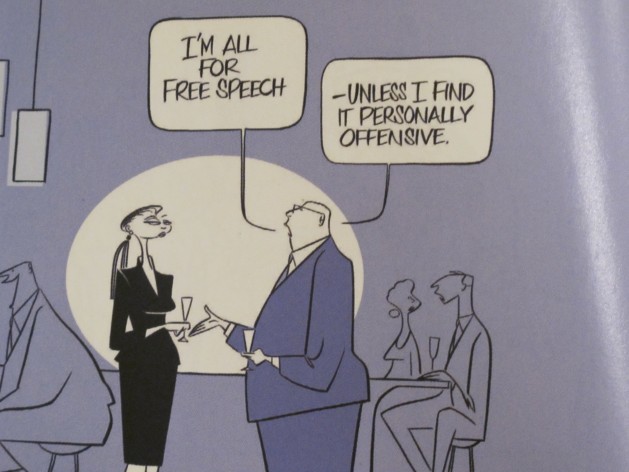
Freedom of speech or expression has often been a sore point of contention for those wishing to protect a full freedom of expression (i.e. no restrictions on speech whatsoever) and those who want to limit it within a certain space to ensure a more harmonious society (i.e. the prevention of hate speech, for example, but allowing for a broad freedom of expression nonetheless) - although the former surely does not prevent a harmonious society as a concept itself. With that in mind, intellectual property is no exception, after all, most ways of expression yourself and/or marking your goods to distinguish them often tread the line of good taste and offense in order to further their respective goals. Especially with trademarks there are certain limitations on what you can use as a registered trademark, but does a limitation on your use of said marks prohibit your effective freedom of speech?

This issue was largely brought to light in the recent Washington Redskins trademark litigation, where the offensiveness of a trademark potentially disparaging native Americans was a heavy point of contention, and the Redskins were subsequently stripped of their trademark (although the loss of their mark is not as straightforward as that) due to the disparaging nature of the mark. However, the Redskins never brought a claim under the First Amendment of the US Constitution.

The matter of free speech was brought into the limelight regarding the refusal to register a trademark after a US Court of Appeals decision in Re: Simon Shiao Tam where the Court affirmed a prior decision to refuse the mark "THE SLANTS" due to its offensiveness against people of Asian descent. The mark related to the name of a rock band called The Slants, fronted by Mr. Tam (including several other members of Asian descent as well). The Court also promptly concluded that there was no impairment of Mr. Tam's First Amendment rights, following the precedent set in Re: Robert L. McGinley some 30 years ago, where the United States Court of Customs and Patent Appeals saw that "...the PTO's refusal to register... [a] mark does not affect his right to use it. No conduct is proscribed, and no tangible form of expression is suppressed. Consequently, [the mark's holder's] First Amendment rights would not be abridged by the refusal to register his mark". Arguably, prima facie at least, a refusal of registration does not prevent the use of a mark, but it does, however, prevent its effective protection under trademark law and can cause issues for the proper monetization of a mark in other commercial endeavors should the holder's venture become more successful than its own field allows it. Albeit this does not affect the use or 'expression' in the mark, but mainly the commercial aspects surrounding the mark.

Peter never was a man of consistency
What makes the decision in Re Simon Shiao Tam interesting are the remarks made by Justice Moore, although not dissenting, after the majority's decision to reject the mark (after which the Court of Appeals issued an Order for an en banc hearing to decide the issue). In her Honor's mind: "...it is unquestionably true that trademarks are protected speech under Supreme Court commercial speech jurisprudence" and that "...the government has conceded that “[t]rademarks are a form of commercial speech.”. Because a trademark identifies the source of a product or service for users, it is protected commercial speech". This writer will wholly admit that his knowledge of US trademark law is not as extensive as he'd hope to be, but the argument presented here seems a tad flimsy. The use of a mark in commerce, on the face of it, is not expressing a point or a view, but merely the distinction of a product or service from other similar ones. The more 'offensive' a mark does not correlate to a higher form of expression necessarily, even if it's to utilize or bring to light racial issues. Yet, the US courts will know more of the substantive side of things, so this writer will not address any other jurisprudential issues here, and awaits the en banc decision in Re Tam with interest.

Are there any freedom of expressions issues in the UK in relation to the same subject matter? Under the Trade Marks Act 1994 a mark can be refused registration if it is "...contrary to public policy or to accepted principles of morality". This would, arguably, cover any racial slurs or other content deemed offensive in the public's view (such as the name The Slants, potentially). Also, under the Public Order Act 1986 speech inciting racial hatred is not allowed, although the freedom of expression is sacrosanct under the Human Rights Act 1998. Arguably freedom of expression is narrower than the one protected by our cousins across the pond, and would not allow for the use of negative language even in trademarks, provided the mark is against public morality (and negative racial connotations, even if hidden behind good intentions, would probably be). This view was firmly illustrated by the UK Intellectual Property Office's decision in Basic Trademark SA's Trade Mark Application, where a mark was refused under the Trade Marks Act's morality provision, and was seen to not infringe Article 10 of the European Convention on Human Rights (and therefore, the Human Rights Act above). The case does, however, highlight the need to balance both interests: "...[the] right to freedom of expression must always be taken into account without discrimination under s3(3)(a) [of the Trade Marks Act] and any real doubt as to the applicability of the objection must be resolved by upholding the right to freedom of expression, hence acceptability for registration". The UK does have more questions in terms of freedom of expression and registered trademarks, but the balancing of both interests does take it into account even in this area of law.

All-in-all the line between the protection of a legitimate freedom of speech (or a more open freedom, such as in the US) and the curbing of possible moral outrage is a fine one, and both interests should be balanced in an assessment of the registrability of a mark. Nevertheless, it is hard to draw a strict comparison with EU and US rights due to their big differences, but both jurisdictions do see a clear need for the allowance of expression even in the world of trademarks. This writer for one, as said above, awaits the en banc decision of the US Court of Appeals in the Tam case, and it will be interesting to see whether trademarks are a true form of expression under US law, and therefore protected by the First Amendment.

Source: World Trademark Review

09 June, 2015

Conflicted Owners - Intellectual Property Law and Ownership of Property

Saying something is truly yours is a rare thing these days, especially with the seemingly impossible future of house ownership in a lot of cities (especially for us here in London), and people often derive a huge sense of achievement and gratification from the fact that they've bought something and it is finally theirs to keep. Intellectual property law has rarely concerned itself with the ownership of physical things, but protects the underlying works rather than the tangible object itself, with the exception of counterfeit goods, for example. That said, there often can be confusion among the less IP-savvy of us with this distinction, but after a recent news article this misconception might not be too far off anymore. This begs the question: can intellectual property law interfere with your ownership of your things?

In a recent letter to the US Copyright office, John Deere, one of the largest manufacturers of agricultural, construction and forestry equipment, potentially put in doubt the ownership of individual's or companies in those fields over the equipment they have purchased. John Deere's comments come in the wake of an inquiry into the Digital Millennium Copyright Act, potentially allowing for the circumvention of technological measures, currently prevented under 17 USC 1201, under certain classes, for example software relating to cars or other vehicles or equipment. This exemption would allow for the breaking of software protection to aid in the diagnosis and repair of vehicles using that software, especially when it comes to non-licensed, cheaper mechanics than those licensed by John Deere, or even the modification of said software for your own purposes.

John Deere's position regarding the proposed changes is quite strong: "Circumvention of the TMPs for Class 21 will make it possible for pirates, third-party software developers, and less innovative competitors to free-ride off the creativity, unique expression and ingenuity of vehicle software designed by leading vehicle manufacturers and their suppliers". Admittedly, allowing for tinkering and free access to software does provide risks (malfunctioning of the vehicle etc.), but allowing for cheaper maintenance and possible customization potentially outweighs those issues. As for piracy, traditional copyright would still protect the software from being used by competitors or 'pirates', since the exception would only apply to repair, modification and improvements and not misappropriation or its blatant copying.

Brick was trying to find the software on his car, but couldn't
How does copyright impact, at least in John Deere's argument, ownership of your vehicle? Their argument is that "[a] vehicle owner does not acquire copyrights for software in the vehicle, and cannot properly be considered an "owner" of the vehicle software". From a plain understanding of copyright law, the argument runs true; when you purchase a piece of software, you don't 'own' the software itself per say, but garner a licence to use that software. Even with that in mind, the end-user does, and should, have rights in their use of the software, albeit not be allowed to make illegal copies of it and distribute it as they wish. John Deere acknowledge this: "...the vehicle owner receives an implied license for the life of the vehicle to operate the vehicle", which is true, at least in terms of the software. One could say it prevents the proper use of the car or its auxiliary uses (should the software fail or be irreparable due to age or lack of repair facilities), but one has to remember to distinguish ownership of the tangible from the intangible. Your car is still your car; the software isn't.

The United Kingdom does not have a similar set of broad protective measures against the circumvention of technological protection, although section 296 of the Copyright, Designs and Patents Act 1988 does prevent an individual from using devices to circumvent such protections (for example using 'mod-chips' to play illegal copies of video games on their consoles). Software is very much protected in the UK under copyright (more on which can be found here), and alleged misuses of vehicle software would very much be protectable against.

Copyright is a complex beast, and it does prevent one from enjoying the things you buy in the manner than some would hope to (i.e. as if they own the right to distribute the content etc.), but does not prevent you from using it in a legitimate, allowed fashion. However, do other IP rights prevent you from using your hard-earned items?

Trademarks apply to the sale of products, aiming to identify those of a certain quality or pedigree, and don't lend themselves well to the interference of ownership. Once you buy a bottle of Coca-Cola (or any brand, per your preference), the company cannot prevent you from using it to trick your siblings, or to make a mess; qualities it would possibly not enjoy associating with its brand. There has been an instance where Deadmau5, a popular electronic music producer, was told by Ferrari to remove unwarranted modifications to his Ferrari Spyder (such as changing the logo to a jumping cat one), and even though, on the face of it, it can seem like an interference with his right to use his own property, one could say the issue was probably more contractual than IP related.

Patents, similarly to trademarks, only really apply in a commercial context, and don't provide an avenue through which a patented item could be prevented from being used in a particular way. Even if your vacuum cleaner has a patented method of collecting refuse, you can still vacuum your pets without a worry or fear of interference from your vacuum brand. Any illegal copying or misuse of patented material would clearly be covered, which steps beyond the bounds of everyday use of said items.

That being said, John Deere and the other parties rallying against an exception to circumvent car software are not, as the article cited here would say, interfering with your ownership of your own items or seeking to do so. The protection of your software has been a long-standing ability within the world of IP, and their aim is not to prevent you from using your tractor that you have rightfully purchased. Whether the exception is introduced or not remains to be seen, but this writer would like to assure you your tractor is still very much yours to keep, at least for now.

Source: Wired